
 አማርኛ
አማርኛ العربية
 বাংলা
বাংলা Български
 中文
中文 Čeština
 Dansk
Dansk Deutsch
 Eesti
Eesti Ελληνικά
 Español
 Français
 हिन्दी
 Hrvatski
 IsiZulu
 Italiano
 日本語
日本語 Kiswahili
 Magyar
 Македонски
 नेपाली
 Nederlands
 فارسی
فارسی Polski
 Português
 Română
 Русский
 Slovenščina
 Suomi
Suomi Svenska
 Tagalog
 Türkçe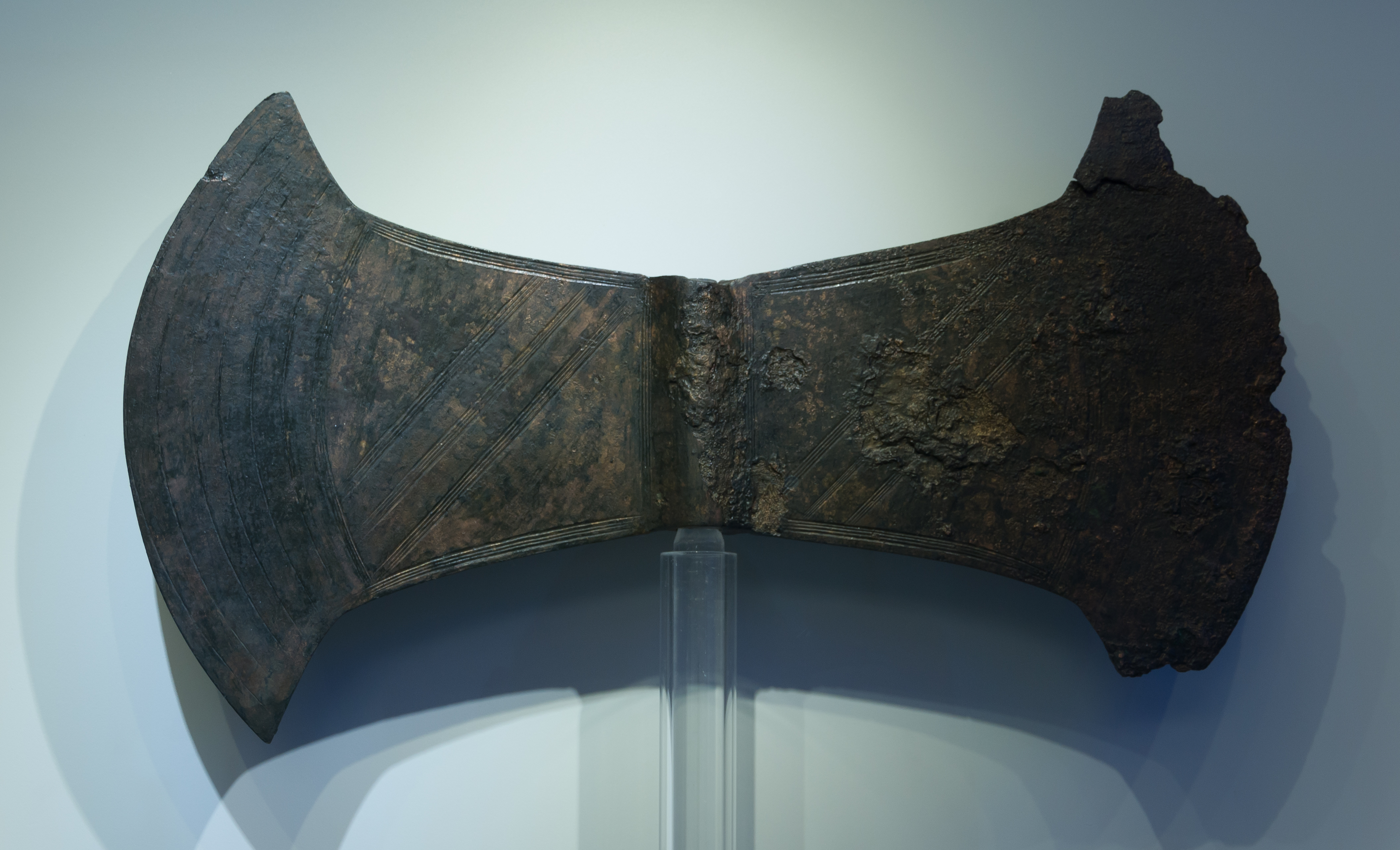


Two blades and a single purpose
The double axe, or labrys, expresses spiritual force gathered into equilibrium and directed by Divine purpose. Its two blades reveal a mystery of coordinated powers, while the central haft gives those powers a single axis of action. Its two blades can be considered together with the central haft: opposing extensions are held within one effective form.
In this inward reading, the axe concerns discernment and decisive action. A clear distinction can release a person from an entanglement that vague intention leaves untouched. Yet the image also asks for a centre capable of governing force. Its spiritual application is the clearing of confusion, the gathering of the will, and the ordering of the soul’s powers.
The two blades and the soul’s polar powers
The double axe places two opposed blades around one governing axis. In Zevist contemplation, it expresses the coordination of the soul’s receptive and projective powers. The Temple describes paired currents and elemental polarities within the spiritual being; the labrys gathers that relationship into a form of concentrated strength. Each side contributes to the whole. Their union around the haft gives power a direction and makes its application deliberate. [4]
The central shaft can be contemplated in relation to the soul’s vertical axis, while the two blades express powers brought into equilibrium around it. The sacred serpent’s ascent belongs to the awakening of this inner order. A current must be cultivated within a whole that can sustain its movement; a strong intention must be supported by a balanced spiritual being. The axe therefore bears a mystery of preparation as well as decision: the powers become capable of a unified act. [5]
The labrys and the work of inner alchemy
The axe gives discernment a decisive form. Within the spiritual life, its cutting action corresponds to separating what nourishes awakening from what disperses it. Attention is freed from confusion, intention becomes more exact, and the will acquires the steadiness needed to sustain a chosen work. The power of Zeus Labraundos stands over this contemplation as the Divine authority that orders force and gives it a worthy purpose.
The metal itself deepens the alchemical reading. Earth supplies the material; Fire renders it workable; measure gives it proportion; disciplined craft brings its latent capacity into effective form. The soul’s development follows a corresponding sacred labor: powers are gathered, refined, balanced, and placed in service to a clear intention. Contemplating the labrys recalls the dignity of this workmanship. A spiritual act gains strength when every part of the being contributes to its accomplishment.
Strength made exact
The Zevist spiritual reading develops the power expressed by the form. Two blades balanced around one axis suggest that strength requires coordination. A decision may need firmness without haste, or receptivity without surrendering judgment. The symbol can hold such paired demands together, reminding the practitioner that effective action begins with an ordered intention.
As a votive form, the axe also brings skill into devotion. Metal, proportion and workmanship are offered toward a sacred purpose. That relationship may encourage the practitioner to regard disciplined craft and careful execution as expressions of reverence. The double axe then contributes something distinctive to the collection: a visible union of power, balance and precision, uniting Divine authority with the disciplined work of the soul.
Bronze Age offerings and Zeus at Labraunda
The Heraklion Archaeological Museum preserves a remarkable assemblage from Arkalochori Cave, dated 1700–1450 BCE. It includes double axes in bronze, silver and gold. The museum explains that the thin construction of many examples indicates a symbolic or votive function rather than ordinary use. It also discusses several possible explanations for the deposit. The objects establish ritual significance, while the exact meaning of the assemblage remains open to interpretation. [1]
Plutarch's Greek Questions 45 asks why the image of Zeus at Labraunda holds an axe instead of a sceptre or thunderbolt. His answer tells an origin story involving Herakles, Hippolyte, Omphale and the kings of Lydia, and explains labrys as a Lydian word for an axe. The passage is a clear literary witness for the attribute of this particular Zeus; its narrative is an ancient cult explanation, not a modern reconstruction verified in every detail. [2]
These two bodies of evidence should not be compressed into one uninterrupted history without further proof. A Bronze Age Cretan offering and a later Carian image are different witnesses. The possible relationships between Caria and Crete have been the subject of sustained research. Their resemblance makes comparison valuable, but it does not establish that every Minoan double axe represented precisely the later cult of Zeus Labraundos. [1][3]