 አማርኛ
አማርኛ العربية
 বাংলা
বাংলা Български
 中文
中文 Čeština
 Dansk
Dansk Deutsch
 Eesti
Eesti Ελληνικά
 Español
 Français
 हिन्दी
 Hrvatski
 IsiZulu
 Italiano
 日本語
日本語 Kiswahili
 Magyar
 Македонски
 नेपाली
 Nederlands
 فارسی
فارسی Polski
 Português
 Română
 Русский
 Slovenščina
 Suomi
Suomi Svenska
 Tagalog
 Türkçe
Sacred meaning and political non-endorsement
Within Zevism, the swastika is contemplated as four powers in motion around a unifying centre: Fire, Water, Earth and Air joined through Aether. The thunderbolt expresses the sovereign, enlivening power of Zeus. The Temple brings these forms together in a spiritual interpretation of creation, transformation and the relation between the physical, mental, emotional and spiritual dimensions of life. [1]
This page examines the symbol in its ancient religious and cultural contexts and explains its meaning within Zevism. Its inclusion does not endorse any political party, political movement, organization or association. It does not endorse Nazism, fascism, racial supremacy or the political appropriation of sacred imagery. No political allegiance should be inferred from the historical objects or religious interpretations presented here.
The turning cross and the currents of the soul
The turning arms express the activity of the four elements within a living spiritual order. Their shared center corresponds to Aether, the unifying presence through which the differentiated powers belong to one whole. The form therefore bears an occult teaching of circulation. Spiritual power is received, gathered, transformed, and expressed; each movement requires a relation to the center. The symbol gives this inner work a visible order, joining the soul’s elemental qualities to the creative authority of Zeus. [6]
The eye follows motion while remembering the center from which it proceeds. In contemplation, this relation develops steadiness within change. The practitioner gathers the qualities of Earth, Water, Air, and Fire into a deliberate intention, seeking a balanced circulation through the spiritual being. The turning figure then becomes a sacred language of coordinated power. Its movement is fruitful because the center gives it purpose, and its fourfold expression is complete because the powers remain joined.
The thunderbolt and the descent of Divine fire
The thunderbolt is the decisive manifestation of Zeus’s power. In the inward life, its sudden radiance corresponds to illumination: the moment when obscurity yields to a clear spiritual apprehension. Its descent expresses Divine power entering the soul and making its capacities more conscious. The devotee approaches the bolt through the mysteries of the crown, the inner sight, and the solar center, contemplating how revelation can be received above and made effective throughout the spiritual being. [6][7]
The revolving form and the descending bolt illuminate complementary operations. One shows the ordered circulation of powers; the other shows the Divine impulse that awakens and directs them. Together they express a soul capable of receiving illumination and sustaining its consequences. The spiritual application is a strong, lucid intention held in devotion to Zeus. Clarity must acquire continuity, and awakened power must enter a life ordered enough to express it with purpose.
Power ordered toward creation
In contemplation, the still centre and the moving arms can be held together. The centre suggests the principle that gives coherence; the arms suggest differentiated activity. The spiritual lesson is that power becomes fruitful through order. A life governed by a clear purpose can bring thought, feeling and action into cooperation instead of exhausting itself in opposed impulses.
The thunderbolt gives this meditation a complementary movement: illumination arriving with decisiveness. Zevist practice relates descending divine power to the empowerment of the soul. As a sacred image, the bolt can therefore call the practitioner from hesitation into lucid intention. Its fire illuminates spiritual intention and gives the will a concentrated form. The devotee approaches it as a sign of Divine command and awakening.
What the ancient evidence establishes
The thunderbolt has a direct and well-attested connection with Zeus. Hesiod's Theogony 139–146 describes the Cyclopes as the makers of His thunderbolt; later, at 501–506, their gift of thunder, lightning and the blazing bolt accompanies His authority over mortals and immortals. These passages belong to Greek sacred poetry and give the weapon a clear divine identity. [2]
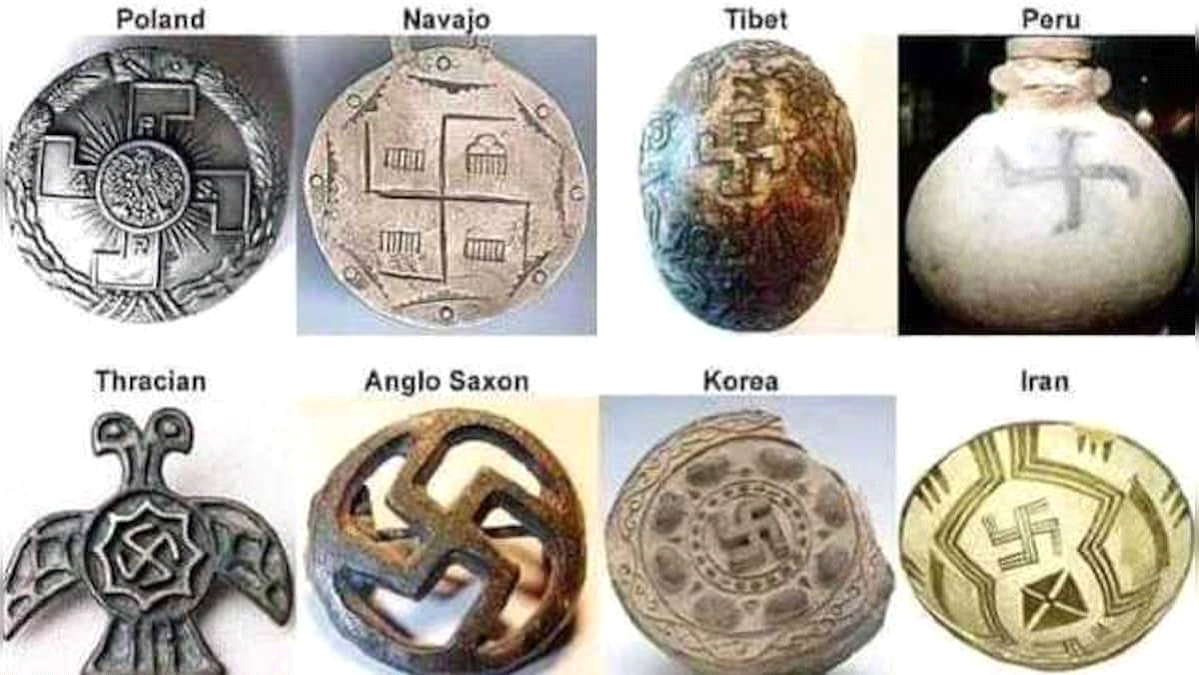
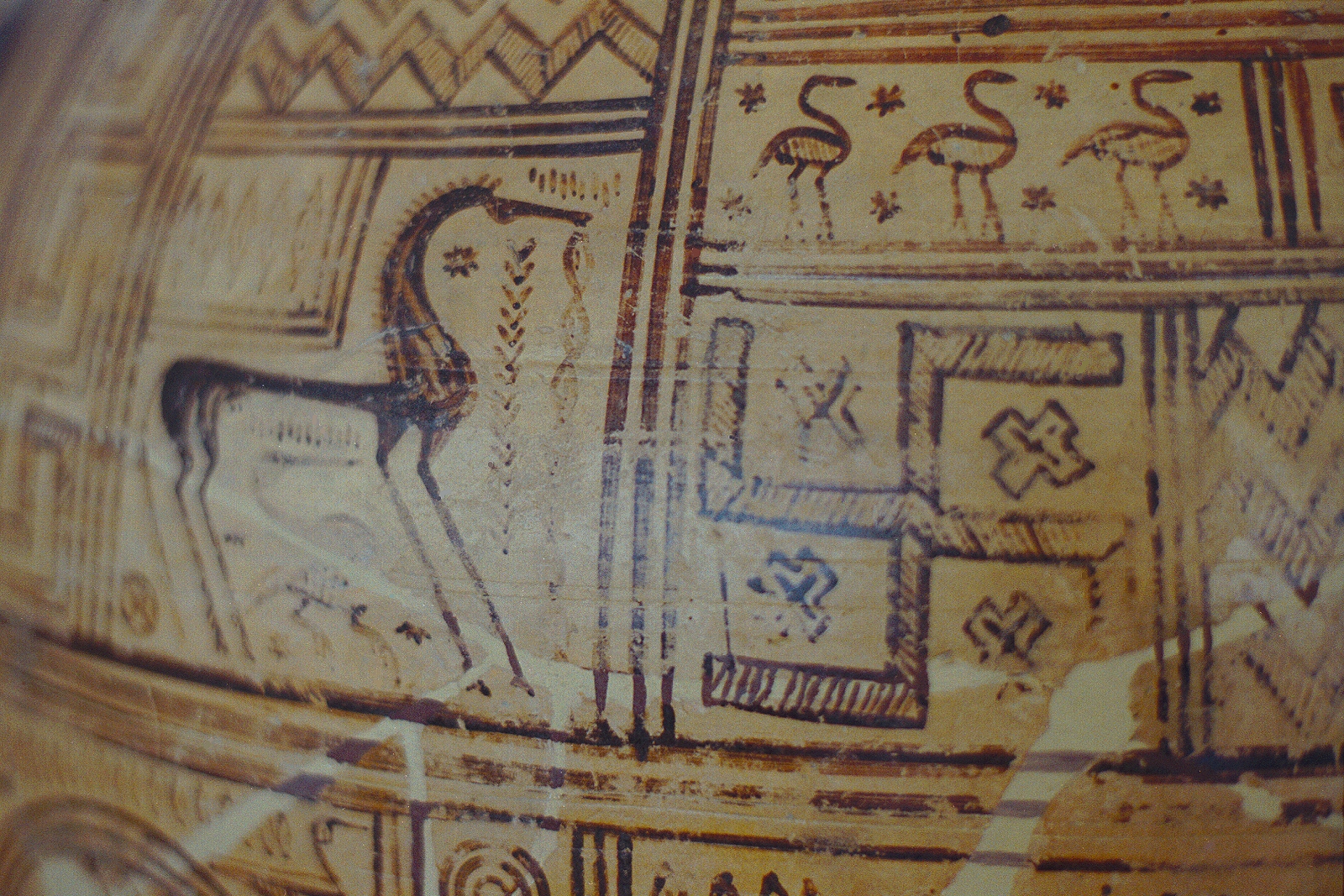
The swastika is a different visual form: a cross with bent arms that creates an impression of rotation. Its presence in ancient Greek ornament is secure. A Melian pottery jug in the British Museum, dated 725–700 BCE, includes the motif beside birds and other decoration. The open photograph on this page supplies another Geometric example, displayed at the Archaeological Museum of Argos. These objects establish an ancient artistic context. [3][4]
A particularly relevant coin from Syracuse, dated about 344–332 BCE, combines a head of Zeus Eleutherios and a thunderbolt on one side with a swastika on the other. The British Museum catalogue records both forms distinctly. This is specific material evidence that the swastika could occur within a civic coin design associated with Zeus; it does not establish that every ancient swastika meant a thunderbolt or carried one universal interpretation. [5]
The Temple reads the four turning arms as a figure of ordered elemental power. Ancient objects establish particular settings for the design, while the Zevist interpretation develops its spiritual significance through the relationship between centre, movement and creation. [1][2][3]