
 አማርኛ
አማርኛ العربية
 বাংলা
বাংলা Български
 中文
中文 Čeština
 Dansk
Dansk Deutsch
 Eesti
Eesti Ελληνικά
 Español
 Français
 हिन्दी
 Hrvatski
 IsiZulu
 Italiano
 日本語
日本語 Kiswahili
 Magyar
 Македонски
 नेपाली
 Nederlands
 فارسی
فارسی Polski
 Português
 Română
 Русский
 Slovenščina
 Suomi
Suomi Svenska
 Tagalog
 Türkçe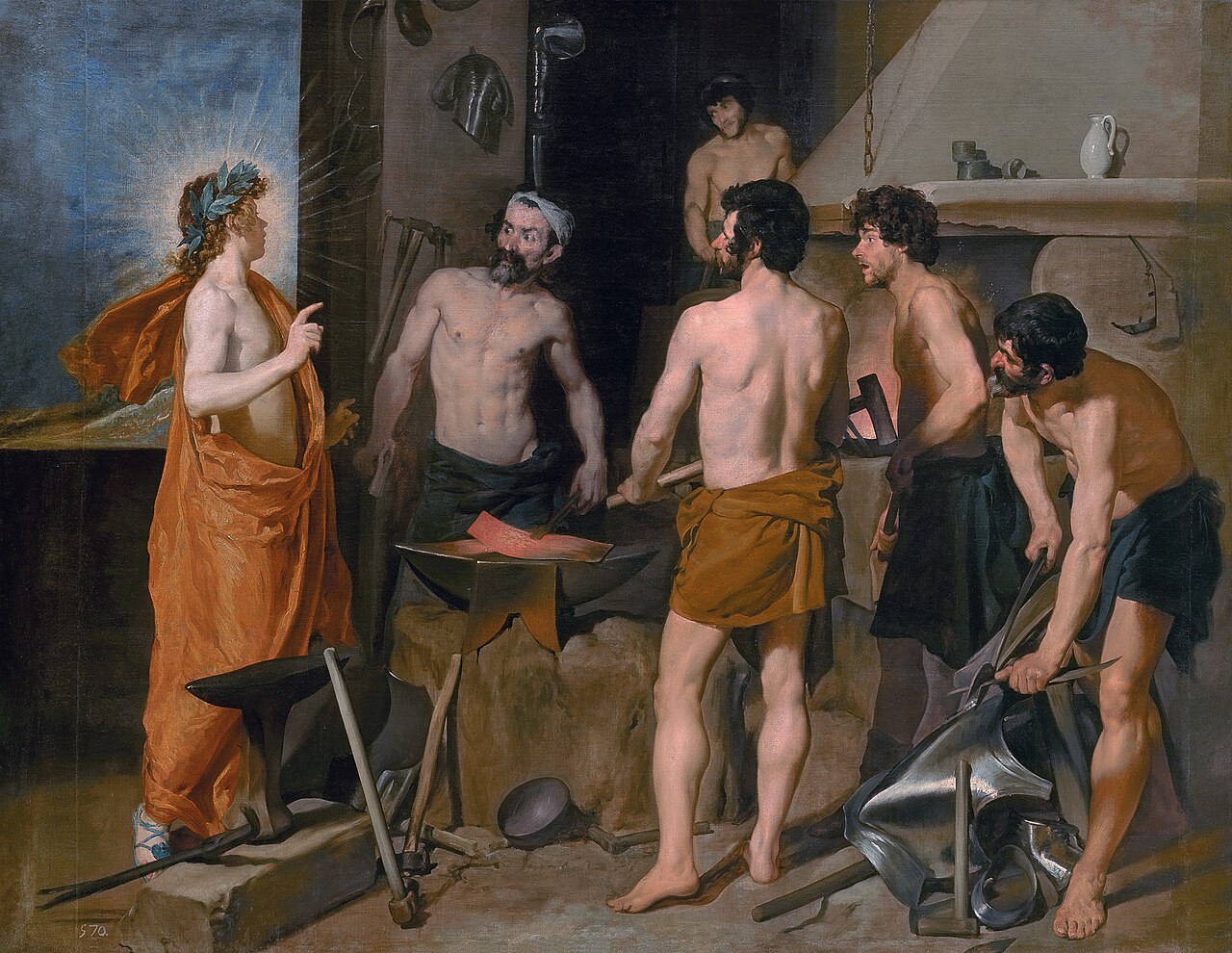


The tools of the divine craftsman
The hammer and anvil of Hephaestus express divine power transforming the soul. The hammer directs force; the anvil gives it a stable foundation; the forge makes transformation possible. In Zevism, inner alchemy brings the powers of the person into an awakened order under the Gods. Hephaestus reveals the sacred art of giving that power a worthy form. His tools signify the active work by which dormant capacities become effective, spiritual energy becomes directed, and the soul is fashioned toward its divine perfection. [3][4]
Homer describes the workshop with extraordinary vividness. Preparing Achilles’s armour, Hephaestus directs His bellows, places metals in the fire, sets a great anvil upon its block, and takes up hammer and tongs. The account gives these implements their firm ancient foundation. They are instruments within a coordinated craft, each answering to the God’s understanding of the work before Him. [1]
Fire, will, and the golden work
The forge illuminates the relation between spiritual fire and formed power. The Temple associates the solar chakra with the will and presents gold as the colour of the perfected soul. In this light, Hephaestus’s work becomes a sacred image of the passage from unformed potential into luminous completion. The devotee gathers energy, gives it direction, and brings each faculty into the service of a coherent spiritual purpose. The golden work is the transformation of the whole being. [4][5]
The anvil signifies the stable centre required by this transformation. Without a firm foundation, force disperses; with steadiness, each act contributes to an enduring form. The hammer signifies will acting upon the work with intention. Their union expresses the relationship between receptivity and direction within the soul. The energies received through the chakras become effective through conscious use, and the craftsman’s precision gives an image of how spiritual power acquires measure. [4]
Hephaestus also teaches the dignity of embodiment. The soul’s development takes form through what the person can actually sustain, create, and accomplish. Sacred making, disciplined study, and the careful execution of a ritual all require powers brought into agreement. To honour the God is to honour this transformation from possibility into living capacity. The devotee approaches the forge inwardly with a clear purpose: to become a worthy instrument of the divine powers and to shape a life capable of receiving greater light.
A world given form
The shield fashioned in the same scene carries earth, sky, sea, heavenly bodies, cities, fields, a vineyard, and dancing figures, with Ocean around its edge. Hephaestus’s art gathers many conditions of existence into a single ordered work. Homer’s description presents craftsmanship on a scale that embraces the world of human life and its cosmic surroundings. [1]
This makes the symbol especially powerful for a religion centred on Zeus and the divine ordering of existence. A worthy work holds its parts in a purposeful relationship. Its strength rests in their fit, proportion, and contribution to the whole. The maker participates in this principle whenever careful thought becomes a sound structure, a beautiful object, a useful instrument, or a clear and enduring piece of writing.
Learning the divine craft
The craftsman learns by attending to the work’s response. A form holds, a joint fits, an edge becomes true, or a correction is required. Spiritual discipline also asks for a faithful awareness of what has developed and what remains unfinished. The devotee studies, practises, and returns to the task with a more capable instrument. Hephaestus gives this patient learning a divine dignity, honouring the knowledge acquired through sustained application.
An undertaking becomes spiritually fruitful when its demands strengthen the person who carries it through. Sacred study develops understanding; the making of an image develops precision; the preparation of a hymn develops voice and attention. Each can become an offering to the Gods through the quality of the work. Hephaestus’s tools encourage the devotee to recognise this inward formation within the outward act of making.
Honouring the work and its maker
The completed work carries responsibility. An instrument should serve its purpose; a structure should support those who depend upon it; a sacred image should receive the care its subject deserves. Reverence for Hephaestus gives these obligations religious depth. It recognises the labour, knowledge, and judgment through which useful and beautiful things enter human life.
The accompanying painting is Velázquez’s Vulcan’s Forge of 1630. Its anvil, tools, and gathered workers make the workshop fully visible. The Prado identifies its episode as Apollo bringing news to Vulcan, rather than the making of Achilles’s shield. This later artistic scene supplies the page with a complete image of the divine craftsman’s setting. [2]