
 አማርኛ
አማርኛ العربية
 বাংলা
বাংলা Български
 中文
中文 Čeština
 Dansk
Dansk Deutsch
 Eesti
Eesti Ελληνικά
 Español
 Français
 हिन्दी
 Hrvatski
 IsiZulu
 Italiano
 日本語
日本語 Kiswahili
 Magyar
 Македонски
 नेपाली
 Nederlands
 فارسی
فارسی Polski
 Português
 Română
 Русский
 Slovenščina
 Suomi
Suomi Svenska
 Tagalog
 Türkçe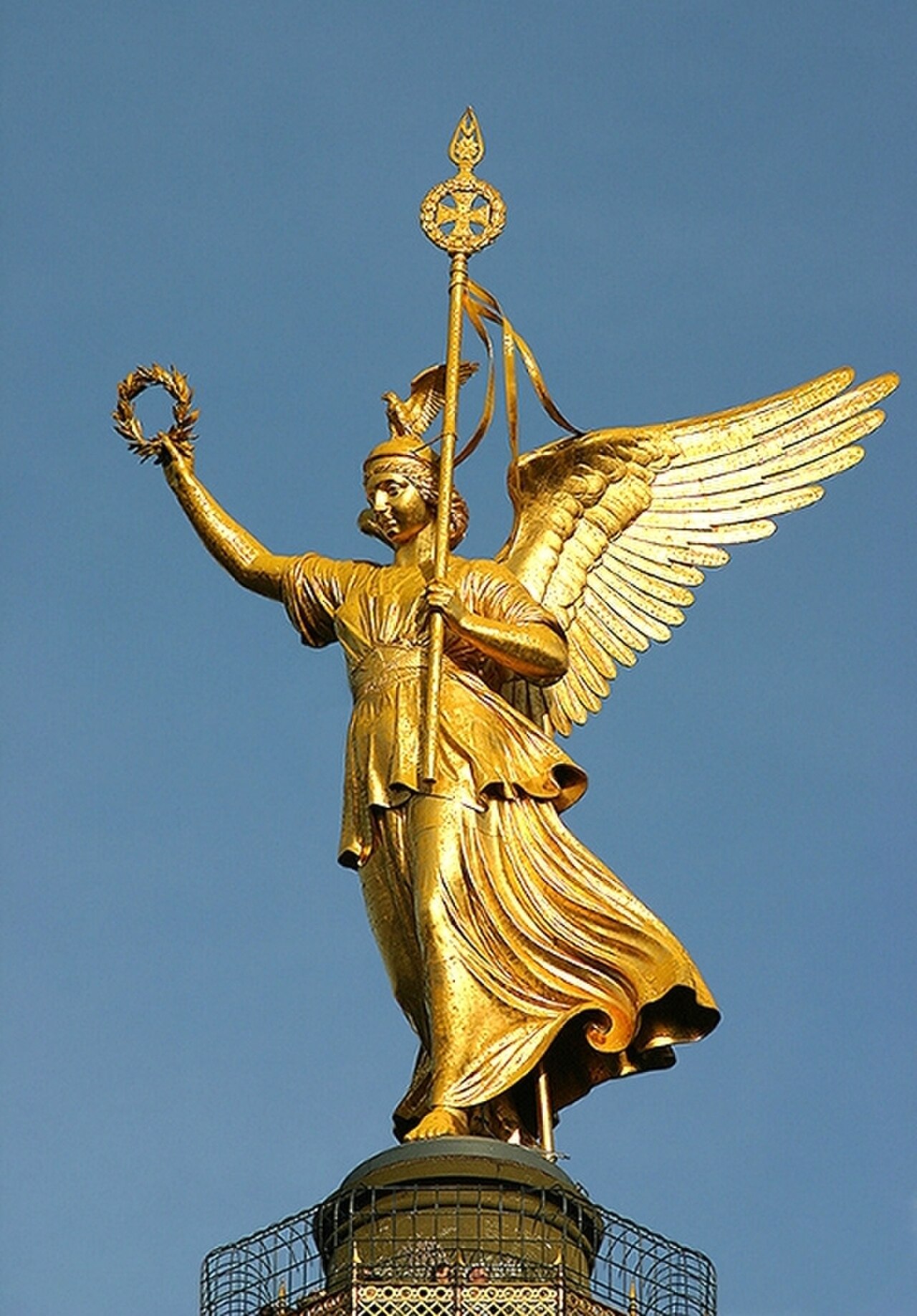


Victory beside the Father of the Gods
Winged Nike expresses the divine power of fulfilment: the soul’s capacity to rise, prevail, and bring its spiritual labour to completion. Her place beside Zeus makes Victory a companion of divine sovereignty. Within Zevism, Her wings also disclose an inward mystery. The Temple associates awakened shoulder chakras with the wings of the soul and the freedom that their empowerment brings. Nike therefore gives a majestic form to spiritual ascent, while Her wreath declares that the powers called forth have reached a worthy accomplishment. [5]
Hesiod places Nike close to Zeus. She is a daughter of Styx and Pallas, alongside Zelos, Kratos, and Bia. Styx brings Her children to Zeus during His struggle with the Titans, and He honours them with a permanent dwelling in His company. The passage makes Victory part of the divine order established around Zeus, joined with powers of emulation, strength, and force. [1]
The wings of the empowered soul
The shoulder centres belong to the Temple’s account of thirteen principal chakras: seven along the spine and paired centres at the hips, shoulders, and temples. The spiritual wings arise within this larger structure. Nike’s image therefore invites contemplation of a soul whose powers support one another, so that ascent rests upon an awakened whole. The Goddess’s flight expresses freedom gained through empowerment and the gathering of spiritual strength into effective action. [5]
The golden radiance of Victory adds the solar meaning of completion. In the Temple’s teaching, gold signifies authority, personal power, success, and the perfection of the soul; Zeus is described as possessing a golden aura. Nike’s shining form can be contemplated within this same field of divine sovereignty. The wreath encircling the head brings victory into relation with the higher centres, whose awakening crowns the work of inner transformation. Gold, wings, and crown join fulfilment with spiritual freedom. [6][4]
This is the victory sought in the great work: the soul becomes capable of greater consciousness and more direct participation in divine life. Each faculty that awakens contributes to that attainment. In devotional practice, Nike’s image gives determination a sacred direction and calls the will to persevere through the stages of transformation. The Goddess stands with Zeus as the presence of accomplishment, reminding the devotee that power reaches its dignity when the work entrusted to it is fulfilled.
Wings, dedication, and thanksgiving
The Acropolis preserves an important historical setting for winged Victory. The Acropolis Museum describes the parapet of Athena Nike’s sanctuary, installed around 410 BCE, as showing winged Nikai leading bulls to sacrifice and attending to trophies. These figures place victory in a religious setting of dedication and honour. Achievement is followed by an acknowledgment of the divine powers within whose world it occurs. [2]
That sequence gives the symbol enduring depth. Success calls for gratitude, and gratitude preserves the relationship between the accomplished work and its sources of strength. The devotee remembers teachers, companions, opportunities, and the Gods. The wreath marks the attained result; the act of thanksgiving places that result within a larger order of belonging.
The victory of an integrated soul
For Zevism, Nike can illuminate victories within the person: attention sustained through distraction, an inherited difficulty patiently mastered, knowledge brought into practice, or a long labour carried to completion. These achievements possess a real shape. They change what the person can understand and do. The wings suggest release into a greater capacity, while the wreath gathers the stages of effort into one fulfilled undertaking.
Victory therefore asks for an exact account of the task. What was to be achieved? What discipline made it possible? What quality has been strengthened? Such questions give aspiration a clear direction. Nike’s image encourages confidence grounded in preparation and the willingness to persist when the first enthusiasm has passed. The completed work becomes evidence of a power the soul can call upon again.
A radiant form across the centuries
The accompanying sculpture is Friedrich Drake’s Victoria, completed for Berlin’s Victory Column in 1873. The city identifies the figure as the Goddess of Victory and records the monument’s commemoration of nineteenth-century German military victories. Its golden surface, complete wings, and raised wreath provide a monumental later interpretation of the classical form. It is presented here with that date and setting clearly identified. [3]
Within this collection, the image invites contemplation of divine victory and the responsibilities of achievement. Each completed task opens a further field of service. The strength gained through one undertaking becomes available for the next, and the devotee carries gratitude forward into renewed effort under Zeus.