 አማርኛ
አማርኛ العربية
 বাংলা
বাংলা Български
 中文
中文 Čeština
 Dansk
Dansk Deutsch
 Eesti
Eesti Ελληνικά
 Español
 Français
 हिन्दी
 Hrvatski
 IsiZulu
 Italiano
 日本語
日本語 Kiswahili
 Magyar
 Македонски
 नेपाली
 Nederlands
 فارسی
فارسی Polski
 Português
 Română
 Русский
 Slovenščina
 Suomi
Suomi Svenska
 Tagalog
 Türkçe
Continuity within the Divine life
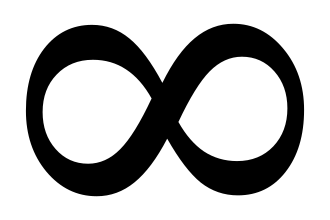
Infinity expresses the continuous life of the soul and its aspiration toward immortality. The Temple relates the sideways eight to the perfected solar soul, its eight rays, and the Divine feminine associated with Astarte, Inanna, and Demeter. The sign gathers enduring life, radiance, and reciprocal spiritual movement into a single continuous form. [1]
The central crossing makes the figure especially suggestive. Movement through either lobe returns to a shared center before entering the other. In Zevist contemplation, this can represent exchange held in unity: receiving and giving, concentration and expression, inward cultivation and outward life. Continuity is sustained through relationship rather than through an isolated part.
The continuous circuit and the life of the soul
The two lobes of infinity disclose an occult relationship between inward reception and outward expression. Follow the line through one curve and it returns through the center into the other. The movement belongs to a single figure. In our spiritual teaching this continuity expresses a life in which illumination can be received, embodied, offered, and gathered again into deeper understanding.
The center is the point of recollection. Whatever the soul encounters must return to a governing awareness if experience is to become wisdom. The solar faculty supplies direction; the receptive powers supply depth and possibility. The Temple's relation between the solar and sixth centers gives this reciprocity a place within its sacred physiology. Will and intuition sustain a common work. [4]
Spiritual immortality is the horizon of that work in Zevism. The soul seeks a form of life that can preserve its light and coherence through transformation. Infinity gives this aspiration a visible continuity. The entire curve remains present even while attention follows one part of it; the whole exceeds the momentary position of the gaze. [1]
The eight rays and the opened Temple
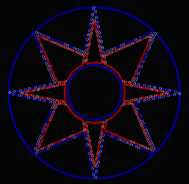
The Temple associates the number eight with Astarte, Inanna, and Demeter, and describes eight rays extending from the solar center. These rays express the soul's power to communicate its radiance. The center is generative: what is gathered there can enliven the surrounding structure. The eightfold image thereby joins unity, abundance, and the Divine feminine within the same sacred account. [1]
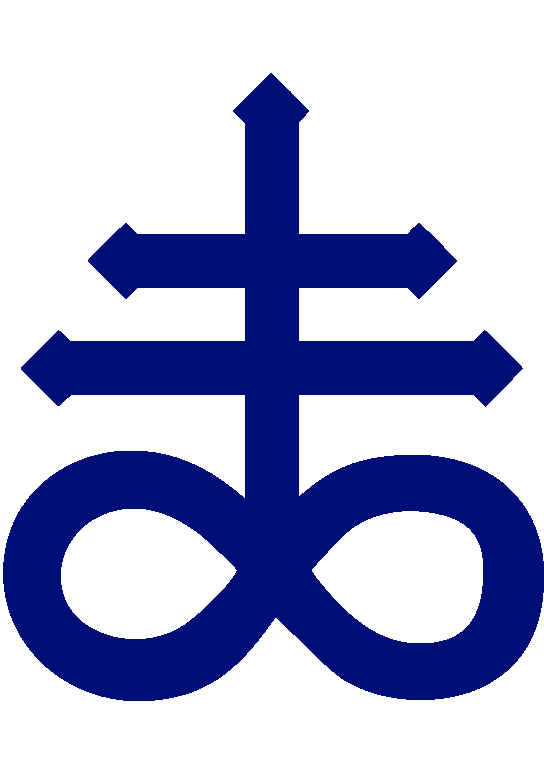
The crossed infinity emblem adds the solar and heart or shoulder levels. The Temple's teaching on the chakras describes the shoulder centers as the source of spiritual wings when awakened. Read together, the emblem and the wings portray continuity acquiring freedom of expression. The soul's architecture becomes a living capacity for relation, movement, and understanding. [5]
Contemplate the complete figure before tracing its movement. Let each return to the center recall a return to the governing purpose of spiritual life. Receiving, creating, learning, and giving can then be considered as phases of one circuit. This practice of recollection strengthens continuity across the ordinary divisions of the day. The Temple of the Sun is built wherever awakened faculties remain in relation, and its radiance grows as that relation becomes steady. [1][6]
Continuity through the changing seasons of life
The aspiration toward enduring spiritual life must pass through changing human circumstances. A period of intense study differs from a period of demanding work or responsibility. The symbol of infinity asks what can remain faithful across these changes. Devotion to the Gods, the pursuit of understanding, and care for the soul provide a continuing orientation even when the outward form of practice must adapt. [1]
Choose a small act of recollection that can remain present through such transitions: a prayer, a passage returned to with attention, or a quiet review of the day's governing intention. Let it preserve the relation between one period of life and the next. A more expansive practice can grow again from that maintained connection. This is a practical meaning of spiritual continuity: the soul retains access to what has been cultivated and carries it forward into new conditions. The endless line becomes an image of fidelity with movement, capable of receiving a changing life without losing its Divine orientation.
A modern sign and an ancient question
The familiar mathematical sign ∞ entered documented mathematical use in the early modern period. John Wallis employed it in De sectionibus conicis in 1655 and again in Arithmetica infinitorum. The University of St Andrews' history of mathematics identifies these publications as the beginning of its mathematical use. [2]
Ancient philosophy nevertheless provides a rich setting for thinking about eternity. In the Timaeus, Plato distinguishes the abiding model from the ordered movement of time and relates temporal measure to the heavens. His discussion does not describe the sideways-eight symbol. It offers an older conceptual resource for considering the relation between enduring order and a world experienced through change. [3]
The Temple's eight-pointed star and its crossed infinity emblem are distinct forms within the same spiritual exposition. The star carries its own Divine associations; the crossed emblem combines an axial structure with the continuous curve. Their relationship here is the Temple's theological account of the solar soul and its powers. [1]