
 አማርኛ
አማርኛ العربية
 বাংলা
বাংলা Български
 中文
中文 Čeština
 Dansk
Dansk Deutsch
 Eesti
Eesti Ελληνικά
 Español
 Français
 हिन्दी
 Hrvatski
 IsiZulu
 Italiano
 日本語
日本語 Kiswahili
 Magyar
 Македонски
 नेपाली
 Nederlands
 فارسی
فارسی Polski
 Português
 Română
 Русский
 Slovenščina
 Suomi
Suomi Svenska
 Tagalog
 Türkçe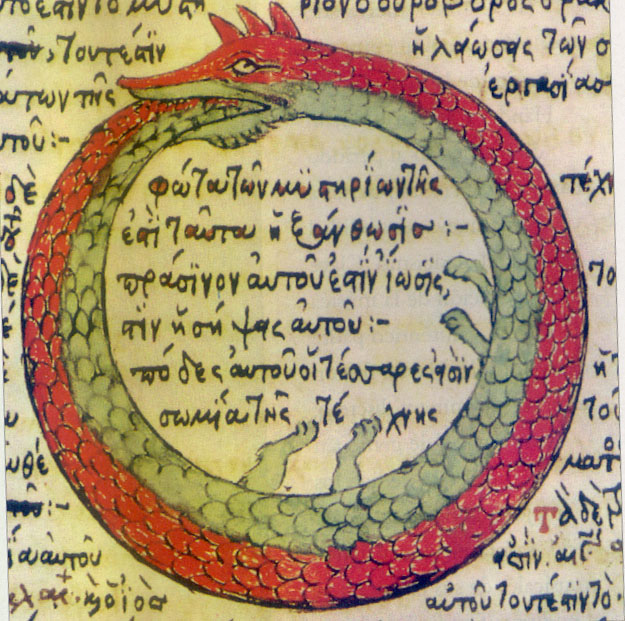

Life returning to its source
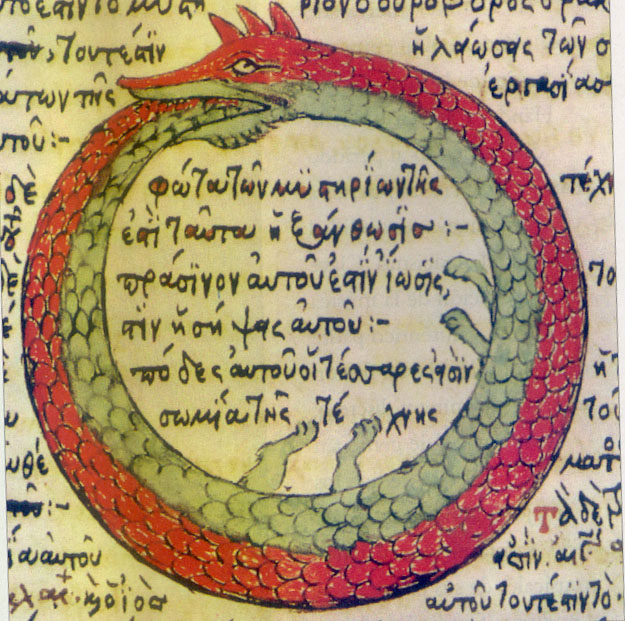
The ouroboros expresses life held within a complete circuit. Its body forms the boundary of a whole, while its mouth meets its tail where beginning and ending become inseparable. In Zevism, this living circle belongs to spiritual continuity, inward transformation, and the ordered relationship of the soul's powers. [4][5]
The form joins the serpent's living power to the circle's completeness. Their union gives an image of a process that preserves coherence through change. The soul returns to its source, gathers the fruit of its experience, and begins again with a greater capacity for understanding.
The serpent that preserves the whole
The serpent forms its own enclosure. Its living body holds the circle together, and the meeting of mouth and tail makes the boundary continuous. In the inward alchemy of Zevism, this form expresses the conservation of spiritual power: what the soul awakens should remain available to the whole instead of being scattered through conflicting intentions. The circle becomes an image of coherent life. [4]
The Temple understands the serpent as Kundalini, the latent power whose awakening unfolds the soul's capacities. The ouroboros brings that serpent into relationship with completeness. It asks how awakened awareness can preserve continuity through change. The answer lies in an ordered circulation: what rises into understanding must become part of the life that nourishes further understanding. Each phase supports the next. [5]
The point of the bite is a threshold. Expression returns to its source, experience returns to reflection, and a completed action becomes knowledge for the next movement. This return gives the alchemical cycle depth. The practitioner becomes more capable of learning from life because each outward passage can be gathered back into the soul's central purpose.
The sealed vessel and the rhythm of renewal
The ouroboros shares a mystery with the Grail: the power to contain. The cup holds the elixir within its chamber; the serpent holds a complete field within its circuit. Both speak of an inward structure able to preserve what has been refined. The Temple's solar teaching places will at the heart of this preservation, so that the soul's light can acquire continuity and direction. [6]
Contemplation of the whole circle can support the completion of a spiritual period. Recall what was intended, what was undertaken, and what was learned. Gather unfinished concerns into clear decisions instead of carrying them as an indistinct burden. The closing movement then nourishes the next beginning. This is the practical rhythm of return: the work is preserved because its meaning has been consciously received.
The deeper aspiration is the soul's enduring coherence in relation to the Gods. Repetition becomes renewal when awareness increases through the circuit. Study enriches meditation, meditation clarifies intention, and intention gives study a more exact direction. The ouroboros holds these movements together in one living line. Its eternity is contemplated through a whole that can remain itself while continuously receiving the fruits of transformation. [4][5]
From the individual soul to the encompassing cosmos
Horapollo's account relates the tail-consuming serpent to the universe and its varied scales to the stars. This cosmic scale gives the symbol a further contemplative field. The practitioner looks beyond the immediate concerns of the individual and attends to the greater whole in which life unfolds. The circle becomes an image of encompassing order. [2]
Contemplation of the night sky or of the returning seasons can accompany this reading. Notice continuity together with variation: a recognizable order contains innumerable particular movements. Bring the inward work into relation with that larger field. Study, devotion, and the cultivation of spiritual power belong to a life sustained through many relationships. The ouroboros gives reverence a complete outline, allowing the soul to contemplate its participation in a Divine cosmos. Its inward circuit concerns the preservation of personal spiritual capacity; its encompassing circuit concerns the whole within which that capacity finds meaning. Holding both scales together deepens the symbol beyond the boundaries of individual experience.
Ancient evidence and later transmission
A late Roman magical gem in the British Museum gives tangible evidence of the form. The museum describes a red jasper intaglio with an ouroboros enclosing an inscription, tentatively dated to the third or fourth century CE. The serpent acts as a visible boundary around the written field. The object demonstrates an ancient use of the enclosing motif; its precise significance must be read with its own inscription and context. [1]
Horapollo's Hieroglyphica offers an explicit literary interpretation. In Book I, chapter 2, a serpent consuming its own tail represents the universe, and its varied scales are related to the stars. This is evidence for the symbolic explanation given in that text. It should not be treated as a modern Egyptological dictionary in which every hieroglyph has the allegorical meaning Horapollo supplies. [2]
The image also continued through the manuscript culture of alchemy. The illustration used here comes from a Greek alchemical manuscript copied in 1478, Parisinus graecus 2327, folio 279. Its late medieval date belongs in the caption. A surviving medieval copy can transmit older material, but the date of the photographed page should not be silently replaced with an assumed date for a lost original. [3]