
 አማርኛ
አማርኛ العربية
 বাংলা
বাংলা Български
 中文
中文 Čeština
 Dansk
Dansk Deutsch
 Eesti
Eesti Ελληνικά
 Español
 Français
 हिन्दी
 Hrvatski
 IsiZulu
 Italiano
 日本語
日本語 Kiswahili
 Magyar
 Македонски
 नेपाली
 Nederlands
 فارسی
فارسی Polski
 Português
 Română
 Русский
 Slovenščina
 Suomi
Suomi Svenska
 Tagalog
 Türkçe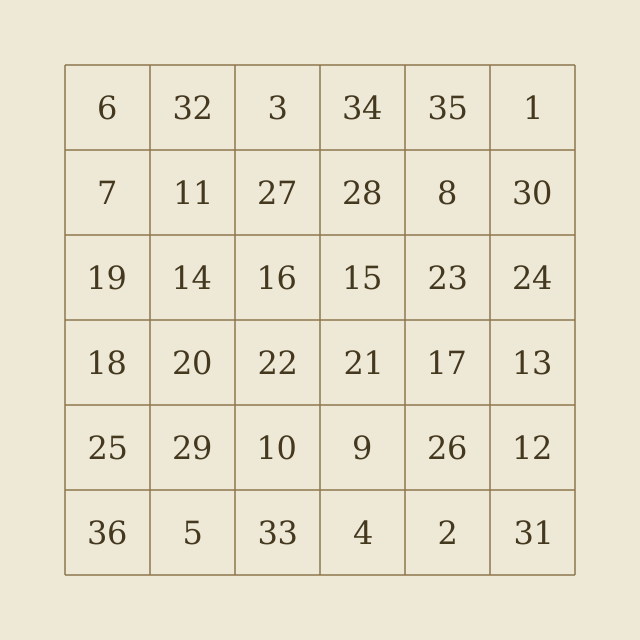
The solar power of the soul
In Zevism, 666 is a sacred symbol of solar power, inner mastery, and the central vitality of the soul. It belongs to the solar chakra and the great work of spiritual completion. Its power is contemplated through illumination, ordered strength, and the awakening of faculties that increasingly act together under a common Divine purpose. [1]
The Sun offers an immediate image for a center whose influence extends beyond itself. Zevist contemplation applies that image inwardly: power must be gathered, ordered, and expressed through the whole person. A center that merely accumulates would remain incomplete. Its purpose is fulfilled through the life and coherence it sustains.
The sovereignty of the inward Sun
The solar center is the chamber of spiritual sovereignty. The Temple identifies its element as fire, its radiance as white-gold, and its governing power as the will. It is also the Grail of Zeus: the center through which the soul holds and distributes the fruits of its awakening. To contemplate 666 is therefore to turn toward the power by which a person gathers the faculties into a coherent purpose. [4]
Sovereignty begins when the will can remain faithful to what understanding has recognized. A passing impulse pulls toward immediate satisfaction; a governing intention can sustain a larger work. The solar faculty gives continuity to study, steadiness to devotion, and effective direction to the powers awakened through meditation. Its fire is the capacity to remain luminous and purposeful through changing circumstances.
Zeus gives this sovereignty its Divine measure. His authority expresses an order in which the many powers have their place. The inward Sun follows that pattern: thought, intuition, affection, memory, and action acquire a common orientation. The soul becomes more capable of bearing power because its powers increasingly belong to one whole. [1][5]
Reading the square as a discipline of the soul
The solar square permits a precise contemplation. Follow one row, then a column, then a principal diagonal. Each contains different numbers, yet each reaches the same total. The image teaches the eye to recognize coordinated difference. In spiritual work, the corresponding question is whether the different movements of a life serve an intelligible common purpose.
This contemplation gives number an inward application. One may bring to mind the work of the intellect, the affections, and the will, considering where their directions agree and where they disperse attention. The desired solar condition is a center able to give each faculty its fitting task. The number supports remembrance of that condition; sustained practice establishes it.
The Temple describes spiritual advancement as a gradual cultivation of the soul's light and power. The solar work accordingly values constancy: a clear intention kept, a meditation undertaken attentively, a piece of knowledge made usable. These become the living stones of the Temple of the Sun. The sacred number stands above the work as a sign of its completion, while the daily ordering of the soul gives that sign substance. [6]
The Temple of the Sun
For the Temple, the perfected soul can be envisioned as an inward Temple of the Sun. The image joins a center, an ordered structure, and a living radiance. Read in this way, spiritual architecture is the formation of a person whose powers have acquired proportion and purpose. The symbolism asks how illumination becomes steady rather than intermittent.
Six can thus suggest a whole whose components sustain one another, while the square offers a disciplined arrangement in which different lines resolve to the same measure. The Zevist interpretation draws upon these visible relations to contemplate unity within multiplicity. The number is an aid to understanding the solar principle, not a substitute for the sustained spiritual work that the principle signifies.
The sacred number calls attention to the quality of one's center: clarity of intention, the ordering of power, and the capacity to nourish an integrated life. Its solar character is fulfilled as the soul becomes more capable of maintaining light through its many operations. The image of completion gives direction to every stage of the work.
Six and the solar square
Ancient Greek arithmetic gives six a precise distinction. Euclid defines a perfect number as one equal to the sum of its proper parts. For six, the positive divisors smaller than itself are one, two, and three, and 1 + 2 + 3 = 6. This defined mathematical property provides an ancient foundation for contemplation of six as a complete numerical whole. [2]
The connection between 666 and the Sun is documented in Heinrich Cornelius Agrippa's Renaissance work De occulta philosophia, Book II, chapter 22. His solar table is a six-by-six magic square containing the integers one through thirty-six. Each row, column, and principal diagonal totals 111; all thirty-six entries together total 666. The dated source establishes this particular solar table within Renaissance occult philosophy. [3]
The total can be checked without any occult premise: 1 + 2 + … + 36 = 36 × 37 ÷ 2 = 666. The numerical sum and the planetary correspondence answer different questions. The first is arithmetic; the second belongs to a historical symbolic system. Their distinction makes the religious interpretation more intelligible, because the reader can see exactly what is calculated and what is contemplated. [2][3]