 አማርኛ
አማርኛ العربية
 বাংলা
বাংলা Български
 中文
中文 Čeština
 Dansk
Dansk Deutsch
 Eesti
Eesti Ελληνικά
 Español
 Français
 हिन्दी
 Hrvatski
 IsiZulu
 Italiano
 日本語
日本語 Kiswahili
 Magyar
 Македонски
 नेपाली
 Nederlands
 فارسی
فارسی Polski
 Português
 Română
 Русский
 Slovenščina
 Suomi
Suomi Svenska
 Tagalog
 Türkçe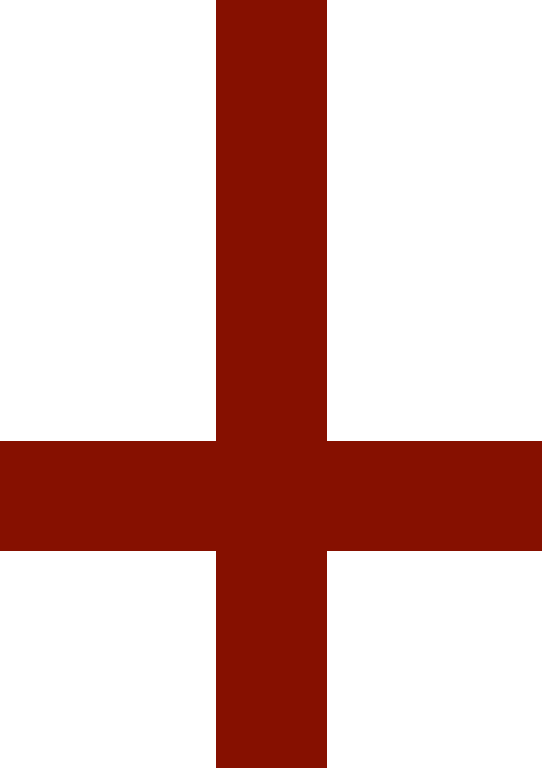
Direction in the Temple's symbolism
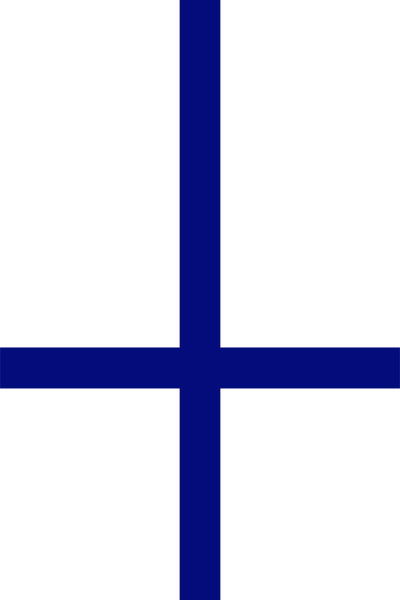
The inverted cross represents the ordering of spiritual power around the solar center in the Temple's teaching. Its longer upper section and lower crossbar form a simple diagram through which Zevism contemplates the soul's structure and the directing of energy. The Temple places it beside the downward orientation of the solar chakra, the symbolism of 666, and the inward building of the perfected soul. [1]
Direction has meaning within this system. The Temple's wider treatment of descending forms associates them with power received and brought into effective relationship with life. The inverted cross can therefore be contemplated as a form of embodiment: a vertical movement arriving at a defined center, where what has been received is ordered and distributed. [1]
Descent, establishment, and the solar center
In the Temple's symbolic language, descent carries the power of embodiment. What is received from above must enter the soul's structure and acquire a place within life. The inverted cross gives this movement a visible axis. Its vertical line carries the sense of continuity, while the lower intersection gathers that movement into a center from which it can be distributed. [1]
The solar teaching makes this center definite. The Grail of Zeus is the seat of will and the soul's central spiritual power. The cross therefore concerns the establishment of illumination as effective capacity. A vision becomes a governing understanding; a resolution becomes a sustained practice; a Divine teaching becomes part of the way one perceives and acts. [4]
The orientation also expresses the completion of a circuit. The soul reaches toward the Gods and receives from Them; it then brings what has been received into the world of action. The downward form directs attention to this second responsibility. Power finds fulfillment when the whole life becomes able to carry it.
The four quarters and the work of the architect
The Temple interprets the aligned soul through four quarters, four elements, and a center. Its chakra teaching assigns earth to the front, fire to the back, water to the left, and air to the right, with aether at the center and in the aura. These are correspondences within our sacred map. The cross provides a compact form through which their relationship can be remembered. [5]
The architect's work is to bring differentiated powers into a structure that stands. The Hiram motif is read within the Temple as an account of the soul's solar building: its centers become pillars, its faculties become working powers, and its light gives the whole an inward presence. The initiate studies the structure in order to become capable of inhabiting it consciously. [1][5]
Contemplation may begin with the center and extend toward the four arms, preserving awareness of the whole form. Consider receptivity, initiative, stability, and understanding as cooperating powers. Each requires cultivation, and each needs a clear relation to the governing purpose. Regular practice then becomes the work of construction. The symbol gathers that work into one image: a soul aligned, centered, and increasingly able to establish the gifts of the Gods within life. [6]
Making the inner building inhabitable
An inward Temple becomes inhabitable through the conditions in which spiritual work is actually undertaken. The architect's image calls for a place, a rhythm, and a purpose that support one another. Prepare a space for study or contemplation, give the work a defined beginning, and bring a single clear intention to it. These simple acts establish a form within which attention can remain gathered.
The cross's intersection can then be used as a point of recollection during interruption. Return to the intention already chosen and resume the work from a definite place. What is being built is the capacity to establish purpose within circumstances. The solar will gains expression through completion, while the receptive powers gain a stable setting in which to unfold. In the Temple's architectural reading, the initiate becomes both the builder and the living place of the work. Each faithfully completed period strengthens the relation between the inward design and the life that embodies it. [1][4][5]
Distinct histories behind similar shapes
The inverted cross also has a documented Christian association. Eusebius, in Church History 3.1.2, transmits a tradition attributed to Origen in which Peter was crucified head downward. This is an early textual witness to the Christian interpretation of inversion in relation to Peter. [2]
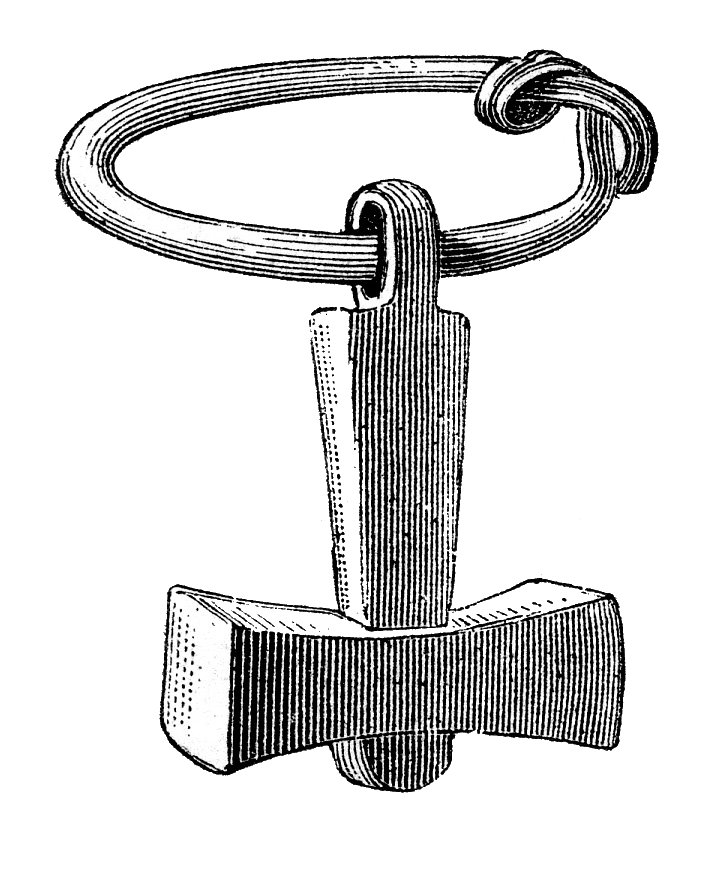
Thor's hammer, Mjölnir, has its own Norse identity. The National Museum of Denmark documents a Viking Age casting mold that could produce both a hammer pendant and Christian crosses. Their presence together records a workshop serving different religious uses. The Temple develops its spiritual comparison through the forms' relationship to the aligned soul. [1][3]