 አማርኛ
አማርኛ العربية
 বাংলা
বাংলা Български
 中文
中文 Čeština
 Dansk
Dansk Deutsch
 Eesti
Eesti Ελληνικά
 Español
 Français
 हिन्दी
 Hrvatski
 IsiZulu
 Italiano
 日本語
日本語 Kiswahili
 Magyar
 Македонски
 नेपाली
 Nederlands
 فارسی
فارسی Polski
 Português
 Română
 Русский
 Slovenščina
 Suomi
Suomi Svenska
 Tagalog
 Türkçe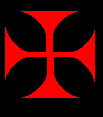
The aligned soul and its four quarters
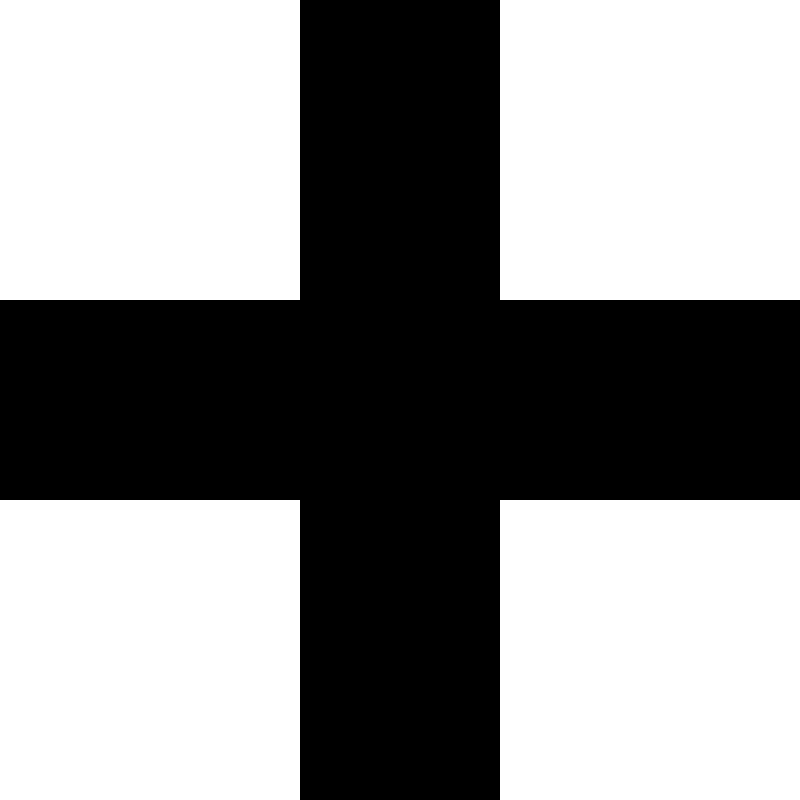
The equal-armed cross is a sacred image of the soul’s alignment. The Temple reads its fourfold structure through the chakras, the quarters of the world, and the powers gathered around a common centre. Within Zevism, this alignment allows spiritual energy to be received, held, and directed through an ordered whole. The cross presents the Divine work in a simple and commanding form: a centre remains present while its power extends in four directions. Each arm participates in the same living structure. [1][4]
The figure expresses equilibrium with reach. The soul becomes centred in order to act more fully, carrying the influence of the Gods into the different fields of life. Its stability gives spiritual power a place from which to move.
The elemental quarters and the power of aether
The Temple’s sacred map assigns earth to the front and north, fire to the back and south, water to the left and west, and air to the right and east. Aether occupies the centre and the aura. These correspondences make the cross an inward orientation as well as an outward figure. The person is contemplated as a living field whose directions possess distinct powers, brought together within a single spiritual presence. [4]
The left is the receptive pole and the right the directing pole in this teaching. Their relationship gives the horizontal axis a movement of receiving and expression. Stability and force contribute their own functions within the fourfold order. At the centre, aether holds the field together. The devotee contemplates the entire arrangement as the architecture through which the soul can participate consciously in the powers of creation, preserving both differentiation and unity. [4]
Chakra alignment and the gathered spiritual will
The Temple describes seven principal chakras along the spine and supporting paired centres at the hips, shoulders, and temples. The cross draws attention to the relationship of axis and extension within that structure. The central path must remain coherent while the surrounding powers awaken. Their alignment gives the spiritual will a more capable instrument: energy enters a connected system, and the work of one centre can support the development of the whole. [4]
The solar centre gives this spiritual architecture a governing power. As the Grail of Zeus, it holds the soul’s energy and brings will into the work of manifestation. The cross’s common meeting point gives a visible form to the need for such a centre. A sacred intention can be received, preserved, and carried outward because the powers answering to it belong to one conscious purpose. Alignment becomes effective spiritual agency under the guidance of the Gods. [4]
The fourfold field in devotional practice
The figure can serve as a focus for establishing a complete spiritual intention. Attend first to the centre, then to each direction, keeping the whole form present. Its symmetry calls the faculties into agreement: receptivity receives its task, the will its direction, stability its foundation, and movement its field of expression. The act honours the Divine order within which these powers become fruitful.
The cross also preserves a point of return during the day’s changing demands. The devotee can approach different responsibilities while remaining conscious of the spiritual work that joins them. Its four arms recall the breadth of that work, and their intersection recalls the unity from which it receives power. The symbol becomes an enduring sign of a soul prepared to receive and establish Divine influence.
Naming the forms accurately
An equal-armed cross is a geometrical description. In a regular form, two perpendicular lines meet centrally and extend equally; Euclid's definition of a perpendicular and right angle supplies the relevant mathematical language. A cross with arms that widen toward their ends is a different stylistic form, commonly termed a cross pattée. A description should identify what the drawing actually shows before a historical or religious meaning is assigned to it. [2][3]
The Iron Cross, as the name of a specific Prussian military decoration, dates to 1813. The Tallinn Museum of Orders of Knighthood documents its establishment by Friedrich Wilhelm III and Karl Friedrich Schinkel's development of its design. That named decoration must not be projected backwards as though the medal itself were an ancient religious object. Its history is distinct from the much broader act of drawing a cross-shaped figure. [3]
The Temple’s spiritual interpretation concerns sacred form, inward alignment, and the power of the soul. Its use belongs to religious contemplation and carries no endorsement of a political party, state, or military association. The ancient and modern histories of particular cross-shaped devices can be studied in their own settings while the Zevist devotee approaches this form through the Divine powers it signifies. [1][3]