 አማርኛ
አማርኛ العربية
 বাংলা
বাংলা Български
 中文
中文 Čeština
 Dansk
Dansk Deutsch
 Eesti
Eesti Ελληνικά
 Español
 Français
 हिन्दी
 Hrvatski
 IsiZulu
 Italiano
 日本語
日本語 Kiswahili
 Magyar
 Македонски
 नेपाली
 Nederlands
 فارسی
فارسی Polski
 Português
 Română
 Русский
 Slovenščina
 Suomi
Suomi Svenska
 Tagalog
 Türkçe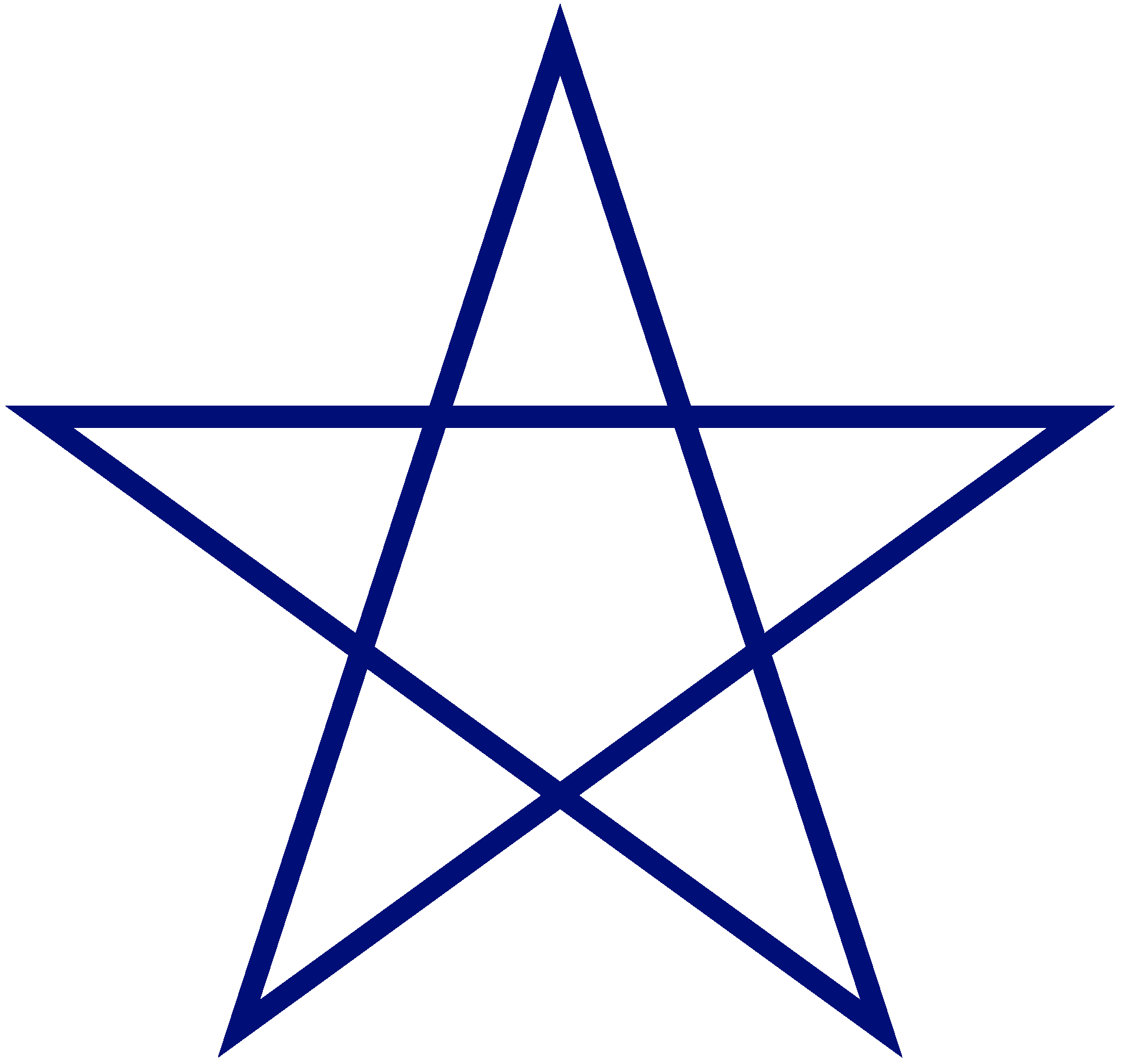
The five powers gathered in one star
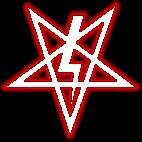
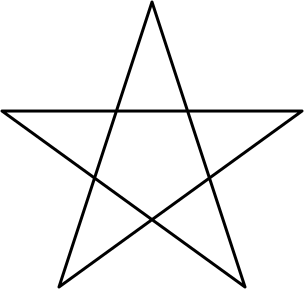
The Pythagorean star expresses the harmony of the powers through which creation takes form. In Zevism, earth, water, air, fire, and aether belong to the sacred structure of the world and the soul. Their relationship appears in the fivefold figure: distinct points joined by a continuous order, each participating in a whole greater than itself. Zeus presides over these powers as the sovereign source of the Divine order. The star gives their accord a form that the eye can hold and the spiritual will can contemplate. [1][5]
Its two orientations reveal two movements of spiritual life. The upward point signifies ascent, while the downward point signifies power received from above and brought into the soul and the Earth. The Temple honours both within the complete circulation of life. [1]
The elements within the living soul
The Temple’s chakra teaching describes the soul through elemental relationships. Earth gives the front its correspondence, fire the back, water the receptive left, and air the directing right; aether occupies the centre and the aura. The pentagram gathers these five powers into one image of spiritual wholeness. Its geometry invites the devotee to contemplate how distinct functions can become fully active while remaining coordinated through a common order. [5]
Inner alchemy requires this accord. A power developed without relation to the others leaves the spiritual structure uneven. The fivefold star calls the practitioner toward a complete work, in which stability, receptivity, movement, force, and the unifying spiritual medium each receive their place. The soul becomes more capable of holding Divine influence as its powers enter conscious relationship. The star’s continuous line expresses that unity without erasing the distinct contribution of any point. [1][5]
Ascent, descent, and the crown’s reception
The upward orientation gives form to the soul’s aspiration and the serpent’s ascent. The lower centres awaken into a movement toward higher perception, and the devotee seeks greater communion with the Gods. The downward orientation gives form to the answering reception. In the Temple’s teaching, the descending point signifies energy entering through the crown and becoming available to empower the soul. The two forms therefore express a complete relationship of approach and reception. [1][9]
The downward movement also carries a responsibility toward embodied life and the Earth. What is received must acquire a worthy expression. Spiritual power can be gathered into an intention, made effective through the awakened centres, and carried into a life capable of creation and service. The star reminds the devotee to preserve the whole circulation. The ascent opens a greater capacity; the descent fills and establishes it; the soul’s ordered form permits the gift to become fruitful. [1]
Venus, the heart, and sacred proportion
The Temple’s association of the star with Venus brings Aphrodite’s harmony into the contemplation of fivefold order. Her power joins the parts through attraction and gives their relationship beauty. The heart’s sacred work stands within this larger correspondence: the powers of the soul become capable of a living accord, and the person learns to receive and express Divine influence with grace. [1][8]
Proportion gives the eye a discipline within that devotion. Follow the complete figure, attend to the crossing lines, and return to the relationship between the outer points and the centre. The star becomes a stable focus for honouring the powers of creation and for gathering the will around a whole spiritual work.
Pythagorean testimony and exact proportion
Lucian, writing in the second century CE, reports in A Slip of the Tongue in Salutation 5 that Pythagoreans called their identifying pentagram Health. His account is valuable ancient testimony for the sign's association with wholeness of body and soul. Because it is later than Pythagoras, it should be cited as Lucian's report of Pythagorean practice, not as a surviving statement written by Pythagoras himself. [2]
The regular pentagram also has exact mathematical properties. Euclid's Elements XIII.8 proves that intersecting diagonals of a regular pentagon divide one another in extreme and mean ratio, now commonly called the golden ratio. Its value is φ = (1 + √5)/2, approximately 1.618. This concerns specific whole-to-part and part-to-part relationships; it does not mean that any two adjacent pieces of any drawn five-pointed star have that ratio. [3]
The fivefold cycle of Venus
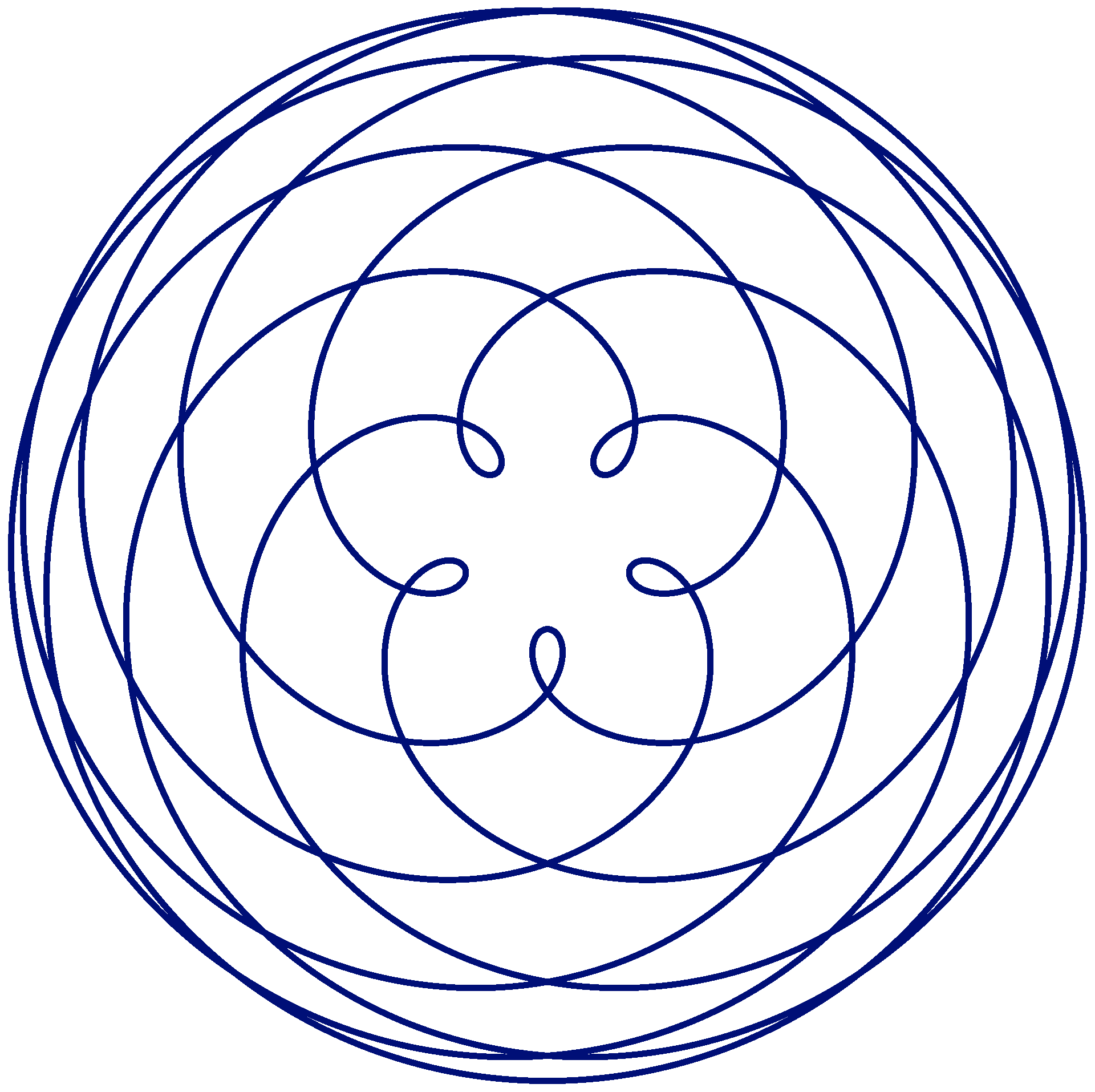
The association with Venus can be explained accurately through its cycle. Five synodic periods of Venus take approximately eight Earth years. Plotting successive occurrences of a chosen phase against the zodiac gives a near-repeating fivefold pattern. The European Southern Observatory explains this as the pentagram of Venus. Venus does not physically orbit the Sun along the straight sides of a pentagram, and the eight-year repetition is approximate rather than exact. [4]