
 አማርኛ
አማርኛ العربية
 বাংলা
বাংলা Български
 中文
中文 Čeština
 Dansk
Dansk Deutsch
 Eesti
Eesti Ελληνικά
 Español
 Français
 हिन्दी
 Hrvatski
 IsiZulu
 Italiano
 日本語
日本語 Kiswahili
 Magyar
 Македонски
 नेपाली
 Nederlands
 فارسی
فارسی Polski
 Português
 Română
 Русский
 Slovenščina
 Suomi
Suomi Svenska
 Tagalog
 Türkçe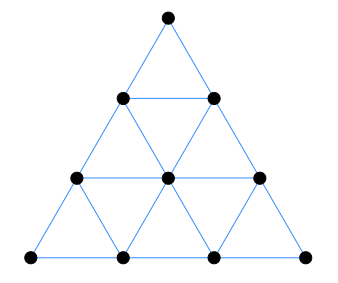


The Divine unity unfolding into order
The tetractys reveals ordered manifestation through ten points in four rows: one, two, three, and four. In Zevist contemplation, its summit directs the soul toward unity under Zeus, while its descending rows disclose a power capable of differentiated expression. The many remain joined within one sacred form. The figure therefore belongs to the mysteries of creation and return: Divine power unfolds into distinct capacities, and awakened consciousness gathers those capacities into a more complete participation in their source. [3][4]
Its simplicity gives the spiritual eye a stable field. Every point can be seen, every row recognised, and the complete triangle held before the mind. The pattern provides a clear vessel for contemplating a Divine order whose richness develops without losing its unity.
Unity, polarity, and the channels of the soul
The first stages of the figure can be read through the Temple’s teaching on the soul. One signifies a common spiritual purpose. Two brings the receptive and directing powers into view. Three reveals their relationship to a central path, expressed in the teaching of Ida, Pingala, and Sushumna. The tetractys gathers these relations into a progression the devotee can hold at once: unity becomes articulate, differentiated powers acquire a relationship, and the centre gives their movement continuity. [3][4]
The fourth row extends contemplation toward the four elemental quarters, held together through the spiritual centre. Earth, water, air, and fire each contribute to the life of the soul; aether gives their meeting its unifying field. The completed triangle thus becomes a sacred image of ordered multiplicity. Its ten points express the fullness of the arrangement, while the ascent of attention toward the summit gathers the whole work back toward its governing Divine principle. [4]
Sacred harmony and the awakened instrument
The tetractys also makes harmony visible. The first four numbers contain relationships through which different tones can belong to one musical order. Inwardly, this gives a form to the soul’s distinct centres and powers. Each must become responsive, yet spiritual wholeness requires their accord. The Temple teaches that the chakras possess different functions within one luminous soul. The tetractys allows the devotee to contemplate the principle by which difference becomes harmony. [4]
Sacred vibration gives this contemplation a practical relation to the inner work. The Temple’s Kundalini teaching joins sound, breath, and concentration in the cultivation of spiritual power. The tetractys supplies a measured image beside that practice, recalling that intensity receives its purpose through order. Apollon’s harmony and Hermes’s communication find a fitting companion in the figure: the awakened soul becomes capable of receiving Divine influence and expressing it through a more coherent instrument. [8]
The descent of power and the return of awareness
Contemplated from the summit downward, the figure presents a spiritual power entering a fuller field of expression. From the base upward, it presents the gathering of differentiated faculties into concentrated awareness. These two movements belong together in the Zevist work. The devotee receives from the Gods and develops the inward order needed to carry Their influence into life. What is made fruitful through that descent enriches the consciousness that returns in devotion. [3]
The intermediate rows give each stage its dignity. A coherent whole develops through relationships that must actually be established. Meditation awakens receptivity, study clarifies understanding, and the will gives continuity to the work. The tetractys becomes a visible reminder that spiritual attainment has an order, and that the soul’s many powers can become instruments of one ascent toward the Godhead.
Ancient Pythagorean witnesses
Iamblichus’ Life of Pythagoras, section 82 in chapter XVIII, preserves teachings connecting the Delphic oracle with the tetractys and harmony with the Sirens. His late antique work is an important witness to Pythagorean religious tradition. The passage places number and harmony within the sacred world of the oracle, supplying a historical foundation for the figure’s contemplative importance. [1]
The first four positive integers sum to ten: 1 + 2 + 3 + 4 = 10. They also supply the familiar ratios 2:1, 3:2 and 4:3, corresponding to the octave, fifth and fourth in the relevant mathematical treatment of musical intervals. This relationship helps explain why the figure could join number and harmony. The Stanford Encyclopedia of Philosophy also notes scholarly disagreement over how early the full tetractys doctrine should be dated. [2]