 አማርኛ
አማርኛ العربية
 বাংলা
বাংলা Български
 中文
中文 Čeština
 Dansk
Dansk Deutsch
 Eesti
Eesti Ελληνικά
 Español
 Français
 हिन्दी
 Hrvatski
 IsiZulu
 Italiano
 日本語
日本語 Kiswahili
 Magyar
 Македонски
 नेपाली
 Nederlands
 فارسی
فارسی Polski
 Português
 Română
 Русский
 Slovenščina
 Suomi
Suomi Svenska
 Tagalog
 Türkçe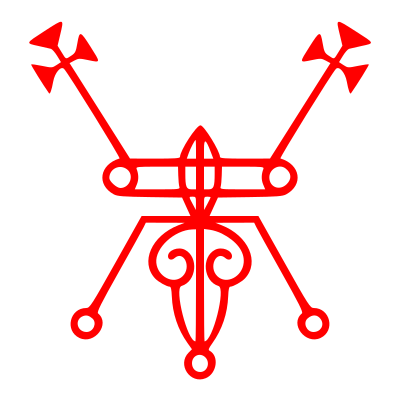
The Goetic sigils and the Ancient Gods
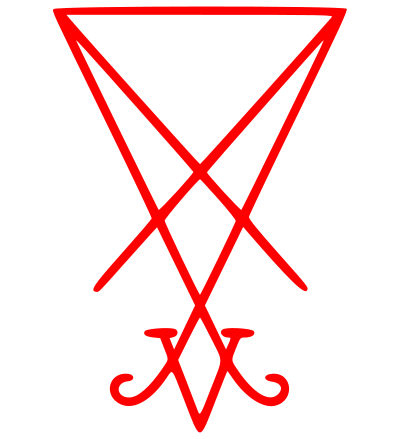
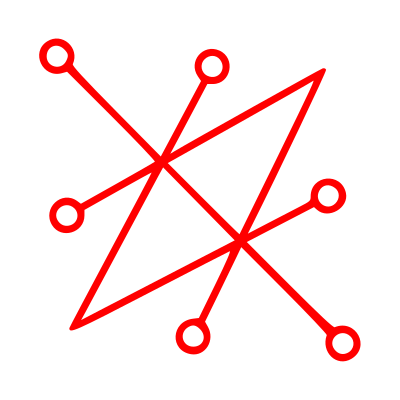
In Zevism, the Goetic sigils are sacred symbols derived from the Ancient Gods. They contain mysticism: knowledge of Divine powers, the structure of the soul, and the relationships through which the human being approaches the Gods. Their application belongs to invocation, meditation, consecration, and spiritual transformation. The visible drawing gathers a Divine name and power into a form through which that relationship can be cultivated. [1]
The Gods precede the books in which Their signs are transmitted. From this Zevist foundation, the history of a manuscript is one part of a much older sacred inheritance. The art of joining Divine names, images, and signs reaches back to Babylon and the wider Mesopotamian world, where seals placed the worshipper in relation to the Gods. Babylon therefore belongs at the beginning of this account of the historical roots of sacred seal-making. [2][3]
A sigil is approached as a living sacred form. Its lines establish an ordered field for recognition, invocation, and the reception of spiritual knowledge. The practitioner learns the God’s names and attributes, preserves the particular sign, and brings intention into accord with the Divine power it expresses. The mystical application develops through that whole relationship.
The sigil as a map of the soul
A Divine sigil gathers several levels of meaning into one sacred form. It identifies the God, expresses a pattern of spiritual power, and gives the devotee a stable focus through which to approach that power. Its lines, centers, crossings, and openings participate in a language of relation. Contemplation follows these relations inward: scattered attention becomes ordered, devotion acquires a clear object, and the soul becomes receptive to the qualities of the God invoked.
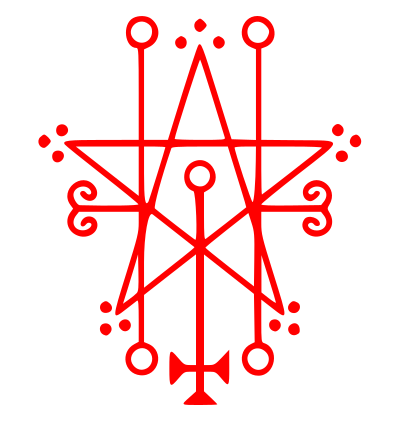
The Temple gives a particular exposition of Aphrodite’s sigil as a diagram of the soul. Its paired bars correspond to the positive and negative pillars; its Venus glyph to the heart chakra; its five points to the elements and quintessence. The sign therefore holds together polarity, elemental wholeness, and the heart’s power of union. The visible design becomes a sacred teaching of how distinct powers can enter a harmonious spiritual order. This is an explicit Zevist interpretation of the emblem. [9]
Each God’s sigil directs that work according to the Divine presence it bears. The sigil of Zeus calls the will toward sovereign order and spiritual command. That of Apollon directs contemplation toward illumination, clarity, and harmony. Aphrodite’s sign gathers attraction and the opening of the heart; Satya’s directs the devotee toward the foundation of truth. These qualities remain related within the whole spiritual life, just as the powers of the soul participate in one being. A sigil is approached with knowledge of its God, reverence for its meaning, and a sustained intention to develop the corresponding power.
Babylonian roots: Divine presence in the seal
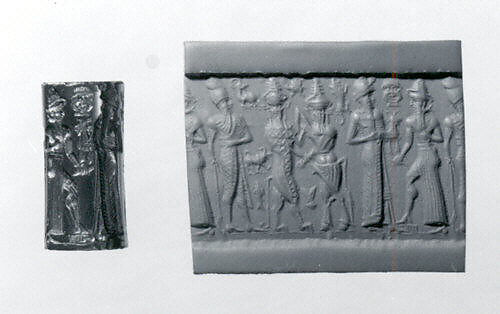
An Old Babylonian cylinder seal in the Metropolitan Museum, dated approximately to the eighteenth century BCE, shows a worshipper before Shamash, the Sun God. His saw identifies Him within the scene. The seal unites a compact engraved form with a Divine encounter; its rolled impression unfolds the scene as a continuous image. [2]
A later Assyro-Babylonian stamp seal, dated to the late eighth or seventh century BCE, shows a worshipper with raised hands before Divine symbols. Marduk’s dragon and spade standard belong to its sacred composition, together with a winged disc and another abstract sign. Here the seal bears recognizable emblems of the Gods as well as a human act of reverence. [3]
These objects establish the deep antiquity of Divine imagery on seals. The historical connection is the older sacred art of names, signs, and Divine powers; tracing the exact strokes of an individual Goetic sigil requires its own manuscript witnesses. The Babylonian evidence and the later written traditions illuminate different stages of that larger history.
Medieval alchemy and the art of talismans
The medieval Picatrix places talismans within a world of celestial correspondences, sacred knowledge, and practical operations. Its Arabic source was compiled in the later tenth century according to the introduction to the modern scholarly translation; transmission into Castilian and Latin followed in the thirteenth century. Materials, timing, images, and invocations belong together in this art. [4]
The connection with alchemy is explicit. In Martin Plessner’s account of Picatrix I.2, the definition of talismans is associated with Jābir ibn Ḥayyān, and the talisman is compared with the elixir of the alchemists. The comparison joins two kinds of concentrated transformation: the prepared material of the alchemist and the prepared image of the talismanic practitioner. It offers a precise medieval witness to the shared language of hidden virtue and operative form. [5]
Albertus Magnus, writing on minerals in the thirteenth century, likewise discusses images engraved upon stones. The chapter on their meaning connects zodiacal and constellation figures with particular qualities and intended effects. His examples include the eagle, the serpent-bearer, and Perseus with the Gorgon’s head. Sacred and celestial figures thus remained active subjects of learned discussion about engraved images and their powers. [6]
From celestial characters to the surviving Goetia
In the Renaissance, Heinrich Cornelius Agrippa developed an extensive account of magical characters. In Three Books of Occult Philosophy II.51–52, he describes characters formed from celestial and geomantic relationships, and signs derived from characteristic Divine attributes: Saturn’s sickle, Jupiter’s sceptre, and Mercury’s staff are among his examples. This gives a documented account of how an image or Divine attribute could be concentrated into a graphic sign. [7]
The Ars Goetia, the first book of the Lemegeton, supplies a later catalogue of names, offices, and seals. Joseph H. Peterson’s transcription follows British Library Sloane MS 3825 and compares related witnesses. Its entries repeatedly direct the use of a seal or character as a lamen, an emblem worn in the operation. The written tradition therefore preserves practical ritual uses alongside the drawings themselves. [8]
The surviving Goetic collection belongs to early modern manuscript history; its textual antecedents include the sixteenth-century works of Johann Weyer and Reginald Scot. This chronology dates the extant compilation and its witnesses. Within Zevism, the Divine source of the sigils is understood through the Ancient Gods, while historical study follows the particular documents through which their forms have reached the present. [1][8]
The Temple’s sigils and mystical applications
The Temple’s displayed set includes Satya/Kronus; Zeus/Baalzevul/Jupiter; Apollon/Mithra/Utu; and Aphrodite/Inanna/Demeter. These sacred identifications guide the reading of the corresponding emblems. The exact drawing, Divine name, and accompanying teaching belong together, for the identity of a sigil rests in the power and relationship it expresses. [1]
In invocation, the sign gathers the practitioner’s approach to the God. In meditation, its proportions and central relations become a field of sustained contemplation. In consecration, it identifies the Divine power to which a sacred object or act is dedicated. In the work of spiritual transformation, it recalls the qualities and faculties to be awakened under Divine guidance.
The same discipline joins the ancient seal-maker’s attention to form, the medieval interest in correspondences, and the Temple’s living practice. Study deepens recognition; faithful form gives recognition stability; reverent application brings the symbol into the spiritual life. The sigil is received through the eye, understood through knowledge, and approached through the whole soul.