 አማርኛ
አማርኛ العربية
 বাংলা
বাংলা Български
 中文
中文 Čeština
 Dansk
Dansk Deutsch
 Eesti
Eesti Ελληνικά
 Español
 Français
 हिन्दी
 Hrvatski
 IsiZulu
 Italiano
 日本語
日本語 Kiswahili
 Magyar
 Македонски
 नेपाली
 Nederlands
 فارسی
فارسی Polski
 Português
 Română
 Русский
 Slovenščina
 Suomi
Suomi Svenska
 Tagalog
 Türkçe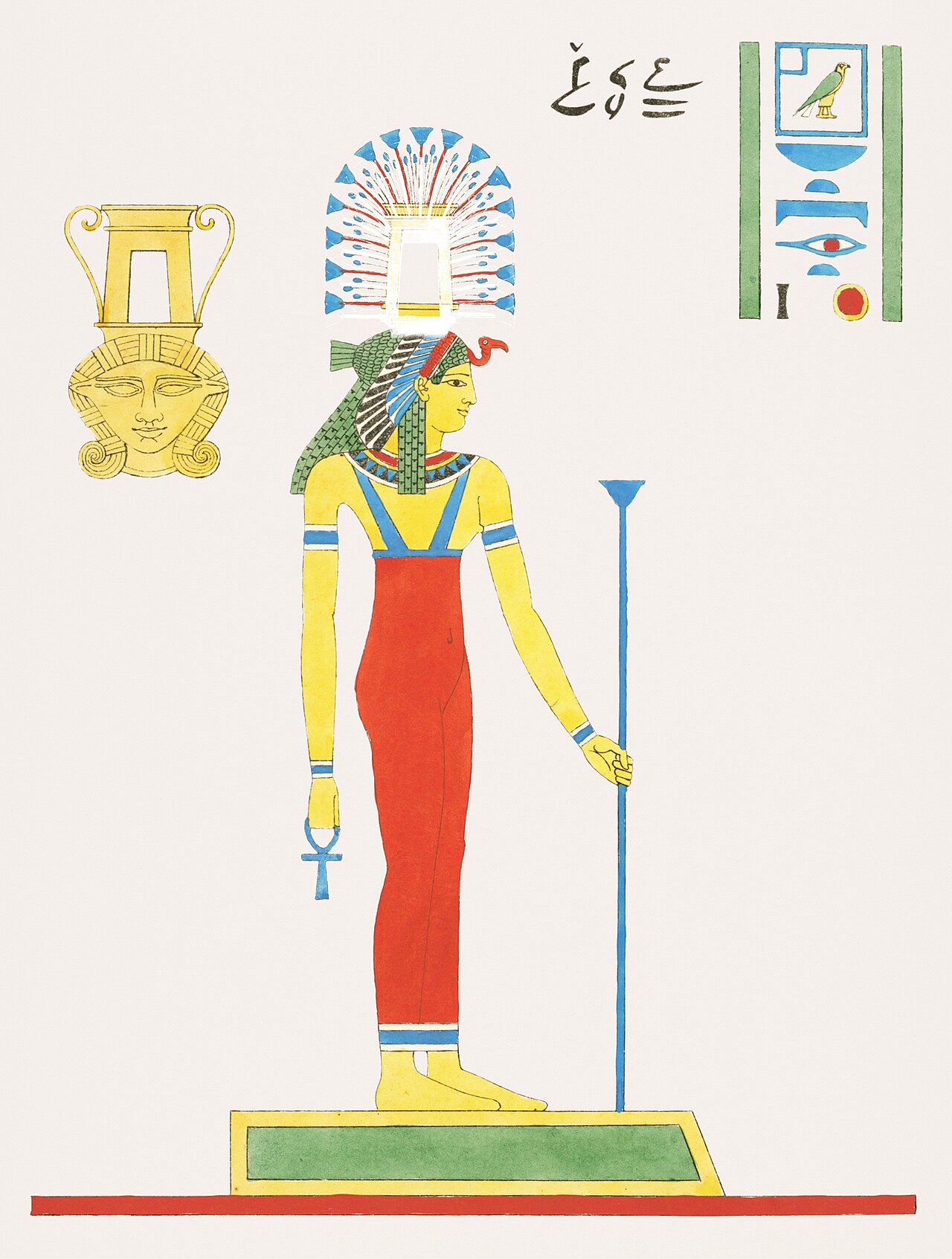
The Goddess who awakens the sanctuary
The sistrum is the sound of a sanctuary coming alive. Its shaking announces movement, presence and renewed power. In the mysteries of Hathor and Isis, the sacred rattle belongs to a world in which the Gods enliven creation and the soul can answer their activity. Zevist contemplation receives it as an emblem of spiritual awakening: dormant powers stir, the inward life becomes radiant, and the person enters the living rhythm of Divine communion.
The instrument joins a firm handle, an enclosing frame and movable sounding parts. Its spiritual teaching begins in this union. The awakened soul requires both continuity and motion: a centre that holds its intention and energies capable of answering that intention. The sistrum gives these complementary powers one form. Its movement becomes a sacred summons through which the Goddess gathers the scattered faculties into an ordered, joyful presence. [1][2]
Vibration, the chakras and the living voice
The Temple describes the chakras as centres of the soul's energy, each possessing its own function and powers. Within this spiritual understanding, the sistrum signifies their awakening to coordinated activity. Its handle can be contemplated as the steadiness of the central intention, its frame as the boundary of the consecrated field, and its moving parts as faculties brought out of inertia. The sound marks the passage from potential into expression. [1]
The heart and throat disclose a particular mystery of this symbol. The heart receives the Goddess through affection, delight and reverence; the throat gives the inward encounter an audible form. Prayer, hymn and sacred address become fuller when feeling and utterance move together. The Temple associates green with the heart and blue with the throat, wisdom and truth. These colours can accompany contemplation of the sistrum: the living green of receptivity joined to the lucid blue of inspired expression. [2]
The sistrum's spiritual operation is therefore different from the lyre's. The lyre displays the harmony of differentiated tones; the rattle emphasizes renewal through recurring movement. It calls the soul back into participation whenever its energies have become dispersed or stagnant. The priestly hand sets a rhythm, and the whole person answers through presence, breath and invocation.
The four elements stirred into life
Plutarch offers a striking ancient interpretation of the instrument. He describes its shaking as an awakening from torpor and its regenerative movement as a resistance to constriction. He also reads four movable parts within its rounded upper frame through fire, earth, water and air. His account concerns the form he describes; surviving sistra need not possess that exact arrangement. [3]
In Zevist inner alchemy, this elemental reading becomes a work of integration. Fire supplies the force of aspiration; air gives mobility and intelligible expression; water allows the soul to receive and circulate impressions; earth establishes the enduring form through which the work is sustained. The sistrum stirs these powers into relationship. Each element contributes its own capacity, while the instrument's encompassing shape keeps their activity within one sacred whole.
Hathor's joy is especially significant here. Spiritual power flowers through beauty, music and the capacity to receive delight. Joy expands the soul's participation in the Gods. The sistrum expresses a strength that can enliven without becoming chaotic, and a serenity that remains capable of movement. Its brightness belongs to the fullness of life restored to sacred order.
Protection through regenerative presence
The sistrum also guards the sanctuary. Its protective meaning arises from the establishment of a Divine presence within a defined field. When the soul holds its centre and its faculties answer one another, intrusive confusion finds less room to govern the inward life. The enclosing frame can therefore be contemplated as the boundary of the aura, while the sounding movement represents the active power maintained within it.
Isis brings the further mystery of renewal: what has become scattered can be gathered, what has fallen silent can answer again. In this symbolism, protection and regeneration cooperate. The sanctuary is kept living through repeated consecration. Each return to hymn and prayer renews the bond between the worshipper and the Goddess, giving the soul a rhythm through which to sustain its awakening.
Ancient instruments and the illustrated Goddess
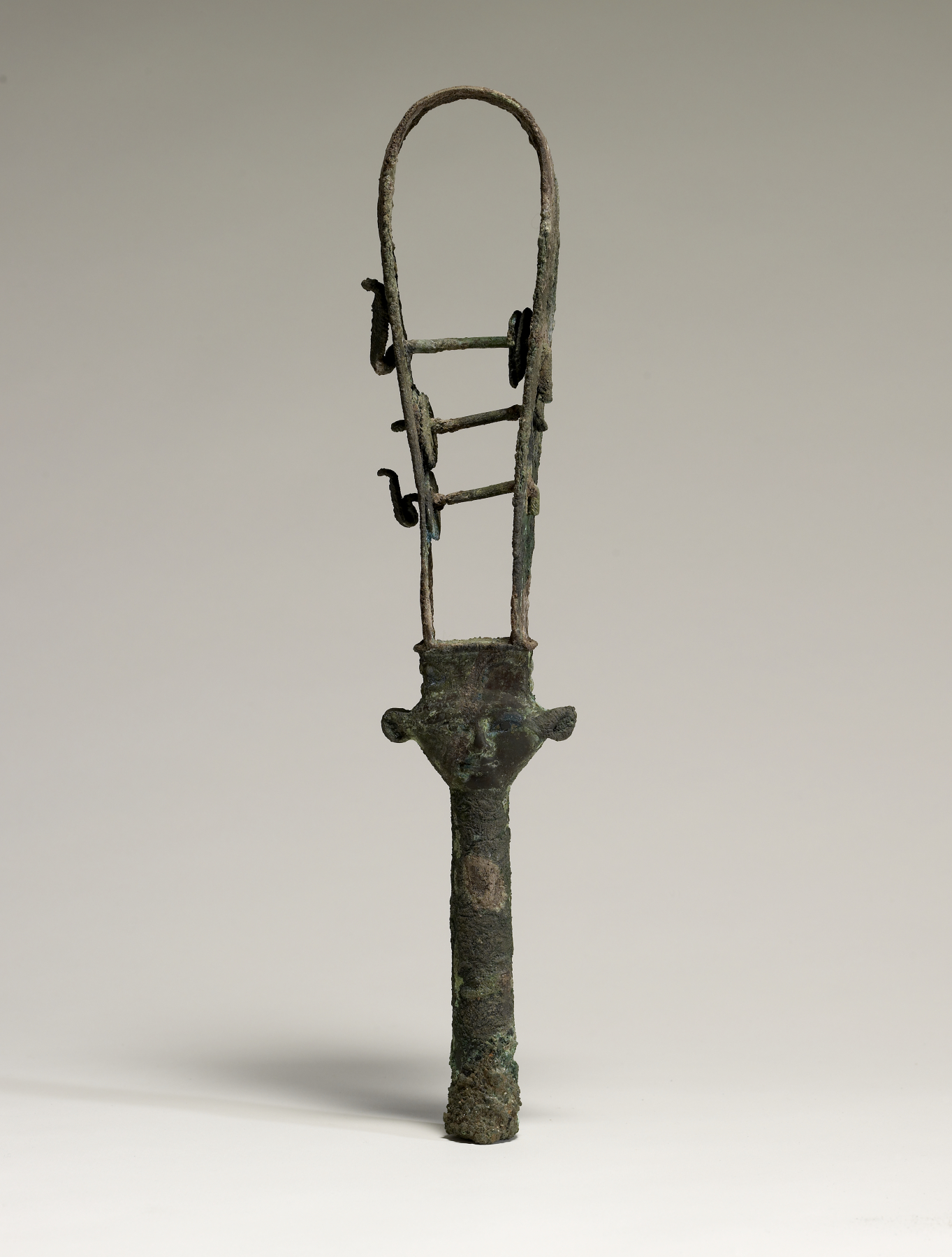
A sistrum inscribed for King Teti, dated by the Metropolitan Museum to approximately 2323–2291 BCE, documents the instrument's early Egyptian history. The museum explains its ceremonial use and its relationship to soothing Hathor. The stone example preserves the shrine-shaped body, while its sounding rods and disks are missing. The complete loop-shaped bronze instrument in the supplemental image belongs to the Walters Art Museum and is dated approximately 380–250 BCE. [4][5]
Plutarch's Isis and Osiris 63, written in the Roman imperial period, supplies the philosophical reading of movement and the elements discussed above. [3] The colourful principal image is a nineteenth-century illustration of Hathor by Léon-Jean-Joseph Dubois, with a sistrum-shaped Hathoric emblem beside the Goddess. It is captioned as that later illustration, while the separate bronze instrument shows the actual handheld form. [5][6]