 አማርኛ
አማርኛ العربية
 বাংলা
বাংলা Български
 中文
中文 Čeština
 Dansk
Dansk Deutsch
 Eesti
Eesti Ελληνικά
 Español
 Français
 हिन्दी
 Hrvatski
 IsiZulu
 Italiano
 日本語
日本語 Kiswahili
 Magyar
 Македонски
 नेपाली
 Nederlands
 فارسی
فارسی Polski
 Português
 Română
 Русский
 Slovenščina
 Suomi
Suomi Svenska
 Tagalog
 Türkçe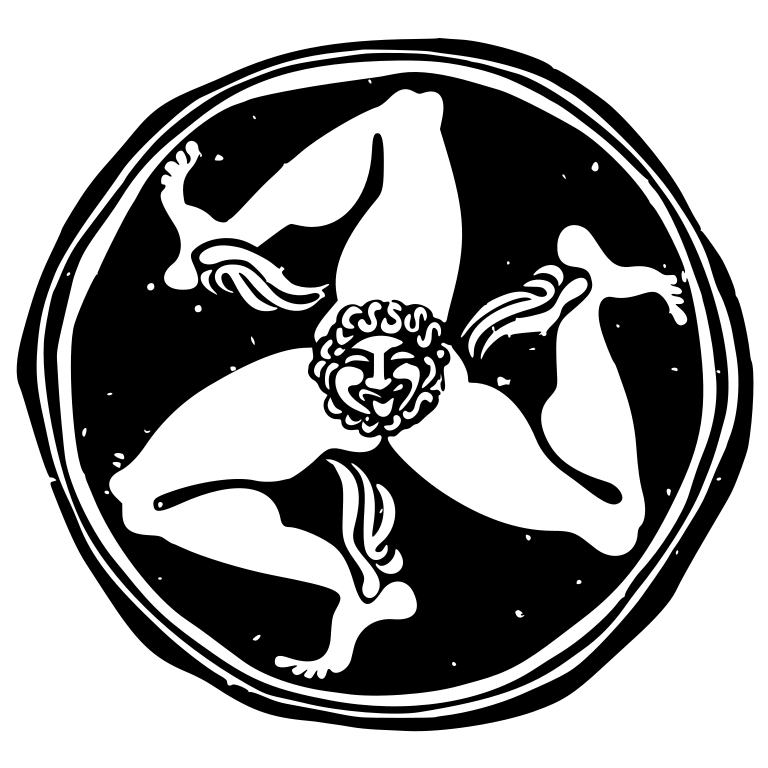
The three Divine movements
The triskelion expresses the sacred powers of creation, preservation, and dissolution. Three movements arise around one centre, declaring that change belongs to an ordered Divine life. In Zevism, these powers act within the cosmos and within the soul’s awakening. A capacity is called forth, established in strength, and transformed when a greater form becomes possible. The Temple’s winged feet bring Hermes into this mystery as the God of ceaseless motion and the passage of spiritual power. The turning image reveals eternity through a living order of movement. [1]
The centre gathers the three powers without arresting them. Their unity allows the work to continue through its different phases. The devotee contemplates a Divine purpose whose expression remains alive, able to generate, sustain, and renew the forms through which the soul advances.
Hermes and the circulation of spiritual power
Hermes gives motion an intelligent direction. Through His power, a message crosses a distance, an understanding passes into expression, and a connection becomes active. The triskelion’s winged limbs make this movement visible. Each returns to the same centre while opening toward a different part of the field. Within the spiritual life, this is the power of circulation: energy received by the soul enters its centres, supports their functions, and becomes available for conscious action. [1][5]
The Temple describes the chakras as moving centres with distinct powers. Their activity belongs to a common structure, so that the awakening of one centre enters a relationship with the whole. The triskelion gives a compact image of that living coordination. Its movement calls attention to the continuity between receiving, directing, and renewing spiritual energy. Hermes presides over the passages through which the soul’s powers communicate and its knowledge becomes increasingly articulate. [5]
Creation, preservation, and dissolution in inner alchemy
Creation begins when a spiritual possibility acquires form. The devotee establishes a sacred intention, turns toward a Divine power, and begins the work needed to become responsive to it. Preservation gives that opening continuity. Meditation, study, and reverence sustain the inward conditions through which the new capacity can mature. Dissolution releases an exhausted or obstructing form so that the soul can advance beyond it. The three movements give inner alchemy a complete rhythm. [1][9]
Their relationship is especially clear in the awakening of the serpent. Power is stirred, its passage is prepared, and the centres become capable of a fuller life. The Temple teaches gradual cultivation, through which development can be established rather than dispersed. The triskelion places the whole process within one sacred figure. Its threefold movement honours the stages required by transformation and gives the practitioner an image of progress that remains faithful to the work’s Divine purpose. [9]
The centre remembered through change
The turning form can accompany contemplation of a particular stage of spiritual labour. One undertaking may require the courage of beginning; another, the strength of continued care; another, the discernment to release what has completed its task. The symbol teaches the person to recognise which power is called for while preserving the unity of the entire ascent.
This is Hermes’s freedom within order. The devotee becomes capable of moving between different operations without losing the sacred direction that joins them. A return to the centre gathers what the passage has revealed, and the next movement begins with greater understanding. Through the triskelion, eternal motion becomes a religious image of a soul continuously renewed in the company of the Gods.
Ancient form and historical variation
The name is connected with the Greek adjective τρισκελής, meaning three-legged. Forms grouped under triskelion include three bent legs and three curving arms, but these should not be treated as identical objects with an automatically identical meaning. The term describes a structure; the context of a particular vessel, coin or emblem is still needed to interpret its use. [2]
A ceramic mixing bowl from Castellazzo near Palma di Montechiaro in Sicily, documented in the British Museum's online exhibition with the Museo Archeologico Regionale di Agrigento, bears a triskeles and is dated about 650–600 BCE. This provides a specific ancient example. The familiar Sicilian emblem with three legs around a central head belongs to a larger history in which the design also acquired geographical and civic associations. [3]
The Temple’s winged-foot rendering brings Hermes into its interpretation of ceaseless motion. In Odyssey 5.43–49, His golden sandals carry Him over land and sea with the speed of the wind. This passage gives an ancient literary witness to the swift Divine messenger. The winged-foot triskelion places that power within the Temple’s own sacred interpretation of the threefold form. [1][4]