
 አማርኛ
አማርኛ العربية
 বাংলা
বাংলা Български
 中文
中文 Čeština
 Dansk
Dansk Deutsch
 Eesti
Eesti Ελληνικά
 Español
 Français
 हिन्दी
 Hrvatski
 IsiZulu
 Italiano
 日本語
日本語 Kiswahili
 Magyar
 Македонски
 नेपाली
 Nederlands
 فارسی
فارسی Polski
 Português
 Română
 Русский
 Slovenščina
 Suomi
Suomi Svenska
 Tagalog
 Türkçe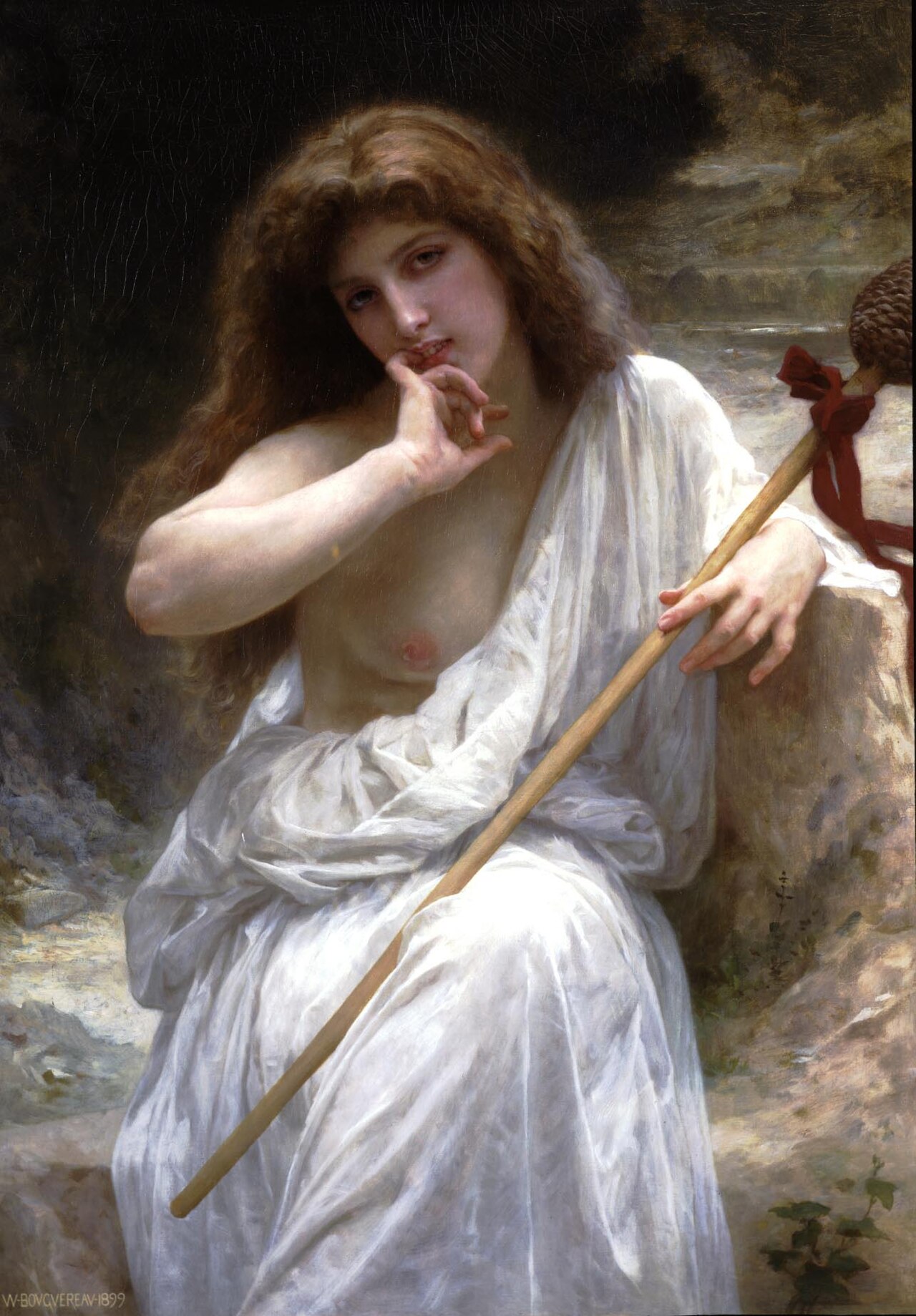
_-_Mailice_(1899).jpg)

The sceptre that bears living growth
The thyrsus is the sacred staff of Dionysus, a sign in which upright power is clothed with living abundance. Its shaft gives direction; its foliage gives luxuriance; its crown gathers the whole into an image of fulfilment. For Zevist contemplation, it is a sceptre of awakened life. Spiritual power rises through a definite course and flowers into a richer participation in the presence of the Gods.
Dionysus reveals a Divine vitality capable of breaking the rigidity that confines the soul. His staff bears the strength of growth, a force that does not remain enclosed within its first condition. What is dormant awakens, what is constricted acquires movement and what is scattered can enter a shared sacred rhythm. The thyrsus makes this power visible through the union of a stable axis and a living, expanding form.
The axis of ascent and the pineal crown
The staff can be contemplated as the central axis of the spiritual being. The Temple describes Kundalini as an awakening power whose ascent passes through the major chakras. In this Zevist correspondence, the thyrsus gives that teaching an image: the shaft is the way of ascent and the vegetation is the flourishing of the faculties nourished by the rising force. The symbol gathers vertical direction and organic development into one form. [1] [2]
Where the thyrsus is represented with a pine-cone finial, the cone offers a further correspondence with the pineal centre. The Temple associates this centre with intuition and inner illumination. The crown of the staff can therefore signify a gathered light at the summit of the soul's development, while the enclosing scales suggest a potency becoming available through awakening. This is a spiritual reading of the cone-bearing form; ancient thyrsoi also appear crowned with foliage. [3] [4]
The staff in ancient testimony
Euripides places the thyrsus in the hands of Dionysus and His followers in the Bacchae. Its ivy-bound form identifies the Divine company; later, the messenger describes water and wine appearing where the staffs touch the earth, and honey flowing from their ivy. The drama presents a world made fertile by the God's presence. [5]
The Metropolitan Museum describes the thyrsos as a fennel stalk crowned with ivy leaves in its record of an Attic skyphos attributed to the Lewis Painter, about 470 BCE. That object also shows Dionysus crowned with vine leaves. The historical forms are botanical and varied: the living staff has a clear ancient setting without requiring every version to carry the same finial. [4]
Sacred ecstasy and the expansion of the soul
The mystical force of the thyrsus concerns the enlargement of spiritual life. Ecstasy, in this devotional setting, is the soul's opening beyond its habitual confinement through communion with a Divine power. The God draws the faculties into a greater intensity of life, while the staff retains a clear axis through that intensity. The symbol holds expansion and direction together.
The vine or ivy around the shaft can be contemplated as energy distributing itself from the central course into the wider luminous being. The Temple's account of the chakras presents the soul as a whole structure whose centres contribute different powers. Dionysian awakening is therefore more than a single elevated sensation. It is a flowering through which vitality, feeling, imagination and spiritual perception become capable of a fuller and more harmonious expression. [2]
Bearing the Divine rhythm
A sceptre identifies authority, and the thyrsus gives authority the form of living fertility. To bear it in contemplation is to ask that one's will be joined to a power greater than personal agitation. The worshipper offers the God the wish for a soul that can receive abundance without becoming disordered, and for an ascent that brings the whole being into its movement.
Contemplate the upright staff, then the spiral of leaves and the gathered crown. Recognize the rooted force, the ordered ascent and the flowering summit as successive aspects of one spiritual process. The Temple emphasizes sustained preparation in its Kundalini teaching; the thyrsus lends this work the presence of Dionysus, whose sacred vitality makes development a movement toward fullness. [1]
The later painting accompanying this article belongs to the artistic reception of the ancient symbol. Its Bacchante carries the staff as a sign of participation in the God's company. In Zevist devotion, the essential image remains the living sceptre itself: power given direction, growth crowned with radiance and the soul brought into a more abundant relation with the Divine.