 አማርኛ
አማርኛ العربية
 বাংলা
বাংলা Български
 中文
中文 Čeština
 Dansk
Dansk Deutsch
 Eesti
Eesti Ελληνικά
 Español
 Français
 हिन्दी
 Hrvatski
 IsiZulu
 Italiano
 日本語
日本語 Kiswahili
 Magyar
 Македонски
 नेपाली
 Nederlands
 فارسی
فارسی Polski
 Português
 Română
 Русский
 Slovenščina
 Suomi
Suomi Svenska
 Tagalog
 Türkçe
Existence, Cosmology and Ethics · The Ten Antithetical Powers · Power X
Ascent and Descent
Ἄνοδος καὶ Κάθοδος
author: High Priest Zevios Metathronos
To the family of Zevists. A working teaching, grounded in Heraclitus's road up and down, in Homer's Zeus beneath the earth and Hesiod's Zeus who raises and brings low, in Plato's Republic, Phaedrus and Theaetetus, in Plotinus, the Homeric Hymn to Demeter and Apollodorus, and in the Egyptian witness of Ra's nightly descent through the Duat and his rebirth at dawn. This is the tenth and last of the Ten Antithetical Powers. It closes the tetractys and returns to Light and Darkness, where the series began. It sets out 3 things: that every true path goes down and comes up, and neither direction is evil; that under Ma'at descent explores the dark and ascent carries back what was learned, as Zeus rules both the heaven above and the earth below, while under Izfet ascent flees and despises the world and descent sinks without return; and that ὁμοίωσις θεῷ is the ascent that descends to serve and rises again, the whole of Zevism on a single road.
I. Opening: The Tenth Power
Light and Darkness opened this series and laid down its law. Every Power is a pair, and neither member is evil. Bound by Ma'at, the structured Order of Cosmic Existence that Zeus holds as Sovereign of the Cosmos, the pair works in harmony and builds life. Bound by Izfet, the same pair turns destructive, and existence falls back toward unstructured chaos. Izfet breaks a pair in 2 ways: one member seizes sole rule, or the pair is torn apart.
This is the base of the tetractys and the end of the series, and it brings the series back to its beginning. Light and Darkness taught that unexplored darkness is the ground you walk into carrying light, and that explored darkness becomes Light. That teaching describes a road: down into the dark, and back up into the light. Power X names the road.
II. The Ancient Witnesses
Heraclitus gives the whole Power in 6 words:
Heraclitus, DK 22 B60
«ὁδὸς ἄνω κάτω μία καὶ ὡυτή.»
"The road up and down is one and the same."
The Greeks worshipped Zeus on both ends of that road. Homer names "Zeus beneath the earth and dread Persephone," Ζεύς τε καταχθόνιος (Iliad IX.457), and Hesiod tells the farmer to "pray to Zeus of the earth, Διὶ χθονίῳ, and to holy Demeter, that the sacred grain of Demeter may grow full and heavy" (Works and Days 465-466). And Hesiod opens his poem with the Zeus who governs every rise and fall:
Hesiod, Works and Days 5-8
«ῥέα μὲν γὰρ βριάει, ῥέα δὲ βριάοντα χαλέπτει, / ῥεῖα δ’ ἀρίζηλον μινύθει καὶ ἄδηλον ἀέξει, / ῥεῖα δέ τ’ ἰθύνει σκολιὸν καὶ ἀγήνορα κάρφει / Ζεὺς ὑψιβρεμέτης, ὃς ὑπέρτατα δώματα ναίει.»
"Easily he makes strong, and easily he crushes the strong; easily he diminishes the conspicuous and raises the obscure; easily he straightens the crooked and withers the proud: Zeus who thunders on high, who dwells in the highest halls."
Plato's greatest dialogue opens on this road. The first word of the Republic is κατέβην: "I went down yesterday to the Piraeus" (Republic I, 327a). A book about justice begins with a descent. At its center, the philosopher who has climbed out of the cave into the sunlight is sent back:
Plato, Republic VII, 520c
«καταβατέον οὖν ἐν μέρει ἑκάστῳ εἰς τὴν τῶν ἄλλων συνοίκησιν καὶ συνεθιστέον τὰ σκοτεινὰ θεάσασθαι.»
"Each of you in turn must go down into the common dwelling of the others and grow used to seeing the dark things."
τὰ σκοτεινά: the dark things. The one who has seen the light goes back into the dark to raise others, which is the first Power lived as a duty.
Plato also shows who leads the ascent: "Zeus, the great leader in heaven, driving a winged chariot, goes first, ordering all things and caring for them" (Phaedrus 246e). And he names its goal: "one must try to flee from here to there as quickly as possible, and the flight is ὁμοίωσις θεῷ κατὰ τὸ δυνατόν; and becoming like God is becoming just and holy with wisdom" (Theaetetus 176a-b).
Plotinus, who climbed that road further than any philosopher, describes both directions in one breath. "Often I wake up out of the body into myself," he writes, and after dwelling in the divine, "having come down from intellect into reasoning, I'm at a loss how I ever come down even now" (Enneads IV.8.1). A few lines later he cites Heraclitus's road.
And Zeus fixed the rhythm in the oldest mystery of all. When Persephone had eaten in the house of Hades, Zeus decreed her path:
Homeric Hymn to Demeter 445-447
«νεῦσε δέ οἱ κούρην ἔτεος περιτελλομένοιο / τὴν τριτάτην μὲν μοῖραν ὑπὸ ζόφον ἠερόεντα, / τὰς δὲ δύω παρὰ μητρὶ καὶ ἄλλοις ἀθανάτοισιν.»
"And he granted that her daughter, as the year came round, should spend the third part under the misty darkness, and the 2 parts beside her mother and the other immortals."
The descent has its measure, and so does the ascent. The seed goes into the dark earth, and the grain comes up.
III. The Egyptian Witness: The Night Journey of Ra
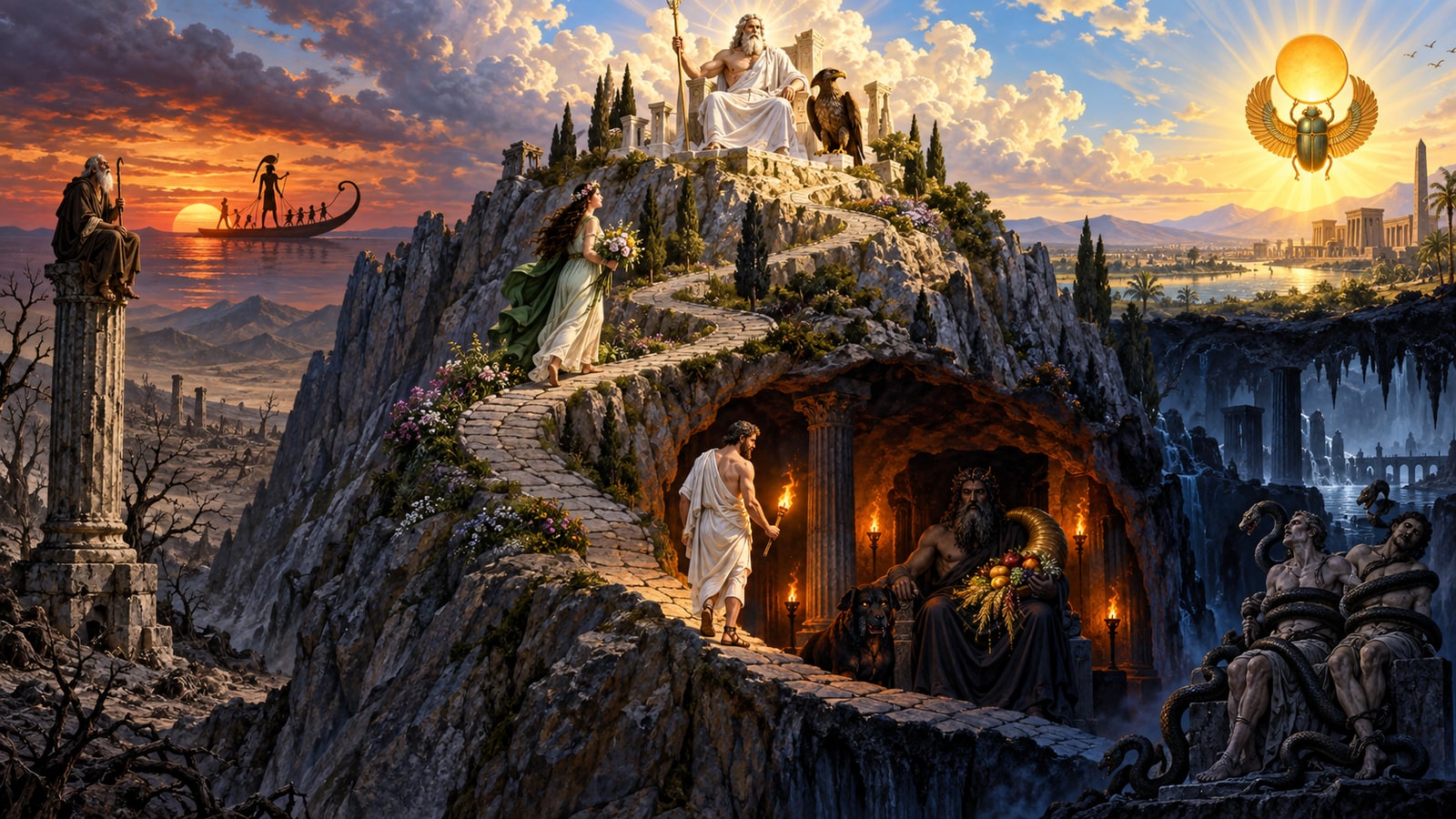
Egypt placed this Power at the center of the cosmos. Every evening Ra descends into the western horizon and sails through the Duat, the underworld, for the 12 hours of the night. The Amduat, "What Is in the Underworld," maps the journey hour by hour. At the 6th hour, the deepest point of the night, the soul of the sun God unites with his body in the form of Osiris: Ra and Osiris, neheh and djet, joined in the dark. At the 7th hour Apep rises and drinks the waters to strand the barque, and the magic of Isis and the Eldest Magician overcomes him while Selket binds him. At the 12th hour Ra is reborn as Khepri, the scarab, and rises into the east.
Egypt drew the lesson every Egyptian hoped to live: the descent is the condition of rebirth. Ra doesn't rise renewed without going down, and the deepest hour of darkness is the hour of union.
IV. Ascent and Descent Under Ma'at
Under Ma'at, descent explores the dark and ascent carries back what was learned. The road is one, and it's walked in both directions with purpose and measure.
- Descent for knowledge. Odysseus sails to the edge of the world and calls up the dead to learn from Teiresias the way home (Odyssey XI). At Lebadeia the consultant descends into the oracle of Trophonius and comes up remembering what he saw, which is Power VIII.
- The mountain. The summit is half the climb. On Everest, of 94 deaths above 8,000 m between 1921 and 2006, 56% came during the descent from the summit, 73% in all while going down, and only 10% on the way up (Firth and colleagues, BMJ, 2008). An ascent without a planned descent kills.
- The dive. Divers breathe gas under pressure, and nitrogen dissolves into their tissues. Rise too fast and it comes out of solution as bubbles: decompression sickness. The ascent needs its measure as much as the descent.
- The teacher. A master goes down to the student's level to raise him. The master who refuses to descend teaches no one.
- Sleep. Each night you descend into deep sleep and rise again, cycle after cycle, and each morning you wake restored.
The circle of the series closes here. Descent is walking into darkness carrying light. Ascent is coming back with the darkness explored, turned into Light: knowledge and wisdom.
V. Ascent and Descent Under Izfet
The first face: ascent alone. Ascent refuses to return and turns into flight from the world. It despises the body, the cosmos and the Gods who govern it, and calls that contempt holiness. Plotinus wrote a whole treatise against the men who taught this:
Plotinus, Enneads II.9.16 (text of Henry and Schwyzer)
«Οὐδ’ αὖ τὸ καταφρονῆσαι κόσμου καὶ θεῶν τῶν ἐν αὐτῷ καὶ τῶν ἄλλων καλῶν ἀγαθόν ἐστι γενέσθαι.»
"Nor again is despising the cosmos, the Gods in it and the other beautiful things the way to become good."
The later cult of contempt for the world, the hermit on his pillar turned away from a withering land, the leader who never goes down to the floor, the climber with summit fever and the diver who shoots for the surface: all share this face.
The second face: descent alone. Descent refuses to rise and sinks. Theseus and Pirithous went down into Hades, and Hades invited them to sit on the throne of Lethe; "they grew fast to it and were held by the coils of serpents" (Apollodorus, Epitome 1.24). Despair that only deepens, addiction's spiral, the fascination with the abyss for its own sake, the cynic who goes into the dark to wallow and learns nothing there: all share this face. Apep is the dark that wants the barque to stay down forever.
The Power at a Glance
| Domain | Under Ma'at | Izfet: Ascent Alone (Flight) | Izfet: Descent Alone (Sinking) |
|---|---|---|---|
| Sun | Sets in the west, rises as Khepri | A day with no night: no renewal | A night with no dawn: Apep wins |
| Philosopher | Out of the cave, then back to serve | The sage who despises the city | The prisoner who never turns |
| Myth | Persephone: a third below, 2 above | Contempt for the earth and its Gods | Theseus on the throne of Lethe |
| Mountain | Summit and safe return | Summit fever, no plan to descend | The fall |
| Soul | ὁμοίωσις θεῷ with service | Contempt of the world | Despair and the abyss |
VI. The Argument
| Step | Statement | Witness |
|---|---|---|
| Observation | Every real path goes down and up: the seed, the sun, the student, the soul. | Heraclitus B60 |
| First test | Ascent without descent flees the world and despises it; it never returns to serve and never learns what the dark holds. | Plotinus II.9.16 |
| Second test | Descent without ascent sinks and stays: the throne of Lethe. | Apollodorus, Epitome 1.24 |
| Third test | Descend to learn and rise to bring it back, and knowledge, harvest and rebirth appear. | Republic VII, 520c; Hymn to Demeter 445-447; the Amduat |
| Conclusion | Neither ascent nor descent is evil. Evil is the flight that never returns or the fall that never rises. Zeus reigns above and below, and the road is one. | Iliad IX.457; Phaedrus 246e |
Objections Answered
- "The spiritual path is ascent only. The world is a prison to escape." Plotinus, the greatest of the ascending philosophers, wrote a treatise against exactly that claim. Plato sends his philosopher back down into the cave. And the "flight" of the Theaetetus is defined as becoming just and holy with wisdom, which is virtue practised in the world.
- "Descending into the dark corrupts." Unexplored darkness isn't evil; that was the first lesson of the series. Descent with light and measure is how every great knowledge was won: Odysseus among the dead, the consultant at Trophonius, Ra in the Duat.
- "If up and down are one road, direction doesn't matter." The road is one; the walker still chooses his direction, his pace and his purpose. Heraclitus unites the road, and Ma'at governs the walking.
VII. The Premise and Purpose in Zevism
ὁμοίωσις θεῷ κατὰ τὸ δυνατόν, becoming as the Gods, as far as possible, is the ascent (Theaetetus 176b), and Zevism is the completed path to it. Its 4 dimensions are the stations of the climb. Yet the ascent the Temple teaches always returns. Zeus is Olympian and Chthonian at once, and the one who becomes like him rules both heights and depths.
The Temple's own mission is this Power. The Temple goes down into the cultural ruins, the darkness where the source was buried, and brings the source back up into the light, restored. The High Priest descends to teach, the student rises to learn, and in time the student descends to teach in turn.
| Dimension of the Zevist Path | What Ascent and Descent Train |
|---|---|
| Meditation (δυνατόν, capacity of power) | Descent inward into the depths of the mind, then ascent toward the Gods: "waking up out of the body into myself" (Plotinus IV.8.1). |
| Ethics (Φρόνησις and Justice) | Justice requires the return: "each in turn must go down" (Republic 520c). |
| Existential (a life in service of ὁμοίωσις θεῷ) | Rank rises and service descends. The higher you climb, the further down your service reaches. |
| Theurgy (Σοφία, Θεουργία) | Zeus drives first on the road of the Gods (Phaedrus 246e). The theurgist follows him up and returns bearing what he's received. |
The Ethic of Ascent and Descent
- Go down with a torch. Enter every dark place, a failure, a hard subject, a wounded community, carrying light and a purpose. Come back with knowledge.
- Plan the descent before the summit. Before every ambition, decide how you'll come back down: from power, from success, from a peak of effort. Most falls happen on the way down.
- Return to serve. Whatever you learn on the heights, bring it back to your family, your brothers and your Temple.
- Rise at the right speed. Growth that outruns its foundation breaks. Ascend in measure, and let each stage settle.
- Never sit on the throne of Lethe. When you go into the dark, don't settle there. Keep moving toward the dawn.
- Keep climbing. The aim remains ὁμοίωσις θεῷ. Every descent serves the next ascent.
VIII. Correlation: The Ten Antithetical Powers Completed
Ascent and Descent completes the Ethics row and the whole tetractys: 1, 2, 3 and 4, which make 10. Each Power obeys the law of the first, and each has its place on the road.
| Power | Pair | Under Ma'at | Under Izfet |
|---|---|---|---|
| I | Light and Darkness | Explored darkness becomes Light; death, life and rebirth in health | Destruction and illness; the fall into chaos |
| II | Limit and Unlimited | The shore and the sea | The mold, or the flood |
| III | The One and the Many | One Sovereign, a living Pantheon | The jealous One, or the heap |
| IV | Love and Strife | Harmonia; the good Strife | Smothering fusion, or murder |
| V | Fire and Water | ἰσονομία: health, steel and rain | Conflagration, or deluge |
| VI | Time and Eternity | The moving image of eternity; the Horai | Kronos devouring, or the frozen hall |
| VII | Necessity and Freedom | Mind persuading necessity; Zeus Moiragetes | The andrapod's fatalism, or the ὕβρις of Xerxes |
| VIII | Memory and Forgetting | Lethe in measure, then Mnemosyne | Grievance, or amnesia of the source |
| IX | Pleasure and Pain | Learning through suffering; pleasure as crown | The life of cattle, or the owned wound |
| X | Ascent and Descent | The descent that learns, the ascent that returns | Flight from the world, or the throne of Lethe |
Over all 10 stands one Sovereign. Zeus holds every pair in measure, and Ma'at is the name of that measure. Walk the road down with light, and walk it up with what the dark has taught you.
Plato, Phaedrus 246e
«ὁ μὲν δὴ μέγας ἡγεμὼν ἐν οὐρανῷ Ζεύς, ἐλαύνων πτηνὸν ἅρμα, πρῶτος πορεύεται, διακοσμῶν πάντα καὶ ἐπιμελούμενος.»
"Zeus, the great leader in heaven, driving a winged chariot, goes first, ordering all things and caring for them."
He goes first. Follow him up the road, and when the road turns down, carry his light into the dark.
ZEFS AENAOS.
High Priest Zevios Metathronos
Temple of Zeus Foundation