 አማርኛ
አማርኛ العربية
 বাংলা
বাংলা Български
 中文
中文 Čeština
 Dansk
Dansk Deutsch
 Eesti
Eesti Ελληνικά
 Español
 Français
 हिन्दी
 Hrvatski
 IsiZulu
 Italiano
 日本語
日本語 Kiswahili
 Magyar
 Македонски
 नेपाली
 Nederlands
 فارسی
فارسی Polski
 Português
 Română
 Русский
 Slovenščina
 Suomi
Suomi Svenska
 Tagalog
 Türkçe
Existence, Cosmology and Ethics · The Ten Antithetical Powers · Power IV
Love and Strife
Φιλότης καὶ Νεῖκος
author: High Priest Zevios Metathronos
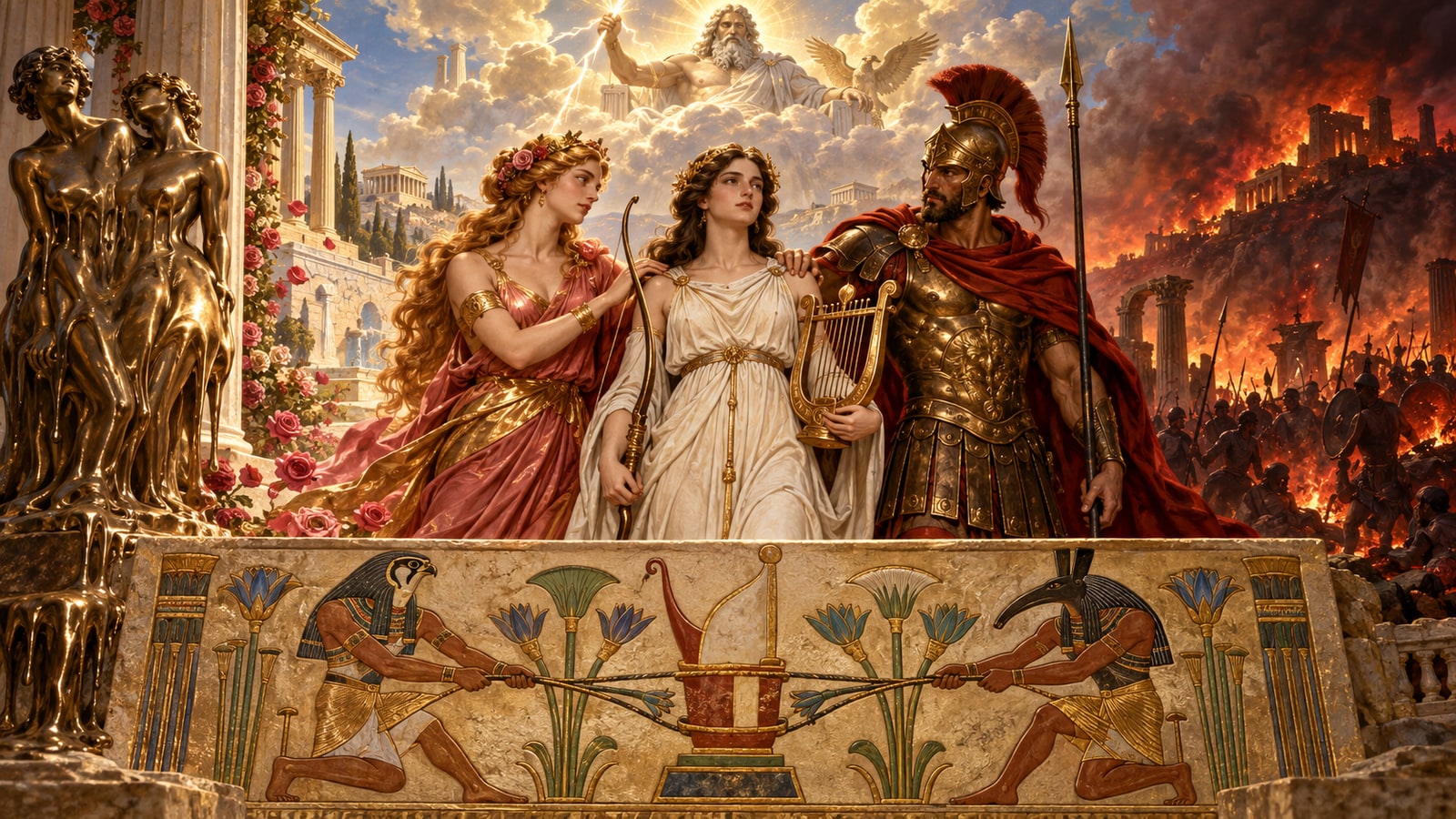
To the family of Zevists. A working teaching, grounded in Empedocles and Heraclitus, in Hesiod's 2 Strifes and the birth of Harmonia, in Cleanthes' Hymn to Zeus and the truce of Olympia, and in the Egyptian witness of Horus and Set, who bind the Two Lands together, and of Set, who spears Apep at the prow of Ra's barque and who murders Osiris. This is the fourth of the Ten Antithetical Powers, the first of the Powers of Cosmology, and it follows Light and Darkness. It sets out 3 things: that the cosmos is built by 2 forces, one that gathers and one that divides, and neither is evil; that under Ma'at Love binds while Strife distinguishes and defends, as Zeus set the good Strife in the roots of the earth, while under Izfet Love becomes smothering fusion and Strife becomes murder; and that the Zevist who masters this Power turns envy into emulation and conflict into ascent.
I. Opening: The Fourth Power
Light and Darkness opened this series and laid down its law. Every Power is a pair, and neither member is evil. Bound by Ma'at, the structured Order of Cosmic Existence that Zeus holds as Sovereign of the Cosmos, the pair works in harmony and builds life. Bound by Izfet, the same pair turns destructive, and existence falls back toward unstructured chaos. Izfet breaks a pair in 2 ways: one member seizes sole rule, or the pair is torn apart.
Powers II and III gave existence its principles: content and boundary, the One and the Many. Power IV sets them moving. Something has to pull things together, and something has to hold them apart. Empedocles named these 2 forces Love and Strife, and every star, body, family and city since has been built between them.
II. The Ancient Witnesses
Empedocles of Akragas states the law of the moving cosmos:
Empedocles, DK 31 B17.7-8
«ἄλλοτε μὲν Φιλότητι συνερχόμεν’ εἰς ἓν ἅπαντα, / ἄλλοτε δ’ αὖ δίχ’ ἕκαστα φορεύμενα Νείκεος ἔχθει.»
"At one time all things come together into one by Love; at another, each is carried apart again by the hatred of Strife."
He then gives the 2 forces their measure:
Empedocles, DK 31 B17.19-20
«Νεῖκός τ’ οὐλόμενον δίχα τῶν, ἀτάλαντον ἁπάντῃ, / καὶ Φιλότης ἐν τοῖσιν, ἴση μῆκός τε πλάτος τε.»
"And accursed Strife apart from them, equal in weight everywhere, and Love among them, equal in length and breadth."
ἀτάλαντον, "equal in weight," and ἴση, "equal." Empedocles set the 2 forces on a balance. His cosmos swings between total gathering and total separation, and the world of plants, animals and men comes to life in the ages when both forces work at once.
Heraclitus goes further and calls Strife a father and a king:
Heraclitus, DK 22 B53
«Πόλεμος πάντων μὲν πατήρ ἐστι, πάντων δὲ βασιλεύς.»
"War is father of all and king of all."
He adds that war "has shown some to be Gods and others men." Contest reveals worth. Then he binds Strife to Justice itself: "one must know that war is common, and justice is strife, δίκην ἔριν, and all things come to be through strife and necessity" (DK 22 B80). A lawcourt is a strife. A trial is a strife. The verdict comes out of the contest.
And he shows the 2 forces working in a single object:
Heraclitus, DK 22 B51
«οὐ ξυνιᾶσιν ὅκως διαφερόμενον ἑωυτῷ ὁμολογέει· παλίντροπος ἁρμονίη ὅκωσπερ τόξου καὶ λύρης.»
"They don't understand how, being at variance, it agrees with itself: a harmony turning back on itself, as of the bow and the lyre."
A bow is a frame and a string pulling against each other. Slacken the tension and it can't shoot. A lyre is the same: no tension, no note. Harmony is the tension held in measure.
Hesiod saw that Strife herself has 2 natures, and he tells who set the good one in place:
Hesiod, Works and Days 11-12, 17-19
«Οὐκ ἄρα μοῦνον ἔην Ἐρίδων γένος, ἀλλ’ ἐπὶ γαῖαν / εἰσὶ δύω. ... τὴν δ’ ἑτέρην προτέρην μὲν ἐγείνατο Νὺξ ἐρεβεννή, / θῆκε δέ μιν Κρονίδης ὑψίζυγος, αἰθέρι ναίων, / γαίης τ’ ἐν ῥίζῃσι, καὶ ἀνδράσι πολλὸν ἀμείνω.»
"So there was never just one breed of Strife; on the earth there are 2. ... The other, the elder, dark Night bore, and the high-throned son of Kronos, who dwells in the aether, set her in the roots of the earth, far better for men."
The good Strife stirs the idle man to work when he sees his neighbour prosper, and "potter bears a grudge against potter, and carpenter against carpenter, beggar envies beggar and singer singer" (Works and Days 25-26). That's competition, and Zeus planted it in the roots of the earth.
Hesiod also gives the genealogy that completes the doctrine. Aphrodite lay with Ares, and she bore Phobos and Deimos, and "Harmonia, whom high-hearted Kadmos made his wife" (Theogony 933-937). Harmony is the daughter of Love and War.
III. The Egyptian Witness: Horus and Set
Egypt put the same truth on the thrones of her kings. On the seated statues of Senusret I from Lisht, Horus and Set, the 2 great rivals of Egyptian myth, pull together on the cords that tie the papyrus of the North and the lotus of the South around the sign sema, "union." The enemies bind the Two Lands. Their rivalry, held under Ma'at, becomes the unity of Egypt.
Set shows the whole doctrine of this series in one God. Under Ma'at, Set stands at the prow of Ra's barque and faces Apep, the serpent of chaos who tries each night to swallow the sun:
Book of the Dead, Spell 108 (translation after R. O. Faulkner)
"Seth will project a lance of iron against him and will make him vomit up all that he has swallowed."
In the Contendings of Horus and Seth, Set declares: "I slay the enemy of Pre every day, standing in the prow of the Bark-of-Millions, and no other god can do it" (after Lichtheim).
Under Izfet, the same Set murders his brother. Plutarch records the Egyptian story: Set gathered 72 conspirators, built a chest to the exact measure of Osiris's body, shut him inside and threw it into the Nile (On Isis and Osiris 13). Same God, same strength, same weapon-arm. At the prow he guards the sun. Turned against his own blood he tears the kingdom apart.
IV. Love and Strife Under Ma'at
Under Ma'at, Love binds and Strife distinguishes and defends. Each keeps the other honest.
- The star. Gravity gathers a star inward; the pressure of fusion at its core pushes outward. Held in balance, the Sun has shone for about 4.6 billion years. When the fuel runs out, the balance breaks: the core collapses under its own gathering, and the outer layers are blown into space.
- The immune system. Tolerance spares the body's own cells; attack destroys invaders. With both in measure, you live. Tolerance without attack lets infection and tumours through. Attack without tolerance turns on the body itself as autoimmune disease.
- Olympia. The festival of Zeus was Strife under Love. Before the games the Eleans proclaimed the ἐκεχειρία, the sacred truce, recorded on the discus of Iphitus (Pausanias V.20.1). Greeks who were at war with each other laid down their arms, came to Zeus's sanctuary and fought each other on the track. When Sparta broke the truce in 420 BC, the Eleans barred her from the sanctuary and the contest (Thucydides V.49).
- Trade and craft. Potter against potter. Rivalry drives every craftsman to better work, and the whole city eats better bread and drinks from better cups.
- Marriage and friendship. A bond strong enough to hold, and honesty sharp enough to correct. A friend who never disagrees with you is a mirror.
The pattern of the first Power repeats. Strife is the darkness most people fear. Explored and bound, it shows what things are: "war has shown some to be Gods and others men." The contest turns unknown worth into known excellence, the way explored darkness turns into Light.
V. Love and Strife Under Izfet
The first face: Love alone. Love swallows difference and becomes fusion. Hesiod warns that Eros, "loosener of limbs, overpowers the mind and wise counsel in the breasts of all Gods and all men" (Theogony 120-122). The couple where neither partner remains a person, the crowd that forbids any disagreement, the cartel that fuses rivals to kill competition, the body that tolerates the tumour: this is Love with no Strife to keep it honest. It smothers.
The second face: Strife alone. Strife breaks loose from Love and becomes murder. Set at the chest of Osiris. Civil war, where a city turns its spear inward. Autoimmune disease, where the body attacks itself. And in the soul, the bad Strife that Hesiod says "fosters evil war and battle" (Works and Days 14): envy that tears down what it can't build. This is the Strife of the andrapod, the one who complains, attacks, negates and deflects, who fights everything and builds nothing, as Private Essay No. 5 sets out. The good Strife says "I'll build a better one." The bad Strife says "I'll break yours."
The Power at a Glance
| Domain | Under Ma'at | Izfet: Love Alone (Fusion) | Izfet: Strife Alone (Murder) |
|---|---|---|---|
| Star | Gravity and fusion pressure in balance | The core collapses | The star is blown apart |
| Egypt | Horus and Set bind the Two Lands; Set spears Apep | Rivals dissolved, no one at the prow | Set murders Osiris |
| Body | Tolerance and defence | Infection and tumour pass unchallenged | Autoimmune disease |
| Games | The contest under Zeus's truce | A contest no one may win | The truce broken, the sanctuary closed |
| Trade | Potter against potter | The cartel | Fraud and sabotage |
| Soul | Love of the Good, war on Izfet | Sentimentality that tolerates anything | Envy and resentment: the andrapod |
VI. The Argument
| Step | Statement | Witness |
|---|---|---|
| Observation | Everything that exists is held together by something that gathers and kept distinct by something that divides: stars, bodies, families, cities. | Empedocles B17.7-8 |
| First test | Remove Strife and everything fuses into one undifferentiated mass: no stars, no species, no persons. | Theogony 120-122 |
| Second test | Remove Love and everything flies apart: no body, no family, no city. | Book of the Dead 108; Plutarch, On Isis 13 |
| Third test | Give each force its measure, "equal in weight," and harmony is born: the bow shoots, the lyre sounds, the star shines. | B17.19-20; B51; Theogony 933-937 |
| Conclusion | Neither Love nor Strife is evil. Evil is the fusion that smothers or the strife that murders. Zeus set the good Strife in the roots of the earth and holds both in measure. | Works and Days 17-19 |
Objections Answered
- "Love is always good, and conflict is always evil." A love that forbids difference smothers the beloved. Hesiod counts 2 Strifes and calls one of them "far better for men." The surgeon's knife, the athlete's rival and the teacher's red ink are all strife, and all of them serve life. Take conflict out of the world and you take out excellence with it.
- "Strife is simply nature. The strong destroy the weak." Heraclitus binds strife to justice: δίκην ἔριν. Strife that serves the order is judged by the order. Egypt's myth doesn't end with the murder of Osiris. Horus avenges his father, the tribunal of the Gods rules in his favour, and Ra takes Set up to dwell beside him and thunder in the sky. Strife that seeks only destruction is Set at the chest, and it loses before the Gods.
- "Then why not end strife completely and live in peace?" Empedocles answers from his own cosmos: living things arise only in the ages when both forces work at once. Olympia answers from history: the truce existed so that the contest could happen. Peace in Ma'at is Strife held in measure. A world with Strife removed would hold no persons at all.
VII. The Premise and Purpose in Zevism
Zevism's aim is ὁμοίωσις θεῷ κατὰ τὸ δυνατόν, becoming as the Gods, as far as possible (Theaetetus 176b). Both forces drive that ascent. Love is the engine: in the Symposium, Diotima describes Eros as the power that carries the soul up, step by step, from one beautiful body to beautiful souls, laws and knowledge, and finally to Beauty itself (Symposium 210a-212a). Strife is the discipline: the Greeks called the athlete's struggle an ἀγών, and the Zevist's life is an ἀγών under Zeus's truce.
The Temple has settled the old conflict of the ruins. The Creator replaces the slave-minded victim, and the good Strife replaces the bad: emulation of the Gods and the great instead of envy of them. That's this Power under Ma'at, lived as a path.
| Dimension of the Zevist Path | What Love and Strife Train |
|---|---|
| Meditation (δυνατόν, capacity of power) | The bow and the lyre. Attention held taut and relaxed at once, the tension that gives the mind its range. |
| Ethics (Φρόνησις and Justice) | Justice is strife (B80): contest, judgment and correction. Φρόνησις knows when to bind and when to divide. |
| Existential (a life in service of ὁμοίωσις θεῷ) | Love for the Gods, the Temple and the brotherhood; war on Izfet wherever it appears in the world. |
| Theurgy (Σοφία, Θεουργία) | Eros is the ladder of ascent (Symposium 210a-212a). The inner war of the soul settles into Harmonia, and a harmonized soul can meet the Gods. |
The Ethic of Love and Strife
- Turn envy into emulation. When someone surpasses you, you face Hesiod's 2 Strifes. One says tear him down. The other says outwork him. Choose the Strife Zeus planted in the roots of the earth.
- Love without fusing. Bind yourself to your family, your brothers and your Temple, and remain a person inside the bond. Love that keeps both people whole is Aphrodite's gift; love that dissolves them is Eros with Strife cut away.
- Fight without murdering. Compete hard, argue hard, correct hard, and keep the bond intact. The Olympic runner races his rival and goes home alive and honoured.
- Keep a rival. Find someone whose excellence stings you, and let it sting. A man with no rival slackens like an unstrung bow.
- Stand at the prow. Direct your fiercest strength outward, against Apep: against chaos, lies and dissolution. That's where Set earns his place beside Ra, and where your own strife earns its place beside the Gods.
VIII. Correlation and Closing
Love and Strife opens the third row of the tetractys, the Powers of Cosmology, beside Fire and Water and Time and Eternity. Love gathers "into one" and Strife carries "apart, each by itself," so this Power sets Power III in motion. Empedocles taught that Love and Strife move the 4 roots, fire, water, earth and air, which leads straight into Power V. And Apep returns in Power X, where Ra descends through the night and Set stands ready.
| Power | Pair | Row of the Tetractys |
|---|---|---|
| I | Light and Darkness | Apex |
| II | Limit and Unlimited | Existence |
| III | The One and the Many | Existence |
| IV | Love and Strife | Cosmology |
| V | Fire and Water | Cosmology |
| VI | Time and Eternity | Cosmology |
| VII | Necessity and Freedom | Ethics |
| VIII | Memory and Forgetting | Ethics |
| IX | Pleasure and Pain | Ethics |
| X | Ascent and Descent | Ethics |
Cleanthes, Hymn to Zeus 18-19
«ἀλλὰ σὺ καὶ τὰ περισσὰ ἐπίστασαι ἄρτια θεῖναι, / καὶ κοσμεῖν τἄκοσμα, καὶ οὐ φίλα σοὶ φίλα ἐστίν.»
"But you know how to make the odd even and to order the disordered, and what is unloved is dear to you."
Zeus binds what fights and orders what rages. Love what deserves love, fight what deserves a fight, and let Harmonia be born in you from both.
ZEFS AENAOS.
High Priest Zevios Metathronos
Temple of Zeus Foundation