 አማርኛ
አማርኛ العربية
 বাংলা
বাংলা Български
 中文
中文 Čeština
 Dansk
Dansk Deutsch
 Eesti
Eesti Ελληνικά
 Español
 Français
 हिन्दी
 Hrvatski
 IsiZulu
 Italiano
 日本語
日本語 Kiswahili
 Magyar
 Македонски
 नेपाली
 Nederlands
 فارسی
فارسی Polski
 Português
 Română
 Русский
 Slovenščina
 Suomi
Suomi Svenska
 Tagalog
 Türkçe
Existence, Cosmology and Ethics · The Ten Antithetical Powers · Power III
The One and the Many
Ἓν καὶ Πλῆθος
author: High Priest Zevios Metathronos
To the family of Zevists. A working teaching, grounded in Heraclitus, the Orphic hymn to Zeus, Homer's golden chain, Aratus, Aristotle's Metaphysics, Plato's Republic and Proclus, and in the Egyptian witness of Amun, "the One who made himself into millions," and of the ruin that followed Akhenaten. This is the third of the Ten Antithetical Powers, and it follows Light and Darkness and Limit and Unlimited. It sets out 3 things: that everything that exists is one and many at once, and neither is evil; that under Ma'at the One unfolds into the Many and the Many share in the One, as the Gods share in the sovereignty of Zeus, while under Izfet a jealous One erases the Many or the Many fall apart into a heap; and that Zevism, the chain of all spirituality from its beginning, is this Power lived.
I. Opening: The Third Power
Light and Darkness opened this series and laid down its law. Every Power is a pair, and neither member is evil. Bound by Ma'at, the structured Order of Cosmic Existence that Zeus holds as Sovereign of the Cosmos, the pair works in harmony and builds life. Bound by Izfet, the same pair turns destructive, and existence falls back toward unstructured chaos. Izfet breaks a pair in 2 ways: one member seizes sole rule, or the pair is torn apart.
Power II gave every existing thing a content and a boundary. Power III asks the next question: how many things are there, and how do they hang together? The Pythagoreans set ἕν and πλῆθος third on their table of 10 opposites (Aristotle, Metaphysics A.5, 986a22-26). Every Zevist lives inside the answer, because every Zevist worships one Sovereign at the head of many Gods.
II. The Ancient Witnesses
Heraclitus, the father of the Logos, states the whole Power in a single line:
Heraclitus, DK 22 B10 ([Aristotle], On the Cosmos 5, 396b; manuscript reading, as in Kirk and Marcovich)
«συλλάψιες· ὅλα καὶ οὐχ ὅλα, συμφερόμενον διαφερόμενον, συνᾷδον διᾷδον, καὶ ἐκ πάντων ἓν καὶ ἐξ ἑνὸς πάντα.»
"Things taken together: wholes and not wholes, converging and diverging, singing together and singing apart; out of all things one, and out of one all things."
Both directions run at once. The Many gather into the One, and the One unfolds into the Many. Heraclitus says who sees this: "listening not to me but to the Logos, it is wise to agree that all things are one" (DK 22 B50).
The Orphic theologians put a name on the One:
Orphic verse in [Aristotle], On the Cosmos 7, 401a
«Ζεὺς κεφαλή, Ζεὺς μέσσα· Διὸς δ’ ἐκ πάντα τέτυκται.»
"Zeus the head, Zeus the middle; from Zeus all things are made."
Plato echoes the same verse when he says the God holds "the beginning, the end and the middle of all things" (Laws IV, 715e).
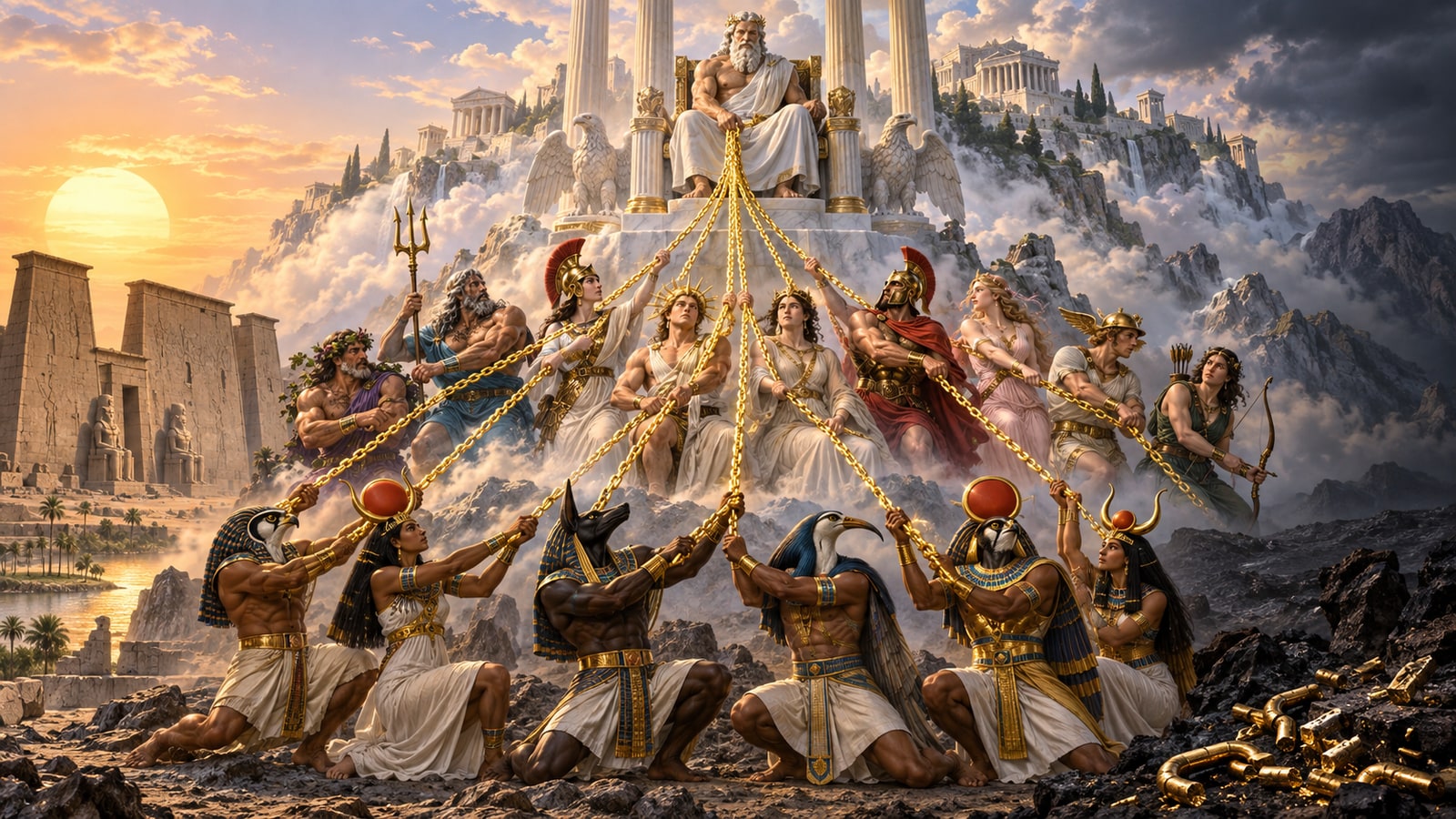
Homer shows how that One rules. In the Iliad, Zeus dares the whole Pantheon to a contest:
Homer, Iliad VIII.19-22
«σειρὴν χρυσείην ἐξ οὐρανόθεν κρεμάσαντες / πάντές τ’ ἐξάπτεσθε θεοὶ πᾶσαί τε θέαιναι· / ἀλλ’ οὐκ ἂν ἐρύσαιτ’ ἐξ οὐρανόθεν πεδίον δὲ / Ζῆν’ ὕπατον μήστωρ’, οὐδ’ εἰ μάλα πολλὰ κάμοιτε.»
"Hang a golden chain from heaven and lay hold of it, all you Gods and all you Goddesses; yet you could not drag Zeus, highest counsellor, from heaven to the plain, not even if you toiled very hard."
Look at what the image keeps. Every God on the chain is real and pulls with real strength. The One takes nothing away from the Many; he outweighs them. Later Platonists read this σειρά as the chain of being itself, running from the Gods down to the least of things.
Aristotle ends his whole theology in Metaphysics Λ with the same verdict, taken from Homer:
Aristotle, Metaphysics Λ.10, 1076a3-4 (quoting Iliad II.204)
«τὰ δὲ ὄντα οὐ βούλεται πολιτεύεσθαι κακῶς. οὐκ ἀγαθὸν πολυκοιρανίη· εἷς κοίρανος ἔστω.»
"But the things that are don't wish to be governed badly: 'The rule of many is not good; let there be one ruler.'"
Homer's next line names that ruler as the one "to whom the son of crooked-counselled Kronos gave" the sceptre (Iliad II.205). The One is the Sovereign whom Zeus appoints, and at the top of all things, Zeus himself.
Aratus shows the One filling the Many without crowding them out:
Aratus, Phaenomena 1-5
«ἐκ Διὸς ἀρχώμεσθα, τὸν οὐδέποτ’ ἄνδρες ἐῶμεν / ἄρρητον· μεσταὶ δὲ Διὸς πᾶσαι μὲν ἀγυιαί, / πᾶσαι δ’ ἀνθρώπων ἀγοραί, μεστὴ δὲ θάλασσα / καὶ λιμένες· πάντη δὲ Διὸς κεχρήμεθα πάντες. / τοῦ γὰρ καὶ γένος εἰμέν.»
"From Zeus let us begin, whom we men never leave unspoken. Full of Zeus are all the streets and all the gathering places of men, full is the sea and the harbours; everywhere all of us need Zeus. For we are also his offspring."
Paul lifted that last line for his sermon at Athens (Acts 17:28). The source was Greek, and it came first.
Proclus gives the principle its exact philosophical form:
Proclus, Elements of Theology, Proposition 1
«Πᾶν πλῆθος μετέχει πῃ τοῦ ἑνός.»
"Every multiplicity participates in some way in the One."
The small word πῃ, "in some way," carries the doctrine. Each member of the Many keeps its own being and shares in the One after its own manner.
III. The Egyptian Witness: Amun of the Millions
Egypt worked on this Power longer than any other people. The standard study of Egyptian theology, by Erik Hornung, carries this Power as its title: Der Eine und die Vielen (1971), in English Conceptions of God in Ancient Egypt: The One and the Many (1982).
Ramesside theology called Amun the One who made himself into millions, the formula Jan Assmann names "one and millions." The great Leiden Hymn puts the One and the Many into a single stanza:
Papyrus Leiden I 350, Chapter 300 (after Erman and Blackman)
"All gods are 3: Amun, Re and Ptah, whom none equals. Hidden is his name as Amun, he is Re in face, and his body is Ptah."
One hidden God, known through many faces, with every face fully divine. Under Ma'at, Egypt kept thousands of temples, each with its own God and its own rites, and held them all inside one order.
Then a king broke it. Akhenaten closed the temples of the many Gods, had the name of Amun hacked from the walls, and imposed the sole worship of the Aten. His successor Tutankhamun recorded what followed:
Restoration Stela of Tutankhamun, Karnak (translation after M.-J. Nederhof)
"The temples of the gods and goddesses, from Elephantine to the lagoons of the Delta, had fallen into ruin. ... The land was in distress, the gods were turning away from this land. If an army was sent to Djahy to widen the borders of Egypt, no success of theirs came about at all. If one prayed to a god to ask a thing of him, he would not come."
Egypt's own verdict: the jealous One brought ruin. The restorers reopened the temples, abandoned Akhenaten's city, and later king lists left his name out.
IV. The One and the Many Under Ma'at
Under Ma'at, the One unfolds into the Many, and the Many share in the One. Nothing is erased, and nothing floats loose.
Heaven gives the model. In the Phaedrus, Zeus drives first, ordering all things, and the army of Gods and daimons follows him in 11 companies, each God leading his own (Phaedrus 246e-247a). Hesiod tells how the order began: after the victory over the Titans, the Gods urged Zeus to reign, and he divided the honours among them (Theogony 881-885). The One gives the Many their offices, and each office is real.
- The living body. About 37 trillion cells, hundreds of cell types, one life. Each cell does its own work; the organism holds them together.
- The orchestra. Many instruments and one score. Every player keeps his own voice, and the music exists only because they share one order.
- Hellas. Hundreds of independent cities, many dialects, one sanctuary of Zeus at Olympia where all Greeks met and competed. Herodotus has the Athenians define Greekness as shared blood and language, the shared shrines and rites of the Gods, and customs of the same kind (Herodotus VIII.144).
- The alphabet. 24 letters, countless words, one language.
- The Temple. One Office at the head and many ranks below, each with its own duties. The ranks keep their dignity because the Office holds them in order.
The pattern of the first Power repeats. The Many, unexplored, look like chaos, the way unexplored darkness looks like emptiness. Explored with the light of the Logos, they show the One running through them, and chaos turns into cosmos.
V. The One and the Many Under Izfet
The first face: the One alone. The One turns jealous and tries to reign over an emptied world. Akhenaten is its Egyptian trial run. The Yehuborist code states its creed:
Exodus 20:3, 5 (Septuagint)
«Οὐκ ἔσονταί σοι θεοὶ ἕτεροι πλὴν ἐμοῦ. ... ἐγὼ γάρ εἰμι κύριος ὁ θεός σου, θεὸς ζηλωτής.»
"There shall be no other gods for you besides me. ... For I am the Lord your God, a jealous God."
Set it beside Homer's chain. Zeus invites every God to pull against him and loses nothing by their strength. The jealous One can't survive a second God, so he needs the others dead. Farming shows the same face: Ireland in the 1840s fed a nation on a single potato variety; one blight arrived, and famine followed.
The second face: the Many alone. The One is abandoned, and the Many fall into a heap. Aristotle draws the line: a true whole is one "not like a heap but like a syllable" (Metaphysics Z.17, 1041b11-12). Hellas showed this face in the Peloponnesian War, when the cities that met at Olympia spent 27 years destroying each other. The modern soul shows it in spirituality with no center: a pinch of every tradition, loyalty to none, and no source anywhere. The mind shows it in attention broken across countless feeds, with no self left to gather them.
Both faces end in Izfet. The jealous One empties the world, and the heap dissolves it.
The Power at a Glance
| Domain | Under Ma'at | Izfet: the One Alone | Izfet: the Many Alone |
|---|---|---|---|
| Heaven | Zeus and the living Pantheon | The jealous One: other Gods erased | Gods with no Sovereign: πολυκοιρανίη |
| Egypt | Amun, one and millions | Akhenaten: empty temples, Gods turned away | A land split among rival kings |
| Hellas | Many cities, one Olympia | An empire that flattens the cities | 27 years of war among brothers |
| Field | Many crops, one farm | Monoculture: one blight, famine | Weeds, no harvest |
| Mind | Many faculties, one self | Obsession: one idea devours the rest | Distraction: countless feeds, no self |
| Religion | Zevism: many roots, one chain | Exclusivism, θεὸς ζηλωτής | Pick-and-mix fragments with no source |
VI. The Argument
| Step | Statement | Witness |
|---|---|---|
| Observation | Everything that exists is one thing made of many: a body, a city, a word, the cosmos. | Heraclitus B10 |
| First test | Take away the One and the parts become a heap: no body, no city, no cosmos. | Metaphysics Z.17; Iliad II.204 |
| Second test | Take away the Many and the One has nothing to rule, gather or give life to: the empty temple, the blighted field. | Restoration Stela |
| Third test | Let the One hold the Many without erasing them, and life, order and beauty appear: the organism, Olympia, the Pantheon. | Iliad VIII.19-22; Phaedrus 246e-247a |
| Conclusion | Neither the One nor the Many is evil. Evil is the One that devours the Many, or the Many that abandon the One. Zeus holds the measure: one Sovereign over a living Pantheon. | Proclus, Elements 1 |
Objections Answered
- "True religion has one God only. Many Gods is primitive." Greece and Egypt held the One long before any exclusivist claimed it: Heraclitus's "out of all things one," the Orphic "Zeus the head, Zeus the middle," and Amun "one and millions" in Ramesside Egypt. They held the One and kept the Many alive. The exclusive One arrives as a later inversion, and its first Egyptian trial ended in the ruin the Restoration Stela records.
- "If Zeus rules, the other Gods are only his masks." Homer's chain answers this. Each God pulls with real strength, and each leads a real company in the Phaedrus. Proclus's πῃ, "in some way," keeps each God's own being inside the participation. The Many are real, the One is real, and Ma'at needs both.
- "Then let every man choose his own god. Plurality is freedom." A Pantheon with no Sovereign is the war of the Titans. Order came when Zeus won and distributed the honours. Plurality without the One is the heap, and a heap has no freedom in it, only drift.
VII. The Premise and Purpose in Zevism
Zevism is the chain of all spirituality from its beginning to today. It gathers the roots of the True Religion, Hellenic, Egyptian and the others, and it places Ancient Hellenism first for its depth and knowledge. It erases none of them. That's this Power under Ma'at: one chain, many roots, each kept in its place. The inversion that followed took the One and made it jealous.
The aim is ὁμοίωσις θεῷ κατὰ τὸ δυνατόν, becoming as the Gods, as far as possible (Theaetetus 176b). The soul begins as a crowd: appetites, spirit and reason pulling in different directions. Plato describes the just man as one who binds them together and becomes "one out of many," ἕνα γενόμενον ἐκ πολλῶν, "self-controlled and harmonized" (Republic IV, 443e). A soul made one can take part in the One. A crowd can't climb.
| Dimension of the Zevist Path | What the One and the Many Train |
|---|---|
| Meditation (δυνατόν, capacity of power) | Many thoughts, one attention. Meditation gathers the scattered mind to a single point, and its capacity multiplies. |
| Ethics (Φρόνησις and Justice) | Justice makes the soul "one out of many" (Republic 443e): every part doing its own work under the rule of reason. |
| Existential (a life in service of ὁμοίωσις θεῷ) | One aim, many works. Every task, every rank and every relationship is ordered toward the single goal. |
| Theurgy (Σοφία, Θεουργία) | Every multiplicity participates in the One (Proclus). The theurgist honours each God in his own chain and rises through them toward Zeus. |
The Ethic of the One and the Many
- Become one out of many. Set reason over the crowd inside you. Give appetite and ambition their work, and let none of them seize the throne. A divided man can't hold a single aim for a single year.
- Honour every God in his office. Worship Zeus as Sovereign, and give each God the honour Zeus distributed to him. The Pantheon is a living order, and the Zevist keeps it whole.
- Refuse the jealous One. Any system that demands you erase every other root, every other teacher and every other God before it will accept you has shown its nature. Measure it against the golden chain.
- Refuse the heap. Collecting fragments from every tradition without a source or a sovereign produces a pile. Stand at the source and let the Many take their place around it.
- Serve the chain. Your family, your Temple and your work are parts of a larger order. Serve your part fully, and you strengthen the whole that holds you.
VIII. Correlation and Closing
The One and the Many stands beside Limit and Unlimited in the second row of the tetractys, and the 2 together are the principles of Existence. This Power runs through the rest. In Power IV, Love gathers the elements "into one" and Strife carries them "apart, each by itself" (Empedocles B17.7-8). In Power VI, eternity "abides in one" while time moves "according to number" (Timaeus 37d). In Power X, the golden chain becomes the road of ascent.
| Power | Pair | Row of the Tetractys |
|---|---|---|
| I | Light and Darkness | Apex |
| II | Limit and Unlimited | Existence |
| III | The One and the Many | Existence |
| IV | Love and Strife | Cosmology |
| V | Fire and Water | Cosmology |
| VI | Time and Eternity | Cosmology |
| VII | Necessity and Freedom | Ethics |
| VIII | Memory and Forgetting | Ethics |
| IX | Pleasure and Pain | Ethics |
| X | Ascent and Descent | Ethics |
Heraclitus, DK 22 B10
«καὶ ἐκ πάντων ἓν καὶ ἐξ ἑνὸς πάντα.»
"Out of all things one, and out of one all things."
One Sovereign, many Gods, one order. Take your place on the golden chain, make your own soul one out of many, and climb.
ZEFS AENAOS.
High Priest Zevios Metathronos
Temple of Zeus Foundation