MAAT
author: High Priest Zevios Metathronos
co-author: Novice Priest Karnonnos
Hieratic Information about Maat
| Divine Names |
|---|
| Maat (Mꜣꜥt) | goddess and principle of truth, order, and justice. |
|---|
| Aletheia (Ἀλήθεια) | “Truth,” the Greek name of the judicial emblem. |
|---|
| Divine Symbols |
|---|
- The Ostrich Feather
- The Scales and Balance
- The Ankh
- Wings
|
| Divine Forces |
|---|
- Truth
- Justice and Law
- Cosmic Order
- Balance and Due Measure
- The Weighing of the Heart
|
| Important Titles |
|---|
- Maat, Daughter of Ra
- Maat, Lady of Heaven
- Maat, Lady of the Two Lands
- Maat the Great
- The Two Maats / Two Truths
- Maat, Mistress of the Gods
|
| Names Across Civilizations |
|---|
| Old Egyptian | Mꜣꜥt |
|---|
| Greek | Ἀλήθεια (Aletheia) |
|---|
I. Names
The Egyptian word and divine name Maat is usually transliterated Mꜣꜥt. It is at once an abstract noun and a goddess-name,
meaning truth, right order, justice, regularity, balance, and what is straight or correct. The spelling is built around the Egyptian root
mꜣꜥ, “true” or “right,” with the feminine ending -t; in hieroglyphic writing the name could be written with phonetic signs
and often with the feather sign, which became the goddess’ most famous emblem. Because the word is both a theological principle and a divine
name, it should not be reduced to one modern English word alone: “Truth” is central, but “cosmic order” and “justice” are also built into the
same semantic field.1, 2
The earliest secure use of mꜣꜥt belongs to the Old Kingdom. In the Pyramid Texts, especially the corpus of Unis from the end of the
Fifth Dynasty, maat already appears as a sacred power and moral-cosmic condition bound to the gods, kingship, and the proper order of
the afterlife. The fully anthropomorphic goddess with the famous feathered head is much more visible in later Egyptian art, but the name and
principle are already securely attested in the Old Kingdom textual record.2, 3
The Greek name used in a context describing Maat is Ἀλήθεια (Aletheia, sometimes written Aleitheia), “Truth.” The earliest
surviving Greek author to describe this Egyptian judicial emblem in an explicit context is Diodorus Siculus. In Library of History
1.75, he says that the chief judge wore around his neck a small image made of precious stones, called Ἀλήθεια, and that trials began
when the chief judge put on this image of Truth. Diodorus does not give the Egyptian word Mꜣꜥt directly, but the description
corresponds to the Egyptian emblem of Maat as Truth and Justice in judicial setting.4
Sources: Hannig, Großes Handwörterbuch Ägyptisch-Deutsch (1995); Allen, The Ancient Egyptian Pyramid Texts (2005); Assmann, Maât (1990); Diodorus Siculus, Library of History.1, 2, 3, 4
II. Maat
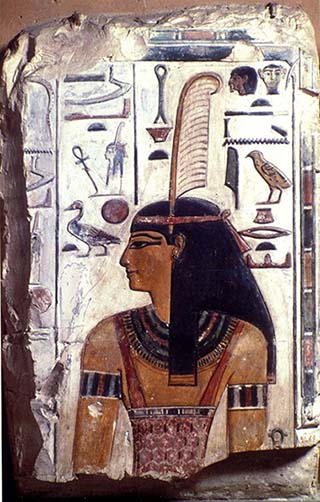
Maat is the Egyptian goddess of order, law, harmony, balance, and truth. She was also one of the most pivotal deities of the Egyptian
pantheon and had far-reaching symbolism, evoked in every high corner of the great civilization of the Nile. She was considered a
divine representative of the legal system as a whole, yet also the dispositor of the seasons, the movements of the stars, and other
aspects etched into nature itself. At the heart of Egyptian law was Maat, the multifaceted term encompassing justice, truth, order,
and balance. Maat was not merely an ethical ideal but a divine principle that ensured the functioning of the universe. Pharaohs were
said to "do Maat" and "live by Maat", offering shows of Maat also, and the goddess of personifying these acts appears in temple
reliefs, tomb inscriptions, and legal contexts as a living symbol of all endeavors that idea encompassed.5, 6
“[Maat] was the principle of right order by which the Gods lived, and which men recognized as needful on earth and incumbent
upon them.”
Lichtheim, Maat in Egyptian Autobiographies and Related Studies7
According to Egyptian cosmology, the goddess Maat existed from the beginning of time, established by the Creator God
(Atum, or most often Re) to ensure the universe functioned harmoniously. She represented the natural order that kept
chaos (izfet) at bay. In the Heliopolitan Ennead creation myth, Maat was implicitly present as the principle that structured the world after
the primordial chaos of Nun. Maat was closely linked to the Sun God Re, and she was often described as His
daughter. She accompanied Ra oon his solar barque as it journeyed through the sky and underworld, protecting him from the chaos serpent Apophis
during the First and Second Hours alongside Khepri. Her function as a guardian of all moral order was highlighted in
this role, and Ramesside depictions often show the Solar gd holding the feather of his daughter. The idea was evocative of cosmic order in a
more abstract way. In Egyptian eyes, Maat controlled the mechanisms of seasonal change, the movement of the stars, and the conditions of the
air. New Kingdom theology cast Maat as the ordering principle that accompanied the Sun and as the First Hour, hence her tiny but essential
figure on the underworld boats.8, 9, 10
Maat was one of the most visible goddesses in public ceremonies and starts to appear visually during Thutmose III's reign, although
her textual presence as the Two Goddesses in court goes as far back as the Pyramid Texts of the Old Kingdom. Her iconography became
prominent in the era following the Pharaoh Horemheb and reached a peak in renown during the Ramesside Pharaohs, when Egypt was
recovering from the impious policies of Akhenaten where the eponymous concept seems to have been abused for repressive purposes. Her
image remained adaptable throughout the progression of Egyptian civilization. Perhaps unsurprisingly, the scenes in which she is
depicted often occur in royal contexts, such as the Temple of Seti I and the court of Thutmose I. New Kingdom iconography using her
symbolism to reinforce order is blatant and clearly intentional, because the Ramesside Pharaohs even started to incorporate their
names as concepts tied to Maat itself. Ramesses III's extension of his Temple at Karnak showcases the Goddess in many front-facing
scenes in the First Court. Furthermore, the tombs of Merneptah, Seti I, Tausret, Ramesses III, Ramesses IV, Ramesses VI, Ramesses VII,
Ramesses IX, and Shoshenq III feature her iconography.2, 6, 11, 12
A subtle aspect of Maat was the relative passivity and reverence of the goddess in regard to the order she presided over. Although
Maat was represented in the Weighing of the Heart ceremony, this was not represented as an aggressive role as a condemner for the most
part, but as the embodiment of all eyes of the law rendering fair testimony. She was also often depicted linking the Gods or the
Pharaoh with the recipient of a ritual. In the Amduat and Book of Gates painted on royal tomb walls, a small standing or seated Maat
rides at the prow or walks before Re's boat, guaranteeing cosmic order even in the night voyage.6, 9
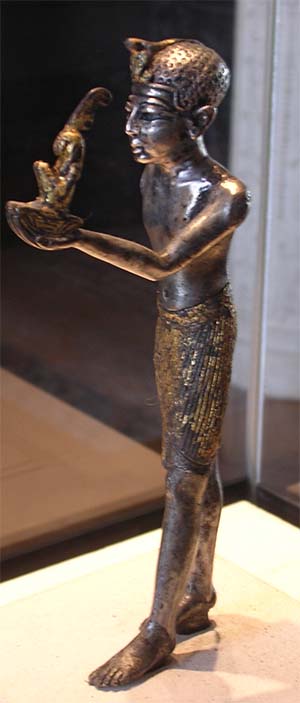
Seti I making Ma’at offering
III. The Epithets of Maat
Maat’s epithets and title-forms are unusually close to her concept. Many of them describe her not through a mythic biography but through her
theological placement: she is the daughter of Ra, mistress of heaven, lady of the Two Lands, and the one who is offered to the gods by the
king. The dual form Mꜣꜥty, “the Two Maats” or “Two Truths,” also appears in judgement and afterlife settings, where truth is doubled
into a complete tribunal of right order, the parallel to the Greek Nemeseis.13, 14, 15
Sources: Leitz, Lexikon der ägyptischen Götter und Götterbezeichnungen (2002); Wilson, A Ptolemaic Lexikon (1997); Kurth, Die Inschriften des Tempels von Edfu (1994–).13, 14, 15
IV. Head of Scribes, Temples
Maat, along with Thoth and Seshat, was appointed as one of the head deities of scribes (sesh) in Egypt. In
day-to-day matters, Egypt was governed by legalistic customs and scribes were pivotal. The minor aspects of law, beyond the capital law and
the law of the Pharaoh, were not identical to modern legal systems. Disputes on a local level would be adjusted in arbitration based on the
circumstances of the individuals involved. Higher courts, with central or capital law codes overseen by the Vizier, could be appealed to if
the judgment of these minor arbitrations was not satisfactory to the plaintiff. The law was meticulously transcribed in Egyptian bureaucracy
long before the scribes of China and the early modern societies of Europe began to do so. Thousands of legal documents survive, many from the
village of Deir el-Medina, where workmen kept detailed contracts and trial records; the Wilbour Papyrus, which inventories land and tax
obligations; the Abbott and Amherst Papyri, detailing tomb robbery investigations; alongside manifold marriage, divorce, and adoption
documents from the Late Period and Ptolemaic era.16, 17
Scribes also ensured abuses of power did not occur and became important intermediaries between classes who had communication with the central
courts of justice. In a sense, the scribe and the written word became the 'glue' between the different classes of Egypt. The equation of the
goddess of justice with the legal system was to such a degree that the highest secular judge of Egypt was the Vizier, named formally as the
Priest of Maat. Judges would also be adorned with the ostrich feather. The judge of the High Court was the Pharaoh himself who also swore to
uphold Maat but delegated the responsibility. In his Library of History (Book I), Diodorus Siculus offered an elaborate description of
Egyptian judicial practices as they existed in the Roman period. He wrote that before a court session began, the chief judge would put on a
golden chain from which hung a small figure made of precious stone, called Truth. The trials would commence only once the judge donned this
emblem of the goddess, signifying that justice was only to be administered in the presence of Maat's power.4
ἐφόρει δ᾿ οὗτος περὶ τὸν τράχηλον ἐκ χρυσῆς ἁλύσεως ἠρτημένον ζῴδιον τῶν πολυτελῶν λίθων, ὃ προσηγόρευον Ἀλήθειαν. τῶν δ᾿ ἀμφισβητήσεων
ἤρχοντο ἐπειδὰν τὴν τῆς Ἀληθείας εἰκόνα ὁ ἀρχιδικαστὴς πρόσθοιτο. τῶν δὲ πάντων νόμων ἐν βιβλίοις ὀκτὼ γεγραμμένων…
The [chief justice] regularly wore suspended from his neck by a golden chain a small image made of precious stones, which they called Truth
(Ma'at); the hearings of the pleas commenced whenever the chief justice put on the image of Truth. The entire body of the laws was written
down in eight volumes which lay before the judges…
ἀμφοτέρων δὲ τῶν ἀντιδίκων τὰ γεγραμμένα δὶς τοῖς δικασταῖς δόντων, τὸ τηνικαῦτ᾿ ἔδει τοὺς μὲν τριάκοντα τὰς γνώμας ἐν ἀλλήλοις ἀποφαίνεσθαι,
τὸν ἀρχιδικαστὴν δὲ τὸ ζῴδιον τῆς Ἀληθείας προστίθεσθαι τῇ ἑτέρᾳ τῶν ἀμφισβητήσεων.
And when both litigants had given written statements to the judges in duplicate, it was then required that the Thirty declare their opinions
among themselves, and that the chief judge add the image of Truth to one of the two sides of the dispute.
Diodorus Siculus, Library of History 1.75 (trans. Oldfather)4
The primary temple of Maat was located in Karnak, with one of the primary temples dedicated to her by Amenhotep III at the Precinct of Montu.
There is textual but relatively unsupported archeological evidence that other temples to her existed at Memphis and Deir el-Medina, the latter
housing one shared with her by Hathor. Rutherford indicates it is known the Pharaoh Ramesses IX congregated the nobility in the complex at
Karnak to discuss the seriousness of grave robberies, which indicates that Maat's sacred precincts were used for convocations about serious
issues and crimes. Another temple complex that prominently features Maat is one where she is shown with endless scenes evoking the eponymous
concept at Dendera, and this is where she is engaged in a complex thematic interplay with Hathor. She is also represented highly thematically
in the Temple of Khnum at Esna where her sacred concepts are invoked strongly. Like many Egyptian gods who became
increasingly prevalent during the New Kingdom, the evidence at these temples shows the worship of Maat benefited from Ptolemaic and Roman
patronage.6, 18, 19
V. Feather Imagery
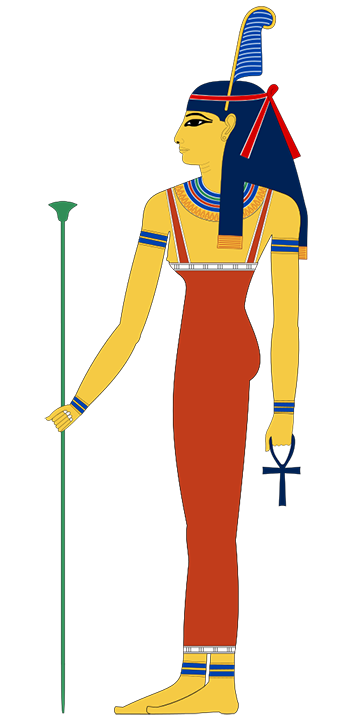
Maat is typically depicted as an idealized young woman wearing a single ostrich feather affixed to a headband. Tomb portrayals show her with
the feather in hand when acting as an emissary of justice. Other goddesses such as Isis or
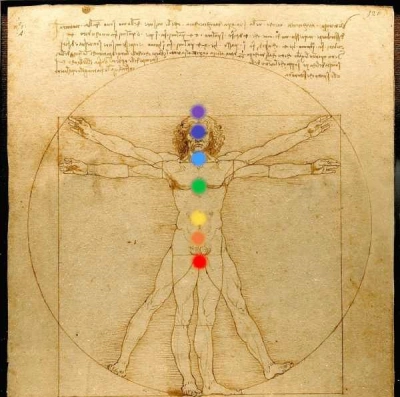
Nephthys could also be depicted holding the feather. One of the major symbolisms of the feather concerns astral
projection and the levity of the Middle Chakra, along with the lightness of the soul after departing the
physical body. The goddess is one of the major rulers of this part of the soul; its powers are barely understood.20
“The feather is evocative of the lightness and grace of Truth. As it is so light, it can be pushed anywhere and everywhere. It also
points towards the pelican feather of Thoth. Knowledge is one of the many arms of Truth. Both Maat and Shu were symbolized by the feather
alone, and the name for it in Egyptian was shut. The man rendering justice to all was represented by the ostrich feather; because that bird,
unlike others, has all its feathers equal.”
Horapollo, Hieroglyphica (trans. Boas)21
Much like in the English language, where a curious convergence of the word for "light" emerged in both weight and the property of light, the
two ideas also shared an overlapping symbolism in Egyptian mystery. Maat was seen as a Goddess of the prism of light who representatively
dispelled all darkness and ignorance.
“Being a symbol of resurrection, ostrich eggs were discovered in ancient Egyptian and Nubian tombs as a kind of funerary offering. It
was believed that ostrich eggshells provided food for the deceased and thus symbolized resurrection and eternal life, a belief that continued
to be found in Muslims' graves.”
Kitat, “Ostrich Egg and Its Symbolic Meaning in the Ancient Egyptian Monastery Churches”22
Often, she is portrayed with two wings, in a similar manner to Isis. Scenes of the Pharaoh offering a small
statuette of Maat to other deities are extremely common, proliferating in sacral imagery up until the end of the Roman period. This type of
symbolism was suggestive of the ruler of Egypt demonstrating that he kept Truth and the maintenance of the Laws alive in his realm. Maat is
often equated with Tefnut in aspect, who represents the creative principle in the fashioning of the world. She is depicted in this guise as
the brother of Shu, a god closely related to Maat and Anubis. She is symbolically rendered as the wife of
Thoth, although this is not true of the Goddess herself.6
VI. Concept of Maat
Maat as a concept was considered the mover of the cosmos in proper order, and the reason for civilization to exist in the Egyptian texts was
to promote a continually refined and evolving world of Maat that would propel individuals towards the divine, compared with the brutality of
lower nature and the primitive sections of humanity who allow for far less of such a thing. Accordingly, the mechanism of Maat embodied
increasing alignment with the gods for those chosen to do so.23
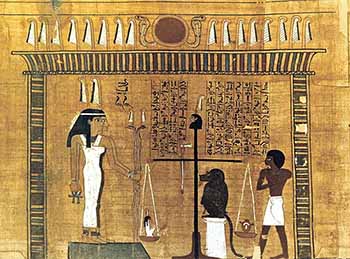
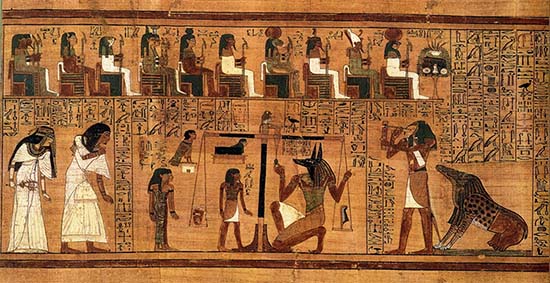
The Weighing of the Heart ceremony was the centerpiece of Maat's role in Egyptian understanding. In the Ritual, the heart (ib) of the
individual being judged was placed on one pan of a scale, with the feather of Maat occupying the other. Osiris was typically depicted as the
ultimate arbiter of the process. The typical gods involved in assessing the process were Maat herself, Anubis, and
Thoth, but also Seshat, Meshqenet, Renenutet and others. If the heart was heavier than the feather, it was thrown
to the devouring beast Ammit. Maat was often represented in a dual role, and the chamber of the Heart Weighing was often called "the Chamber
of the Two Goddesses." The reasons for this become more obvious when examining how Maat was viewed in Hellenic civilization. She was also
accompanied by 42 Judges and lesser deities.24
One aspect of Maat as the feather and the law exemplified the lightness of an unadulterated soul versus the dirt, sins, and moral
transgressions of a less favorable individual. The heaviness of the heart was bound up in testimony of certain truths relating to these areas
of life, which the gods could always hear. The dual pathway of the ceremony was similar to Greek mores of the afterlife, like Tartarus and the
Elysian Fields. Abominable acts, unfathomable ignorance, self-rotting excesses, and evil-mindedness could make the heart heavy beyond
redemption. A pathway of pure spitefulness fulfilled through destruction and hatred was the easiest method to end up in the maw of Ammit. In
this is reflected Maat's close association with Isis, particularly the virtue of
Balance. Egyptian texts and instructional manuals associated with the goddess repeatedly warn from the
earliest point against using fear and excessive violence to control other believers too. This is explicitly cited as an abuse of Maat, which
will render those put under such a regimen as ignorant, only believing out of fear and not out of true will, therefore the spread of fear and
ignorance under a divine banner was another major transgression against Maat.25
In an occult sense, on the Zevist path with enough spiritual cleansing, the initiate's soul becomes more and more light. Energy begins to hit
the Crown when the Chakras are opened, and it flows unobstructed. The feeling of being pinned, tied, and weighed down dissipates altogether,
and total ease of operating magic becomes attainable. The feeling of lightness is symbolic of being able to traverse everything with ease, and
it can be considered the opposite of being bound to brute materialism, hence the divine symbolism: the one who has mastered and transformed the soul
becomes, at will, as light as a feather.
However, one aspect of Maat that is poorly understood is a specific set of meanings relating to self-progression and apotheosis (making
oneself a god). These meanings have been marred, as many Egyptologists cross-referenced the Weighing of the Heart with passages referencing
similar symbolism in the Bible, distorted there to have a distinctly vulgar and lowbrow meaning. Maat is also equated with the blinkered
understanding of karma from modern Hinduism, Buddhism, and the New Age movements.
VII. Maat and the Self
The heart was not just indicative of its weight in relation to blatant sins such as horrible aggression towards others and corrupting others
above, which many recognize correctly as destructive behaviors that disturb order, but of the integrity of the organ in expressing proper
selfhood and keeping the soul alive enough to desire proper incarnation. In modern culture, such a concept can be conveyed succinctly in stock
phrases such as "following one's heart." An individual whose whims are completely controlled by others, whose entire journey through life
consists of cowardice in the face of malignancy, and who furthermore imperils the course of law altogether by doing nothing, could also be
deemed an individual mired in Izfet and apt to be devoured by Ammit, irrespective of how we may view this now.
Instructive texts associated with the goddess, such as The Eloquent Peasant, demonstrated the correct way to act and not to allow insult or
injustice to go unnoticed. Proper redress was seen as an important individual initiative. A totally passive individual could be compared to a
microcosm of a civilization that has gone seriously wrong and has become lawless by not using the arms of nature to protect what is valuable.
Each person had a duty to uphold Maat, not only by attempting to refrain from doing injustice, but also by not submitting to it without
challenge. Here is a very important distinction to make between Egyptian religion and the endless martyrology of Yehubor and other scrouges.27
Yehubor endlessly preaches endless passivity and damnation which causes an imbalance. The botched and fearful always made for the perfect
controlled individual; the foremost representatives of our contemporary civilizations also compulsively preach self-appointed victimhood
rather than taking action as the highest ideal, while the use of justice to protect the truly innocent is "nailed to the wall," creating a
situation in which genuine grievances can be mixed up with resentment and pettiness to the point that many people are pulled apart by opposing
forces. Chaos has resulted in defiance of Maat.
“When you lie down, guard your own heart, for no man has adherents on the day of woe.”
The Instruction of Amenemhat I, in Simpson, The Literature of Ancient Egypt28
“Do not let yourself be called ‘idiot’ because of silence when it is time to speak.
There is one who lives on little so as to
save, yet he becomes poor.”
Insinger Papyrus (trans. Lichtheim)29
VIII. Meaning of Life
Yet this did not refer only to this sort of individual, but even to those who lived charmed and pleasant lives full of distractions such as a
life lived harming no one else, yet doing nothing for the gods, nor for themselves in terms of spiritual evolution, leading to stagnation of
the soul. Even a pleasurable, happy life constituted a sort of erroneous existence if not subjected to philosophical and practical testing of
life’s margins. Most importantly, beyond the deluded and evil individuals preaching the kind of Yehuboric precepts that lead to direct
transgressions against others, this also applies to the deviated ascetics of some religions that teach disengagement with life, pursuing only
total adherence to slave-like spirituality with no mover to spur on development. The gods themselves have smacked down the very few who
managed to reach certain levels while preaching total hatred of life. Egypt emphatically did not take the life-hating approach to spiritual
development as the Black Land was a civilization of life to be lived in all its facets.
In this is also a code relating to the Middle Chakra, plus the two signs of Venus and associated mundane Houses, particularly the 7th House.
To allow just “anyone” in is to have the heart wrung by dozens of grasping and lustful hands; yet to allow nobody in is to fill the heart with
regret and leave it to rot. Both hearts if beset with excess and deprivation could be devoured by Ammit or thrown to the Lake of the Fire.
“The great God named Thoth has set a balance in order to make right measure on Earth by it.
He placed the heart hidden in the
flesh for the right measure of its owner.
If a wise man is not balanced, his wisdom does not avail.
One does not discover
the heart of a wise man if one has not tested him in a matter.”
Insinger Papyrus (trans. Lichtheim)29
If one does not do right by themselves, one's heart has not been rendered light. In a sense, how could it be light when the one having the
heart is a free-falling and heavy anvil through life? The truth is that making the heart fly involves the hard labor of activating aspects of
the developing self, developing a true sense of true personhood. There are no easy shortcuts for such a process. Part of this emphasis on
self-development to uphold the principle of Truth is why Maat has the ruling planet of Mars which may seem unusual to those familiar with
Astrology. Nietzsche clarified with Thus Spake Zarathustra on this subject:
“Creating, that is the great salvation from suffering, and life's alleviation. But for the creator to appear, suffering itself is needed,
and much transformation.
Yes, much bitter dying must there be in your life, you creators! Thus are you advocates and justifiers of
all perishableness.
For the creator himself to be the new-born child, he must also be willing to be the child-bearer, and endure the
pangs of the child-bearer.”
Nietzsche, Thus Spoke Zarathustra (trans. Del Caro)30
IX. The Distortions of Maat
The interloper Akhenaten distorted the concept of Maat to punish his enemies and to formulate an ideology of control. This is why Horemheb and
his successors doled out extreme penalties for distortion of the concept, and the cult of Maat as something accountable and truthful took hold
in Egypt during the latter half of the New Kingdom.6
Numerous Yehuboric conventions existed to rip off the idea of the scales from an early point, such as the Midrash literature like the Kohelet
Rabbah. Rabbinical literature links the judgment of Maat with Rosh haShanah. The Zohar describes the “Chamber of Merit,” guarded by angels
charged with “the scales of justice,” with merits pulling to the right pan, sinners to the left, and presided over by ‘Mozniya’ a
badly-formulated Nemesis. The chief of these kinds of scales also has two lights in emulation of Maat. This passage indirectly also
mentions the presence of Ra, Thoth, and Maat on the “evil side,” who “seduce the world” and judge those who “come to be defiled.” Such
mechanisms attempt to prevent the believers from being judged in the same way as the “filth” of the earth, the nonbelieving peoples called the
'sitra archa'. Then with the advent of Christianity, explicit references to Maat by name virtually disappear from surviving texts, as direct
worship of the Goddess ended. Later with the emergence of early Christianity, an intriguing number of Coptic writings adapt or echo themes
that were prominent in Maat’s cult, especially concerning the afterlife judgment, which also parallels the emerging concept in rabbinical
literature.31
One of the most illustrative is the Coptic Apocalypse of Paul (part of the Nag Hammadi library, 4th century CE), where the apostle Paul
experiences a visionary ascent and, at one stage, encounters a weighing of souls. In this text, souls of the dead are weighed on scales by a
divine figure to determine their righteousness, a clear parallel to the ancient “weighing of the heart” before Maat, placed in a Christian
Gnostic framework. Another example is found in a later Coptic saint’s legend, The Story of Butrus the Ascetic, preserved in an Arabic-Coptic
synaxarium (medieval era). In this story, the miserly Butrus has a dream of his personal judgment, resembling the Hebrew fear of “the other
side”:32
“Butrus saw a pair of scales set up, and a throng of ugly black beings carrying his sins and injustices to put in the left pan of the
scales, and a host of shining angels placing any good deeds in the right pan.”
The Story of Butrus the Ascetic, Arabic-Coptic Synaxarium (trans. Budge)33
In Islam, the primary term for the “scales” used to weigh human deeds on the Day of Resurrection is al-Mizan, which was blatantly ripped off
from Egyptian religion and not even veiled, unlike in Judaism or Christianity. This is explicitly mentioned several times in the Ǫur’an:
وَنَضَعُ ٱلْمَوَازِينَ ٱلْقِسْطَ لِيَوْمِ ٱلْقِيَٰمَةِ فَلَا تُظْلَمُ نَفْسٌ شَيْـًٔا ۖ وَإِن كَانَ مِثْقَالَ حَبَّةٍۢ مِّنْ خَرْدَلٍ
أَتَيْنَا بِهَا ۗ وَكَفَىٰ بِنَا حَٰسِبِينَ
We will set up scales of justice for the Day of Resurrection, so that no soul will be dealt with unjustly in the least. And if there should be
even the weight of a mustard seed, We shall bring it forth. We take excellent account.
Qur’an 21:47
وَٱلسَّمَآءَ رَفَعَهَا وَوَضَعَ ٱلْمِيزَانَ أَلَّا تَطْغَوْا۟ فِى ٱلْمِيزَانِ ﴿٨﴾ وَأَقِيمُوا۟ ٱلْوَزْنَ بِٱلْقِسْطِ وَلَا تُخْسِرُوا۟
ٱلْمِيزَانَ
And the heaven he raised, and he set the balance (al-mizan), that you may not transgress within the balance. And establish weight in justice,
and do not defraud the balance.
Qur’an 55:7–9
Muslim commentators were also strongly aware of Maat among the pagan Goddesses. They wrote:
“They (the ancient judges of Egypt) used to wear, hung around their necks, a small golden figure of a woman holding a pair of scales and
a feather, so that all who saw her would know that she weighed their deeds in Truth.”
Al-Maqrīzī, al-Khiṭaṭ34
The 9th-century historian Ibn Abd al-Hakam, in his Conquest of Egypt, recounts a possibly apocryphal tale: when the Caliph Umar was given the
Pharaoh’s treasure, among it was found an idol or engraving of a woman with a sword in one hand and scales in the other, which Umar’s advisors
interpreted as a representation of Justice.
X. Lady Philosophy
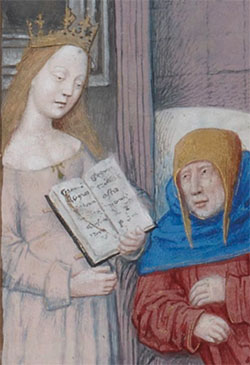
Boethius, a late Roman author and Christian apologist, wrote a work named The Consolation, which drew on certain themes explaining the nature
of order and attempted to hybridize Platonic themes with the Catholic Church that he served. This work represented an imaginary dialogue where
Philosophy, personified as a woman (known as Lady Wisdom), argues that despite the apparent inequality of the world, there is a higher power
and everything else is secondary to that divine Providence.35
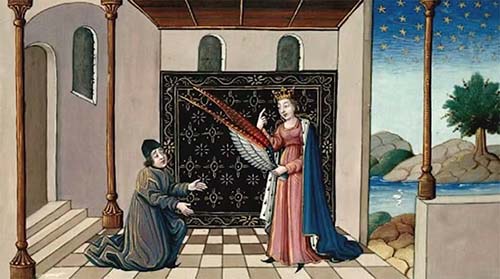
Consolation of Boethius, 15th century school
It was typical to represent Lady Wisdom in medieval stylistic conventions as possessing two feathers or wings, taken from the stories of
Boethius. Unfortunately, the popularity of this work triggered many of the major attempts by forces to co-opt Hellenic virtue and wisdom.
Liberal sciences also represent a sort of code relating to Maat’s functions. Firstly, all liberal arts represent a desire for
universal understanding predicated on the universal order. In medieval Europe, study of such matters signified the status of a free
man who was expected to understand the virtues and codes of the society he lived in, hence the term liberalis, meaning “expected of a
free man." Seven liberal arts, music, arithmetic, geometry, astronomy, rhetoric, grammar, and logic, existed, reflecting the primacy of
the number seven as the vehicle of karma and its central tie to Maat herself. These arts, particularly the trivium of scribes, were
central to the study of law. While Maat remained referenced blithely as the “Lady Wisdom” in medieval conventions, such arts were
accredited to belong to "virgin Mary":
“It is written, “Wisdom hath built herself a house, she hath hewn her out seven pillars” (Proverbs 9:1). This house is the Blessed
Virgin; the seven pillars are the seven liberal arts.”
Albertus Magnus, Mariale36
Sources and Bibliography
- Hannig, Rainer. Großes Handwörterbuch Ägyptisch-Deutsch: Die Sprache der Pharaonen (2800–950 v. Chr.). Kulturgeschichte der Antiken Welt 64. Mainz: Philipp von Zabern, 1995. S.v. “mꜣꜥt.”
- Allen, James P., trans. The Ancient Egyptian Pyramid Texts. Writings from the Ancient World 23. Atlanta: Society of Biblical Literature, 2005. Sections cited: Unis corpus and references to mꜣꜥt.
- Assmann, Jan. Maât: Gerechtigkeit und Unsterblichkeit im Alten Ägypten. Munich: C. H. Beck, 1990.
- Diodorus Siculus. Library of History. Vol. 1, Books 1–2.34. Translated by C. H. Oldfather. Loeb Classical Library 279. Cambridge, MA: Harvard University Press, 1933. Section cited: 1.75, Egyptian chief judge’s image of Ἀλήθεια.
- Wilkinson, Richard H. The Complete Gods and Goddesses of Ancient Egypt. London: Thames & Hudson, 2003. Sections cited: Maat, iconography, and divine functions.
- Teeter, Emily. The Presentation of Maat: Ritual and Legitimacy in Ancient Egypt. Studies in Ancient Oriental Civilization 57. Chicago: Oriental Institute of the University of Chicago, 1997.
- Lichtheim, Miriam. Maat in Egyptian Autobiographies and Related Studies. Orbis Biblicus et Orientalis 120. Freiburg, Switzerland: Universitätsverlag; Göttingen: Vandenhoeck & Ruprecht, 1992.
- Assmann, Jan. Religion and Cultural Memory: Ten Studies. Translated by Rodney Livingstone. Stanford, CA: Stanford University Press, 2006.
- Abt, Theodor, and Erik Hornung. Knowledge for the Afterlife: The Egyptian Amduat, A Quest for Immortality. Zurich: Living Human Heritage Publications, 2003.
- Assmann, Jan. Solar Discourse: Ancient Egyptian Ways of Worldreading. Translated by David Lorton. Leiden: Brill, 1995.
- The Epigraphic Survey. The Eighteenth Dynasty Temple. Part II: The Façade, Pillars, and Architrave Inscriptions of the Thutmosid Peripteros, with Translations of Texts, Commentary, and Glossary. Edited by Andrew Baumann. Oriental Institute Publications. Chicago: Oriental Institute of the University of Chicago.
- Costa, Salvador, and Teresa Magadán. “Ramesses III as Guarantor of Maat: The Iconographic Evidence at Medinet Habu.” Trabajos de Egiptología / Papers on Ancient Egypt 6 (2015): 31–66.
- Leitz, Christian, ed. Lexikon der ägyptischen Götter und Götterbezeichnungen. 7 vols. Orientalia Lovaniensia Analecta 110–116. Leuven: Peeters, 2002. Entries cited: Mꜣꜥt and Mꜣꜥty.
- Wilson, Penelope. A Ptolemaic Lexikon: A Lexicographical Study of the Texts in the Temple of Edfu. Orientalia Lovaniensia Analecta 78. Leuven: Peeters, 1997.
- Kurth, Dieter, ed. Die Inschriften des Tempels von Edfu. Wiesbaden: Harrassowitz, 1994–. Sections cited: offering and divine-title formulae involving Maat.
- Fielding, Hannah. “Ancient Egyptian Scribes.” Accessed May 2, 2026. Sections cited: scribal profession and divine patrons of writing.
- Gardiner, Alan H. The Wilbour Papyrus. 4 vols. Oxford: Oxford University Press, 1941–1952.
- Redford, Donald B., ed. The Oxford Essential Guide to Egyptian Mythology. New York: Berkley Books, 2003. S.v. “Maat.”
- Richter, Barbara A. The Theology of Hathor of Dendera: Aural and Visual Scribal Techniques in the Per-Wer Sanctuary. PhD diss., University of California, Berkeley, 2012.
- Budge, E. A. Wallis. The Gods of the Egyptians; or, Studies in Egyptian Mythology. 2 vols. London: Methuen, 1904. Sections cited: Maat and feather imagery.
- Horapollo. The Hieroglyphics of Horapollo. Translated by George Boas. Bollingen Series 23. New York: Pantheon Books, 1950.
- Kitat, Sara El Sayed. “Ostrich Egg and Its Symbolic Meaning in the Ancient Egyptian Monastery Churches.” Journal of Association of Arab Universities for Tourism and Hospitality 14, no. 1 (2017): 1–18.
- Fox, Michael V. “World Order and Maʿat: A Crooked Parallel.” Journal of the Ancient Near Eastern Society 23 (1995): 37–48.
- Budge, E. A. Wallis, ed. The Book of the Dead: The Papyrus of Nebseni. London: British Museum, 1910.
- Gunn, Battiscombe, trans. The Instruction of Ptah-Hotep and the Instruction of Ke’Gemni: The Oldest Books in the World. London: John Murray, 1906.
- Parkinson, R. B., trans. The Tale of the Eloquent Peasant. Oxford: Griffith Institute, Ashmolean Museum, 1991.
- Simpson, William Kelly, ed. The Literature of Ancient Egypt: An Anthology of Stories, Instructions, Stelae, Autobiographies, and Poetry. 3rd ed. New Haven, CT: Yale University Press, 2003. Section cited: “The Instruction of King Amenemhet I for His Son Senwosret.”
- Lichtheim, Miriam. Late Egyptian Wisdom Literature in the International Context: A Study of Demotic Instructions. Orbis Biblicus et Orientalis 52. Freiburg, Switzerland: Universitätsverlag; Göttingen: Vandenhoeck & Ruprecht, 1983. Sections cited: Insinger Papyrus.
- Nietzsche, Friedrich. Thus Spoke Zarathustra: A Book for All and None. Translated by Adrian Del Caro. Cambridge: Cambridge University Press, 2006.
- Matt, Daniel C., trans. The Zohar: Pritzker Edition. 12 vols. Stanford, CA: Stanford University Press, 2004–2017. Sections cited: Heikhal ha-Zekhut / Chamber of Merit traditions.
- Robinson, James M., ed. The Nag Hammadi Library in English. 3rd rev. ed. San Francisco: HarperSanFrancisco, 1990. Section cited: The Apocalypse of Paul.
- Budge, E. A. Wallis, trans. The Book of the Saints of the Ethiopian Church. 4 vols. Cambridge: Cambridge University Press, 1928. Section cited: Synaxarium traditions comparable to Butrus the Ascetic.
- Al-Maqrīzī. Al-Mawāʿiẓ wa-l-iʿtibār bi-dhikr al-khiṭaṭ wa-l-āthār [al-Khiṭaṭ]. Cairo: Būlāq, 1853–1854. Section cited: traditions concerning ancient Egyptian judges and images of justice.
- Boethius. The Consolation of Philosophy. Translated by S. J. Tester. Loeb Classical Library 74. Cambridge, MA: Harvard University Press, 1973.
- Albertus Magnus. Mariale super Evangelium: Quaestiones super Missus est. Edited by Augustus Borgnet. In Opera Omnia, vol. 37. Paris: Louis Vivès, 1898. Section cited: liberal arts and the seven pillars of wisdom.