
 አማርኛ
አማርኛ العربية
 বাংলা
বাংলা Български
 中文
中文 Čeština
 Dansk
Dansk Deutsch
 Eesti
Eesti Ελληνικά
 Español
 Français
 हिन्दी
 Hrvatski
 IsiZulu
 Italiano
 日本語
日本語 Kiswahili
 Magyar
 Македонски
 नेपाली
 Nederlands
 فارسی
فارسی Polski
 Português
 Română
 Русский
 Slovenščina
 Suomi
Suomi Svenska
 Tagalog
 Türkçe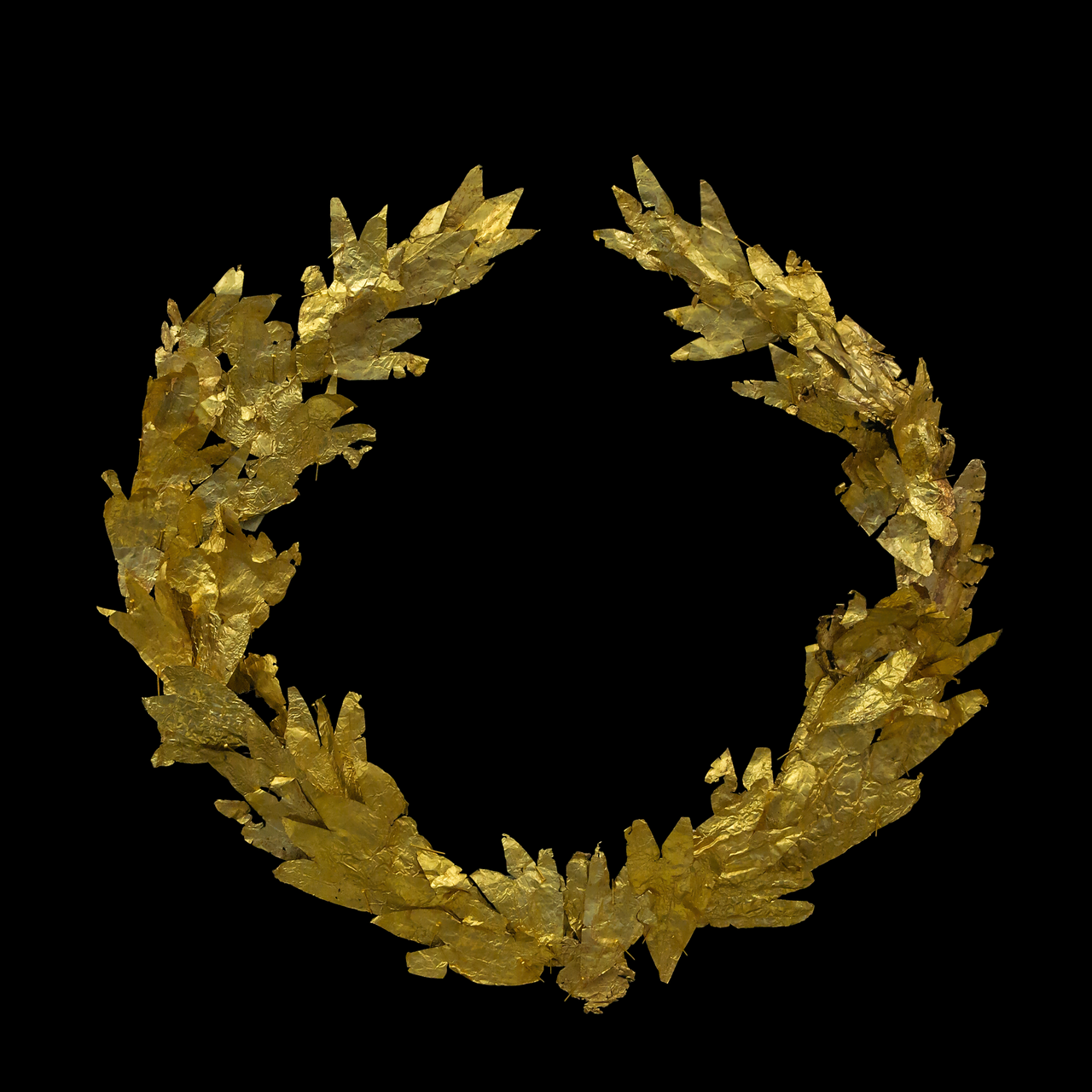


The crown of the awakened soul
The Laurel Crown is the dignity of spiritual victory made visible. Resting above the brow, it honours the soul that has awakened its powers and brought them into the service of Divine intelligence. Apollon crowns illumination, inspired speech, clear vision and excellence brought to fulfilment. In Zevism, this coronation expresses an actual spiritual purpose: the human being becomes increasingly capable of receiving the Gods, bearing their light and acting through an empowered soul.
The living laurel and the crown formed from it disclose different aspects of the mystery. The plant grows; the crown consecrates. A branch belongs to the unfolding of life, while a wreath gathers that life around the seat of higher perception. Its encircling leaves proclaim that attainment has acquired a centre. The initiate's work is crowned when awakening becomes a coherent power within the whole being. [1][2]
The crown chakra and the descending light
The Temple identifies the crown chakra, Sahasrara, at the summit of the head and associates it with enlightenment, bliss and the psychic senses. Its correspondence is Jupiter, its colour violet. The Laurel Crown gives this upper sanctuary a ceremonial image: the summit of the soul receives honour because it opens toward Divine communion. Apollonian consecration belongs within the greater sovereignty of Zeus; the Gods' distinct powers cooperate in the soul's elevation. [2]
The wreath also surrounds the field of the head's other spiritual faculties. The Temple's symbol teaching describes the halo as the radiance of activated head chakras, while its pineal meditation employs white-gold light for intuition and inward illumination. In contemplation, the laurel's gold gathers this luminosity around the brow. Gold expresses spiritual perfection; violet remains the crown centre's own correspondence. The two colours teach complementary aspects of the work: the centre receiving Divine influence and the radiance of the soul brought toward fulfilment. [1][2][3][4]
Consecration and the authority to create
A sacred crown establishes a relationship between the one who receives honour and the Divine power through which the achievement becomes possible. Apollon's laurel consecrates the faculties of the illumined person: vision to truth, speech to inspired expression, and will to the creation of worthy forms. The soul's powers become instruments through which the God's presence can enter the world.
This is the occult meaning of spiritual victory. The scattered currents have been gathered; the inward eye has become clearer; the awakened will can sustain a chosen direction. Each leaf may be contemplated as a faculty joined to this common sovereignty. None needs to disappear for the crown to become whole. The completed wreath gives many powers one order, and its beauty expresses the harmony achieved through their union.
The Laurel Crown and the Crown of Thorns
Zevist theology reads the Christian Crown of Thorns as an inversion of the Laurel Crown: the sign of radiant accomplishment is recast as the emblem of wounded kingship. This is a judgment about the spiritual meaning given to crowning. Where Apollon's wreath honours the flowering of power, the thorn crown places humiliation and suffering at the centre of the sacred image.
Our criticism calls this reversal defeatism when suffering itself becomes the measure of holiness and the living person's sovereignty is surrendered to it. The Zevist answer is the restoration of the victorious crown. The Gods call the soul toward illumination, beauty, knowledge and the strength to create. Hardship may be encountered and overcome along that path; the object of consecration is the power that emerges and flourishes. To receive the laurel is to affirm that spiritual life can become accomplished, joyous and sovereign. The historical texts below show how differently the two religious traditions interpret the crowned head.
Ancient victory and the later Christian comparison
Pausanias, Description of Greece 10.7.5–8, records the Pythian victory crown and explicitly identifies its material as laurel. Its setting is Apollon's sanctuary at Delphi, with musical and athletic contests. This is a precise ancient foundation for the crown's association with sacred achievement. [5] It should be distinguished from the olive wreath of Olympia. [12] The golden wreath illustrated here belongs to the Hellenistic period and is preserved in the Kerameikos Archaeological Museum; it is not identified as a surviving Pythian prize. [6]
In Mark 15.16–20, Matthew 27.27–31 and John 19.1–5, Roman soldiers place thorns upon Jesus during a mock royal ceremony. Matthew also supplies a reed as a mock sceptre. These passages name thorns, without identifying laurel or declaring an intention to replace Apollon's wreath. Their narrative action is the humiliation of a claimed king. [7][8][9]
Tertullian makes the comparison explicit in De Corona. Chapter 12 associates laurel with Apollo and Bacchus; chapter 14 sets Christ's thorns against laurel, myrtle, olive and floral crowns, urging Christians away from such adornment. Chapter 15 nevertheless promises heavenly coronation and victory. His argument documents a conscious Christian opposition to pagan crowning, alongside a Christian reinterpretation of triumph. The Met's historical account also notes the later Christian reuse of laurel for Christ's triumph and eternal life. The Zevist critique concerns this revaluation of victory through suffering; it does not require the Gospel authors to have recorded a direct botanical substitution. [10][11]
Receiving the living crown
Contemplate the golden wreath above the brow as a consecration of awakened faculties. Offer Apollon the wish that perception may become luminous, expression exact and spiritual power creative. Let the crown gather the whole ascent of the soul into one radiant intention, while the authority of Zeus gives that attainment its greater order.
The Laurel Crown is worn inwardly through the life that follows the moment of consecration. Its honour continues in the knowledge one develops, the works one completes and the light one becomes able to bear. The crowned soul carries its victory into living action.