
 አማርኛ
አማርኛ العربية
 বাংলা
বাংলা Български
 中文
中文 Čeština
 Dansk
Dansk Deutsch
 Eesti
Eesti Ελληνικά
 Español
 Français
 हिन्दी
 Hrvatski
 IsiZulu
 Italiano
 日本語
日本語 Kiswahili
 Magyar
 Македонски
 नेपाली
 Nederlands
 فارسی
فارسی Polski
 Português
 Română
 Русский
 Slovenščina
 Suomi
Suomi Svenska
 Tagalog
 Türkçe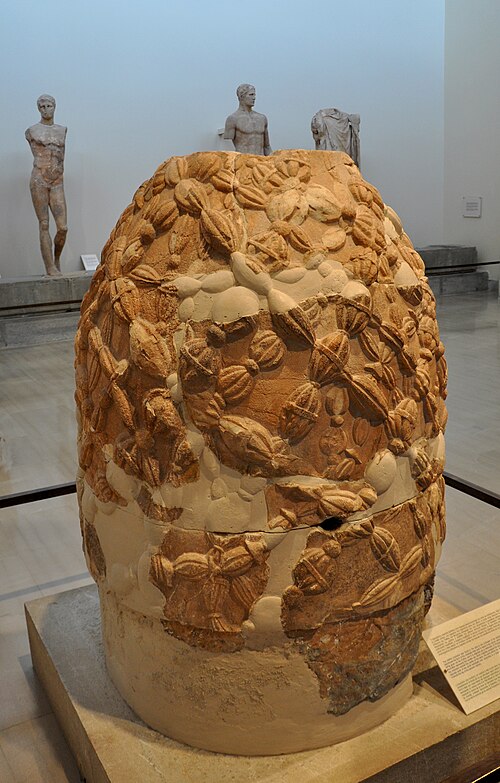


A center through which the whole is ordered
The omphalos expresses sacred orientation under Zeus and Apollo. A center gathers what is dispersed and allows the surrounding whole to acquire an intelligible order. For the Zevist soul, its mystery is the integration of the faculties around Divine presence, so that knowledge, will, intuition, and action remain connected to a common source. [2][4]
The Greek word ὀμφαλός means navel. Its bodily image recalls connection, origin, and nourishment. At Delphi, that image belongs to a sacred geography in which the world is gathered around a meaningful center. The same form directs inward contemplation toward the relations that sustain the soul's life. [1]
Zeus, Apollo, and the center of spiritual life
A sacred center establishes relationship. The omphalos gathers the world around Delphi, where the authority of Zeus and the counsel of Apollo meet within one religious landscape. In the inward work, the same image directs the soul toward a governing presence. Its many faculties find a common orientation when they are gathered around devotion to the Gods and a deliberate pursuit of understanding.
Zeus' eagles approach from opposite horizons. Their convergence gives the center a dynamic character: it is discovered through the meeting of powers that have traveled by different paths. Intellect and intuition, memory and aspiration, inward vision and outward experience can likewise be brought into relation. The omphalos becomes the place of their reconciliation, where difference contributes to a more complete awareness. [2]
Apollo gives this gathering the quality of illumination. To seek Divine counsel is to become capable of receiving a measure beyond immediate preference. The soul must listen deeply enough for a larger pattern to become intelligible. Within our spiritual practice, this Apollonian center joins clear attention, inward receptivity, and the courage to understand what has been disclosed.
The navel, the solar chamber, and inward orientation
The name navel recalls connection and nourishment. The Temple locates the solar chakra slightly above the navel and describes it as the Grail of Zeus. This sacred physiology gives the bodily image a fruitful contemplative relation: the center gathers the powers required to sustain a whole. Solar will preserves direction while the receptive faculties bring understanding into the chamber of attention. [4][5]
The omphalos can therefore be contemplated as a point of return. Begin with the complete stone and its woven covering. Let each crossing band recall a relation within life: study, devotion, affection, work, and the cultivation of the soul. Bring these relations toward a common center and consider the purpose by which they are ordered. The act is one of recollection, a deliberate gathering of what has become scattered.
The Temple's teaching on intuition and comprehension complements this centeredness. A quiet inward field allows connections to become visible; a steady will gives them continuity. The practitioner can preserve a short record of what becomes clear in contemplation and return to it through study and action. The center then becomes inhabitable. The soul increasingly knows where it stands, what it serves, and how its different powers belong to one Divine work. [6]
Preparing to receive counsel
Before seeking counsel in contemplation, bring the matter into a clear form. State what is already known, what remains uncertain, and what decision actually requires understanding. This preparation gathers the question around a center. An undefined concern pulls attention in many directions; a well-formed question gives inward listening a definite purpose.
Under Apollo's sign, allow a period of quiet after the question has been stated. Record any understanding that emerges without enlarging it in the moment. Return to it through study, consideration of the circumstances, and reflection on the responsibilities involved. The center at Delphi joins sacred counsel to the life of those who seek it. In the inward application, the omphalos recalls the same seriousness: a question should be worthy of the attention given to it, and an answer should be understood well enough to guide action. The soul becomes receptive to counsel by learning how to ask, how to listen, and how to carry understanding into the world.
The stone and the Delphic tradition
Pausanias, writing in the second century CE, describes the Delphians' omphalos as a white marble object and records their belief that it marked the center of the Earth. His account is explicit about whose claim he is reporting. It gives a clear ancient witness to the object and its sacred interpretation without requiring every later representation of the omphalos to be the very stone he saw. [1]
The Archaeological Museum of Delphi explains the myth in which Zeus sends two eagles from opposite ends of the world and they meet at Delphi. The same museum describes the carved bands of its omphalos as the representation of a woolen covering, or agrenos, ornamented with precious stones. Its current object account dates the exhibited work to 330–325 BCE and associates it with Apollo's power of divination. [2]
The museum also relates this omphalos to the Dancers' or Acanthus Column. Its broader gallery account describes that reconstruction as a recent theory. The connection remains a reconstruction of the monument; the stone's Delphic religious significance has separate support in the literary and archaeological setting. [2][3]