 አማርኛ
አማርኛ العربية
 বাংলা
বাংলা Български
 中文
中文 Čeština
 Dansk
Dansk Deutsch
 Eesti
Eesti Ελληνικά
 Español
 Français
 हिन्दी
 Hrvatski
 IsiZulu
 Italiano
 日本語
日本語 Kiswahili
 Magyar
 Македонски
 नेपाली
 Nederlands
 فارسی
فارسی Polski
 Português
 Română
 Русский
 Slovenščina
 Suomi
Suomi Svenska
 Tagalog
 Türkçe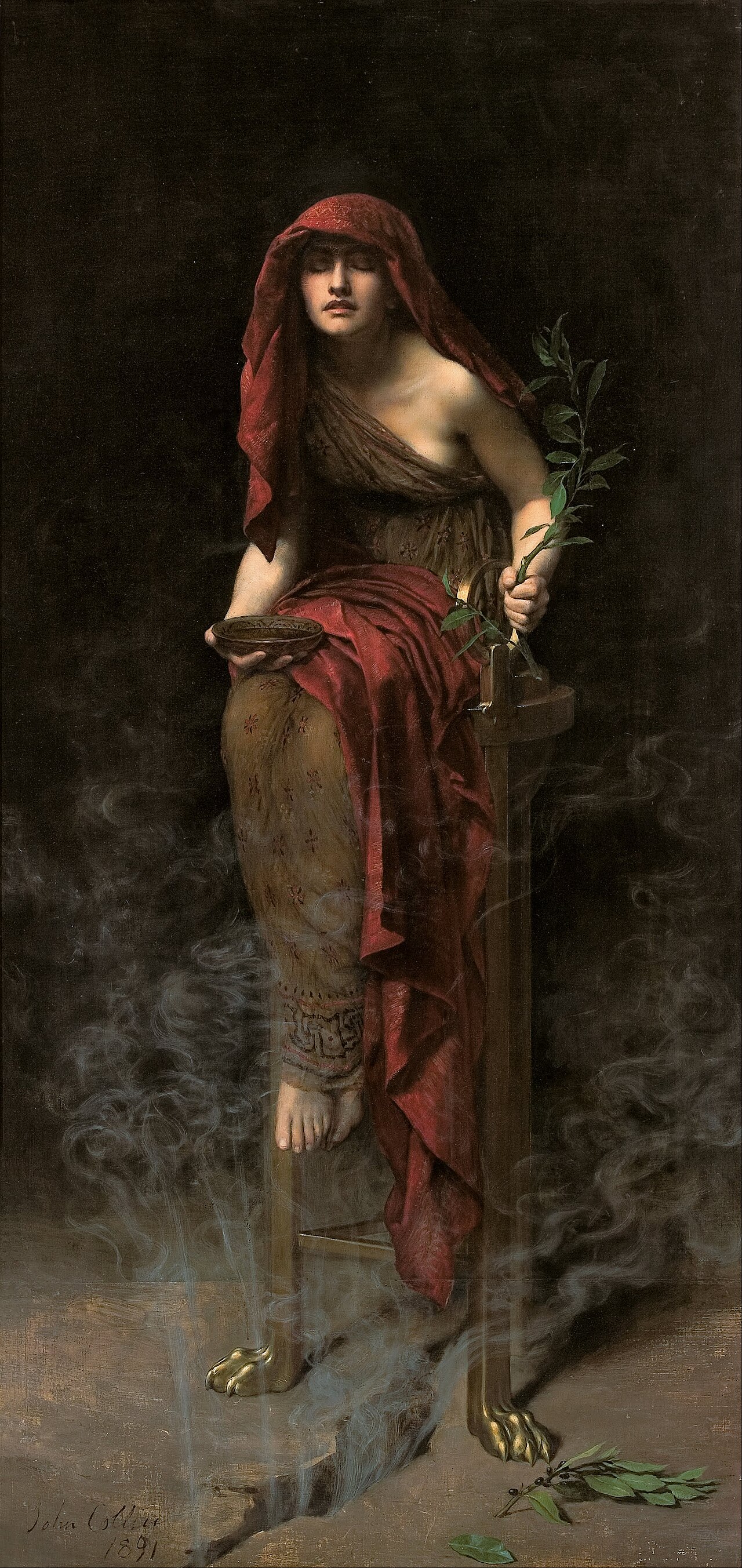


The seat prepared for Apollon
The Delphic tripod is the seat of a sacred encounter. Its three supports raise the place of revelation above the ground while keeping it firmly established within the sanctuary. In Zevism, this form expresses the soul prepared to receive Apollon: stable in its foundation, gathered in its powers and open to the God whose light brings hidden things into intelligible presence.
The tripod belongs beside the omphalos and the lyre, yet possesses its own mystery. The omphalos establishes the sacred centre; the lyre reveals harmony through proportion; the tripod provides the supported place from which revelation is received and spoken. Its power concerns the fitness of the vessel. Divine inspiration becomes fruitful when the faculties that receive it can hold, distinguish and express what has entered their field.
The three supports of inspired knowledge
The three legs can be contemplated as the cooperation of receptivity, discernment and expression. Receptivity allows the soul to become attentive to Divine presence. Discernment gives the received impression clarity and proportion. Expression carries the illumination into meaningful speech or action. These powers support one another, just as each leg contributes to the stability of the seat.
This is an active spiritual equilibrium. Receptivity without discernment leaves impressions unresolved; expression without receptivity empties speech of its source. Their union establishes an inward place where the God can be approached with the whole person. The tripod thus teaches theurgy as preparation of the human instrument: its capacity grows through the ordered cultivation of its powers.
Within the Temple's teaching, the chakras possess distinct functions while belonging to one soul. The tripod's threefold support gives a visible form to the cooperation required among these centres. It does not reduce the seven major chakras to three; it reveals how differentiated faculties can sustain one act of Divine communion. [1]
The inward eye and the voice of revelation
The Third Eye supplies a particularly direct correspondence. The Temple identifies it with the soul's astral sight and connects it with the sixth chakra and pineal centre. In the tripod's mystery, this faculty receives the inward image. The receptive field of the soul holds that image, while the throat gives it an articulate expression. Revelation passes from presence into perception and from perception into speech. [2]
Apollonian illumination also carries the quality of white-gold light used in the Temple's pineal meditation. Within this sacred imagery, light fills the inner sanctuary and renders its contents clearer. Gold signifies the soul's perfection; the tripod's imagined golden vessel therefore becomes a fitting emblem of receptivity refined until it can bear greater power. These are the spiritual correspondences through which the ancient form enters Zevist contemplation. [3][4]
The oracle's authority begins with the God. The seat, the priestly preparation and the inward faculties establish the conditions of encounter. Their dignity lies in becoming capable of receiving a higher intelligence while preserving the coherence needed to communicate it. Apollon's light calls the soul into greater clarity, and the tripod shows that clarity supported by a whole spiritual structure.
The vessel and the consecrated interval
A tripod surrounds an open space. Its supports hold a centre without filling every interval around it. This gives the symbol a further contemplative depth: the sanctuary requires room for what the worshipper has not already supplied. The soul gathers itself, offers its question and allows the encounter to unfold. Sacred receptivity is maintained through the steadiness of the whole vessel.
The image also joins height with groundedness. The seat rises, yet every support reaches the earth. Spiritual perception acquires enduring value when its illumination can enter embodied life. The tripod therefore belongs to the passage between worlds: the God inspires, the soul receives, and the person carries the revelation into a living form.
The tripod in ancient testimony and later art
Diodorus Siculus, Library of History 16.26.1–5, recounts an ancient origin story in which a three-supported contrivance provides the Delphic prophetess with a safe place to mount and deliver responses. His narrative is evidence for the ancient understanding of the tripod's oracular function; its story about the sanctuary's discovery is presented as a transmitted tradition. [5]
Pausanias describes a dedication showing Apollon and Herakles contending over the tripod, and relates the story of its removal and return. He also records the Greek victory offering of a golden tripod upon a bronze serpent. These are distinct objects and traditions, demonstrating both oracular and dedicatory meanings. [6] John Collier's Priestess of Delphi, painted in 1891, gives the Pythia's elevated seat a dramatic later interpretation. Its atmosphere and costume belong to that artist's reconstruction, preserved in the Art Gallery of South Australia. [7][8]