 አማርኛ
አማርኛ العربية
 বাংলা
বাংলা Български
 中文
中文 Čeština
 Dansk
Dansk Deutsch
 Eesti
Eesti Ελληνικά
 Español
 Français
 हिन्दी
 Hrvatski
 IsiZulu
 Italiano
 日本語
日本語 Kiswahili
 Magyar
 Македонски
 नेपाली
 Nederlands
 فارسی
فارسی Polski
 Português
 Română
 Русский
 Slovenščina
 Suomi
Suomi Svenska
 Tagalog
 Türkçe
The staff of Divine command
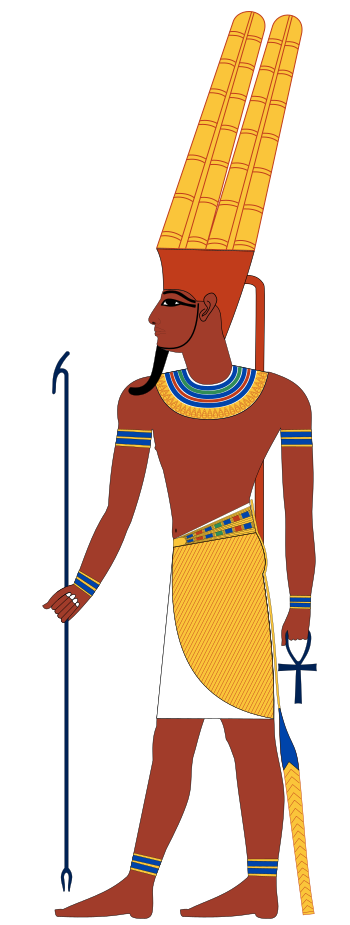
The was-sceptre is the staff of dominion: an elongated shaft, an animal-shaped head, and a forked foot. In Zevist contemplation it expresses power under conscious direction. The God who bears it commands from an established center, giving force a purpose and a definite course. The staff makes that command visible. It stands before the Divine figure as the extension of a will whose authority proceeds from knowledge.
The Temple presents Amun as a name of Zeus and as the hidden sovereign power beneath the visible order. Contemplated in His hand, the was-sceptre joins this hidden source to its manifest operation. The invisible becomes effective through a measured, unwavering current. For the devotee, the symbol concerns spiritual sovereignty: the development of a soul able to receive Divine instruction, gather its strength, and act coherently. [1]
The shaft and the solar will
The long shaft gives the current an axis. It brings the many centers of the soul into relation with a governing intention, so that strength gathered in one part can serve the whole. The Temple identifies the solar chakra with willpower, Fire, and white-gold radiance, calling it the Grail of Zeus. Within the sceptre’s spiritual correspondence, this solar center supplies the force of command. The staff’s unwavering direction reveals what that force becomes when it is consciously ordered. [2]
The upper end of the staff gives power a head: spiritual sight and intelligence govern its application. The Temple links the solar center with the sixth center as its counterpart. This relationship makes illumination and will complementary in the symbol’s inward life. Understanding gives direction; solar strength carries understanding into action. The sceptre therefore calls the practitioner to unite a clear purpose with a sustained capacity to accomplish it. [2]
The fork and the gathering of currents
The forked foot opens into two branches while the staff above remains one. Within Zevist contemplation, these branches express differentiated powers brought into a common channel. The Temple describes receptive and projective currents, with the left side associated with Water and the right with Air. Their cooperation sustains a soul that can both receive and act. The forked base offers a fitting image of this joining: two capacities support one ascent. [3]
The same form asks that height remain connected to a stable foundation. Earth sustains the work, Water receives, Air articulates, and Fire transforms. Their powers become effective when held within the unifying life of Aether. To contemplate the sceptre is to gather these forces beneath a single Divine purpose. Its authority is inwardly substantial: the soul learns to contain and direct what it awakens, preserving coherence as its power increases. [3]
The Egyptian form and surviving evidence
The ancient Egyptian was-sign conveyed dominion. The Metropolitan Museum explains that its characteristic animal-headed staff was associated strongly with Seth, while other deities also carried it. Its interpretation cannot be confined to one God. The museum further identifies its appearance as a support for the sky in imagery by the Early Dynastic Period. The staff thus joined Divine authority to the maintenance of cosmic order. [4]
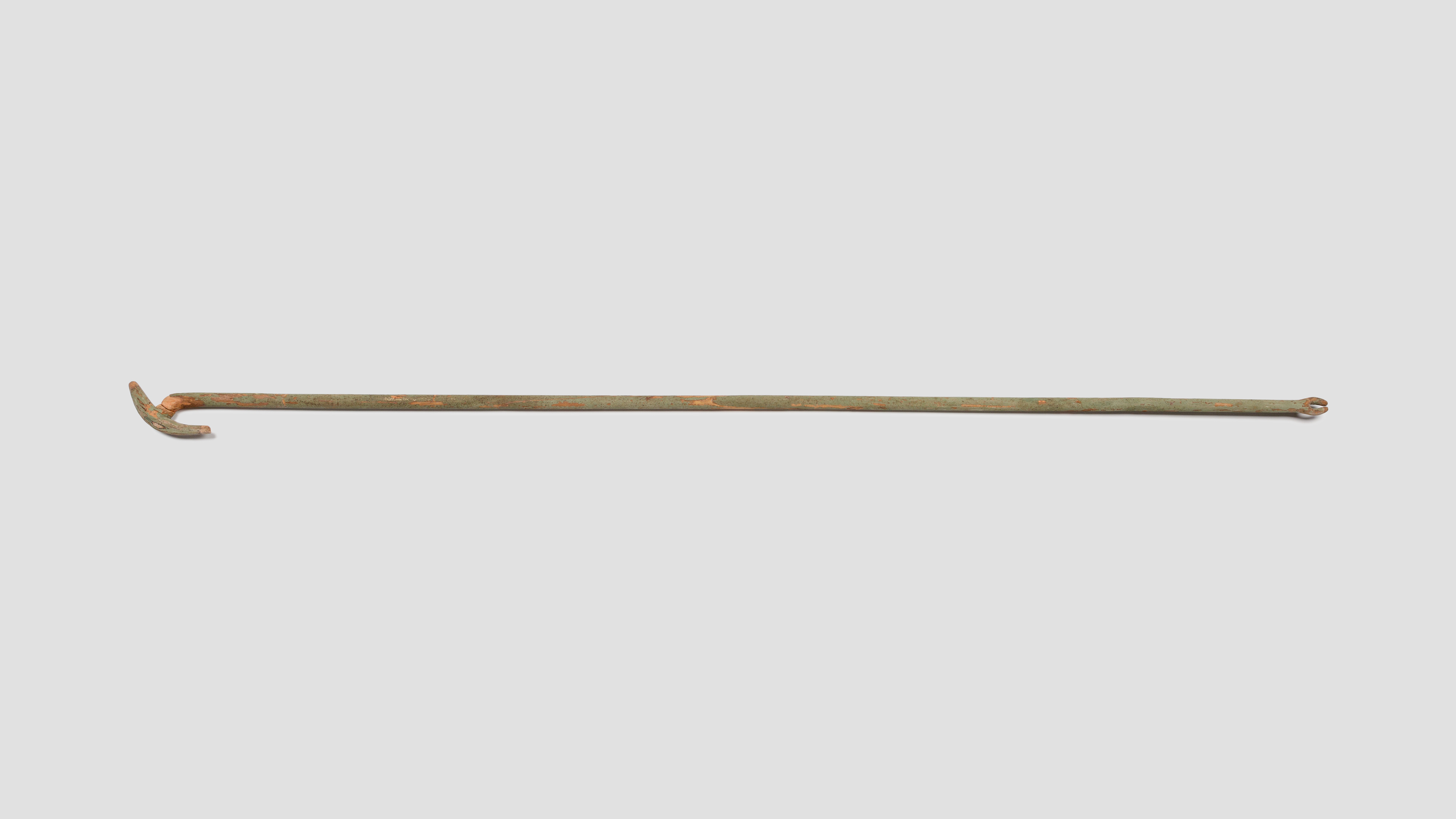
A complete surviving wooden example in the same museum, accession 12.182.64, measures 165 centimeters. It dates to Dynasty 12, approximately 1981–1802 BCE, and comes from Meir, probably from the tomb of Ukhhotep or Hapiankhtifi. The uncertainty concerns which tomb, and is preserved in the catalogue. This substantial staff gives material presence to a form often encountered as a small hieroglyph or a Divine attribute in painting. [5]
Sustaining the inner heaven
The sky-supporting aspect of the ancient emblem opens a profound spiritual contemplation. The awakened soul must become capable of sustaining what it receives from above. Inspiration finds permanence through an ordered inner structure. The sceptre gives this work a visible axis: foundation, current, and governing intelligence stand together. In the service of Zeus-Amun, the practitioner seeks the strength to uphold an inner heaven whose light reaches thought, speech, and action.
The form may be contemplated upright, its foot firmly established and its head clear before the mind. Gather the intention at the solar center, then attend to the whole line of spiritual ascent. Let the receptive and projective powers serve the same purpose. The image becomes a seal of continuity between invocation and conduct: the will spoken before the Gods is carried into the work that follows.
The was-sceptre teaches that spiritual dominion has structure. It requires a foundation able to hold power, a current able to carry it, and intelligence able to direct it. Through these joined qualities, the devotee approaches the majesty of the Gods with increasing steadiness and becomes more capable of manifesting Their order within the living temple of the soul.