 አማርኛ
አማርኛ العربية
 বাংলা
বাংলা Български
 中文
中文 Čeština
 Dansk
Dansk Deutsch
 Eesti
Eesti Ελληνικά
 Español
 Français
 हिन्दी
 Hrvatski
 IsiZulu
 Italiano
 日本語
日本語 Kiswahili
 Magyar
 Македонски
 नेपाली
 Nederlands
 فارسی
فارسی Polski
 Português
 Română
 Русский
 Slovenščina
 Suomi
Suomi Svenska
 Tagalog
 Türkçe
Existence, Cosmology and Ethics · The Ten Antithetical Powers · Power V
Fire and Water
Πῦρ καὶ Ὕδωρ
author: High Priest Zevios Metathronos
To the family of Zevists. A working teaching, grounded in Pindar's first Olympian ode, in Heraclitus and Thales, in Alcmaeon of Croton, Aristotle and the Hippocratic On Regimen, in Homer's smith and Plato's Timaeus, and in the Egyptian witness of Nun and the Island of Flame and of Ra's burning Eye quenched by a red flood. This is the fifth of the Ten Antithetical Powers, and it follows Light and Darkness. It sets out 3 things: that every living thing is composed of fire and water, which are contrary in both of their qualities, and that neither is evil; that under Ma'at the 2 hold ἰσονομία, equal rights, and produce health, while under Izfet one of them seizes μοναρχία and burns or drowns; and that Zeus, who steers all things by the thunderbolt and sends the rain, holds both, so the Zevist who masters this Power learns to govern his own heat and his own cold.
I. Opening: The Fifth Power
Light and Darkness opened this series and laid down its law. Every Power is a pair, and neither member is evil. Bound by Ma'at, the structured Order of Cosmic Existence that Zeus holds as Sovereign of the Cosmos, the pair works in harmony and builds life. Bound by Izfet, the same pair turns destructive, and existence falls back toward unstructured chaos. Izfet breaks a pair in 2 ways: one member seizes sole rule, or the pair is torn apart.
Power IV set the cosmos moving with Love and Strife. Power V shows what they move. Of all the elements, fire and water stand furthest apart. Aristotle gives the reason: "fire is hot and dry, air hot and wet, water cold and wet, and earth cold and dry" (On Generation and Corruption II.3, 330b3-5). Fire and water are contrary in both qualities at once. If any pair should be at war, it's this one. Yet the living world is made from exactly these 2, and the first Power returns in them in bodily form: fire is the body of light, and water is the dark deep.
II. The Ancient Witnesses
Pindar opens the first of his odes for the games of Zeus at Olympia with both:
Pindar, Olympian 1.1-2
«ἄριστον μὲν ὕδωρ, ὁ δὲ χρυσὸς αἰθόμενον πῦρ / ἅτε διαπρέπει νυκτὶ μεγάνορος ἔξοχα πλούτου.»
"Best is water; and gold, like blazing fire, shines out in the night above all lordly wealth."
Thales, whom Aristotle calls the founder of natural philosophy, said the first principle is water, perhaps "from seeing that the nourishment of all things is moist" (Metaphysics A.3, 983b20-22). Heraclitus answered with fire, and he tied fire to measure:
Heraclitus, DK 22 B30
«κόσμον τόνδε, τὸν αὐτὸν ἁπάντων, ... ἦν ἀεὶ καὶ ἔστιν καὶ ἔσται πῦρ ἀείζωον, ἁπτόμενον μέτρα καὶ ἀποσβεννύμενον μέτρα.»
"This cosmos, the same for all, ... always was and is and will be: ever-living fire, kindled in measures and quenched in measures."
Then he joins the 2 directly: "fire's turnings: first sea" (DK 22 B31). Fire becomes water, and water returns to fire. And he names what governs the exchange:
Heraclitus, DK 22 B64
«τὰ δὲ πάντα οἰακίζει Κεραυνός.»
"The Thunderbolt steers all things."
οἰακίζω means to steer by the tiller. The weapon of Zeus is the helm of the cosmos.
Greek medicine built on this. The Hippocratic author of On Regimen states that all living things, man included, "are composed of 2, different in power but working together in use: fire, I mean, and water" (On Regimen I.3). Alcmaeon of Croton, a physician of the Pythagorean circle, gave the law of their health:
Alcmaeon, DK 24 B4 (Aetius V.30.1)
«τῆς μὲν ὑγείας εἶναι συνεκτικὴν τὴν ἰσονομίαν τῶν δυνάμεων, ὑγροῦ, ξηροῦ, ψυχροῦ, θερμοῦ, πικροῦ, γλυκέος καὶ τῶν λοιπῶν, τὴν δ’ ἐν αὐτοῖς μοναρχίαν νόσου ποιητικήν· φθοροποιὸν γὰρ ἑκατέρου μοναρχίαν.»
"What holds health together is the equal rights of the powers, wet, dry, cold, hot, bitter, sweet and the rest; the monarchy of one among them produces disease, for the monarchy of either of a pair is destructive."
ἰσονομία is health. μοναρχία of one power is disease. Alcmaeon wrote the Izfet doctrine of this whole series in medical terms.
Plato gives the same law on the scale of history. An old priest of Sais tells Solon that "there have been, and will be, many destructions of mankind in many ways, the greatest by fire and water" (Timaeus 22c). The Greek story of Phaethon, who took his father's chariot, couldn't hold it on the road and burned the earth, records one of those fires. Then the priest adds: "for us the Nile, our saviour in other ways too, saves us from this plight as well" (Timaeus 22d). Water held in measure rescues a land from fire unmeasured.
III. The Egyptian Witness: Nun, the Island of Flame and the Red Flood
Egyptian cosmogony set creation at the meeting of the 2. Nun is the boundless water. The Island of Flame is the fiery place where the sun was born at the first moment and is reborn each dawn. Existence begins where fire rises out of water.
Egypt also told how the Sovereign governs both. In the Book of the Heavenly Cow, mankind plots against Ra, and Ra sends his Eye against them as Hathor. She slays them in the desert and becomes Sekhmet, a fire that won't stop. Ra's answer is water in measure:
Book of the Heavenly Cow (after M.-J. Nederhof, from de Buck's text)
"Go to Elephantine, and bring me haematite in great quantity. ... Seven thousand jars of beer were made. ... She drank and it pleased her heart, and she returned drunk without having perceived mankind."
The red beer is poured over the fields in the middle of the night, 3 palms deep. The flood quenches the burning Eye, and mankind survives. The fire remains in the world as Sekhmet, Ra's protector, and the water remains as the river. Neither is abolished. Ra rules both.
Egypt also knew the second face. In the Book of the Dead, Atum foretells that at the end he'll destroy all he has made and the land will return into Nun, into the flood, as it was in the beginning (Spell 175). Water with no fire left against it is the return to the formless.
IV. Fire and Water Under Ma'at
Under Ma'at, fire and water hold equal rights. Each checks the other, and life appears between them.
- The body. Your core runs near 37°C, held within about a degree, and water makes up roughly 50 to 60% of an adult body. Sweat is water sent to cool fire. Fever is a controlled fire the body lights against infection. Health is Alcmaeon's ἰσονομία, measured in degrees and litres.
- The forge. Homer knew the smith's secret: the smith plunges the glowing axe into cold water, "for this in turn is the strength of iron" (Odyssey IX.391-393). Heat steel, quench it in water and it turns hard; temper it with gentle heat and it turns tough. The finest blade is fire and water in exact measure.
- The weather. The sun's fire lifts water from the sea, and the rain returns it to the fields. The Athenians prayed, "Rain, rain, dear Zeus, on the ploughland of the Athenians and on the plains" (Marcus Aurelius, Meditations V.7). The same Zeus holds the thunderbolt.
- The kitchen and the engine. Fire and water together make bread, soup and every civilized meal. Fire boiling water drove the engines that built the modern world.
- Worship. Greek worship begins with water, the washing of hands in lustral water, and rises in fire on the altar. Purification first, ascent second.
The pattern of the first Power repeats. Water is the dark deep, Nun before the first dawn. Fire is light in body. When fire explores the dark water, the world is born, the way explored darkness becomes Light.
V. Fire and Water Under Izfet
The first face: fire alone. Fire seizes μοναρχία and burns. Phaethon scorches the earth. Sekhmet wades in blood. In the body, fever escapes control and heatstroke cooks the brain. In the forge, overheated steel burns and crumbles. In the soul, θυμός with no cooling becomes rage, fanaticism and burnout: the man who burns everything around him and finally himself.
The second face: water alone. Water seizes μοναρχία and drowns. Atum returns the world to Nun. In the body, hypothermia and drowning. In the forge, too severe a quench cracks the steel. In the soul, cold with no fire becomes apathy and sloth: the man who never ignites, feels nothing and builds nothing.
Both faces end in the destruction Alcmaeon names: φθοροποιὸν γὰρ ἑκατέρου μοναρχίαν, "the monarchy of either is destructive."
The Power at a Glance
| Domain | Under Ma'at | Izfet: Fire Alone | Izfet: Water Alone |
|---|---|---|---|
| Cosmos | Sun and sea in cycle | Phaethon: the earth burned | The deluge |
| Egypt | The Island of Flame rising from Nun | Sekhmet's slaughter | The world returned to Nun |
| Body | 37°C, 50 to 60% water | Heatstroke, fever out of control | Hypothermia, drowning |
| Forge | Heat, quench, temper | Burnt, crumbling steel | Quench cracks |
| Soul | Drive with composure | Rage, fanaticism, burnout | Apathy, sloth |
| Worship | Lustral water, then the altar fire | Frenzy with no purification | Washing with no ascent |
VI. The Argument
| Step | Statement | Witness |
|---|---|---|
| Observation | Every living thing is made of fire and water, contrary in both qualities. | On Regimen I.3; On Generation II.3 |
| First test | Let fire rule alone and it burns the living thing: fever, drought, conflagration. | Alcmaeon B4; Timaeus 22c |
| Second test | Let water rule alone and it drowns or chills it: flood, hypothermia, apathy. | Alcmaeon B4; Book of the Dead 175 |
| Third test | Keep their equal rights and health, bread, steel and weather appear. | Alcmaeon B4; Odyssey IX.391-393 |
| Conclusion | Neither fire nor water is evil. The monarchy of either is destruction. The Thunderbolt that steers all things holds both in measure. | Heraclitus B64 |
Objections Answered
- "Alcmaeon condemns monarchy, and Zeus is a monarch." Alcmaeon condemns the monarchy of one power over its equals: hot over cold, wet over dry. Zeus is no element. He stands above the elements as the Thunderbolt that steers them, and his sovereignty is what guarantees their equal rights, the way a judge over 2 litigants belongs to neither side. Where no sovereign stands above the elements, one of them always seizes power. The ἰσονομία of the powers depends on the βασιλεία of Zeus.
- "Fire destroys, so fire belongs to the evil side." Fire warms the hearth of Hestia, cooks the meal, lights the lamp, forges the blade and carries worship to the Gods. Plato says the knowledge of Limit and the Unlimited came down from the Gods "together with a blazing fire" (Philebus 16c). Fire unmeasured destroys. So does water unmeasured.
- "Water is gentle and harmless." Until it rules alone. The priest of Sais counted flood among the 2 greatest destroyers of mankind, and Atum's final threat is water.
VII. The Premise and Purpose in Zevism
Zevism's aim is ὁμοίωσις θεῷ κατὰ τὸ δυνατόν, becoming as the Gods, as far as possible (Theaetetus 176b). Human beings swing between heat and cold: ambition and exhaustion, fury and numbness. The Gods hold their powers in measure. Becoming as the Gods includes becoming a steady fire over still water, and that's a skill the Zevist trains.
The order of Greek worship already teaches it: water first, fire second. The worship of Zeus washes before it kindles, and the Zevist purifies before he ascends. This is the source, and the Zevist stands at the source.
| Dimension of the Zevist Path | What Fire and Water Train |
|---|---|
| Meditation (δυνατόν, capacity of power) | A steady flame of attention over the still water of the mind: neither agitation nor torpor. |
| Ethics (Φρόνησις and Justice) | Anger at the right things, toward the right people, in the right way, at the right time and for the right length (Aristotle, Nicomachean Ethics IV.5). Φρόνησις measures your fire. |
| Existential (a life in service of ὁμοίωσις θεῷ) | Campaigns and recovery, work and rest, heat and quench: the seasons of a life that forge a man instead of breaking him. |
| Theurgy (Σοφία, Θεουργία) | Purify with water, rise with fire. The order of worship is the order of ascent. |
The Ethic of Fire and Water
- Know your temperament. Some run hot and some run cold. Learn which way you lean, and bring in the other element deliberately: the hot man learns stillness, the cold man learns ignition.
- Quench your steel. After every heat comes the quench: after battle, rest; after a great effort, stillness. That's how a man gets hard without turning brittle.
- Keep the hearth burning. Never let your fire go out entirely. Even in grief and exhaustion, keep one flame alive: one discipline, one act of worship, one task you finish every day.
- Keep the wells full. Fire with no water behind it is burnout. Refill through study, sleep, silence and the company of those who calm you.
- Purify before you kindle. Before any great act, wash: clear the mind, settle the body, put down resentment. Then light the fire.
VIII. Correlation and Closing
Fire and Water stands at the center of the Cosmology row of the tetractys, between Love and Strife and Time and Eternity. Love and Strife move the elements, and this Power shows which elements they move. Heraclitus's fire "always was and is and will be," which leads into Power VI. Fire kindled "in measures" returns to Power II, and fire as the body of light returns to Power I.
| Power | Pair | Row of the Tetractys |
|---|---|---|
| I | Light and Darkness | Apex |
| II | Limit and Unlimited | Existence |
| III | The One and the Many | Existence |
| IV | Love and Strife | Cosmology |
| V | Fire and Water | Cosmology |
| VI | Time and Eternity | Cosmology |
| VII | Necessity and Freedom | Ethics |
| VIII | Memory and Forgetting | Ethics |
| IX | Pleasure and Pain | Ethics |
| X | Ascent and Descent | Ethics |
Heraclitus, DK 22 B64
«τὰ δὲ πάντα οἰακίζει Κεραυνός.»
"The Thunderbolt steers all things."
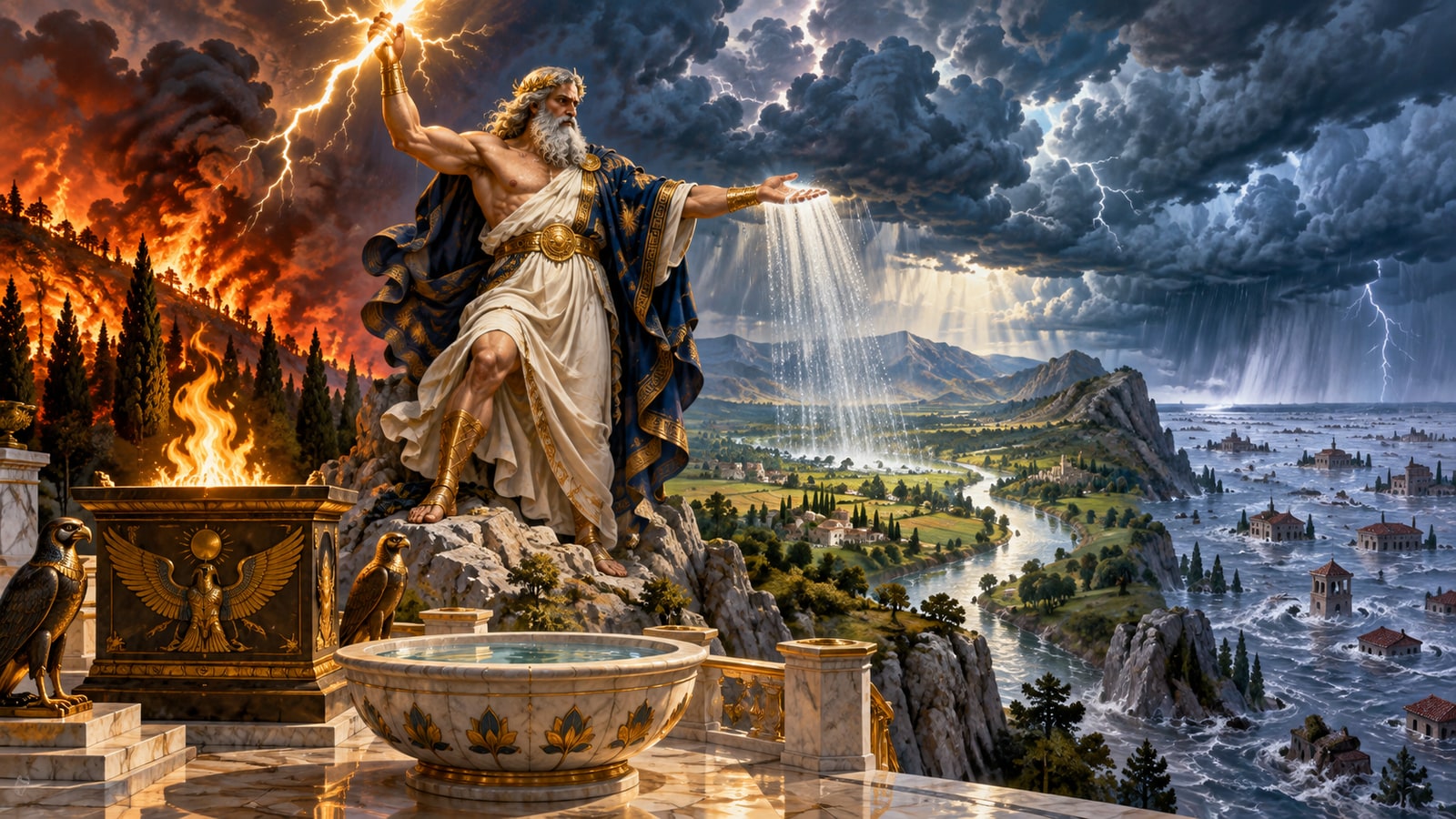
Zeus holds the thunderbolt in one hand and the rain in the other. Burn like his fire, stay clear like his water, and let no single power rule you.
ZEFS AENAOS.
High Priest Zevios Metathronos
Temple of Zeus Foundation