 አማርኛ
አማርኛ العربية
 বাংলা
বাংলা Български
 中文
中文 Čeština
 Dansk
Dansk Deutsch
 Eesti
Eesti Ελληνικά
 Español
 Français
 हिन्दी
 Hrvatski
 IsiZulu
 Italiano
 日本語
日本語 Kiswahili
 Magyar
 Македонски
 नेपाली
 Nederlands
 فارسی
فارسی Polski
 Português
 Română
 Русский
 Slovenščina
 Suomi
Suomi Svenska
 Tagalog
 Türkçe
Existence, Cosmology and Ethics · The Ten Antithetical Powers · Power VII
Necessity and Freedom
Ἀνάγκη καὶ Ἐλευθερία
author: High Priest Zevios Metathronos
To the family of Zevists. A working teaching, grounded in Plato's Timaeus and Republic, in Homer's Odyssey, Heraclitus and Simonides, in Cleanthes, Epictetus and Seneca, in Pausanias's altars of Zeus Moiragetes and Herodotus's account of Xerxes, and in the Egyptian witness of Shai and Renenet and the weighing of the heart. This is the seventh of the Ten Antithetical Powers, the first of the Powers of Ethics, and it follows Light and Darkness. It sets out 3 things: that every human life is lived between what can't be changed and what can be chosen, and neither is evil; that under Ma'at mind persuades necessity and the will moves with it, as Zeus leads the Moirai, while under Izfet necessity alone breeds the fatalism of the andrapod and freedom alone breeds the ὕβρις of Xerxes; and that the Zevist becomes as the Gods by leading his necessity instead of being dragged by it.
I. Opening: The Seventh Power
Light and Darkness opened this series and laid down its law. Every Power is a pair, and neither member is evil. Bound by Ma'at, the structured Order of Cosmic Existence that Zeus holds as Sovereign of the Cosmos, the pair works in harmony and builds life. Bound by Izfet, the same pair turns destructive, and existence falls back toward unstructured chaos. Izfet breaks a pair in 2 ways: one member seizes sole rule, or the pair is torn apart.
The first 6 Powers built the world: its principles in the row of Existence, its motion in the row of Cosmology. The row of Ethics asks how a human being should live inside that world, and ethics begins with one question. Epictetus puts it in the first line of his handbook: "Of the things that exist, some are up to us, and some are not" (Enchiridion 1.1). What's not up to you is necessity. What's up to you is freedom. This Power governs every decision you'll ever make.
II. The Ancient Witnesses
Plato places this pair at the birth of the cosmos itself:
Plato, Timaeus 47e-48a
«μεμειγμένη γὰρ οὖν ἡ τοῦδε τοῦ κόσμου γένεσις ἐξ ἀνάγκης τε καὶ νοῦ συστάσεως ἐγεννήθη· νοῦ δὲ ἀνάγκης ἄρχοντος τῷ πείθειν αὐτὴν τῶν γιγνομένων τὰ πλεῖστα ἐπὶ τὸ βέλτιστον ἄγειν, ταύτῃ κατὰ ταῦτά τε δι’ ἀνάγκης ἡττωμένης ὑπὸ πειθοῦς ἔμφρονος οὕτω κατ’ ἀρχὰς συνίστατο τόδε τὸ πᾶν.»
"The generation of this cosmos was mixed, born from a combination of necessity and intellect. Intellect ruled necessity by persuading her to lead most of the things that come to be toward what is best, and so, through necessity yielding to wise persuasion, this universe was built in the beginning."
Mind rules necessity by persuasion, τῷ πείθειν, and leads her toward the best. Simonides says the same of the Gods: "against necessity not even the Gods fight," ἀνάγκῃ δ’ οὐδὲ θεοὶ μάχονται (quoted in Plato, Protagoras 345d). The Gods lead necessity.
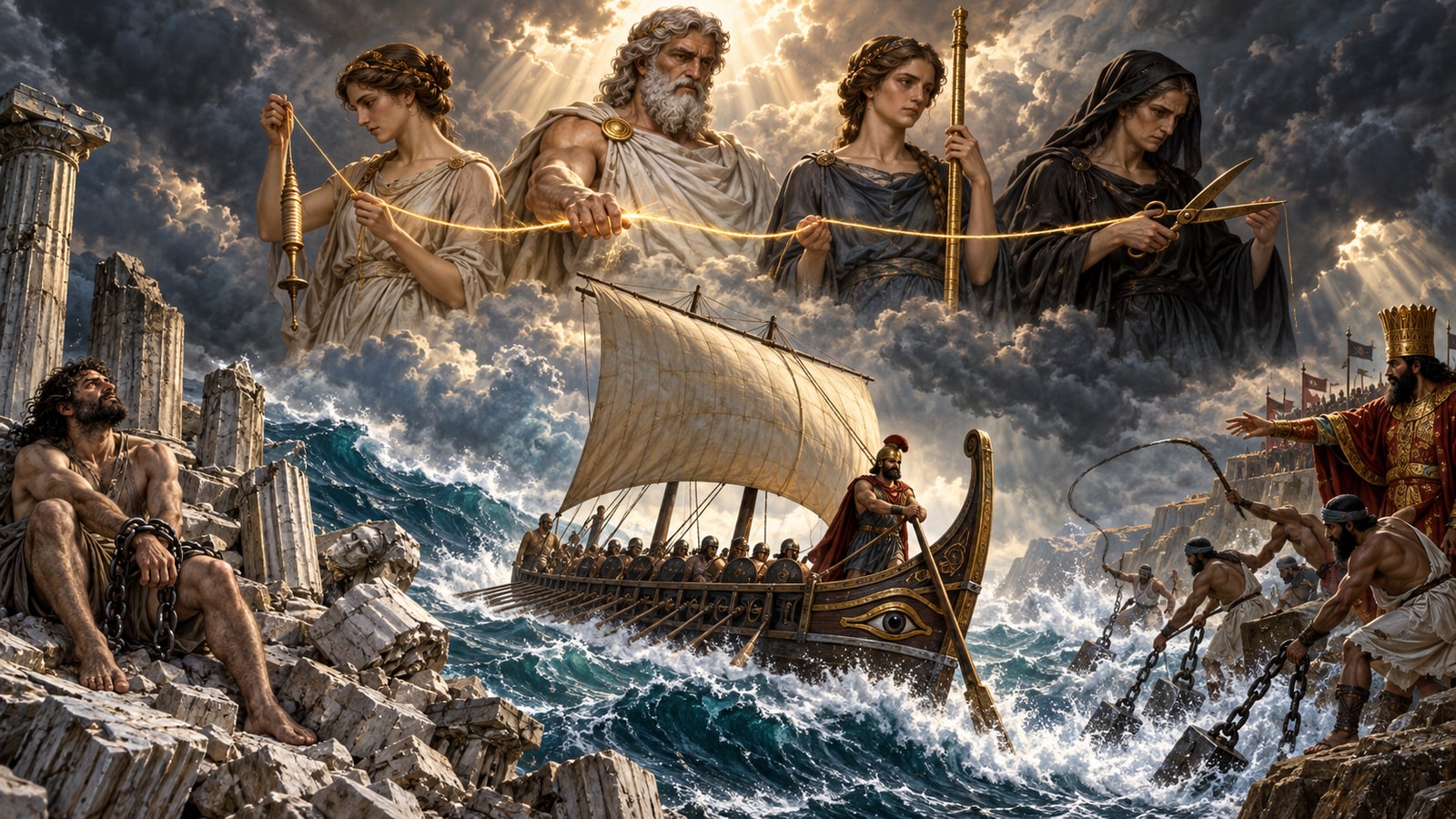
The Greeks gave that leadership to Zeus by title. At Olympia, on the way to the starting gate of the horses, stood an altar inscribed Μοιραγέτα:
Pausanias V.15.5
«δῆλα οὖν ἐστιν ἐπίκλησιν εἶναι Διὸς ὃς τὰ ἀνθρώπων οἶδεν, ὅσα διδόασιν αἱ Μοῖραι καὶ ὅσα μὴ πέπρωταί σφισι.»
"Clearly it's a title of Zeus, who knows the affairs of men: all that the Moirai grant, and all that is not fated for them."
At Delphi, Pausanias saw statues of 2 Moirai, and "in place of the third, Zeus Moiragetes and Apollo Moiragetes stand beside them" (Pausanias X.24.4). Zeus stands where Fate herself would stand. He's the Leader of the Fates.
Yet the Greeks never let fate excuse a man. In the Myth of Er, the souls stand before Lachesis, daughter of Necessity, and hear her herald:
Plato, Republic X, 617e
«ἀρετὴ δὲ ἀδέσποτον, ἣν τιμῶν καὶ ἀτιμάζων πλέον καὶ ἔλαττον αὐτῆς ἕκαστος ἕξει. αἰτία ἑλομένου· θεὸς ἀναίτιος.»
"Virtue has no master; as each honours or dishonours her, he'll have more or less of her. The responsibility is the chooser's; God is not responsible."
Just before, the herald tells them: "No daimon will draw you by lot; you will choose your daimon." Heraclitus says it in 3 words: ἦθος ἀνθρώπῳ δαίμων, "character is a man's destiny" (DK 22 B119).
Zeus himself opens the Odyssey with this doctrine:
Homer, Odyssey I.32-34
«ὢ πόποι, οἷον δή νυ θεοὺς βροτοὶ αἰτιόωνται· / ἐξ ἡμέων γάρ φασι κάκ’ ἔμμεναι, οἱ δὲ καὶ αὐτοὶ / σφῇσιν ἀτασθαλίῃσιν ὑπὲρ μόρον ἄλγε’ ἔχουσιν.»
"Oh, how mortals blame the Gods! They say their troubles come from us, yet they themselves, by their own reckless folly, suffer beyond their lot."
ὑπὲρ μόρον: beyond their lot. Fate assigns a portion. Folly adds the rest.
Cleanthes turned the doctrine into a prayer, and Epictetus closes his handbook with it:
Cleanthes, quoted in Epictetus, Enchiridion 53 (text of Schenkl)
«ἄγου δέ μ’, ὦ Ζεῦ, καὶ σύ γ’ ἡ Πεπρωμένη, / ὅποι ποθ’ ὑμῖν εἰμι διατεταγμένος· / ὡς ἕψομαί γ’ ἄοκνος· ἢν δέ γε μὴ θέλω, / κακὸς γενόμενος, οὐδὲν ἧττον ἕψομαι.»
"Lead me, Zeus, and you too, Destiny, wherever you've appointed me; I'll follow without shrinking. And if I'm unwilling, I'll become base and follow all the same."
Seneca compressed it into a single line: "Ducunt volentem fata, nolentem trahunt," "The Fates lead the willing and drag the unwilling" (Letters 107.11).
III. The Egyptian Witness: Shai, Renenet and the Heart
Egypt named the given portion Shai, Fate, and set Renenet, Fortune, beside him. Amenemope warns: "Do not set your heart on wealth, there is no ignoring Fate and Fortune; do not let your heart go straying, every man comes to his hour" (Instruction of Amenemope, chapter 7, after Lichtheim). A man can't choose his hour.
And yet Egypt judged every man by his heart. In the Hall of the Two Truths, the heart is weighed against the feather of Ma'at, and the dead man declares the wrongs he didn't commit (Book of the Dead, Spell 125). The scale weighs conduct. Ptahhotep states the principle behind it: "Great is Ma'at, lasting in effect, unchallenged since the time of Osiris" (Maxim 5, adapted from Lichtheim, who renders Ma'at as "justice"). Fate sets the hour; Ma'at judges the heart.
IV. Necessity and Freedom Under Ma'at
Under Ma'at, mind persuades necessity and the will moves with it. Freedom grows by understanding what can't be changed and working through it.
- The helmsman. No sailor chooses the wind. He chooses the sail, the angle and the course, and a well-handled ship can make headway straight into the wind by tacking across it. Necessity supplies the force. Freedom supplies the direction.
- The aircraft. No aircraft defies gravity. It uses the pressure of the air on its wings, which obeys the same physical law, and rises. Every flight is necessity persuaded.
- The body. Heredity loads the risk; choices shape the outcome. In the Diabetes Prevention Program, adults at high risk who changed their diet and exercise cut their onset of type 2 diabetes by 58% (New England Journal of Medicine, 2002). The genes were necessity. The 58% was freedom.
- The market. No trader chooses the direction of the market. He chooses his size, his entry and his exit. The market is necessity; the risk he carries is his own choice, and his own responsibility.
- The Zevist's life. Your birth, era and nation are given. What you make of them is yours. The Temple itself was founded in the cultural ruins, and the founding was a choice.
The pattern of the first Power repeats. Necessity is like darkness: the part of the world you can't see into or change. Explored, it becomes known ground, and known ground is where freedom stands. Every law of nature you understand turns a wall into a tool.
V. Necessity and Freedom Under Izfet
The first face: necessity alone. The will surrenders, and fate becomes an excuse. This is the andrapod of Private Essay No. 5: the one who lives in the cultural ruins and complains, attacks, negates, deflects and reminisces instead of restoring. The system did it, history did it, the Gods did it. Victimhood becomes an addictive identity that removes corrective justice, because a man who can't act can't be held to account. Zeus answered this condition in the first scene of the Odyssey: mortals blame the Gods and suffer beyond their lot by their own folly.
The second face: freedom alone. The will denies necessity and breaks against it. When a storm wrecked his bridge across the Hellespont, Xerxes ordered the sea given 300 lashes and a pair of fetters sunk into it, and had it addressed: "O bitter water, your master lays this penalty on you" (Herodotus VII.35). Months later his fleet lay broken at Salamis. Icarus flew toward the sun as if wax didn't melt. The gambler who thinks the odds don't apply to him, and the doctrine that a person can become anything by decree, share the same face.
The Power at a Glance
| Domain | Under Ma'at | Izfet: Necessity Alone (Fatalism) | Izfet: Freedom Alone (Hubris) |
|---|---|---|---|
| Cosmos | Mind persuades necessity | Blind mechanism, no mind | A will that ignores law: no cosmos |
| Sea | The helmsman tacks into the wind | Drifting where the wind blows | Xerxes whipping the sea |
| Body | Inherited risk met by chosen habits | "It's in my genes" | Ignoring limits until the body breaks |
| Market | Position sized to the market | "The market robbed me" | Leverage with no stop |
| Soul | Character chosen, destiny shaped | The andrapod blaming fate | Icarus |
| Religion | ὁμοίωσις θεῷ κατὰ τὸ δυνατόν | "All is decreed; nothing to do" | Self-deification by decree, with no discipline |
VI. The Argument
| Step | Statement | Witness |
|---|---|---|
| Observation | Every life has 2 parts: what's given (body, era, birth, the laws of nature) and what's chosen (character, effort, direction). | Epictetus, Enchiridion 1.1 |
| First test | Deny necessity and you break against it: Xerxes whips the sea and loses his fleet. | Herodotus VII.35 |
| Second test | Deny freedom and you drift, blame, and suffer "beyond your lot." | Odyssey I.32-34 |
| Third test | Let mind persuade necessity, and the cosmos itself appears; let the will move with necessity, and a human life becomes a work. | Timaeus 47e-48a |
| Conclusion | Neither necessity nor freedom is evil. Evil is the fatalism that surrenders the will or the ὕβρις that denies the world. Zeus leads the Moirai. | Pausanias V.15.5; X.24.4 |
Objections Answered
- "If everything is fated, choice is an illusion." Lachesis, daughter of Necessity, tells the souls that they'll choose their own daimon, and that the responsibility is the chooser's. The Moirai spin the thread; the soul chooses the life. Seneca adds the last word: the Fates lead the willing and drag the unwilling. Your choice decides whether you're led or dragged.
- "My circumstances made me what I am." Circumstances set the field, and conduct decides the game. Zeus says men suffer beyond their lot by their own folly, and Egypt weighed the heart, never the circumstances. Plenty of men were born into ruins. Some complained there for life; others rebuilt.
- "Then I can become anything I will." Not even the Gods fight necessity. Freedom grows by understanding necessity, the way the helmsman's freedom grows with his knowledge of the wind. A will that ignores the world ends like Xerxes.
VII. The Premise and Purpose in Zevism
Private Essay No. 5 sets out the Zevist resolution: the andrapod's condition is a natural slavery, the Temple of Zeus has resolved the conflict, the Creator and Übermensch replaces the slave-minded victim, and creation is open forward and requires work. This Power is the metaphysics beneath that doctrine. Necessity is real, and it's the material. Freedom is real, and it's the craft.
The aim is ὁμοίωσις θεῷ κατὰ τὸ δυνατόν, becoming as the Gods, as far as possible (Theaetetus 176b). Zeus is Moiragetes: he leads the Fates. To become as the Gods is to lead your own necessity, as far as possible, instead of being dragged by it. The theurgists went further. Iamblichus taught that the soul holds a principle higher than all nature, by which it can be united with the Gods and rise above the order of the cosmos, and that through priestly theurgy it ascends to what lies above fate (On the Mysteries VIII.4, VIII.7).
| Dimension of the Zevist Path | What Necessity and Freedom Train |
|---|---|
| Meditation (δυνατόν, capacity of power) | Seeing clearly what's up to you and what isn't: calm toward the given, full force on the chosen. |
| Ethics (Φρόνησις and Justice) | Φρόνησις is the helmsman's art. Justice places responsibility on the chooser: αἰτία ἑλομένου. |
| Existential (a life in service of ὁμοίωσις θεῷ) | Follow willingly where the order leads, and build without limit where the choice is yours. |
| Theurgy (Σοφία, Θεουργία) | Joined to the Gods, the soul rises above the bonds of fate. |
The Ethic of Necessity and Freedom
- Sort the given from the chosen. Every morning, name what you can't change today and what you can. Spend no energy fighting the first. Spend all of it on the second.
- Stop blaming. The moment you hear yourself blame the Gods, the system, your history or your nation for your present condition, recall Zeus's words and ask what folly of your own is adding to your lot.
- Respect the wind. Study the laws you live under: of the body, of money, of power, of nature. Every law you understand becomes a force you can use.
- Choose your daimon. Your character is your destiny. Build it deliberately, habit by habit, because it'll carry you further than any circumstance.
- Follow willingly. When the order of things leads you somewhere hard, go without shrinking. The willing are led; the unwilling are dragged to the same place.
VIII. Correlation and Closing
Necessity and Freedom opens the Ethics row of the tetractys, beside Memory and Forgetting, Pleasure and Pain, and Ascent and Descent. Necessity is Limit at the scale of a human life, and freedom lives inside that shore, which is Power II. The Moirai are sisters of the Horai, both fathered by Zeus, which is Power VI. Heraclitus says "all things come to pass through strife and necessity," which joins Power IV. Pleasure and pain are the 2 great pulls on every choice, which leads into Power IX.
| Power | Pair | Row of the Tetractys |
|---|---|---|
| I | Light and Darkness | Apex |
| II | Limit and Unlimited | Existence |
| III | The One and the Many | Existence |
| IV | Love and Strife | Cosmology |
| V | Fire and Water | Cosmology |
| VI | Time and Eternity | Cosmology |
| VII | Necessity and Freedom | Ethics |
| VIII | Memory and Forgetting | Ethics |
| IX | Pleasure and Pain | Ethics |
| X | Ascent and Descent | Ethics |
Seneca, Letters 107.11
«Ducunt volentem fata, nolentem trahunt.»
"The Fates lead the willing and drag the unwilling."
Zeus leads the Fates. Walk with him, choose your daimon, and take the helm of your own life.
ZEFS AENAOS.
High Priest Zevios Metathronos
Temple of Zeus Foundation