 አማርኛ
አማርኛ العربية
 বাংলা
বাংলা Български
 中文
中文 Čeština
 Dansk
Dansk Deutsch
 Eesti
Eesti Ελληνικά
 Español
 Français
 हिन्दी
 Hrvatski
 IsiZulu
 Italiano
 日本語
日本語 Kiswahili
 Magyar
 Македонски
 नेपाली
 Nederlands
 فارسی
فارسی Polski
 Português
 Română
 Русский
 Slovenščina
 Suomi
Suomi Svenska
 Tagalog
 Türkçe
Existence, Cosmology and Ethics · The Ten Antithetical Powers · Power VIII
Memory and Forgetting
Μνημοσύνη καὶ Λήθη
author: High Priest Zevios Metathronos
To the family of Zevists. A working teaching, grounded in Hesiod's Theogony, the Orphic gold tablet of Petelia, Plato's Meno, Phaedrus and Republic, Pausanias on the oracle of Trophonius and Aristotle on the amnesty of Athens and the bitter man, and in the Egyptian witness of the name that must be spoken and the book that makes a man remembered. This is the eighth of the Ten Antithetical Powers, and it follows Light and Darkness. It sets out 3 things: that memory and forgetting both serve the soul, and neither is evil; that under Ma'at memory is the recollection of the source and forgetting is release from grievance, both given through the Muses whom Mnemosyne bore to Zeus, while under Izfet memory hardens into grievance and forgetting sinks into amnesia of the source; and that the Zevist restores the source by remembering what he is.
I. Opening: The Eighth Power
Light and Darkness opened this series and laid down its law. Every Power is a pair, and neither member is evil. Bound by Ma'at, the structured Order of Cosmic Existence that Zeus holds as Sovereign of the Cosmos, the pair works in harmony and builds life. Bound by Izfet, the same pair turns destructive, and existence falls back toward unstructured chaos. Izfet breaks a pair in 2 ways: one member seizes sole rule, or the pair is torn apart.
Power VI gave the cosmos its time. Memory is the soul's hold on time: what it keeps from the past and what it lets go. This Power sits at the heart of the Zevist method, because Zevism looks to the past and holds that one must stand at the source. A Zevist who misunderstands memory will either lose the source or drown in the ruins.
II. The Ancient Witnesses
Hesiod gives the genealogy that governs this whole Power:
Hesiod, Theogony 53-55
«τὰς ἐν Πιερίῃ Κρονίδῃ τέκε πατρὶ μιγεῖσα / Μνημοσύνη, γουνοῖσιν Ἐλευθῆρος μεδέουσα, / λησμοσύνην τε κακῶν ἄμπαυμά τε μερμηράων.»
"These Mnemosyne, who rules the hills of Eleuther, bore in Pieria after lying with the father, the son of Kronos: a forgetting of evils and a rest from cares."
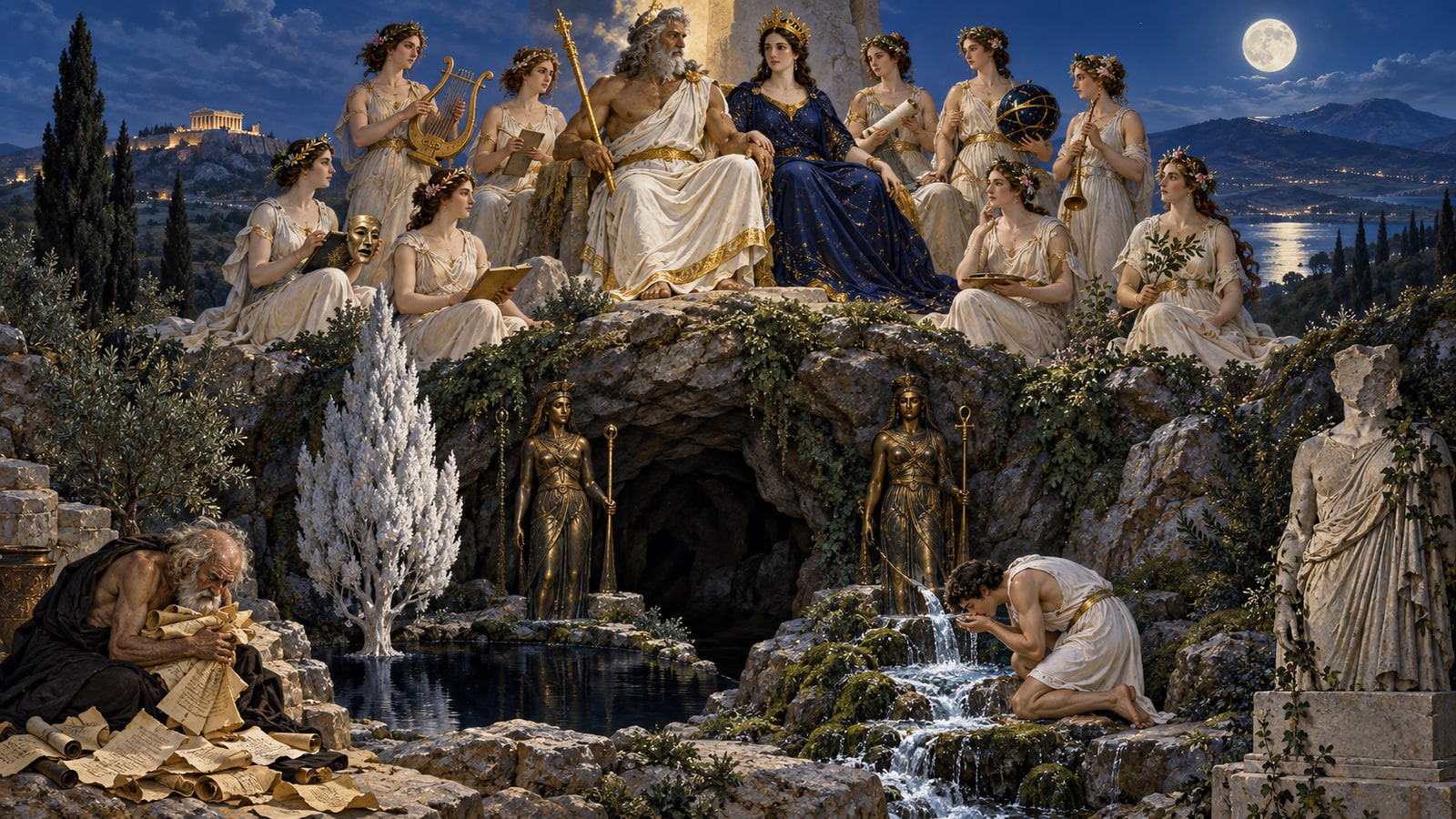
Memory, joined to Zeus, gives birth to the Muses, and the Muses bring forgetting of evils. Memory and forgetting come from one mother and one father. Hesiod shows how it works: when a man is withered with fresh grief and a singer, servant of the Muses, sings the glories of earlier men and the blessed Gods, "at once he forgets his heaviness and remembers none of his cares" (Theogony 98-103). Remembering the great releases the small.
The Orphic initiates carried this Power into death. A gold tablet buried with one of them at Petelia gives the instructions:
Orphic gold tablet from Petelia (OF 476 Bernabé)
«εὑρήσεις δ’ Ἀΐδαο δόμων ἐπ’ ἀριστερὰ κρήνην, / πὰρ δ’ αὐτῆι λευκὴν ἑστηκυῖαν κυπάρισσον· / ταύτης τῆς κρήνης μηδὲ σχεδὸν ἐμπελάσειας. / εὑρήσεις δ’ ἑτέραν, τῆς Μνημοσύνης ἀπὸ λίμνης / ψυχρὸν ὕδωρ προρέον· φύλακες δ’ ἐπίπροσθεν ἔασιν. / εἰπεῖν· Γῆς παῖς εἰμι καὶ Οὐρανοῦ ἀστερόεντος, / αὐτὰρ ἐμοὶ γένος οὐράνιον.»
"You'll find on the left of the house of Hades a spring, and standing beside it a white cypress. Don't even come near this spring. You'll find another: cold water flowing from the lake of Memory, and guards stand before it. Say: 'I am a child of Earth and starry Heaven, but my race is heavenly.'"
What the initiate remembers at the spring is his own origin. His race is heavenly. That's memory at its highest.
Plato made it the key to all learning. Socrates tells Meno that the soul has seen all things, so that "if one is brave and doesn't tire of seeking," nothing stops him from recovering them:
Plato, Meno 81d
«τὸ γὰρ ζητεῖν ἄρα καὶ τὸ μανθάνειν ἀνάμνησις ὅλον ἐστίν.»
"For seeking and learning are, after all, wholly recollection."
Yet Plato also gives Lethe her place. In the Myth of Er, the souls about to be reborn cross the plain of Lethe and camp by the river Ameles, and each must drink a measure of its water; those not saved by wisdom drink more than the measure and forget everything (Republic X, 621a). Forgetting has a measure too.
The oracle of Trophonius at Lebadeia set both waters in their right order:
Pausanias IX.39.8
«ἐνταῦθα δὴ χρὴ πιεῖν αὐτὸν Λήθης τε ὕδωρ καλούμενον, ἵνα λήθη γένηταί οἱ πάντων ἃ τέως ἐφρόντιζε, καὶ ἐπὶ τῷδε ἄλλο αὖθις ὕδωρ πίνειν Μνημοσύνης· ἀπὸ τούτου τε μνημονεύει τὰ ὀφθέντα οἱ καταβάντι.»
"There he must drink the water called Lethe, so that he forgets everything he had been thinking until then; and after this he drinks another water, of Mnemosyne, and by it he remembers what he saw in his descent."
Lethe first, to clear the mind. Mnemosyne second, to keep what the Gods show. Under Ma'at, both waters serve revelation.
III. The Egyptian Witness: The Name and the Book
Egypt held the name, ren, to be part of the person. The tombs asked passers-by to speak the names of the dead and recite the offering formula for them, because a name spoken keeps its bearer present among the living. Erasing a name destroyed the person a second time. That's why the king list of Seti I at Abydos passes in silence from Amenhotep III to Horemheb, leaving out Akhenaten and the kings of his line.
Egypt also knew how memory outlives a body. A scribe of the Ramesside age wrote:
"The Immortality of Writers," Papyrus Chester Beatty IV (after Lichtheim)
"Man decays, his corpse is dust, all his kin have perished; but a book makes him remembered through the mouth of its reciter."
Plato preserves the other half of the Egyptian teaching. In the Phaedrus, Theuth, the Egyptian Thoth, lord of the Logos, brings writing to King Thamus, whom Plato identifies with Ammon, and the king warns him:
Plato, Phaedrus 275a
«τοῦτο γὰρ τῶν μαθόντων λήθην μὲν ἐν ψυχαῖς παρέξει μνήμης ἀμελετησίᾳ ... οὔκουν μνήμης ἀλλὰ ὑπομνήσεως φάρμακον ηὗρες.»
"This will produce forgetfulness in the souls of those who learn it, through neglect of memory. ... You've found a drug not of memory but of reminding."
Thoth's book preserves. Ammon's warning keeps the memory alive inside the soul. Egypt needed both: the written record and the living mind that recites it.
IV. Memory and Forgetting Under Ma'at
Under Ma'at, memory is recollection of the source and forgetting is release from what poisons. The soul keeps the lesson and lets go of the sting.
- The immune system. A vaccine teaches the body to remember an enemy for decades. The same system learns tolerance: it lets harmless things pass without attack. Memory and tolerance together make immunity.
- The brain. The developing brain prunes away vast numbers of unused connections, and the connections that remain grow stronger. Learning is keeping and letting go at once.
- Athens, 403 BC. After the Thirty Tyrants fell, the restored city swore an amnesty: "concerning past events, no one is permitted to remember wrongs against anyone," μνησικακεῖν, except against the Thirty and a few officials, "and not even against these, if they submit to an audit" (Aristotle, Constitution of the Athenians 39.6). When a man broke the oath, he was put to death, and "no one ever again bore a grudge" (40.2). Justice first, then release. The city healed.
- The Temple. Restoring the Gods, the texts and the rites is memory. Refusing to relive every wound of the ruins is forgetting. The Temple does both.
The pattern of the first Power repeats. The forgotten is darkness, and remembering brings it into the light. Forgetting under Ma'at is the night that lets a new day begin: sleep clears the mind so that morning can see.
V. Memory and Forgetting Under Izfet
The first face: memory alone. Memory refuses to release and becomes grievance. Aristotle describes the bitter man: "the bitter are hard to reconcile and stay angry a long time, for they hold their anger in" (Nicomachean Ethics IV.5, 1126a19-21). The body shows this face as allergy, the immune system remembering a harmless thing as an enemy. The mind shows it in post-traumatic stress, where a fear memory refuses to fade and replays itself. The city shows it as blood feud, where every killing remembers the last. And the culture shows it as the andrapod of Private Essay No. 5: the one who reminisces in the ruins, rehearses old wrongs and turns grievance into an identity. Private Essay No. 5 names this cultural paralysis as the parallel of PTSD. Memory that only laments never rebuilds.
The second face: forgetting alone. Forgetting drinks beyond the measure and becomes amnesia of the source. The souls "not saved by wisdom" drink too much of Ameles and forget everything. Theseus and Pirithous sat down in Hades on the throne of Lethe, and they grew fast to it, held by serpent coils (Apollodorus, Epitome 1.24). A people that forgets its Gods, its founders and its own language becomes whatever others tell it to be. That's how the source was lost in the first place.
The Power at a Glance
| Domain | Under Ma'at | Izfet: Memory Alone (Grievance) | Izfet: Forgetting Alone (Amnesia) |
|---|---|---|---|
| Soul | Lethe in measure, then Mnemosyne | The ghost that can't let go | Drinking beyond the measure |
| Body | Immune memory and tolerance | Allergy and autoimmunity | An immunity that forgets |
| Brain | Keep and prune | Fear that won't fade | Dementia |
| City | The amnesty of 403 BC under law | Blood feud | A people ignorant of its founders |
| Egypt | The name spoken, the book recited | Old enmities carved in stone | The name chiselled away |
| Culture | The source restored | The andrapod reminiscing in the ruins | The source forgotten |
VI. The Argument
| Step | Statement | Witness |
|---|---|---|
| Observation | Every living mind keeps and lets go at once: the brain prunes, the body remembers and tolerates, the city records and forgives. | Theogony 53-55 |
| First test | Keep everything and the soul drowns in old wounds: the bitter man, the vendetta, the fear that won't fade. | Nicomachean Ethics IV.5 |
| Second test | Let everything go and the soul loses itself: the plain of Lethe, the throne of Lethe, the forgotten source. | Republic X, 621a; Apollodorus, Epitome 1.24 |
| Third test | Drink Lethe first, then Mnemosyne, and the soul sees and remembers what it saw. | Pausanias IX.39.8 |
| Conclusion | Neither memory nor forgetting is evil. Evil is memory hardened into grievance or forgetting sunk into amnesia. Zeus fathered on Mnemosyne the Muses, who give memory and the forgetting of evils together. | Theogony 53-55 |
Objections Answered
- "Forgetting wrongs lets the guilty escape." Athens exempted the Thirty from the amnesty unless they submitted to an audit. Under Ma'at, forgetting follows justice: judge, then release. The man who keeps his grievance forever keeps the wound and calls it justice.
- "The past is gone. Why keep remembering it?" You are what you remember. Plato calls all learning recollection, and the initiate at the spring of Memory recovers his heavenly race. A people without memory can be told anything.
- "Remembering past glory is exactly what the Temple does." The Temple restores; the andrapod reminisces. Memory under Ma'at acts and rebuilds. Memory under Izfet laments and stays seated. The Temple remembers the source in order to build on it.
VII. The Premise and Purpose in Zevism
Zevism focuses on the past because one must stand at the source. Knowledge evolves through transmission, and the source holds priority. That's Mnemosyne's work, done under Ma'at: memory in service of restoration. The andrapod and the Zevist both look back. The andrapod sees the ruins and weeps. The Zevist sees the source and builds.
The aim is ὁμοίωσις θεῷ κατὰ τὸ δυνατόν, becoming as the Gods, as far as possible (Theaetetus 176b). The gold tablet shows that the path is also a remembering. The initiate says, "my race is heavenly." To become as the Gods is, in part, to remember what the soul already is, and to live up to it.
| Dimension of the Zevist Path | What Memory and Forgetting Train |
|---|---|
| Meditation (δυνατόν, capacity of power) | Lethe then Mnemosyne: release the day's residue, then return to the source. The order of Trophonius is the order of practice. |
| Ethics (Φρόνησις and Justice) | Justice judges, then releases: μὴ μνησικακεῖν. Φρόνησις keeps the lesson and drops the sting. |
| Existential (a life in service of ὁμοίωσις θεῷ) | Keeping the memory of the Temple: its texts, its rites and the names of the Original Authors, spoken and recited. |
| Theurgy (Σοφία, Θεουργία) | ἀνάμνησις of the divine origin: "I am a child of Earth and starry Heaven, but my race is heavenly." |
The Ethic of Memory and Forgetting
- Keep the lesson, drop the sting. From every failure and every injury, extract what it teaches and write it down. Then let the heat of it go. Carrying the sting teaches nothing further.
- Keep a record. A book makes a man remembered. Keep a journal of your practice, your work and your decisions, and you'll have your own past to learn from.
- Learn by heart. Take Ammon's warning. Memorize the verses, prayers and principles that matter most, so they live inside you and not only on the page.
- Judge, then release. When someone wrongs you, settle it: demand justice, take the lesson, set the boundary. Then swear your own amnesty and stop reliving it.
- Speak the names. Name your ancestors, your teachers and the Original Authors aloud. A name spoken keeps its bearer present.
- Remember what you are. Say it with the initiate: "my race is heavenly." Live as someone who remembers it.
VIII. Correlation and Closing
Memory and Forgetting stands in the Ethics row of the tetractys, beside Necessity and Freedom, Pleasure and Pain, and Ascent and Descent. Memory is the soul's hold on the time of Power VI. Aeschylus speaks of "pain that remembers its hurt," which leads into Power IX. The waters of Trophonius are drunk before a descent, and Theseus sat on the throne of Lethe in Hades, which leads into Power X. And the erased names of Akhenaten's line return to the jealous One of Power III.
| Power | Pair | Row of the Tetractys |
|---|---|---|
| I | Light and Darkness | Apex |
| II | Limit and Unlimited | Existence |
| III | The One and the Many | Existence |
| IV | Love and Strife | Cosmology |
| V | Fire and Water | Cosmology |
| VI | Time and Eternity | Cosmology |
| VII | Necessity and Freedom | Ethics |
| VIII | Memory and Forgetting | Ethics |
| IX | Pleasure and Pain | Ethics |
| X | Ascent and Descent | Ethics |
Orphic gold tablet from Petelia
«Γῆς παῖς εἰμι καὶ Οὐρανοῦ ἀστερόεντος, / αὐτὰρ ἐμοὶ γένος οὐράνιον.»
"I am a child of Earth and starry Heaven, but my race is heavenly."
Drink the measure of Lethe, then drink deep from Mnemosyne. Let go of the wounds, keep the source, and never forget the race you belong to.
ZEFS AENAOS.
High Priest Zevios Metathronos
Temple of Zeus Foundation