 አማርኛ
አማርኛ العربية
 বাংলা
বাংলা Български
 中文
中文 Čeština
 Dansk
Dansk Deutsch
 Eesti
Eesti Ελληνικά
 Español
 Français
 हिन्दी
 Hrvatski
 IsiZulu
 Italiano
 日本語
日本語 Kiswahili
 Magyar
 Македонски
 नेपाली
 Nederlands
 فارسی
فارسی Polski
 Português
 Română
 Русский
 Slovenščina
 Suomi
Suomi Svenska
 Tagalog
 Türkçe
Existence, Cosmology and Ethics · The Ten Antithetical Powers · Power IX
Pleasure and Pain
Ἡδονὴ καὶ Λύπη
author: High Priest Zevios Metathronos
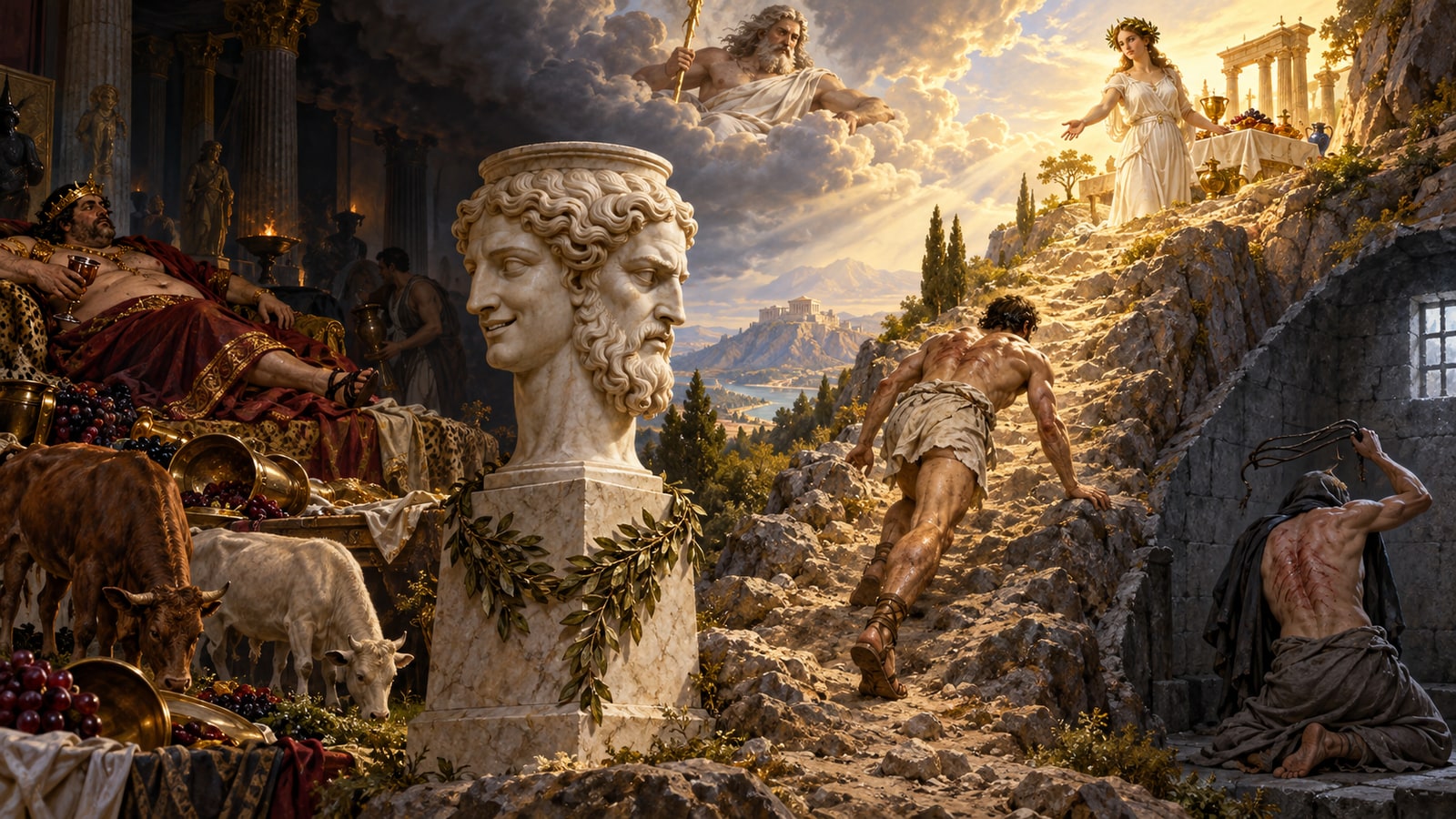
To the family of Zevists. A working teaching, grounded in Plato's Phaedo and Laws, in Aristotle's Nicomachean Ethics, in Hesiod's steep road to virtue and Aeschylus' Hymn to Zeus, and in the Egyptian witness of Ptahhotep, who tells a man to follow his heart and to hold to Ma'at. This is the ninth of the Ten Antithetical Powers, and it follows Light and Darkness. It sets out 3 things: that pleasure and pain are joined at one head, and neither is evil; that under Ma'at pain guards and forges while pleasure crowns completed action, as Zeus set learning through suffering, while under Izfet pleasure alone makes the slavish life of cattle and pain alone makes the identity of the victim; and that the Zevist becomes as the Gods by learning to delight and to grieve at the right things.
I. Opening: The Ninth Power
Light and Darkness opened this series and laid down its law. Every Power is a pair, and neither member is evil. Bound by Ma'at, the structured Order of Cosmic Existence that Zeus holds as Sovereign of the Cosmos, the pair works in harmony and builds life. Bound by Izfet, the same pair turns destructive, and existence falls back toward unstructured chaos. Izfet breaks a pair in 2 ways: one member seizes sole rule, or the pair is torn apart.
Necessity and Freedom asked what's up to you. Memory and Forgetting asked what you keep. Pleasure and Pain asks what moves you. Every creature that feels is pulled by these 2, and Aristotle says the whole of moral virtue concerns them. Master this Power and you master the reins of your own life.
II. The Ancient Witnesses
Plato sets the scene on the last morning of Socrates' life. The chains have just been taken off his legs, and as he rubs the sore place he says:
Plato, Phaedo 60b
«ὡς ἄτοπον, ὦ ἄνδρες, ἔοικέ τι εἶναι τοῦτο ὃ καλοῦσιν οἱ ἄνθρωποι ἡδύ· ὡς θαυμασίως πέφυκε πρὸς τὸ δοκοῦν ἐναντίον εἶναι, τὸ λυπηρόν.»
"How strange, gentlemen, this thing seems that people call pleasant, and how wonderfully it's related to what seems its opposite, the painful."
He adds that whoever pursues and catches one is almost always forced to take the other, "as though they were 2 fastened to a single head," and that if Aesop had thought of it he'd have told a fable: the God wanted to end their war, couldn't, and so joined their heads together (Phaedo 60b-c).
In the Laws, Plato gives the rule for drawing on them:
Plato, Laws I, 636d-e
«δύο γὰρ αὗται πηγαὶ μεθεῖνται φύσει ῥεῖν, ὧν ὁ μὲν ἀρυτόμενος ὅθεν τε δεῖ καὶ ὁπότε καὶ ὁπόσον εὐδαιμονεῖ ... ὁ δ’ ἀνεπιστημόνως ἅμα καὶ ἐκτὸς τῶν καιρῶν τἀναντία ἂν ἐκείνῳ ζῴη.»
"For these 2 springs [pleasure and pain] are let flow by nature. Whoever draws from them where he should, when he should and as much as he should is happy. ... Whoever draws without knowledge and outside the right moments lives the opposite life."
Aristotle builds his ethics on the same foundation:
Aristotle, Nicomachean Ethics II.3, 1104b8-13
«περὶ ἡδονὰς γὰρ καὶ λύπας ἐστὶν ἡ ἠθικὴ ἀρετή ... διὸ δεῖ ἦχθαί πως εὐθὺς ἐκ νέων, ὡς ὁ Πλάτων φησίν, ὥστε χαίρειν τε καὶ λυπεῖσθαι οἷς δεῖ· ἡ γὰρ ὀρθὴ παιδεία αὕτη ἐστίν.»
"Moral virtue concerns pleasures and pains. ... So one must be brought up in a certain way from youth, as Plato says, to delight in and be pained by the right things; for this is correct education."
Aeschylus names the God who set pain to work:
Aeschylus, Agamemnon 176-181
«τὸν φρονεῖν βροτοὺς ὁδώσαντα, τὸν πάθει μάθος θέντα κυρίως ἔχειν. στάζει δ’ ἔν θ’ ὕπνῳ πρὸ καρδίας μνησιπήμων πόνος· καὶ παρ’ ἄκοντας ἦλθε σωφρονεῖν.»
"Zeus, who set mortals on the road to understanding, who made 'learning through suffering' hold sovereign force. In sleep, pain that remembers its hurt drips before the heart, and good sense comes even to the unwilling."
πάθει μάθος: learning through suffering, established by Zeus. Pain has a task, and the task is wisdom.
Hesiod shows the road that task follows:
Hesiod, Works and Days 289-292
«τῆς δ’ ἀρετῆς ἱδρῶτα θεοὶ προπάροιθεν ἔθηκαν / ἀθάνατοι· μακρὸς δὲ καὶ ὄρθιος οἶμος ἐς αὐτὴν / καὶ τρηχὺς τὸ πρῶτον· ἐπὴν δ’ εἰς ἄκρον ἵκηται, / ῥηιδίη δὴ ἔπειτα πέλει, χαλεπή περ ἐοῦσα.»
"Before virtue the immortal Gods have set sweat. Long and steep is the path to her, and rough at first; but when a man reaches the summit, then she becomes easy, hard though she is."
And Aristotle names pleasure's proper place: "pleasure completes the activity," not as its cause, "but as a supervening end, like the bloom of youth on those in their prime" (Nicomachean Ethics X.4, 1174b31-33). Pain on the road, pleasure at the summit.
III. The Egyptian Witness: Follow Your Heart, Hold to Ma'at
Egypt never condemned pleasure. The oldest book of Egyptian wisdom commands it:
Instruction of Ptahhotep, Maxim 11 (after Lichtheim)
"Follow your heart as long as you live, do no more than is required, do not shorten the time of 'follow-the-heart,' trimming its moment offends the ka."
The same book declares, "Great is Ma'at, lasting in effect" (Maxim 5, where Lichtheim renders Ma'at as "justice"). Egypt held both. The banquet and the festival were sacred, and so was the scribe's long training and the discipline of the priest's purity. Pleasure followed the heart; Ma'at set the measure; and at the end the heart itself was weighed.
IV. Pleasure and Pain Under Ma'at
Under Ma'at, pain guards and forges, and pleasure crowns what's been completed.
- Pain the watchman. People born unable to feel pain suffer wounds, burns and broken bones that go unnoticed, and they may have shorter lives (MedlinePlus Genetics). Pain is the body's guard, and a body without it walks on its own fractures.
- The trained body. Every athlete knows the cycle: stress, then recovery, then adaptation. The soreness of the hard session is the price of the next season's strength.
- The victor's crown. At Olympia the contest came first and the celebration after: the olive wreath, the feast, the ode. Pindar's poems are pleasure crowning completed effort.
- The market. The disciplined trader takes the small, planned loss at his stop, a pain he accepts so as to avoid a large one. He takes profit where his plan says, a pleasure that completes the work. Pain accepted early protects the capital; pleasure taken on plan keeps the discipline.
- Education. Plato and Aristotle agree: raise the young to delight in the right things and to be pained by the right things. Character is trained pleasure and trained pain.
The pattern of the first Power repeats. Pain is the darkness everyone flees. Explored, it teaches: πάθει μάθος. The pain you walk into with understanding becomes wisdom, the way explored darkness becomes Light.
V. Pleasure and Pain Under Izfet
The first face: pleasure alone. Pleasure seizes the throne and leads. Aristotle gives the verdict with a word that belongs to Zevist doctrine:
Aristotle, Nicomachean Ethics I.5, 1095b19-22
«οἱ μὲν οὖν πολλοὶ παντελῶς ἀνδραποδώδεις φαίνονται βοσκημάτων βίον προαιρούμενοι, τυγχάνουσι δὲ λόγου διὰ τὸ πολλοὺς τῶν ἐν ταῖς ἐξουσίαις ὁμοιοπαθεῖν Σαρδαναπάλλῳ.»
"The many appear utterly slavish, choosing a life of grazing cattle; and they get a hearing because many in power share the tastes of Sardanapallus."
ἀνδραποδώδεις: like the andrapod, the slave. Aristotle calls the life ruled by pleasure slavish. Medicine confirms the trap: repeated drug use blunts the brain's reward response, so the user needs more to feel less, while ordinary pleasures fade (Volkow, Koob and McLellan, New England Journal of Medicine, 2016). Pleasure pursued alone ends by destroying pleasure.
The second face: pain alone. Pain seizes the throne and becomes an identity. This is the andrapod of Private Essay No. 5 in another form: the victim who owns his wound, displays it, and would lose himself without it. History shows the religious form of this face in the flagellant processions of 1349, when men marched through the towns of Europe whipping their own backs as worship. The Gods of Greece filled the sanctuary of Zeus at Olympia with statues of the human body in its strength. The overtrained athlete, grinding himself into injury, shows the same face in the gym.
The Power at a Glance
| Domain | Under Ma'at | Izfet: Pleasure Alone | Izfet: Pain Alone |
|---|---|---|---|
| Body | Pain warns, pleasure rewards health | Addiction and tolerance | Overtraining and injury |
| Training | Stress, recovery, adaptation | Comfort and atrophy | Grinding into breakdown |
| Market | The planned loss, the planned profit | Euphoria, chasing gains | Revenge trading, frozen by fear |
| Soul | Delight and grief at the right things | Sardanapallus: the life of cattle | The victim who owns his wound |
| City | Contest, then festival | The endless feast | The endless mourning |
| Religion | Discipline and festival under the Gods | Ecstasy with no discipline | Hatred of the body as worship |
VI. The Argument
| Step | Statement | Witness |
|---|---|---|
| Observation | Every creature that feels is moved by pleasure and pain, and the 2 come joined at one head. | Phaedo 60b-c |
| First test | Remove pain and the body walks on broken bones, and the soul never learns. | MedlinePlus; Agamemnon 176-178 |
| Second test | Remove pleasure and action loses its crown: work becomes grinding, and life greys out. | Nicomachean Ethics X.4 |
| Third test | Draw from the 2 springs where, when and as much as you should, and you're happy. | Laws I, 636d-e |
| Conclusion | Neither pleasure nor pain is evil. Evil is pleasure seized as master or pain seized as identity. Zeus set learning through suffering, and the summit of virtue is sweet. | Agamemnon 176-178; Works and Days 289-292 |
Objections Answered
- "Pleasure is the good. Life is about feeling good." Aristotle calls that choice slavish, the life of cattle. And pleasure pursued as master destroys itself: tolerance rises, joy fades, and the hedonist ends unable to feel what he chased.
- "Pain purifies. The more suffering, the holier." Zeus set learning through suffering, and the goal is the learning. Hesiod's road is rough at first and easy at the summit. Pain that teaches nothing and leads nowhere is Izfet wearing a monk's robe.
- "Then avoid both and feel nothing." Plato says the 2 springs flow by nature. The man who dams both dries up. Numbness is the Lethe of Power VIII drunk beyond the measure. Φρόνησις draws from both springs in their right measure.
VII. The Premise and Purpose in Zevism
The aim is ὁμοίωσις θεῷ κατὰ τὸ δυνατόν, becoming as the Gods, as far as possible (Theaetetus 176b). Homer calls the Gods μάκαρες, the blessed. Aristotle says the activity of the divine is contemplation, the most pleasant of all activities (Nicomachean Ethics X.7-8). The bliss of the Gods is the pleasure that crowns perfect activity. Men reach toward it by Hesiod's road: sweat first, summit after.
This Power also settles the Zevist answer to the andrapod. The andrapod holds his wound and calls it his identity. The Zevist takes the wound, extracts its lesson and uses it to climb. Pain becomes a tool, and pleasure becomes a reward earned in order.
| Dimension of the Zevist Path | What Pleasure and Pain Train |
|---|---|
| Meditation (δυνατόν, capacity of power) | Sitting through discomfort without flinching, and noticing pleasure without grasping. Capacity grows where neither pulls you off the seat. |
| Ethics (Φρόνησις and Justice) | Moral virtue concerns pleasures and pains: delight and grieve at the right things (Nicomachean Ethics II.3). |
| Existential (a life in service of ὁμοίωσις θεῷ) | The road and the summit: disciplined work, then festival, in a steady rhythm. |
| Theurgy (Σοφία, Θεουργία) | The blessedness of the Gods is the pleasure of perfect activity. The theurgist tastes it in worship and contemplation. |
The Ethic of Pleasure and Pain
- Take the small pain now. The early rise, the hard session, the planned loss, the difficult conversation. Small pains taken on time prevent large ones.
- Let pleasure crown, never lead. Enjoy fully what follows completed work. When pleasure starts choosing your actions, it has taken the throne.
- Listen to pain. Pain is a message. Read it before you silence it: injury, error, wrong direction.
- Refuse to own your wound. Take the lesson and move on. A wound kept as an identity is the andrapod's possession.
- Feast at the festivals. Honour the Gods with celebration as well as discipline. Joy in its right time is worship.
- Train your delight. Educate what you enjoy. Learn to take pleasure in study, craft, beauty and worship, and the road to virtue gets shorter.
VIII. Correlation and Closing
Pleasure and Pain stands in the Ethics row of the tetractys, beside Necessity and Freedom, Memory and Forgetting, and Ascent and Descent. The goddess of Philebus 26b set law and limit on pleasures because they had none, which is Power II. Pleasure and pain are the 2 great pulls on every choice, which is Power VII. Aeschylus' "pain that remembers its hurt" is Power VIII. Hesiod's steep road to the summit leads straight into Power X.
| Power | Pair | Row of the Tetractys |
|---|---|---|
| I | Light and Darkness | Apex |
| II | Limit and Unlimited | Existence |
| III | The One and the Many | Existence |
| IV | Love and Strife | Cosmology |
| V | Fire and Water | Cosmology |
| VI | Time and Eternity | Cosmology |
| VII | Necessity and Freedom | Ethics |
| VIII | Memory and Forgetting | Ethics |
| IX | Pleasure and Pain | Ethics |
| X | Ascent and Descent | Ethics |
Aeschylus, Agamemnon 177-178
«τὸν πάθει μάθος θέντα κυρίως ἔχειν.»
"Zeus, who made 'learning through suffering' hold sovereign force."
Sweat on the road, delight at the summit. Take pain as your teacher and pleasure as your crown, and let Zeus set the measure of both.
ZEFS AENAOS.
High Priest Zevios Metathronos
Temple of Zeus Foundation