 አማርኛ
አማርኛ العربية
 বাংলা
বাংলা Български
 中文
中文 Čeština
 Dansk
Dansk Deutsch
 Eesti
Eesti Ελληνικά
 Español
 Français
 हिन्दी
 Hrvatski
 IsiZulu
 Italiano
 日本語
日本語 Kiswahili
 Magyar
 Македонски
 नेपाली
 Nederlands
 فارسی
فارسی Polski
 Português
 Română
 Русский
 Slovenščina
 Suomi
Suomi Svenska
 Tagalog
 Türkçe
Existence, Cosmology and Ethics · The Ten Antithetical Powers · Power VI
Time and Eternity
Χρόνος καὶ Αἰών
author: High Priest Zevios Metathronos
To the family of Zevists. A working teaching, grounded in Plato's Timaeus, in Heraclitus and Hesiod, in Pindar's odes for Olympia and Plutarch's On Isis and Osiris, and in the Egyptian witness of neheh and djet, the eternity that returns and the eternity that endures. This is the sixth of the Ten Antithetical Powers, the last of the Powers of Cosmology, and it follows Light and Darkness. It sets out 3 things: that everything in the cosmos moves in time and takes its form from what doesn't pass, and that neither time nor eternity is evil; that under Ma'at time is the moving image of eternity, ordered by the Horai whom Zeus fathered, while under Izfet time becomes Kronos devouring his children or eternity freezes into a stillness that transmits nothing; and that Zevism, which stands at the eternal source and hands it on through time, is this Power lived.
I. Opening: The Sixth Power
Light and Darkness opened this series and laid down its law. Every Power is a pair, and neither member is evil. Bound by Ma'at, the structured Order of Cosmic Existence that Zeus holds as Sovereign of the Cosmos, the pair works in harmony and builds life. Bound by Izfet, the same pair turns destructive, and existence falls back toward unstructured chaos. Izfet breaks a pair in 2 ways: one member seizes sole rule, or the pair is torn apart.
Love and Strife set the cosmos moving, and Fire and Water gave the motion its body. Power VI asks what the motion runs on. Everything that moves moves in time: it begins, grows and passes. Yet everything that moves also carries a form that doesn't pass: the ratio of the octave, the shape of the circle, the law of justice. Time and eternity: the last and widest of the Powers of Cosmology.
II. The Ancient Witnesses
Plato gives the definition that every later thinker had to answer:
Plato, Timaeus 37d
«εἰκὼ δ’ ἐπενόει κινητόν τινα αἰῶνος ποιῆσαι, καὶ διακοσμῶν ἅμα οὐρανὸν ποιεῖ μένοντος αἰῶνος ἐν ἑνὶ κατ’ ἀριθμὸν ἰοῦσαν αἰώνιον εἰκόνα, τοῦτον ὃν δὴ χρόνον ὠνομάκαμεν.»
"He planned to make a moving image of eternity; and while he ordered the heaven, he made, of eternity abiding in unity, an everlasting image moving according to number: this is what we've named time."
Eternity abides in one. Time moves according to number. Time is eternity's image, and an image shows its original. Plato adds that time "came into being together with the heaven," made "after the pattern of the everlasting nature, so as to be as like it as possible" (Timaeus 38b). Time exists to resemble eternity.
Heraclitus gives the same truth as a picture:
Heraclitus, DK 22 B52
«αἰὼν παῖς ἐστι παίζων, πεσσεύων· παιδὸς ἡ βασιληίη.»
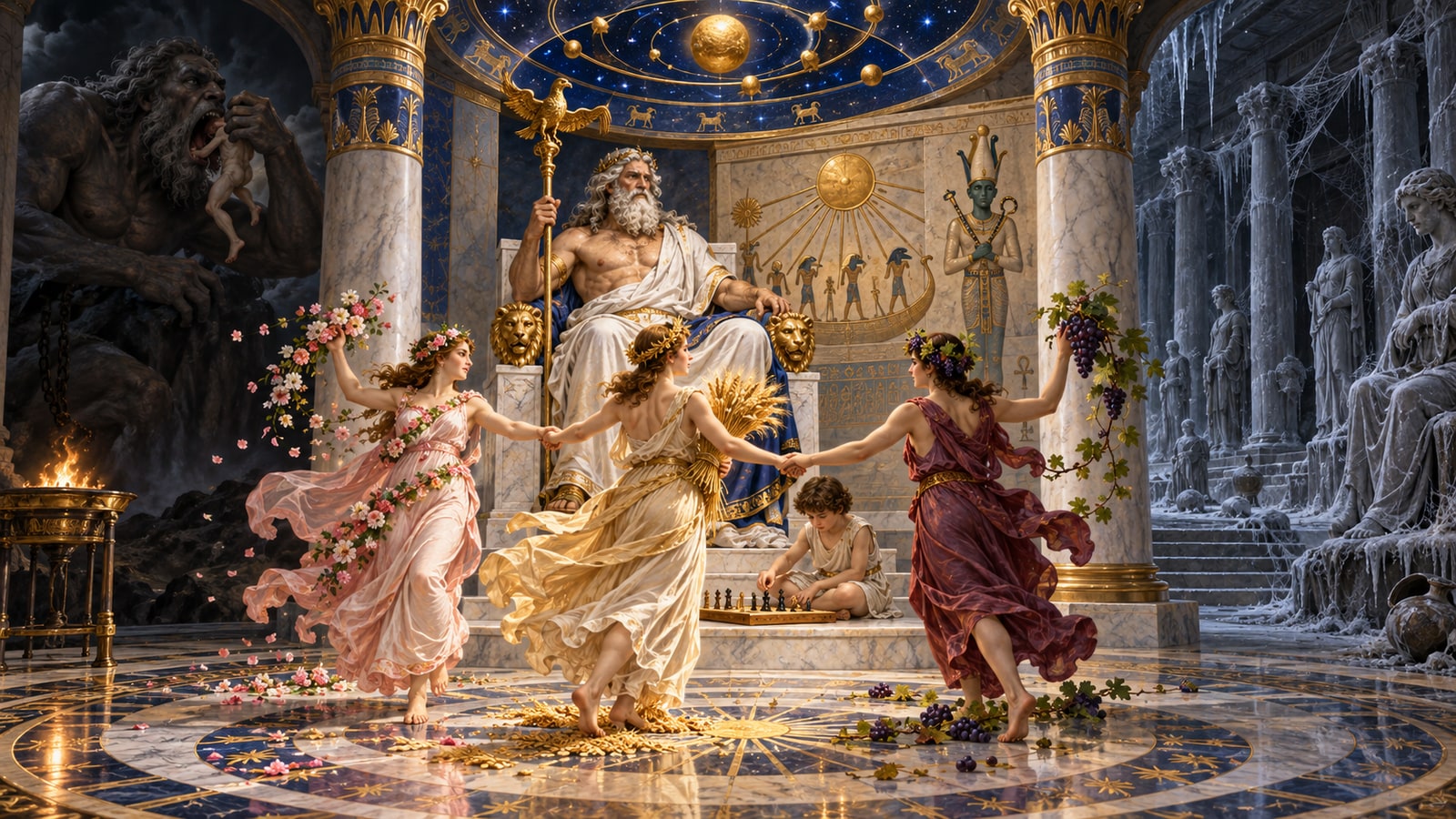
"Aion is a child at play, moving pieces on a board; the kingship is a child's."
The game moves piece by piece, in time. The rules of the game don't move at all. Every move happens inside a law that stays the same.
Hesiod tells what happens when time rules alone:
Hesiod, Theogony 459-460
«καὶ τοὺς μὲν κατέπινε μέγας Κρόνος, ὥς τις ἕκαστος / νηδύος ἐξ ἱερῆς μητρὸς πρὸς γούναθ’ ἵκοιτο.»
"And great Kronos swallowed them, each as he came from his mother's holy womb to her knees."
The Greeks read the myth exactly this way. Plutarch reports that "the Greeks allegorize Kronos as chronos," time (On Isis and Osiris 32). Time with no eternity above it devours everything it produces.
Then Hesiod tells what Zeus did once Kronos fell:
Hesiod, Theogony 901-903
«δεύτερον ἠγάγετο λιπαρὴν Θέμιν, ἣ τέκεν Ὥρας, / Εὐνουμίην τε Δίκην τε καὶ Εἰρήνην τεθαλυῖαν, / αἳ ἔργ’ ὠρεύουσι καταθνητοῖσι βροτοῖσι.»
"Second, he took radiant Themis as wife, who bore the Horai, Good Order, Justice and blooming Peace, who watch over the works of mortal men."
The Horai are the Seasons, the Hours, the ordered parts of time. Their names are Good Order, Justice and Peace, and their father is Zeus. Under Kronos, time swallowed. Under Zeus, time keeps watch.
Pindar adds that at the founding of the Olympic festival, when Heracles established the games of Zeus, "the Moirai stood near, and he who alone puts genuine truth to the test: Time" (Olympian 10.52-55). Time in the service of Zeus tests and reveals.
III. The Egyptian Witness: Neheh and Djet
Egypt had 2 words for eternity, and together they hold this whole Power. Neheh is the eternity that returns: the sun's daily circuit, the recurring cycle of days, seasons and years. Djet is the eternity that endures: completed, unchanging permanence, the stillness of what has been perfected. Jan Assmann's studies of Egyptian time tie neheh to Ra and djet to Osiris.
The Book of the Dead joins the 2 Gods through the same pair:
Book of the Dead, Spell 17 (after T. G. Allen and R. O. Faulkner)
"Mine is yesterday, I know tomorrow. What does it mean? Yesterday is Osiris, tomorrow is Ra. ... As for neheh, it is day; as for djet, it is night."
Osiris is completed time, what has been gathered in and preserved. Ra is renewing time, what rises again each morning. Egypt needed both. A temple that only renewed would forget its founding. A temple that only endured would stop living. Egyptian religion lasted more than 3,000 years because it held neheh and djet together under Ma'at.
IV. Time and Eternity Under Ma'at
Under Ma'at, time is the moving image of eternity. It moves by number, it keeps its seasons, and every cycle shows the unchanging law behind it.
- The Olympiad. The Greeks counted history in Olympiads: 4-year cycles of the festival of Zeus, traditionally dated from 776 BC. Timaeus of Tauromenium lined up the Olympic victors against the kings, magistrates and priestesses of other cities, and Eratosthenes made the Olympiad the standard frame of Greek chronology. Greek history ran on the calendar of Zeus's festival.
- The body's clock. Nearly every cell in your body keeps its own clock of about 24 hours, and the discovery of its molecular gears won the Nobel Prize in 2017. When your days follow the sun, the clocks agree, and sleep, digestion and repair run in order. Time held in rhythm is health.
- The farmer's year. Hesiod's Works and Days is a calendar of the stars: begin the harvest when the Pleiades rise, and the ploughing when they set (Works and Days 383-384). The stars keep their eternal circuit, and the farmer times his work by it.
- Music. A melody unfolds note by note, in time. The form of the piece exists whole before the first note and after the last. Every performance is a moving image of a form that doesn't move.
- A living tradition. The source is eternal, and its transmission happens in time. Each generation receives the same source, carries it and hands it on. The Temple's founding as a legal institution in 2026 and the Temple community reaching back to 2002 are moments in time. What they carry is older than Homer.
The pattern of the first Power repeats. Time unexplored is like darkness: the future is unknown and the past is fading. Explored, every moment shows the eternal form inside it, the way explored darkness becomes Light.
V. Time and Eternity Under Izfet
The first face: time alone. Time breaks free of eternity and becomes Kronos again, devouring everything it produces. This is the tyranny of the new, where yesterday's truth is discarded because it's yesterday's; the economy of planned obsolescence, where things are made to break; the horizon of a single quarter; the man who lives only for today and has no eternity to anchor him. Nothing lasts because nothing is allowed to last. Kronos swallows his own children.
The second face: eternity alone. Eternity refuses time and freezes. The source is locked in a glass case and never handed on. This is the museum religion, admired and dead; the doctrine that can't speak to anyone living; and the nostalgia of the andrapod, who sits in the cultural ruins reminiscing about glory instead of restoring it, as Private Essay No. 5 sets out. A golden age mourned and never rebuilt is eternity with the time cut out of it.
The Power at a Glance
| Domain | Under Ma'at | Izfet: Time Alone (Kronos) | Izfet: Eternity Alone (the Frozen Hall) |
|---|---|---|---|
| Cosmos | The heavens moving by number | Everything born is swallowed | No motion: no days, no seasons |
| Egypt | Neheh and djet, Ra and Osiris | Renewal that preserves nothing | Stillness with no dawn |
| Body | The 24-hour clock in every cell | No rest: the rhythm broken | Tissue that no longer renews |
| Culture | The eternal source handed on | Novelty worship, the source discarded | The museum and the mourned golden age |
| Economy | Long cycles and patient building | The quarterly horizon | Stagnation |
| Soul | The present act aimed at the eternal | Living for today | Living in yesterday |
VI. The Argument
| Step | Statement | Witness |
|---|---|---|
| Observation | Everything that exists moves in time, and everything that moves carries a form that doesn't pass. | Timaeus 37d |
| First test | Time without eternity devours: each moment swallows the one before, and nothing lasts. | Theogony 459-460; Plutarch, On Isis 32 |
| Second test | Eternity without time never enters the world: a form never embodied, a source never handed on. | Timaeus 38b |
| Third test | Let time image eternity, and the heavens, the seasons, the Olympiad and a living tradition appear. | Theogony 901-903; Olympian 10.52-55 |
| Conclusion | Neither time nor eternity is evil. Evil is the time that devours or the eternity that freezes. Zeus overthrew Kronos and set the Horai over the works of men. | Theogony 901-903 |
Objections Answered
- "Time destroys everything. Time is the enemy." Time under Kronos devours, and time under Zeus ripens. The Horai bring the grain to harvest and the child to manhood, and Pindar calls Time the one who "alone puts genuine truth to the test." A lie can survive a day. Time exposes it. Time that serves eternity is the friend of every true thing.
- "Eternity is all that matters. Time is illusion." Plato calls time an image of eternity, and an image is how the original becomes visible. Egypt needed both neheh and djet. A truth that never enters time reaches no one, and a source that's never handed on dies with its last keeper.
- "Then tradition has to change with the times." The transmission can adapt; the source holds priority. The vessel changes, the wine stays the same. The festival at Olympia kept the same God, the same sanctuary and the same 4-year rhythm for more than 1,000 years.
VII. The Premise and Purpose in Zevism
Zevism looks to the past because one must stand at the source. That's eternity. Knowledge evolves through transmission. That's time. The source holds priority, and the transmission serves it. Zevism is this Power under Ma'at: an eternal source, handed on in time, with neither side allowed to swallow the other.
The aim is ὁμοίωσις θεῷ κατὰ τὸ δυνατόν, becoming as the Gods, as far as possible (Theaetetus 176b). Homer calls the Gods θεοὶ αἰὲν ἐόντες, "the Gods who are forever." Pindar calls men ἐπάμεροι, "creatures of a day." The path of Zevism is the passage between those 2 conditions. Plato says the lover of wisdom must think immortal and divine thoughts and, "insofar as human nature can partake of immortality," leave no part of it undone (Timaeus 90b-c).
| Dimension of the Zevist Path | What Time and Eternity Train |
|---|---|
| Meditation (δυνατόν, capacity of power) | Attention that rests fully in the present moment touches what doesn't pass. The now is the gate to the eternal. |
| Ethics (Φρόνησις and Justice) | καιρός, the right moment, "best in all things" (Works and Days 694). Justice herself is one of the Horai. |
| Existential (a life in service of ὁμοίωσις θεῷ) | A life ordered by the Horai: daily practice, the calendar of worship and festival, the source carried and handed on. |
| Theurgy (Σοφία, Θεουργία) | The creature of a day takes part in the Gods who are forever, as far as human nature can partake of immortality. |
The Ethic of Time and Eternity
- Keep the Horai. Give your days a rhythm: fixed hours of worship, work, study and sleep. Good Order is the name of a daughter of Zeus. Honour her in your calendar.
- Seize the καιρός. Every act has its right moment. Learn to recognize it, and when it comes, act fully.
- Build for the long time. Measure your work by what it'll mean in 50 years. Kronos rules the man who lives for the quarter.
- Stand at the source and hand it on. Learn the old texts, the old rites and the old Gods at their source. Then teach them. A source you keep to yourself is a frozen hall.
- Refuse both Kronos and the museum. Don't let novelty swallow what's true, and don't let reverence freeze it. Restore, then build.
VIII. Correlation and Closing
Time and Eternity completes the Cosmology row of the tetractys, after Love and Strife and Fire and Water. Eternity "abides in one" while time moves "according to number," which carries Power III into motion. Heraclitus's fire "always was and is and will be," which is Power V seen from above. The Horai are sisters of the Moirai, both fathered by Zeus (Theogony 901-906), and the Moirai lead into Power VII, Necessity and Freedom. Memory is the soul's hold on time, and it leads into Power VIII.
| Power | Pair | Row of the Tetractys |
|---|---|---|
| I | Light and Darkness | Apex |
| II | Limit and Unlimited | Existence |
| III | The One and the Many | Existence |
| IV | Love and Strife | Cosmology |
| V | Fire and Water | Cosmology |
| VI | Time and Eternity | Cosmology |
| VII | Necessity and Freedom | Ethics |
| VIII | Memory and Forgetting | Ethics |
| IX | Pleasure and Pain | Ethics |
| X | Ascent and Descent | Ethics |
Pindar, Pythian 8.95-97
«ἐπάμεροι· τί δέ τις; τί δ’ οὔ τις; σκιᾶς ὄναρ / ἄνθρωπος. ἀλλ’ ὅταν αἴγλα διόσδοτος ἔλθῃ, / λαμπρὸν φέγγος ἔπεστιν ἀνδρῶν καὶ μείλιχος αἰών·»
"Creatures of a day! What is anyone? What is no one? Man is a dream of a shadow. But when the radiance given by Zeus comes, a shining light rests on men, and their life is sweet."
The creature of a day becomes radiant when Zeus's light reaches him, and the first Power shines again at the end of the Cosmology. The signature of the Temple says the rest: ἀέναος, ever-flowing, time that flows forever.
ZEFS AENAOS.
High Priest Zevios Metathronos
Temple of Zeus Foundation