
 አማርኛ
አማርኛ العربية
 বাংলা
বাংলা Български
 中文
中文 Čeština
 Dansk
Dansk Deutsch
 Eesti
Eesti Ελληνικά
 Español
 Français
 हिन्दी
 Hrvatski
 IsiZulu
 Italiano
 日本語
日本語 Kiswahili
 Magyar
 Македонски
 नेपाली
 Nederlands
 فارسی
فارسی Polski
 Português
 Română
 Русский
 Slovenščina
 Suomi
Suomi Svenska
 Tagalog
 Türkçe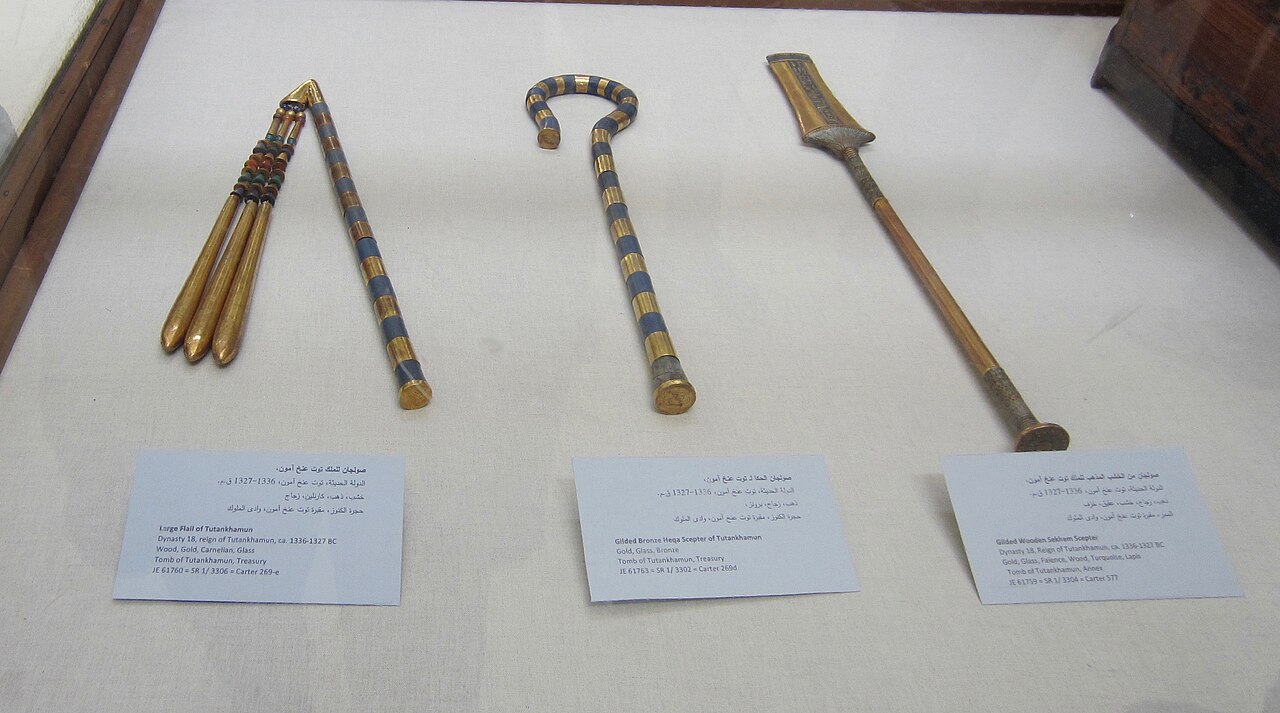


The regalia of inward sovereignty
The crook and flail place spiritual authority in the hands of the regenerated being. Held by Osiris, they declare the continuity of Divine power through transformation. Zevist contemplation reads them as the regalia of a soul that has recovered its centre and can direct its own forces. Their royalty is inward before it becomes outward: the person learns to gather, sustain and employ the powers bestowed by the Gods.
The two implements reveal complementary movements. The crook curves back toward its bearer and expresses gathering, guidance and the return of dispersed energy. The flail extends through articulated strands and expresses the distribution of power into ordered activity. Together they proclaim a sovereignty that can receive and act, conserve and release, hold a centre and give its purpose a form.
The crook and the gathering of the soul
The crook's returning curve gives a visible shape to recollection in its fullest spiritual sense. The soul calls its faculties home. Attention, desire, imagination and will cease to pull in unrelated directions and begin to answer a common intention. The energy that had been dispersed becomes available for consecrated work. Under Divine guidance, the inward life acquires a place from which it can govern its movement.
This gathering belongs to the Temple's understanding of the soul as an energetic whole. The chakras have distinct functions, and their powers must cooperate if the whole being is to become strong. The crook symbolizes the unifying intention through which this cooperation is maintained. It draws the activity of the centres toward the purpose established at the heart of the work. [1]
The curve also shelters what it gathers. In spiritual contemplation, it becomes a sign of guardianship over the developing faculties. Newly awakened perception requires continuity; a power strengthens when it is cultivated and given a stable place within the soul. The crook thus belongs to the patient maintenance of illumination as well as to the first moment of awakening.
The flail and the direction of living power
The flail carries the complementary mystery of expression. Gathered force becomes creative when the soul can direct it. Its several strands offer an image of differentiated powers issuing from one guiding hand: intention remains unified while its effects take multiple forms. In Zevist spiritual work, this movement concerns the passage from inward command to energy consciously employed.
Will, sacred speech and sustained action become channels of one purpose. The solar centre gives the symbolism a further emphasis on radiance: power held within the person can illuminate the surrounding field. The Temple associates gold with the Sun, spiritual power and the perfection of the soul. On the royal regalia, gold therefore offers a fitting colour for mastery brought into expression. [2]
The flail's motion also teaches renewal through rhythm. A single declaration is followed by repeated acts through which its intention becomes established. The initiate returns to meditation, invocation and the cultivation of the centres, allowing the chosen purpose to acquire continuity. Spiritual sovereignty grows through this union of inward authority and sustained manifestation.
The crossed regalia and the heart of Osiris
When the implements cross upon the chest, their movements meet around the inward sanctuary. The crook's return and the flail's extension are held within one sovereign presence. The heart becomes the place where authority is joined to relationship: the soul receives the Gods, gathers its strength and gives that strength a worthy direction.
The image of Osiris gives this union the depth of regeneration. His stillness contains enduring power. In Zevist contemplation, the enveloped figure expresses the preservation of the soul's essential life through profound change, while the regalia show that this life retains the capacity to act. Transformation culminates in a renewed sovereignty, with the faculties recollected and their energies again available to the whole.
The crown and the crossed emblems complete one spiritual figure. Illumination above, centred power within and the instruments of direction in the hands belong together. The goal of the work is a soul whose perception, vitality and will cooperate under Divine intelligence. The crook and flail make that achieved relationship visible.
Egyptian royal emblems and their surviving forms
The Metropolitan Museum's Osiris statuette 89.2.565, dated 664–30 BCE, presents the God with the royal crook and flail and his arms crossed on his chest. The museum records other arm arrangements as well; the crossed pose is one attested form rather than an invariant rule. Another Osiris figure, 04.2.580, even reverses the usual allocation of the two emblems between the hands. [3][4]
The emblems also belong to Egyptian kingship more broadly. Egypt's Ministry of Tourism and Antiquities identifies the crook and flail as royal symbols in its description of the colossal Akhenaten. [5] The principal photograph shows complete regalia from Tutankhamun's tomb: the flail at left, crook in the centre, and a separate sekhem sceptre at right. The third object is included in the caption by its own name. These ancient royal implements provide the material foundation for the spiritual reading developed here. [6]