
 አማርኛ
አማርኛ العربية
 বাংলা
বাংলা Български
 中文
中文 Čeština
 Dansk
Dansk Deutsch
 Eesti
Eesti Ελληνικά
 Español
 Français
 हिन्दी
 Hrvatski
 IsiZulu
 Italiano
 日本語
日本語 Kiswahili
 Magyar
 Македонски
 नेपाली
 Nederlands
 فارسی
فارسی Polski
 Português
 Română
 Русский
 Slovenščina
 Suomi
Suomi Svenska
 Tagalog
 Türkçe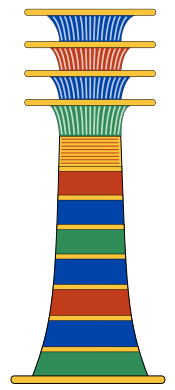


The pillar that stands within the soul
The Djed of Osiris reveals a power indispensable to spiritual advancement: the capacity to stand, to endure, and to preserve the unity of the soul through transformation. Its upright body gives visible form to an inward axis. Around this axis, the faculties of the practitioner cease to behave as scattered forces and begin to participate in a coherent spiritual being. In the Temple’s dedicated teaching, the Pillar of Osiris becomes a column of living light joining the lower, middle, and upper regions of the soul. [1]
Osiris governs resurrection and the recovery of life through sacred order. His pillar therefore concerns more than the resistance of something rigid. It concerns the strength of a living structure that can receive power, sustain its circulation, and remain whole. The devotee approaches this emblem with a steady purpose: to establish within the self a dwelling worthy of the presence and guidance of the Gods. [1][2]
The spinal axis and the ascending light
The Temple describes the ascending pillar as white-gold light moving from the base of the spine through the Lower, Middle, and Upper Divine Triangles toward the crown. This is the Djed’s precise correspondence in the Temple’s sacred physiology: the vertical axis integrates successive regions of spiritual activity. Its upward movement expresses awakening, the gathering of strength, and the elevation of consciousness toward the Divine. [1]
The pillar teaches continuity. An aspiration at the summit must remain connected to the foundation that sustains it. The practitioner’s concentration, vitality, emotional steadiness, and higher perception belong to one work, although each faculty has its own development. In contemplating Osiris’s upright form, one recognizes that a lasting ascent requires the whole being to participate. The light is gathered into a path; the path receives direction; and the soul acquires the stability to carry its own awakening.
Descent, receptivity, and the heart’s interior Sun
The teaching also gives the pillar a descending movement, from the crown toward the lower centers. Divine reception and spiritual ascent complete one another. In the final phase, called the Djed Medu, the upward and downward currents meet at the heart chakra, Anahata, where the Temple describes their union as a brilliant interior Sun. The three Divine Triangles enter a synchronized relationship, and the resulting light extends through the being into the aura. [1]
This union gives the Djed a profound meaning for devotion. The practitioner brings effort upward and receives guidance downward; the heart becomes the place where these movements acquire a common life. Determination becomes receptive to wisdom. Reverence acquires the strength to act. The pillar is fulfilled when illumination can circulate throughout the soul, rather than remaining a passing experience confined to one faculty or moment.
Osirian silence and the preservation of power
The Temple’s account of Osiris emphasizes silence, contemplation, and progressive initiation. Within the symbolism of the Djed, silence protects the formation of spiritual substance. A purpose continually broken by distraction cannot mature with the same fullness as one given sustained attention. The God teaches the soul to retain what it receives, to bring its experiences into order, and to let understanding deepen before expression. [2]
For contemplation, the image can serve as a reminder of uprightness and continuity: return to the central purpose, gather attention, and allow reverence to become steady. The Temple presents its complete Djed meditation as an advanced practice requiring prior mastery of the Divine Triangles. The symbol’s introductory lesson is already substantial: a sacred life needs an axis, and an awakened faculty needs a stable place within the whole. [1]
The ancient Egyptian form
The characteristic Djed consists of a vertical shaft with four horizontal crossbars. The Metropolitan Museum’s record for amulet 2021.41.22 describes an early association with permanence and a later identification with the backbone of Osiris. Its proposed origin in a structure made of plant material remains a scholarly reconstruction. The museum dates that faience amulet to 664–30 BCE and explains its probable funerary function through permanence and participation in Osiris’s renewed life. [3]
These historical associations give the modern spiritual reading a clear foundation in the symbol’s ancient form. The specific Divine Triangles, white-gold currents, and heart-centered union described above belong to the Temple’s articulated practice. The two contexts meet through the pillar’s enduring themes: stability, restored wholeness, and the power of life to stand again. [1][3]
Reading the illustration
The colored illustration is a modern drawing by Jeff Dahl, created in 2008. It presents the complete pillar with a broad base, a narrowing shaft, and four distinct crossbars. Its clean form makes the governing structure easy to contemplate. The colors belong to this modern rendering; the drawing is not a photograph of the museum amulet or a reproduction of the Temple’s advanced meditation diagram. [4]