
 አማርኛ
አማርኛ العربية
 বাংলা
বাংলা Български
 中文
中文 Čeština
 Dansk
Dansk Deutsch
 Eesti
Eesti Ελληνικά
 Español
 Français
 हिन्दी
 Hrvatski
 IsiZulu
 Italiano
 日本語
日本語 Kiswahili
 Magyar
 Македонски
 नेपाली
 Nederlands
 فارسی
فارسی Polski
 Português
 Română
 Русский
 Slovenščina
 Suomi
Suomi Svenska
 Tagalog
 Türkçe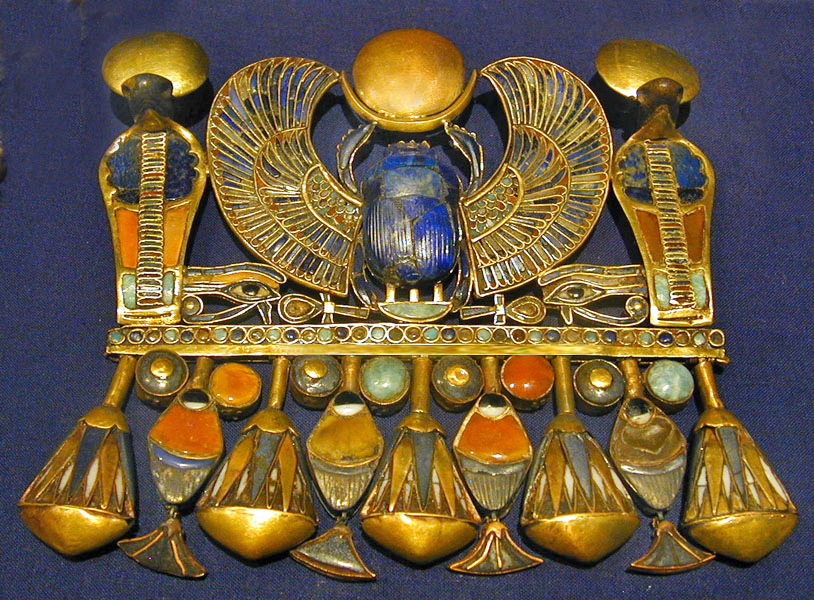

Khepri and the first light of becoming
Khepri is the God of the emerging Sun and of creation becoming manifest anew. His scarab teaches that the soul possesses a future greater than its present condition. A beginning contains power: the capacity to gather what is dispersed, give it form, and set it upon a path. In the Temple’s teaching, Khepri governs repeated and distinct creation, including the development of the individual through the cycles and quests of life. [1]
The scarab therefore belongs to the mysteries of self-formation. The devotee seeks the God’s aid in making a spiritual character capable of enduring change. Each sincere return to practice becomes an act of becoming; each disciplined effort gives a clearer shape to the being that is emerging. Khepri’s gift is the power to begin with purpose and to carry the new form toward its fulfillment.
The sphere and the coherent spiritual self
The Temple gives special weight to the sphere in Khepri’s symbolism. A sphere gathers many possible circles around a common center; in the theological reading, the changing circumstances and cycles of a life gather around an inward core. Khepri’s scarab and its solar sphere express the construction of a self that can participate in the world while retaining its own direction. [1]
This correspondence concerns the soul’s ability to organize experience. Knowledge gained in study, strength acquired through practice, and judgment refined through action should contribute to the same center. A life can otherwise accumulate events without acquiring form. Under Khepri, experience becomes material for spiritual creation. The practitioner learns to preserve what nourishes the inner Sun and to turn each new stage toward a more complete expression of the soul’s Divine potential.
Solar will and the golden center
The Temple describes the solar chakra, Manipura, as the center of will and spiritual power, giving it the correspondences Sun, Fire, gold, and brilliant white-gold light. Read beside this teaching, the scarab raising the solar disk becomes an image of will awakening to conscious direction. The spiritual Sun must be formed and sustained; its radiance expresses a purpose that has acquired clarity and force. [2]
Khepri’s work begins where intention takes a definite shape. A wish becomes a chosen undertaking; a chosen undertaking receives regular effort; effort matures into an enduring faculty. The devotional meaning is exact: becoming requires participation. The God’s image gives the practitioner a form through which to contemplate renewed courage, deliberate action, and the capacity to complete what has been rightly begun. These are powers by which the soul becomes increasingly capable of its own development.
The threefold solar passage and inner alchemy
The Temple distinguishes Khepri’s morning emergence from the noon fullness of Re and the evening completion associated with Atum. This threefold passage gives spiritual growth a rhythm. A beginning must be protected while it is forming, expressed when it has strength, and understood when its cycle reaches completion. Each phase has a task; the dawn is precious because it contains the possibility of what follows. [1]
In the inner alchemy of the scarab, renewal includes the gathering of what a previous cycle has taught. One returns to a practice with greater understanding, enters a responsibility with stronger judgment, or undertakes a new study with a more disciplined mind. The form is new, yet the soul carries forward its acquired substance. Khepri’s mystery joins freshness with continuity: the practitioner becomes again without surrendering the spiritual wealth already earned.
Ancient scarabs and the promise of renewal
Egyptian scarab imagery appears in objects combining religious, funerary, and sealing functions. A New Kingdom faience example at the Metropolitan Museum, 09.180.937, places a beetle between papyrus stems beneath a solar disk; its curator identifies the combined motifs with renewal and regeneration. The object is dated approximately 1550–1300 BCE. This gives a securely documented ancient setting for the chapter’s central theme. [3]
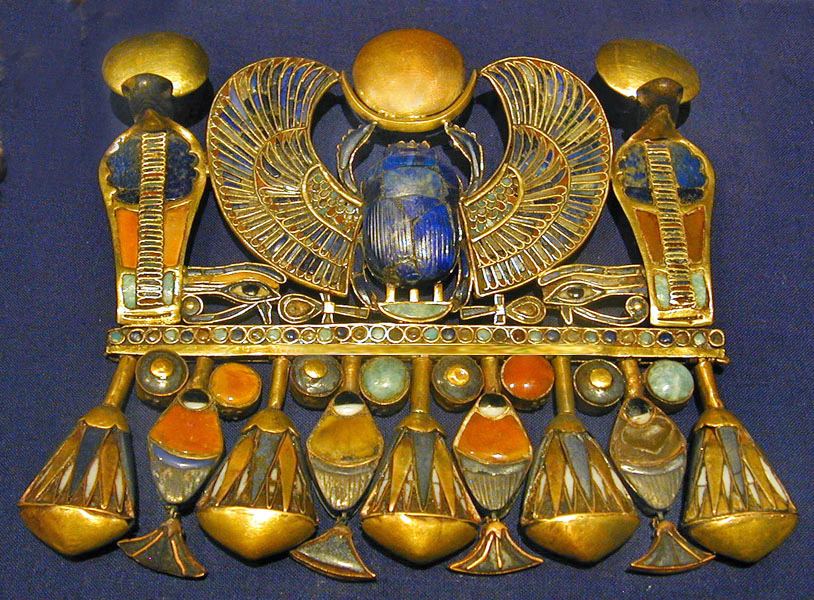
Royal jewelry could incorporate the scarab into the writing of a king’s name as well as solar imagery. The Global Egyptian Museum explains this in its record for Tutankhamun’s pectoral JE 61888, where scarab, plural strokes, solar disk, and basket sign form the royal prenomen. That documented pectoral is a separate comparison from the lotus-fringe pectoral illustrated here. Their shared imagery should not obscure their different object identities. [4][5]
The complete pectoral and the contemplative image
The photograph by Jean-Pierre Dalbéra shows a complete pectoral of Tutankhamun with a central blue scarab, spreading gold wings, a disk above, paired cobras, and a hanging lotus fringe. It is Eighteenth Dynasty royal work, photographed in 2007. The whole composition gives the scarab a setting of radiance, protection, and ordered beauty. [5]
For the Zevist devotee, its central action remains the lifting of the Sun. Contemplation returns to the emerging spiritual self: gather the faculties, preserve the chosen direction, and give renewed life a worthy form. The scarab carries the promise of dawn into the deliberate work of the soul.