
 አማርኛ
አማርኛ العربية
 বাংলা
বাংলা Български
 中文
中文 Čeština
 Dansk
Dansk Deutsch
 Eesti
Eesti Ελληνικά
 Español
 Français
 हिन्दी
 Hrvatski
 IsiZulu
 Italiano
 日本語
日本語 Kiswahili
 Magyar
 Македонски
 नेपाली
 Nederlands
 فارسی
فارسی Polski
 Português
 Română
 Русский
 Slovenščina
 Suomi
Suomi Svenska
 Tagalog
 Türkçe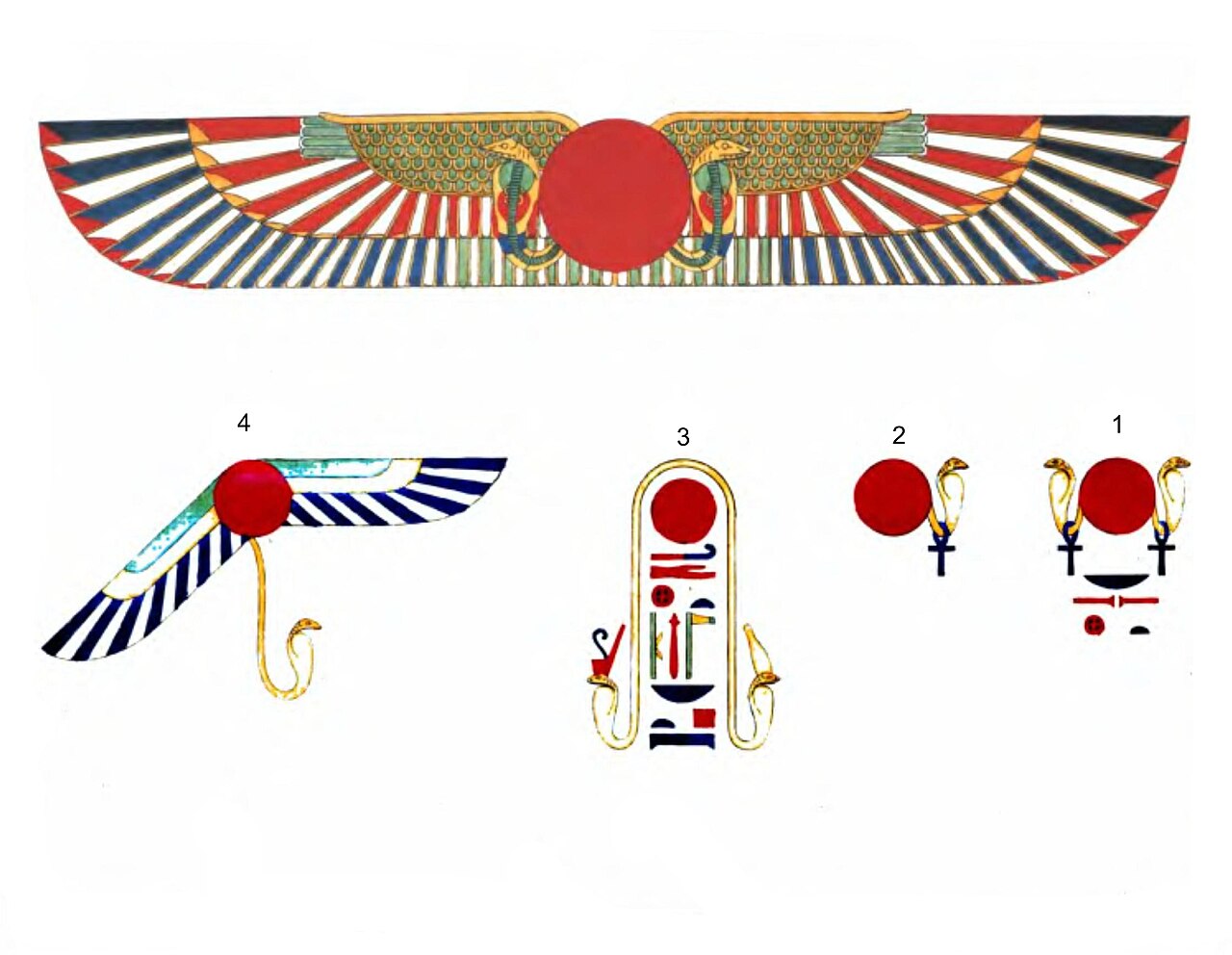
.jpg)

The radiance that extends its wings
The winged Sun brings a luminous center and its outward extension into a single sacred form. The disk gathers light; the wings carry its presence across a wider field. In Zevist contemplation, this is an image of awakened consciousness extending the order it has established within. Spiritual power acquires direction from a center capable of illumination, and its influence bears the character of that center.
The Temple’s teaching of Apollo places light, harmony, purification, spiritual alchemy, and oracular vision among His Divine forces. Its account of Amon Ra describes the manifestation of solar power through a distinctive Divine agency. These teachings provide the present chapter’s theological setting, while the Egyptian identity of the winged disk as Horus the Behdetite retains its own historical evidence and name. [1][2]
The inner Sun and conscious command
The Temple assigns the solar chakra the powers of will and spiritual force, with the correspondences Sun, Fire, gold, and white-gold radiance. The winged disk can be contemplated through this sacred center: the will gathers its light and gives coherent direction to the faculties surrounding it. A scattered intention is recalled into a definite purpose. A definite purpose receives the steadiness needed to become effective. [3]
This inward solar command requires illumination as well as strength. The practitioner seeks to understand the purpose of an action, its place in the larger work, and the faculty through which it should be carried out. The disk at the center of the image expresses that unity of awareness and direction. The wings show power becoming available for action while remaining joined to the intelligence that governs it.
The balanced wings and spiritual alignment
The paired wings give the emblem a visible balance. In the spiritual exposition developed here, they invite the coordination of receptive understanding with active expression. The soul must be able to receive guidance, examine what it has understood, and bring that understanding into life. These functions become fruitful through their relation to the central light. Their alignment gives spiritual movement its steadiness.
The Temple’s Apollo teaching joins harmony with law and purification. Applied to this emblem, harmony concerns the proportion of the faculties: clarity in thought, firmness in purpose, and fitting expression in action. The many feathers can be contemplated as differentiated powers participating in one movement. The image asks the practitioner to make the whole being available to the Divine purpose, so that an awakened insight is carried faithfully into conduct. [1]
The guardianship of the sacred threshold
The winged Sun also carries a protective meaning. Its placement above an entrance gives the passage beneath it a Divine horizon. For the devotee, this can become a reminder to enter sacred work with collected attention: set the purpose, recollect the God, and bring the faculties into order. The threshold is the moment when ordinary dispersion yields to deliberate participation in the sacred.
Protection here includes the preservation of inward coherence. The practitioner learns which impressions deserve attention, which undertakings serve the chosen purpose, and how to keep spiritual practice present through the changes of daily life. The spread wings express an encompassing power; the central disk preserves the source of its direction. The soul becomes more capable of sustaining the light it has received and giving that light a worthy field of action.
Horus the Behdetite in the ancient evidence
A limestone lintel of Seti I in the Penn Museum, E13573, is dated 1290–1279 BCE. Its winged disk is identified by accompanying hieroglyphs as the Behdetite, the epithet associated with Horus of Edfu. The Met also preserves an earlier doorway relief from the pyramid temple of Senwosret I, approximately 1961–1917 BCE, whose winged solar disk represents Horus. The motif therefore has a documented architectural history long before the Ptolemaic temple at Edfu. [4][5]
The Edfu hymns translated by A. Gaber praise Horus the Behdetite as a winged disk illuminating the horizon and the darkness. One associated doorway inscription names Nekhbet and Wadjet as the two cobras beside Him. These precise Egyptian identifications anchor the imagery of light, wings, and guardianship. They also distinguish this form from the Persian winged figure commonly called the Faravahar, which appears separately in the Temple’s solar symbolism. [6][1]
The colored plate and its meaning
The illustration is a nineteenth-century plate by Léon-Jean-Joseph Dubois from Champollion’s Panthéon égyptien, dated 1823 in the image record. A red disk, paired cobras, and richly colored wings occupy its upper register, with related solar and serpent forms below. It is an antiquarian illustration of Egyptian imagery, rather than a photograph of a surviving temple relief. [7]
Its broad, complete form makes the emblem’s contemplative structure clear: a single source of radiance, an ordered extension of power, and a protected center from which the soul can act.