
 አማርኛ
አማርኛ العربية
 বাংলা
বাংলা Български
 中文
中文 Čeština
 Dansk
Dansk Deutsch
 Eesti
Eesti Ελληνικά
 Español
 Français
 हिन्दी
 Hrvatski
 IsiZulu
 Italiano
 日本語
日本語 Kiswahili
 Magyar
 Македонски
 नेपाली
 Nederlands
 فارسی
فارسی Polski
 Português
 Română
 Русский
 Slovenščina
 Suomi
Suomi Svenska
 Tagalog
 Türkçe
Friends of Zevism: For Those Merely Interested
author: High Priest Zevios Metathronos
Ζεὺς Φίλιος · Ζεὺς Ξένιος
Zeus has always kept an open table.
Αʹ Who Is a Friend of Zevism?
Answer. Anyone who comes to the Path with honesty and respect, to read, to question, to debate and to learn. No belief is required, and Initiation remains a free choice, made in each person's own time.
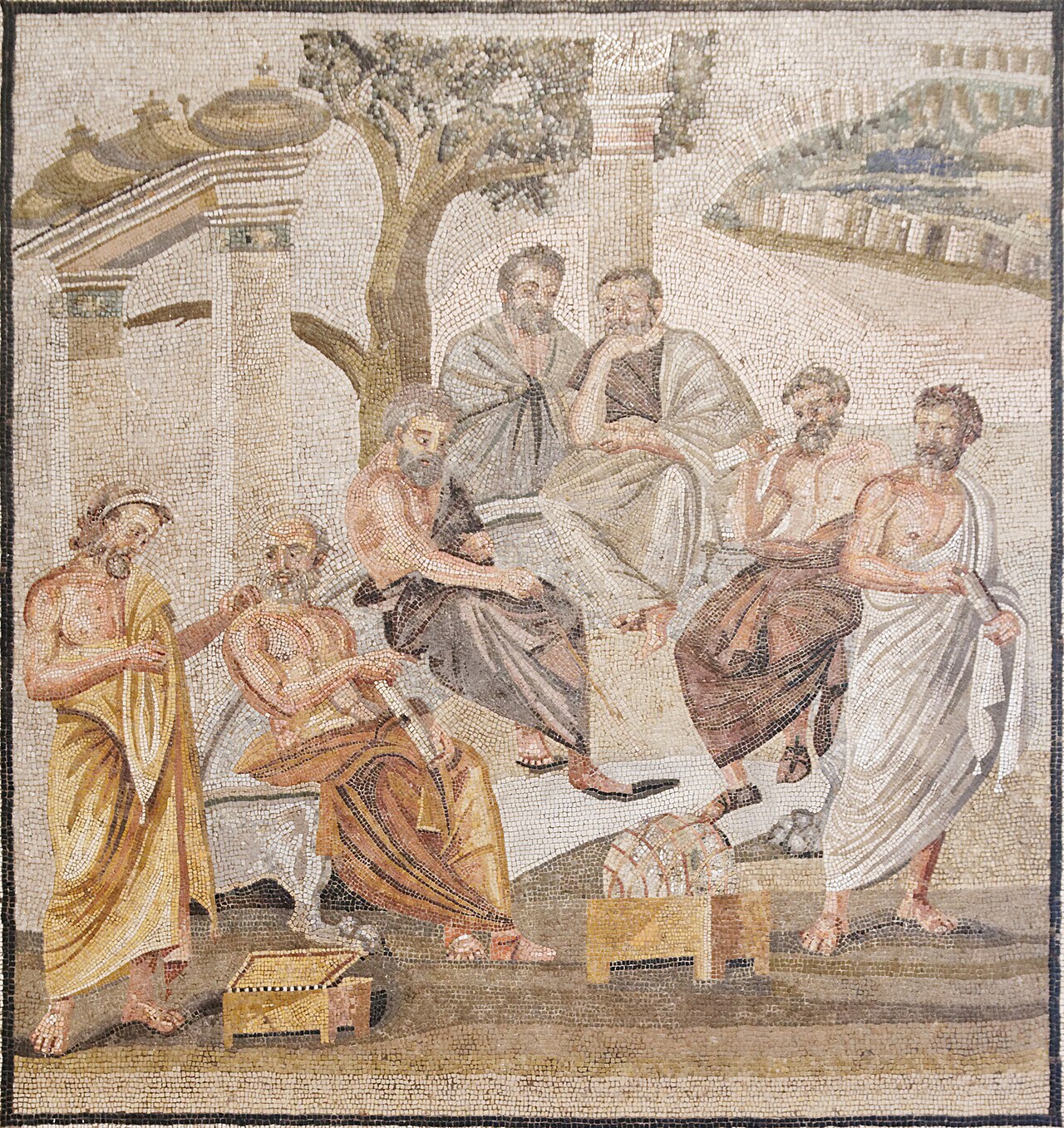
Evidence: The Philosophers in Open Conversation
Object. Mosaic known as Plato's Academy, from the Villa of T. Siminius Stephanus near Pompeii, 1st century BCE to 1st century CE. Naples, Museo Archeologico Nazionale, inv. 124545.
Evidence. Philosophy lived in open company. Beneath a tree, 7 philosophers sit and stand in debate around a celestial globe, the city on its height behind them.
The Greeks honoured Him as Zeus Philios, God of Friendship, and as Zeus Xenios, Protector of the Stranger. He brings people together and wants them to be friends to one another. Whoever comes to His house in honesty is received as a guest.
The Temple of Zeus keeps that table set. Its Friends include scholars, seekers, followers of other traditions and declared atheists, and the Temple asks 2 things of every one of them: honesty and respect.
The ancient schools worked the same way. When Pythagoras reached Croton, he addressed the council of elders, then the young men, then the boys, then the women of the city. Socrates gave his conversation to rich and poor alike and took no fee. Plotinus drew many hearers, Roman senators among them, and a smaller circle of companions who shared his life. Philosophy stood open to all. Initiation waited for those who chose it.
Zevism offers its Friends an open door and the same 2 gifts the ancients offered theirs.
Αʹ The Open Door
Come with honest questions and a respectful tongue. The sermons, the doctrines, the library and the forums are open to you today, free of charge. No one will pressure you, and no one will ask you to pretend.
Βʹ The Path of the Mind
Whoever studies the Path receives what the ancients received: an ethics that holds under strain, a mind that governs itself, friendships built on virtue, and a clear view of the source of Western thought. These gifts belong to believer and unbeliever alike.
Γʹ The Path of Initiation
What the mind approaches, the Initiate touches. Through alignment, meditation and Initiation, the Gods stop being a subject of study and become a living presence that answers. Every Friend of Zevism can walk this road, at the hour of their own choosing.
Βʹ Why Is Zeus Called the God of Friendship?
Answer. Because the Greeks worshipped Him as Zeus Philios and Zeus Xenios, the God who gathers people into friendship and guards the stranger at the door. Homer, Aratus, Plato and Dio Chrysostom bear witness to it, and Athenian worshippers carved it in marble.
Dio Chrysostom, Olympic Discourse (Oration 12), 76:
«Φίλιος δὲ καὶ Ἑταιρεῖος, ὅτι πάντας ἀνθρώπους ξυνάγει καὶ βούλεται φίλους εἶναι ἀλλήλοις, ἐχθρὸν δὲ ἢ πολέμιον οὐδένα οὐδενός, […] Ξένιος δέ, ὅτι δεῖ μηδὲ τῶν ξένων ἀμελεῖν μηδὲ ἀλλότριον ἡγεῖσθαι ἀνθρώπων μηδένα […]»— "He is called God of Friendship and God of Comradeship, because He brings all people together and wants them to be friends to one another, and no one an enemy or a foe of anyone [...] and God of Strangers, because one must not neglect even strangers, nor regard any human being as an outsider [...]"
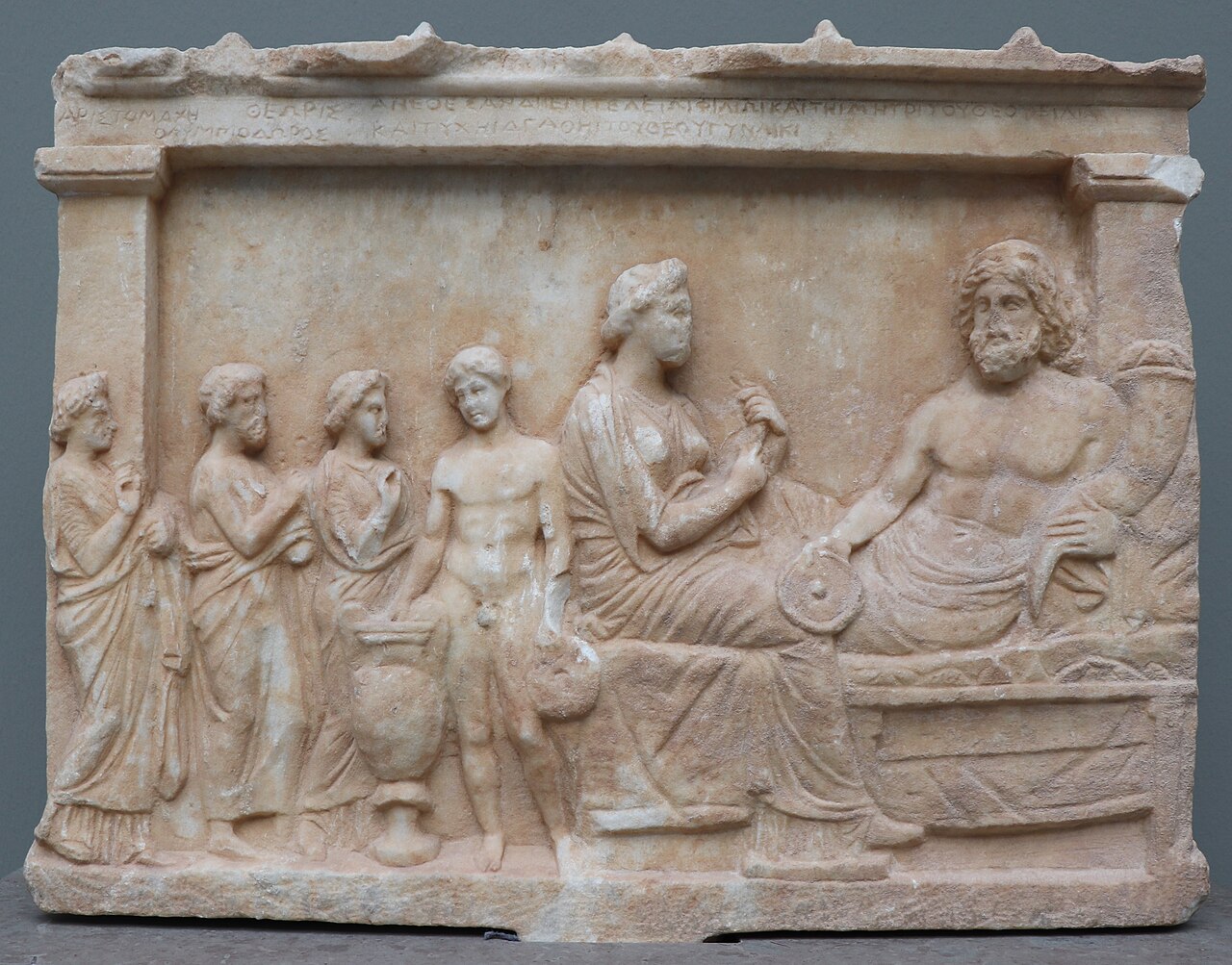
Evidence: Zeus Philios Receives His Friends
Object. Attic votive relief, second half of the 4th century BCE. Copenhagen, Ny Carlsberg Glyptotek, inv. 1558 (IG II² 4627).
Evidence. Athenians worshipped Zeus as the God of Friendship. Aristomache, Theoris and Olympiodoros dedicated this relief to Zeus Epiteleios Philios, to Philia "the mother of the god" and to Agathe Tyche "the wife of the god". The God reclines at the banquet with a horn of plenty and an offering bowl as His worshippers approach.
Word. Ἐπιτέλειος comes from τέλος , fulfilment, the root that also gives τελετή , the rite of initiation.
Homer's heroes knew that the stranger at the door belonged to Zeus. When Nausicaa finds Odysseus shipwrecked and naked on the shore of Scheria, she orders her maids to feed and wash him, and she gives the reason in a single line.
Homer, Odyssey VI, 207-208:
«πρὸς γὰρ Διός εἰσιν ἅπαντες ξεῖνοί τε πτωχοί τε, δόσις δ᾽ ὀλίγη τε φίλη τε.»— "For all strangers and beggars come from Zeus, and a gift, though small, is dear."
Later Odysseus reminds the Cyclops of the same law. Zeus avenges the suppliant and the stranger, and He walks beside every guest who deserves respect.
Homer, Odyssey IX, 270-271:
«Ζεὺς δ᾽ ἐπιτιμήτωρ ἱκετάων τε ξείνων τε, ξείνιος, ὃς ξείνοισιν ἅμ᾽ αἰδοίοισιν ὀπηδεῖ.»— "Zeus is the avenger of suppliants and strangers, Zeus of Strangers, who walks beside strangers worthy of respect."
The word αἰδοῖος runs in both directions. The guest is owed respect, and the guest shows it. Ancient ξενία bound host and guest alike. The Cyclops broke that bond and became the emblem of lawless savagery. The terms the Temple sets for its Friends are the oldest terms in Greek literature: honesty and respect on both sides of the table.
The poet Aratus opened his poem on the heavens with the same truth. Zeus fills the streets and the ἀγοραί, the marketplaces where people meet, trade and argue. Every human being is His kin.
Aratus, Phaenomena 1-5:
«Ἐκ Διὸς ἀρχώμεσθα, τὸν οὐδέποτ᾽ ἄνδρες ἐῶμεν ἄρρητον· μεσταὶ δὲ Διὸς πᾶσαι μὲν ἀγυιαί, πᾶσαι δ᾽ ἀνθρώπων ἀγοραί, μεστὴ δὲ θάλασσα καὶ λιμένες· πάντη δὲ Διὸς κεχρήμεθα πάντες. τοῦ γὰρ καὶ γένος εἰμέν […]»— "Let us begin from Zeus, whom we mortals never leave unspoken. Full of Zeus are all the streets and all the marketplaces of men, full are the sea and the harbours. Everywhere, all of us have need of Zeus. For we are also His offspring [...]"
Even in hard debate the philosophers kept Zeus Philios as their witness. When Socrates pressed Euthyphro on his beliefs about the Gods, he swore by the God of Friendship and asked for the truth.
Plato, Euthyphro 6b3-4:
«ἀλλά μοι εἰπὲ πρὸς Φιλίου, σὺ ὡς ἀληθῶς ἡγῇ ταῦτα οὕτως γεγονέναι;»— "But tell me, by the God of Friendship, do you truly believe these things happened so?"
Read more on the Head of the Pantheon in The Eternal Head God: Zeus.
Γʹ Did the Ancient Philosophers Teach Those Who Were Not Initiated?
Answer. Yes. Pythagoras, Socrates, Plato and Plotinus all kept a wide circle of hearers and friends around a smaller circle of committed students, and the way between the 2 circles stayed open.
Pythagoras began at Croton by addressing the whole city: the council of elders, the young men, the boys gathered from their schools, and the women (Porphyry, Life of Pythagoras 18). Those who came to him formed 2 classes.
Porphyry, Life of Pythagoras 37:
«Διττὸν γὰρ ἦν αὐτοῦ τῆς διδασκαλίας τὸ σχῆμα. καὶ τῶν προσιόντων οἱ μὲν ἐκαλοῦντο μαθηματικοί, οἱ δ᾽ ἀκουσματικοί· καὶ μαθηματικοὶ μὲν οἱ τὸν περιττότερον καὶ πρὸς ἀκρίβειαν διαπεπονημένον τῆς ἐπιστήμης λόγον ἐκμεμαθηκότες, ἀκουσματικοὶ δ᾽ οἱ μόνας τὰς κεφαλαιώδεις ὑποθήκας τῶν γραμμάτων ἄνευ ἀκριβεστέρας διηγήσεως ἀκηκοότες.»— "His teaching had a twofold form. Of those who came to him, some were called Mathematikoi and others Akousmatikoi. The Mathematikoi had mastered the fuller account of the science, worked out to precision. The Akousmatikoi had heard only the summary precepts of the writings, without the more exact explanation."
The ἀκουσματικοί, the Hearers, received the rules of life and the sayings of the school. The μαθηματικοί, the Learners, received the full science. Pythagoras taught both. His idea of friendship reached further still. Iamblichus records that he taught friendship of all toward all: of the Gods toward humans, of citizen toward citizen, and even toward the ἑτερόφυλοι, people of foreign stock.
Iamblichus, On the Pythagorean Life 229:
«Φιλίαν δὲ διαφανέστατα πάντων πρὸς ἅπαντας Πυθαγόρας παρέδωκε, θεῶν μὲν πρὸς ἀνθρώπους δι᾽ εὐσεβείας καὶ ἐπιστημονικῆς θεραπείας […] ἀνθρώπων δὲ πρὸς ἀλλήλους, πολιτῶν μὲν διὰ νομιμότητος ὑγιοῦς, ἑτεροφύλων δὲ διὰ φυσιολογίας ὀρθῆς […]»— "Pythagoras handed down, most luminously of all, the friendship of all toward all: of the Gods toward humans through piety and worship grounded in knowledge [...] of humans toward one another, of fellow citizens through sound respect for law, and of people of other stock through a right understanding of nature [...]"
The same tradition credits Pythagoras with 2 sayings the Temple keeps close: friends hold their goods in common, and friendship is equality (Diogenes Laertius VIII.10). The Temple's sermons and library stand free for that reason.
Socrates kept no closed door at all.
Plato, Apology 33a6-b2:
«Εἰ δέ τίς μου λέγοντος καὶ τὰ ἐμαυτοῦ πράττοντος ἐπιθυμοῖ ἀκούειν, εἴτε νεώτερος εἴτε πρεσβύτερος, οὐδενὶ πώποτε ἐφθόνησα […] ἀλλ᾽ ὁμοίως καὶ πλουσίῳ καὶ πένητι παρέχω ἐμαυτὸν ἐρωτᾶν […]»— "If anyone, younger or older, wished to hear me speaking and doing my own work, I never begrudged it to anyone [...] I offer myself alike to rich and poor, to question me [...]"
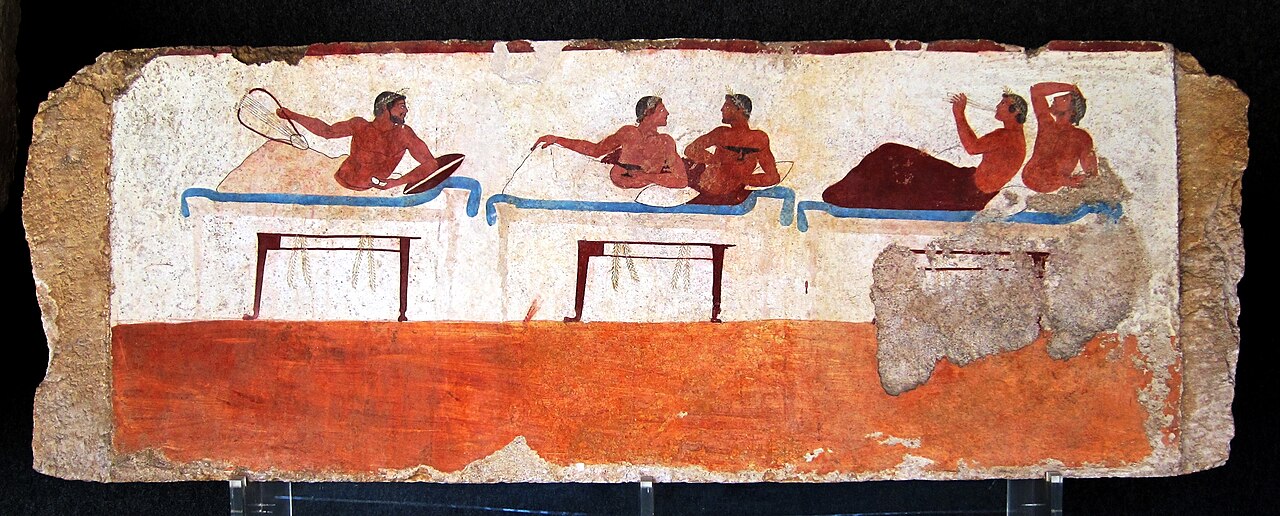
Evidence: Friends at the Symposium
Object. Fresco on the south wall of the Tomb of the Diver, Poseidonia (Paestum), c. 480 to 470 BCE. Paestum, Museo Archeologico Nazionale.
Evidence. The symposium was the Greek evening of friends. 5 men recline on 3 couches with wine cups and a lyre, in conversation and song. Plato and Xenophon both set dialogues on love and the divine at such a gathering.
Plato wrote his most famous letter, the Seventh, to the relatives and companions of his friend Dion, and in it he spoke openly about the limits of what writing can teach. Friends in Sicily, far from the Academy, received the philosopher's own account of the path.
6 centuries after Socrates, Plotinus ran his school in Rome on the same pattern. His student Porphyry records it plainly.
Porphyry, Life of Plotinus 7:
«Ἔσχε δὲ ἀκροατὰς μὲν πλείους, ζηλωτὰς δὲ καὶ διὰ φιλοσοφίαν συνόντας […]»— "He had many hearers, and also devoted followers who kept company with him for the sake of philosophy [...]"
Senators of Rome sat among his hearers. His companions included physicians, a poet, a rhetor, and women "greatly devoted to philosophy", Gemina and Amphiclea. The emperor Gallienus and his wife Salonina honoured and revered him (Porphyry, Life of Plotinus 7, 9, 12). One of those senators, Rogatianus, went so far that he gave up his property, his slaves and his rank to live the philosophy.
The Temple of Zeus keeps this ancient order. Friends of Zevism form the wide circle. Initiates form the inner one. The step between them is taken freely, by each person, in their own time.
Meet the teachers themselves in The Four Great Philosophers: Divine Men Among Mortals and The Greatest Followers of Zeus in the Ancient Times.
Δʹ Can an Atheist Be a Friend of Zevism?
Answer. Yes. Socrates reasoned patiently with a man who mocked the Gods, and Plutarch counted the honest search for truth as a longing for the divine. The Temple asks only for honesty and respect.
Xenophon records a conversation between Socrates and Aristodemus, nicknamed "the Small". Aristodemus made no offerings to the Gods, used no divination, and laughed at those who did. Socrates kept him in the conversation and asked him a question.
Xenophon, Memorabilia I.4.2:
«Καταμαθὼν γὰρ αὐτὸν οὔτε θύοντα τοῖς θεοῖς οὔτε μαντικῇ χρώμενον, ἀλλὰ καὶ τῶν ποιούντων ταῦτα καταγελῶντα, εἰπέ μοι, ἔφη, ὦ Ἀριστόδημε, ἔστιν οὕστινας ἀνθρώπους τεθαύμακας ἐπὶ σοφίᾳ;»— "Having learned that he neither made offerings to the Gods nor used divination, and even laughed at those who did, he said: Tell me, Aristodemus, are there any men you have admired for their wisdom?"
What followed was an argument conducted with patience and reason. At its close Socrates offered his friend an experiment, the kind an honest sceptic can respect.
Xenophon, Memorabilia I.4.18:
«Ἂν μέντοι, ὥσπερ ἀνθρώπους θεραπεύων γιγνώσκεις τοὺς ἀντιθεραπεύειν ἐθέλοντας καὶ χαριζόμενος τοὺς ἀντιχαριζομένους καὶ συμβουλευόμενος καταμανθάνεις τοὺς φρονίμους, οὕτω καὶ τῶν θεῶν πεῖραν λαμβάνῃς θεραπεύων, εἴ τί σοι θελήσουσι περὶ τῶν ἀδήλων ἀνθρώποις συμβουλεύειν, γνώσει τὸ θεῖον ὅτι τοσοῦτον καὶ τοιοῦτόν ἐστιν ὥσθ᾽ ἅμα πάντα ὁρᾶν καὶ πάντα ἀκούειν καὶ πανταχοῦ παρεῖναι καὶ ἅμα πάντων ἐπιμελεῖσθαι.»— "By serving men you learn who is willing to serve you in return, by doing favours you learn who returns them, and by taking counsel you find out who is wise. If in the same way you put the Gods to the test by serving them, to see whether they will counsel you on things hidden from mortals, you will know that the divine is so great and of such a kind that it sees all things and hears all things at once, is present everywhere, and cares for all things at once."
Socrates asked for a test, and the Temple extends the same offer. Its guide for newcomers warns that the intensity of real spiritual experience can come as a surprise, even a shock, to those raised in Christian homes or atheistic environments. Read What You Can Expect.
Plutarch, priest of Apollo at Delphi and a philosopher, went further. He held that the search for truth is itself a movement toward the divine.
Plutarch, On Isis and Osiris 2, 351E:
«διὸ θειότητος ὄρεξίς ἐστιν ἡ τῆς ἀληθείας μάλιστα δὲ τῆς περὶ θεῶν ἔφεσις […]»— "Therefore the striving for truth, and above all for the truth about the Gods, is a longing for divinity [...]"
By Plutarch's measure, the honest atheist who wants the truth and follows the argument wherever it leads is already reaching upward. Plutarch also set the standard for a real devotee. Beards and rough cloaks don't make philosophers, he wrote, and linen robes and shaven heads don't make servants of Isis. The true devotee receives the rites and then examines them by reason (On Isis and Osiris 3, 352C).
Zevism asks the same of its own. The Temple advocates all learning, all inquiry and all free thought. A Friend who reasons hard is working inside the Temple's own method.
Εʹ What Does the Study of Zevism Give the Mind?
Answer. An examined life, an ethics that works, a soul in command of itself, friendship grounded in virtue, and a clear view of the sources of Western civilisation. All of it is open to believer and unbeliever alike.
- The examined life. Socrates told his judges that the unexamined life isn't worth living for a human being (Plato, Apology 38a). Zevist philosophy trains the habit of testing every belief, your own first. The result is a mind that the crowd can't easily herd. See The Four Great Philosophers.
- An ethics that holds under strain. Aristotle defined virtue as a settled disposition, chosen deliberately, lying in a mean relative to the individual (Nicomachean Ethics II.6, 1106b36). Justice, courage, temperance and practical wisdom become daily tools. The Ethics & Guidelines of Zevism and Law, Justice, and the Duty of the Citizen put them to work in modern life.
- A soul formed with care. The Greeks called education παιδεία, the forming of the whole person. Its aim was character: reason in command, appetite trained, courage steady. See ΠΑΙΔΕΙΑ: Education as Μόρφωσις, the Sacred Forming of the Human Soul.
- Friendship as a discipline. Aristotle wrote that without friends no one would choose to live, though they had every other good, and that a friend is another self (Nicomachean Ethics VIII.1, 1155a5-6; IX.4, 1166a31-32). The ancient schools grew out of such friendships, and Friends of Zevism inherit the model.
- Kinship with every human being. "One can see in one's travels," Aristotle observed, "how every human being is akin and dear to every other" (Nicomachean Ethics VIII.1, 1155a21-22). The Temple ranks by Ma’at, never by race or origin, and its Friends stand on that same ground.
- Composure before fortune and death. The philosophers trained the mind to meet loss, illness and death with a steady face. See Preparation for Every Fortune and The Tetrapharmakos.
- The source of Western civilisation. Philosophy, law, medicine, drama and the sciences grew in the culture that worshipped Zeus. Reading that culture at its source restores the whole picture. See Western Civilization: Its Foundations, Its Gifts, and Your Duty and The Greatest Followers of Zeus in the Ancient Times.
- Noble speech and good conduct. The ancients treated courtesy as a discipline of the soul, since speech shapes the speaker. See Good Manners, Kindness, and the Discipline of Courtesy and Noble Speech, Good Conduct, and Reverence to the Gods.
- A clear aim for a whole life. Greek philosophy named the aim: εὐδαιμονία, the flourishing of a soul in good order. See Eudaimonia: The End Goal of Zevism.
These gifts ask for attention and honest work, and every Friend of Zevism can carry them home. The full body of teaching waits in Advanced Zevist Philosophy, the Sermons and the Library of Thoth.
Ϛʹ Where Does Study End and Experience Begin?
Answer. At the threshold of the rite. Aristotle, Plato and Iamblichus agreed that the highest knowledge of the divine is undergone, and that thought alone doesn't join a human being to the Gods.
Aristotle, in a passage preserved by Synesius, drew the line exactly.
Aristotle, On Philosophy, fr. 15 Rose (in Synesius, Dion 8):
«[…] Ἀριστοτέλης ἀξιοῖ τοὺς τελουμένους οὐ μαθεῖν […] ἀλλὰ παθεῖν καὶ διατεθῆναι […]»— "Aristotle holds that those being initiated are not to learn [...] but to undergo, and to be brought into a certain state [...]"
Plato said the same of his own deepest teaching. It can't be put into words like other studies. It's born in the soul after long companionship.
Plato, Seventh Letter 341c5-d2:
«Ῥητὸν γὰρ οὐδαμῶς ἐστιν ὡς ἄλλα μαθήματα, ἀλλ᾽ ἐκ πολλῆς συνουσίας γιγνομένης περὶ τὸ πρᾶγμα αὐτὸ καὶ τοῦ συζῆν ἐξαίφνης, οἷον ἀπὸ πυρὸς πηδήσαντος ἐξαφθὲν φῶς, ἐν τῇ ψυχῇ γενόμενον αὐτὸ ἑαυτὸ ἤδη τρέφει.»— "It can't be put into words at all, like other studies. After long companionship with the matter itself, and after living with it, suddenly, like a light kindled from a leaping fire, it is born in the soul and from then on feeds itself."
In the Symposium, Diotima of Mantinea leads Socrates through the lesser teachings on love and then halts at the threshold of the higher rites.
Plato, Symposium 209e5-210a2:
«Ταῦτα μὲν οὖν τὰ ἐρωτικὰ ἴσως, ὦ Σώκρατες, κἂν σὺ μυηθείης· τὰ δὲ τέλεα καὶ ἐποπτικά, ὧν ἕνεκα καὶ ταῦτα ἔστιν, ἐάν τις ὀρθῶς μετίῃ, οὐκ οἶδ᾽ εἰ οἷός τ᾽ ἂν εἴης.»— "Into these matters of love, Socrates, perhaps even you could be initiated. But the final rites and the revelations, for whose sake these exist, if one pursues them rightly, I don't know whether you would be able."
Philosophy prepares the soul and fits it for the rite. In the Phaedo, Socrates quotes the old saying of the Mysteries and names those who cross over.
Plato, Phaedo 69c8-d2:
«“ναρθηκοφόροι μὲν πολλοί, βάκχοι δέ τε παῦροι”· οὗτοι δ᾽ εἰσὶν κατὰ τὴν ἐμὴν δόξαν οὐκ ἄλλοι ἢ οἱ πεφιλοσοφηκότες ὀρθῶς.»— "'Many carry the wand, but few become Bacchoi.' And these, in my judgement, are none other than those who have practised philosophy rightly."
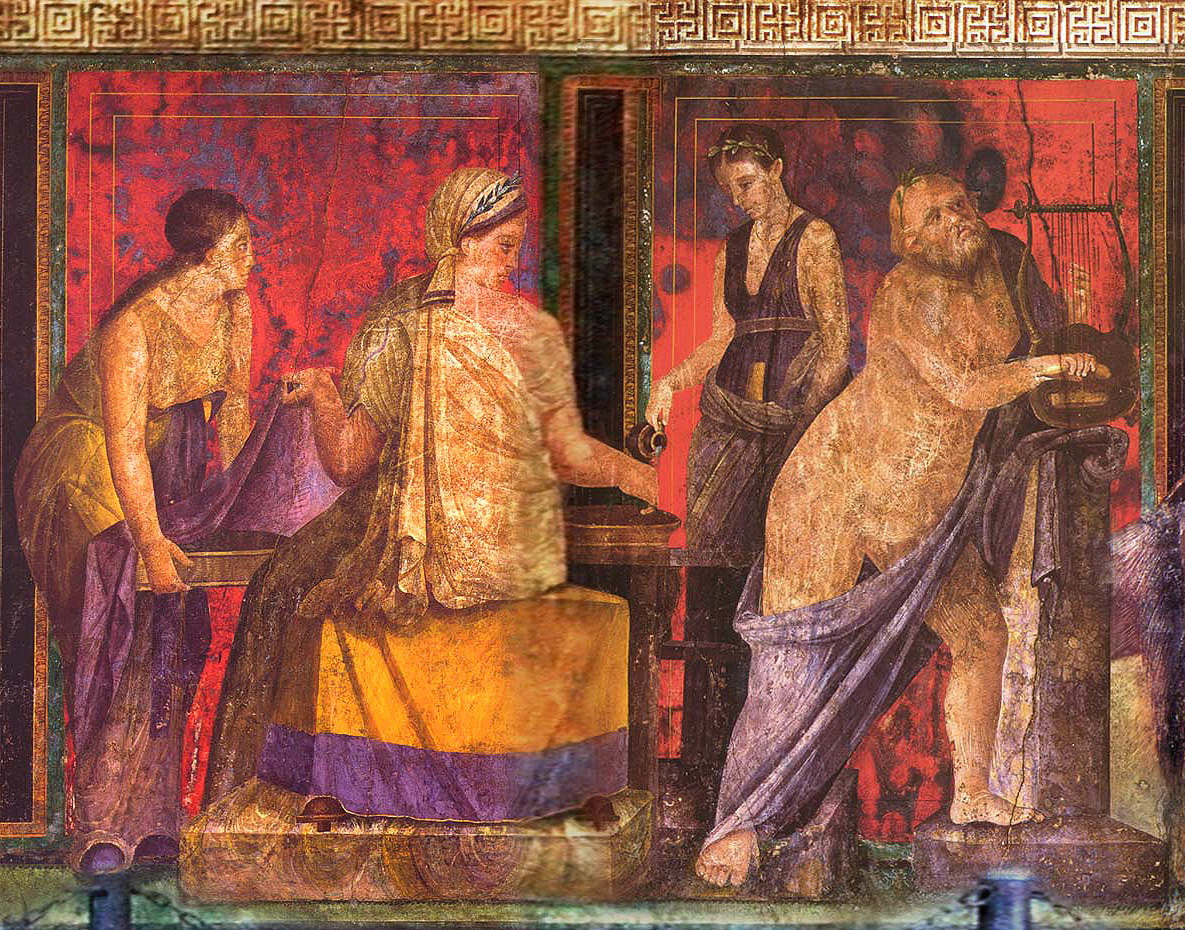
Evidence: The Rite Prepared
Object. Fresco in the Hall of the Mysteries, Villa of the Mysteries, Pompeii, c. 60 BCE. In situ.
Evidence. Initiation was a sequence of sacred acts. A seated woman, often identified as a priestess, performs a rite at a table while attendants assist her, and Silenus plays the lyre beside them. The frieze that runs around the hall is widely read as an initiation into the Mysteries of Dionysus, the rites of the Bacchoi.
Iamblichus, the master of theurgy, fixed the limit of thought alone.
Iamblichus, On the Mysteries II.11, 96.13-16 Parthey:
«Οὐδὲ γὰρ ἡ ἔννοια συνάπτει τοῖς θεοῖς τοὺς θεουργούς· ἐπεὶ τί ἐκώλυε τοὺς θεωρητικῶς φιλοσοφοῦντας ἔχειν τὴν θεουργικὴν ἕνωσιν πρὸς τοὺς θεούς;»— "For thought doesn't join the theurgists to the Gods. Otherwise, what would stop those who philosophise theoretically from having theurgic union with the Gods?"
Union comes, he continues, through the sacred acts performed beyond all intellection and through the power of the symbols understood by the Gods alone.
Seneca saw the same pattern in the Stoic school. The living voice and a shared life teach more than any book. Cleanthes, he wrote, would never have taken on the form of Zeno by listening alone: he shared Zeno's life (Moral Letters 6.5-6).
Here the Friend of Zevism stands at the door with a lamp already lit. Study has brought them this far. Experience carries them through.
Ζʹ What Does the Initiate Receive?
Answer. Direct contact with the Divine. The ancients described it as lightning in the soul, as the sight of life's Zeus-given beginning, and as union with the God over all.
Initiation changes the relationship itself. The Temple works with the Gods directly, as living realities, and every Initiate enters that work in person. Plutarch described the moment with the image of Zeus's own weapon.
Plutarch, On Isis and Osiris 77, 382D:
«Ἡ δὲ τοῦ νοητοῦ καὶ εἰλικρινοῦς καὶ ἁπλοῦ νόησις ὥσπερ ἀστραπὴ διαλάμψασα τῆς ψυχῆς ἅπαξ ποτὲ θιγεῖν καὶ προσιδεῖν παρέσχε. διὸ καὶ Πλάτων καὶ Ἀριστοτέλης ἐποπτικὸν τοῦτο τὸ μέρος τῆς φιλοσοφίας καλοῦσιν […]»— "The intellection of the intelligible, the pure and the simple, flashes through the soul like lightning and allows it, even once, to touch and behold. For this reason Plato and Aristotle call this part of philosophy epoptic, the part of the vision [...]"
The Greeks called the Initiate who had seen the final rite an ἐπόπτης, one who has beheld. The poets named the reward.
Pindar, fragment 137 (in Clement of Alexandria, Stromateis III.3.17):
«Ὄλβιος ὅστις ἰδὼν κεῖν᾽ εἶσ᾽ ὑπὸ χθόν᾽· οἶδε μὲν βίου τελευτάν, οἶδεν δὲ διόσδοτον ἀρχάν.»— "Blessed is the one who has seen those things and then goes beneath the earth. He knows the end of life, and he knows its Zeus-given beginning."
Cicero judged that of all the excellent things Athens gave to human life, none surpassed the Mysteries.
Cicero, On the Laws II.36:
«[…] nihil melius illis mysteriis, quibus ex agresti immanique vita exculti ad humanitatem et mitigati sumus, initiaque ut appellantur, ita re vera principia vitae cognovimus; neque solum cum laetitia vivendi rationem accepimus, sed etiam cum spe meliore moriendi.»— "[...] nothing is better than those Mysteries, by which we were drawn out of a rough and savage life, refined and softened into humanity. They are called initia, beginnings, and in them we have truly come to know the first principles of life. We have received from them a way not only of living with joy but also of dying with a better hope."
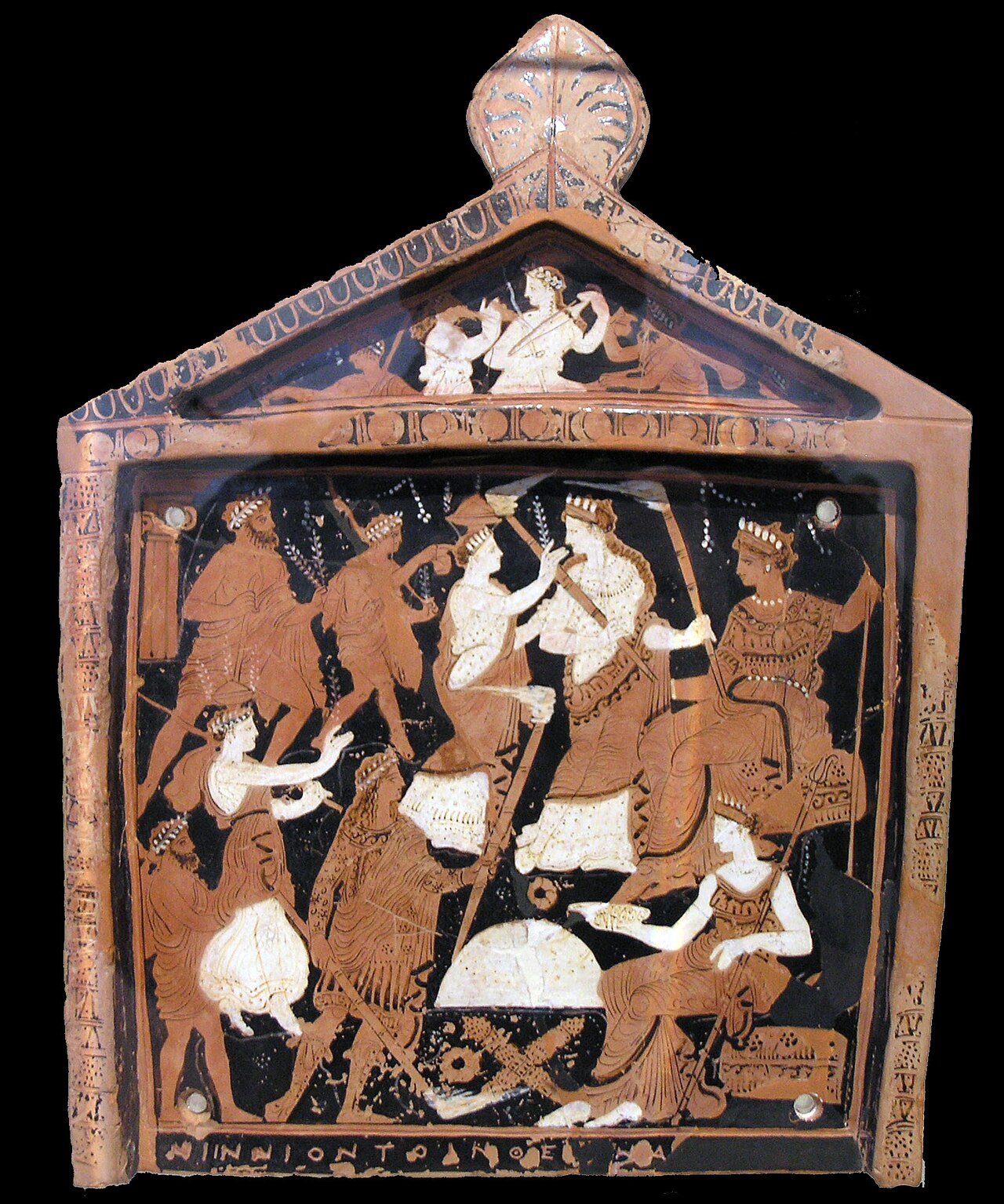
Evidence: The Procession of the Initiates
Object. The Ninnion Tablet, painted terracotta votive plaque from the sanctuary of Eleusis, c. 370 BCE. Athens, National Archaeological Museum, inv. 11036.
Evidence. The Eleusinian initiation, painted in Plato's lifetime. Iakchos, bearing torches, leads wreathed Initiates toward Demeter and Persephone. It's among the very few ancient images of the rites.
Seneca, the Stoic, put the nearness of the divine in 3 clauses.
Seneca, Moral Letters 41.1-2:
«[…] prope est a te deus, tecum est, intus est. […] sacer intra nos spiritus sedet, malorum bonorumque nostrorum observator et custos.»— "[...] God is near you, He is with you, He is within you. [...] A holy spirit dwells within us, the watcher and guardian of our evil and our good."
Plotinus made union with the God over all the aim of his life. Porphyry, who lived beside him, counted the times he reached it.
Porphyry, Life of Plotinus 23:
«Τέλος γὰρ αὐτῷ καὶ σκοπὸς ἦν τὸ ἑνωθῆναι καὶ πελάσαι τῷ ἐπὶ πᾶσι θεῷ. ἔτυχε δὲ τετράκις που, ὅτε αὐτῷ συνήμην, τοῦ σκοποῦ τούτου ἐνεργείᾳ ἀρρήτῳ.»— "His end and his goal was to be united with the God who is over all and to draw near to Him. 4 times, I think, while I was with him, he reached that goal, in an actuality beyond words."
The oldest aim of the Path stands written in Plato's Theaetetus.
Plato, Theaetetus 176a8-b3:
«Διὸ καὶ πειρᾶσθαι χρὴ ἐνθένδε ἐκεῖσε φεύγειν ὅτι τάχιστα. φυγὴ δὲ ὁμοίωσις θεῷ κατὰ τὸ δυνατόν· ὁμοίωσις δὲ δίκαιον καὶ ὅσιον μετὰ φρονήσεως γενέσθαι.»— "That is why one must try to flee from here to there as quickly as possible. The flight is becoming like God as far as possible, and to become like Him is to become just and holy, with wisdom."
For the Initiate these texts turn into a map of lived experience. Initiation opens:
- Signs and answers. Initiates report clear signs, meaningful coincidences and real responses, often soon after they begin. See What You Can Expect.
- Power built by practice. Meditation builds the strength of the soul the way training builds the body, and a strong soul can hold what it receives. See Power Meditation and Meditation Information.
- Theophany by degrees. The Gods show themselves in stages, from psychic impressions through symbol and noetic vision to union. See The Five Levels of Divine Theophany.
- Becoming like the Gods. The work aims at the transformation of the human being toward the divine, the ὁμοίωσις θεῷ of Plato. See Ὁμοίωσις θεῷ: Becoming a God.
- A spiritual family. Initiates enter the companionship of fellow Initiates, with the Temple's structure and doctrine behind them. See The Family of Zeus: For Initiates.
- A better hope in death. The Mysteries promised it, and Zevism teaches what waits for the soul. See The Afterlife & Death.
The rite that opens this road is the Dedication of the Soul to Zeus and the Original Gods. It's performed once and for life, by those who have decided.
Ηʹ Which Values Lead a Friend to the Gods?
Answer. Truth, respect, friendship, hospitality, justice, freedom and the sense of the right moment. They're simple to name and demanding to live, and whoever lives them for long finds they already walk the Path.
- Ἀλήθεια, Truth. Honesty is the entry price, and the whole of it. The Temple meets honest disagreement with argument and meets deceit with a closed door. Plutarch counted the longing for truth as a longing for the divine.
- Αἰδώς, Respect. The reverence Zeus Xenios requires of host and guest alike. A Friend may doubt every doctrine and still speak of the Gods and their worshippers with courtesy. That courtesy marks an educated person.
- Φιλία, Friendship. Equality and sharing, as Pythagoras taught. Friends receive the Temple's knowledge freely and meet its members as equals in discourse.
- Ξενία, Hospitality. No human being is an outsider to Zeus. The Temple receives people of every nation, race and former religion who come with respect.
- Δίκη and Ma’at, Justice and Right Order. The Temple stands for the Good and upholds Ma’at, the Cosmic Law of truth, justice and right order. Friends see that order at work in the doctrine, the ethics and the conduct of the community.
- Ἐλευθερία, Freedom. There are no mediators in Zevism, and no one thinks on another's behalf. Friends keep full liberty of judgement, and the Temple treats them as responsible adults.
- Καιρός, the Right Moment. Every flower blooms at its own hour. The Temple sets no deadline on anyone's decision. See All Flowers Bloom at Their Own Time.
These values lead somewhere. A person who practises truth, respect and friendship in the company of the Gods' teaching begins to feel the pull the ancients felt: the wish to see for themselves what the texts describe. When that wish comes, the door is already open.
Θʹ What Does the Temple Ask of Its Friends?
Answer. Honesty, respectful speech and good faith in debate. In return it gives its teaching freely, and it never pressures anyone.
- What the Temple asks. Honest questions, respectful speech about the Gods and their worshippers, and good faith in debate. Mockery, deceit and hostility end the conversation.
- What the Temple gives. Free access to the sermons, the doctrines and the Library of Thoth, open discussion on the Ancient Forums, and answers from the Clergy through Temple Support & Community.
- What the Temple never does. It never pressures anyone, never demands conversion, and never asks a Friend to pretend belief.
Athens once honoured the Samians, who stayed loyal after the defeat at Aegospotami while her other allies revolted. The city granted them citizenship, the highest honour Athens could give to foreigners, and set the decree beneath an image of 2 goddesses clasping hands.
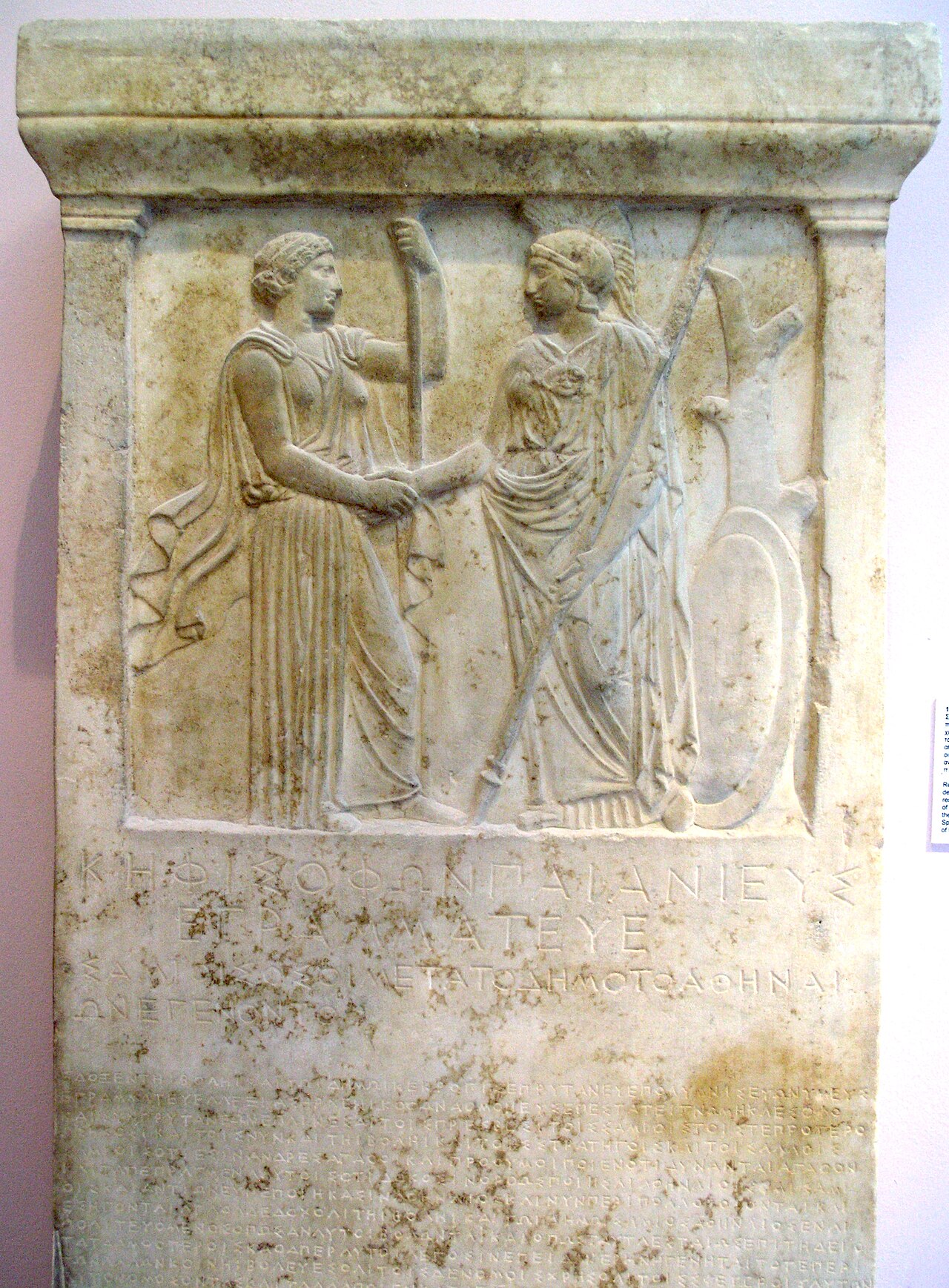
Evidence: Athena and Hera Clasp Hands
Object. Relief crowning the honorary decrees for the Samians, 405/4 and 403/2 BCE, Pentelic marble. Athens, Acropolis Museum, Akr. 1333 (IG II² 1).
Evidence. Friendship proven in loyalty became citizenship. Beneath this handclasp of the goddesses of Athens and Samos, Athens granted the Samians its citizenship, the highest honour it gave to foreigners.
Friendship proven over time has always opened the way to belonging. When the Athenians celebrated the Mysteries of Eleusis, any Greek who wished could be initiated.
Herodotus, Histories VIII.65.4:
«[…] καὶ αὐτῶν τε ὁ βουλόμενος καὶ τῶν ἄλλων Ἑλλήνων μυεῖται […]»— "[...] and whoever wishes, of the Athenians themselves and of the other Greeks, is initiated [...]"
Ὁ βουλόμενος: whoever wishes. The decision belongs to the Friend.
Ιʹ How Does a Friend Begin?
Answer. Read the sermons, join the discourse on the forums, and put any question to the Clergy. When the wish to see for yourself arrives, the Dedication opens the next door.
Epicurus, whose gods never meddled in human affairs, still left antiquity one of its finest lines on friendship.
Epicurus, Vatican Sayings 52:
«Ἡ φιλία περιχορεύει τὴν οἰκουμένην κηρύττουσα δὴ πᾶσιν ἡμῖν ἐγείρεσθαι ἐπὶ τὸν μακαρισμόν.»— "Friendship dances around the inhabited world, calling on all of us to wake to blessedness."
Come as a Friend. Read the sermons, question the doctrines, argue on the forums. Stay as long as you like, and take what serves you.
When reading no longer satisfies, and the texts start to read like descriptions of a country you want to see with your own eyes, the next door is already open.
Where Friends Begin
The Door Stands Open
Read, speak, and when the hour comes, cross the threshold.
Begin with the Philosophy Join the Discourse Initiate Your Soul