





| Epithet | Meaning | Domain |
|---|---|---|
| Aequitas Augusti (AEQVITAS AVGVSTI) | Equity of the Augustus | Imperial fairness |
| Aequitas Aug. (AEQVITAS AVG) | Equity of the Empire | Aequitas holding scales and cornucopia |
| Aequitas Publica (AEQVITAS PVBLICA) | Public equity | Order and form |
10 min read
AEQUITAS
author: High Priest Zevios Metathronos
co-author: Novice Priest Karnonnos
I. Name
The name, aequitas, is derived from Latin aequus. "Level" or "even." While it originally meant simply "physical evenness," when used in a moral, legal, or political context, it means "fairness," "equitable," or "just and equitable."”1,2
Under the Roman Empire, the abstract noun, aequitas, became a tangible representation of the Roman concept of fair treatment, or equity. She is typically depicted as a draped female figure carrying a set of balances and sometimes holding a cornucopia, rod, or scepter. The use of scales emphasizes the concept of balance in the application of the law3,4
The name attaches equity to the emperor’s rule, especially to his public promise of fair measure, honest distribution, and legitimate administration.3,5
II. Imperial personification
Aequitas belongs to the Roman group of deified abstractions: not a goddess with a rich myth-cycle, genealogy, lovers, battles, and temples like the major Olympian-style deities, but a personified public value. Aequitas does not have a rich myth cycle, genealogy, lovers, battles, and temples like other deities. Instead, she embodies the virtues and values that Rome felt necessary to sustain its public order. These include: Fides (faithfulness), Pietas (piety), Concordia (harmony), Victoria (victory), Providentia (providence), and Aequitas (equity). In essence, these deities embodied the qualities that Rome believed necessary to sustain its public order..5
Imagery of Aequitas is largely numismatic. She is typically depicted on imperial coinage as a standing female figure. She is commonly depicted as holding a balance-scale (Libra) and occasionally holds a cornucopia, rod, or scepter. The balance-scale clearly illustrates the concept of aequitas - that is the principle of fairness in the measurement of goods and services. The cornucopia represents the bounty that results from the correct application of the principles of aequitas.3,4,5
The first time Aequitas appears as an imperial symbol on coins was on Galba's issues from 68-69 CE. On these coins, the legend AEQVITAS AVGVSTI, "the justice/empathy of the emperor," reflects the political climate during this unstable period following Nero. In using the term Aequitas, Galba chose to depict himself not by military victory or by grandeur of his dynasty, but rather by a quality that has connotations of administration, finance, and morality. This quality is characterized as the restoring of due balance after turmoil. All later emperors continued to use this issue (coin), showing its use.3,4
Aequitas is especially close to money because scales, weights, and honest measure were central to Roman economic trust. On coins, she can overlap visually with Moneta, the personification connected with minting and money. Modern numismatic discussion of Nerva’s coinage stresses that Aequitas could carry more than one meaning at once: she could point to fair government, but also to monetary reliability, honest accounting, and the emperor’s control over an orderly financial system.4,5
III. Epithets
Sources: De Vaan, Etymological Dictionary of Latin and the Other Italic Languages, (2008); Glare, Oxford Latin Dictionary, (2012); Mattingly, The Roman Imperial Coinage, (1984); Elkins, "Aequitas and Iustitia on the Coinage of Nerva", (2017); Noreña, "The Communication of the Emperor’s Virtues", (2001); Mattingly, The Roman Imperial Coinage, (1949); Mattingly, The Roman Imperial Coinage, (1938);1,2,3,4,5,6,7
Aequitas’ “epithets” are mostly coin-legends rather than poetic cult epithets. They work like miniature theological-political statements. Aequitas Augusti says that fairness belongs to the emperor; Aequitas Publica moves the idea toward public order; Aequitas Augg. expands it to more than one imperial authority.
IV. Aequitas
Within Roman society and culture, aequitas was greater than the goddess herself. It denoted the expectation that judgmen judicial interpretation would not deviate from being even, uniform, rather than being biased or disproportionate. The term suggested equivalence, proportionate treatment, reasonable treatment-and redressing excessiveness. Consequently, it was simple to depict Aequitas using scales: the image did not simply convey ‘justice’ as understood today in a courtroom setting-but rather referred to the balance between opposing forces.1,2
Even in the juristic tradition preserved in Justinian’s Digest, Paulus’s maxim says that “in all things, especially however in law, equity must be regarded” in omnibus quidem, maxime tamen in iure, aequitas spectanda sit. This is a compact statement of what Roman legal temperament was meant to represent.8
Similarly, social significance underlies why Aequitas was beneficial to emperors. An emperor who included Aequitas on his coins was stating that his administration kept accounts in order, weighted accurately in measured law distributed fairly. Given that coinage traveled further than speeches throughout the large expanse of the Roman Empire-Aequitas translated an administrative promise into a circulating image. Each scale and cornucopia indicated that Roman stability rested on harmony.4,5
The concept also belongs beside iustitia, but the two are not identical. Iustitia tends toward justice as right order or giving each person their due; aequitas has the flavor of levelness, proportion, fairness, and correction where strict application might become uneven.9
V. The State
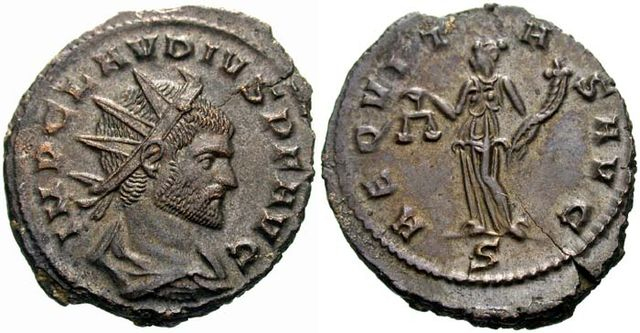
Antoninianus of Emperor Claudius II
In the Roman state and culture, the goddess role was rendered in the concept of aequitas and goddess called Aequitas. As said, she carries a cornucopia, representing the result of good commercial practices and the abundance caused by the proper exercise of justice. She also typically carries Libra, the scales, symbolizing the occult concept of Ma'at.
Aequitas is described succinctly in this academic extract:
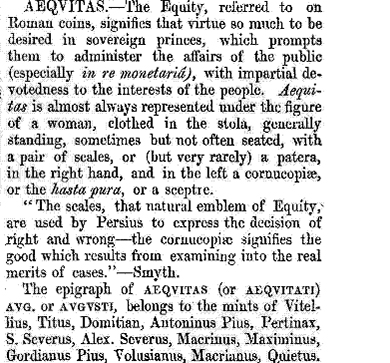
A Dictionary of Roman Coins, Seth William Stevenson
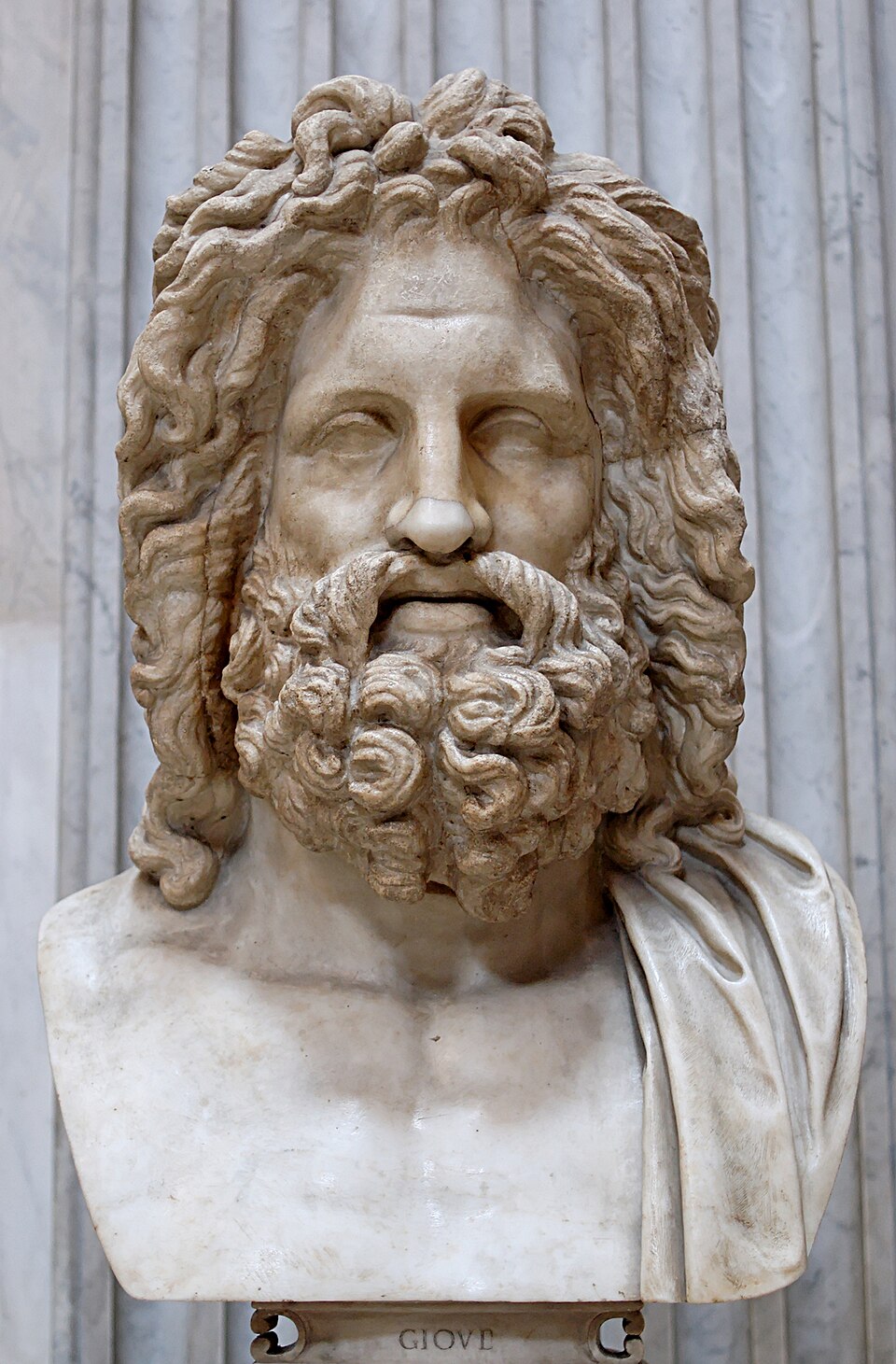
She is represented via the concept of Aequitas as a deputy of Jupiter, the head god of Rome, as Zeus is the Ultimate Judge of the cosmos, and she enacts many of His decrees. Jupiter Optimus Maximus ("Best-Greatest") was not only the King of the Gods but also a divine overseer of laws, contracts, and justice in Roman society, the aspect of Jupiter to whom Oaths were sworn. Aequitas was also represented as a masculine aspect of the Roman god Mars's powers. The Roman promotion of Mars as a mitigator of legal matters is relatively distinct in nature from Ares; Aequitas is one reason why.
She served as the figure behind many aspects of a cult, particularly in the functions of the court. She also represented the power of the lictors (bodyguards of Roman kings and later consuls) and the equites (knights or cavalry of Rome) and presided over any Roman equivalent of the police across the ages. Both Ares and Aequitas are very ancient gods of Rome. In addition to Rome, she was the head God of the Aequi, one of Rome's traditional formidable enemies who lived in the Apennine Mountains northeast of the city and were supremely skilled in all matters of warfare. This crafty and persevering nation was known to live in sophisticated fortresses that they created on mountaintops and hills, posing a frequent threat to Rome with perhaps hundreds of wars between the two states. Absorption of the Aequi and their mores into the city of Rome's population and into the aristocracy of the nascent state contributed to many aspects of Roman culture, particularly in the military arena.
Aequitas represented the mores of aequitas within the military, ensuring soldiers were subjected to fair standards. As historians such as Livy relay at length, the formation of the military in the days of the Kingdom of Rome was a highly stratified and strained affair. Reforms were progressively made during the Republican period to address this, providing soldiers with sufficient incentives to transform Rome into the most powerful entity on the planet, whose military might was both feared and admired.
VI. The Concept of Aequitas
Aequitas within Roman society was a particularly complex kind of terminology governing many aspects of legal interpretation, moral conduct, reaching agreement with others, business affairs, matters of caste, consumer standards, fair judgment, and marriage matters, as well as matters of black magick and deflecting curses in the occult sphere. Cicero (De Officiis and Topica), Ǫuintillian (Institutio Oratoria), Seneca (De Beneficiis), Apuleius (Metamorphoses), Gaius, Ulpian, and many others discuss the concept at length in discussing how to interpret the law. Aequitas is not directly translatable to any term in English, even though we derive the term equity from it as a pale resemblance. Many of its facets relate to the sign of Libra and involve occult processes of Eligos; indeed, it is known Eligos is associated with Venus.10,11,12,13
One example of the nature of this word is attributable to Cicero:14
Aequitas lucet ipsa per se; dubitatio cogitationem significat iniuriae.
"… for righteousness shines with a brilliance of its own, but doubt is a sign that we are thinking of a possible wrong."
Cicero, De Officiis 1.30
Much of the Roman concept of aequitas was related to establishing civil order and proper class divisions, with good conduct playing a central role in this. It aimed to remove any curse that might lead to a reversion to the mean, contrasting with the relative anarchy of caste that arose with the advent of the Christian order. After the assassination of Julius Caesar, culminating in the Battle of Philippi and the return of the Roman standard from Parthia, his nephew, the first emperor Augustus, erected a glorious cult and temple dedicated to Mars Ultor (Mars the Avenger), citing aequitas as the reason for this act. Seneca also links aequitas with being an essential quality of a virtuous emperor.
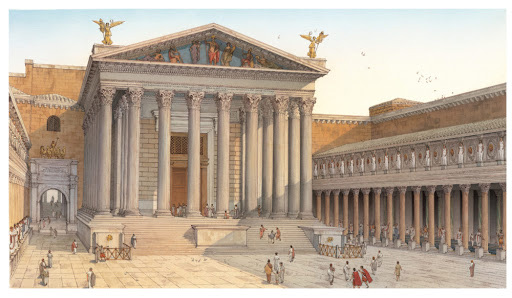
This avenging quality (Ultio) that the emperor must exhibit in pursuit of virtuosity is literal and not merely symbolic: if the state is threatened by an existential crisis, blood must be shed for the curse to be removed. Never is this the most pleasant aspect of life, but it is true nonetheless.
As far as the internal anatomy of any state is concerned, the goddess indeed serves as an important deity in matters of policing, the military, the legal professions, mercenary work, and espionage. It is advised that members who wish to join any kind of police or paramilitary force consult him for success and to guide them in exercising proper judgement and ethics, as this is a difficult career where one has to act in the interests of the public at all times.
Sources and Bibliography
- De Vaan, Michiel. Etymological Dictionary of Latin and the Other Italic Languages. Leiden Indo-European Etymological Dictionary Series 7. Leiden: Brill, 2008. See aequus and related forms, including aequitas.
- Glare, P. G. W., ed. Oxford Latin Dictionary. 2nd ed. Oxford: Oxford University Press, 2012. See aequitas and aequus.
- Mattingly, Harold, C. H. V. Sutherland, and R. A. G. Carson, eds. The Roman Imperial Coinage. Volume I: From 31 BC to AD 69. Rev. ed. London: Spink, 1984. See Galba, nos. 491–493, for AEQVITAS and AEQVITAS AVGVSTI types.
- Elkins, Nathan T. “Aequitas and Iustitia on the Coinage of Nerva: A Case of Visual Panegyric.” Numismatic Chronicle 177 (2017): 93–106. See discussion of Aequitas as fairness, financial guarantee, and imperial virtue on Nerva’s coinage.
- Noreña, Carlos F. “The Communication of the Emperor’s Virtues.” Journal of Roman Studies 91 (2001): 146–68. See discussion of imperial virtues, personifications, and the communicative role of coinage.
- Mattingly, Harold, Edward A. Sydenham, and C. H. V. Sutherland, eds. The Roman Imperial Coinage. Volume IV, Part III: Gordian III–Uranius Antoninus. London: Spink, 1949. See Philip I and related third-century AEQVITAS AVG / AEQVITAS AVGG types.
- Mattingly, Harold, Edward A. Sydenham, and C. H. V. Sutherland, eds. The Roman Imperial Coinage. Volume IV, Part II: Macrinus to Pupienus. London: Spink, 1938. See Elagabalus, Julia Paula, and Julia Maesa types with AEQVITAS PVBLICA and the three Monetae.
- Justinian. The Digest of Justinian, 50.17.90. Edited by Theodor Mommsen and Paul Krueger. Translated by Alan Watson. 4 vols. Philadelphia: University of Pennsylvania Press, 1985.
- Schulz, Fritz. Principles of Roman Law. Translated by Marguerite Wolff. Oxford: Clarendon Press, 1936. See discussion of aequitas, legal interpretation, and Roman legal values.
- Tasić, Aleksandar. “The Interpretation of Law in Accordance with the Principle of Aequitas in Roman Law.” Zbornik radova Pravnog fakulteta u Novom Sadu 49, no. 4 (2015): 1503–1517. Section cited: aequitas as a principle allowing interpretation beyond the strict meaning of legal norms.
- Basedow, Jürgen, Klaus J. Hopt, and Reinhard Zimmermann, eds. “Equity.” Max Planck Encyclopedia of European Private Law. Oxford: Oxford University Press, 2012. Section cited: Roman aequitas as the root of equity and as a channel for moral and ethical principles into law.
- Marković, Branimir. “Aequitas and Bona Fides in the Legal Practice of Ancient Rome.” Facta Universitatis: Law and Politics 1, no. 7 (2003): 625–634. Sections cited: aequitas, bona fides, contracts, fair agreement, and Roman legal practice.
- Frier, Bruce W., and Thomas A. J. McGinn. A Casebook on Roman Family Law. Oxford: Oxford University Press, 2004. Sections cited: requirements for Roman marriage, including conubium, adulthood, consent, and family authority.
- Cicero. De Officiis. Edited and translated by Walter Miller. Loeb Classical Library 30. Cambridge, MA: Harvard University Press, 1913.