





9 min read
Philosopher of Beauty
Abhinavagupta
author: High Priest Zevios Metathronos
Understanding, Practice and the Experience of Beauty
Dates: Approximately 950–1020 CE; scholarly datings vary.
Period: Ignorance (1000–1336 CE), following his mature work around the turn of the millennium.
Abhinavagupta was a Śaiva theologian of Kashmir who wrote the Tantrāloka, a work that “expounded all aspects of the Trika, theoretical, yogic, and ritual.” He also won what Alexis Sanderson calls “pan-Indian recognition” in aesthetics, for his commentaries on Ānandavardhana's Dhvanyāloka and on the Nāṭyaśāstra of Bharata.1
In the Abhinavabhāratī he gave a theory of the spectator. Aesthetic experience, he argued, is “a distinct mode of cognition between worldly, appetitive awareness and the blissful interiority of enlightened consciousness.”2
He was a devotee of Śiva, and the recognition his school sought was the recognition of one's identity with Śiva.3 Zevism reads his work as a link in the chain of spirituality under 2 Greek powers: Hermes the interpreter, and Apollo with the Muses, who govern drama, dance and music.
LIFE AND CONTEXT
The dates aren't certain. The Internet Encyclopedia of Philosophy gives c. 975–1025 CE, and David Lawrence's Oxford bibliography gives c. 950–1020. Britannica records that he “flourished 1014.”4
He belonged to the “recognition” school, pratyabhijñā, of Kashmiri Śaiva monism. That school “conceived of the god Shiva (the manifestation of ultimate reality), the individual soul, and the universe as essentially one.”5 He stood 2 generations from Utpaladeva: he “was a disciple of a disciple of Utpaladeva,” whose Verses on the Recognition of the Lord he later explained.6
The school built its case on 2 terms. “Prakāsha is the ‘bare subjective awareness’ that validates each cognition, so that one knows that one knows.” Vimarsha is apprehension “with a recognitive structure,” and Lawrence glosses it as “recognitive apprehension.” The student, in Lawrence's account, comes “to see this self-recognition as the inner reality of all that is experienced,” and is “led to full participation in it.”7
In the Trika his main effort went into a single scripture. He treated the Mālinīvijayottara Tantra as “the fundamental scripture of the Trika” and as “the essence of the entire Śaiva revelation.” In his Mālinīvijayavārttika he argued for a “supreme nondualism.” He then wrote the Parātriṃśikāvivaraṇa on the elite Kaula practices, and after it the Tantrāloka.2
The Tantrāloka gathered into the Trika later and more heterodox material, “particularly the Krama-based cult of Kālī,” under the authority of the Mālinīvijayottara. Lawrence describes the same work as a synthesis of Trika teaching with a wide range of Śaiva and Śākta traditions.8
The Krama had a book of its own. He wrote a commentary on the Kramastotra, the Krama hymn of the lineage of Jñānanetranātha, and it hasn't survived. What's left of his Krama work is his own short Kramastotra and a quotation from an unnamed book in which he follows the Krama worship of the Devīpañcaśataka.2
In philosophy he wrote 2 commentaries on Utpaladeva, one on the verses and one on the author's longer auto-commentary. Utpaladeva's auto-commentary is lost, but Abhinavagupta's commentary on it isn't. With these books, Sanderson writes, the nondual school could reject “the dualism of the Śaiva Siddhānta” and “the illusionism of the Vedānta,” while treating those positions as approximations to its own.2
His aesthetics grew from 2 older books. The Nāṭyaśāstra, credited to the sage Bharata and placed between the 1st century BCE and the 3rd century CE, is a “detailed treatise and handbook on dramatic art,” with chapters on “dance, music, poetics, and general aesthetics.” Britannica puts its main importance in “its justification of Indian drama as a vehicle of religious enlightenment.”9
The theory of rasa, aesthetic flavour, is attributed to Bharata. Britannica defines it as “an essential element of any work of visual, literary, or performing art that can only be suggested, not described.”10 Ānandavardhana had tied it to suggestion: when suggestion conveys the rasa of a poem, “it is called rasa-dhvani.” Abhinavagupta commented on both books.11
His pupil Kṣemarāja wrote simpler works that spread the teaching. “Abhinava's own disciple, Kshemarāja, further pursued his teacher's agendas.”6 Sanderson writes that Abhinavagupta shaped the later Śaivism of Kashmir “both directly and indirectly,” the indirect road running through Kṣemarāja's “simpler and more formulaic works of popularization.”2
ATTAINMENTS
- He wrote the Mālinīvijayavārttika, arguing that the Absolute, as autonomous consciousness, has “the power to contain both plurality and unity.”1
- He composed the Tantrāloka, a single systematic account of Trika doctrine, yoga and ritual that took in the Krama cult of Kālī.2
- He wrote the Īśvarapratyabhijñāvimarśinī on Utpaladeva's verses and the Īśvarapratyabhijñāvivṛtivimarśinī on Utpaladeva's lost auto-commentary.12
- His Locana on the Dhvanyāloka defended the primacy of suggestion, dhvani, in poetry. After it, the emphasis in Indian poetics “shifts onto the reader's emotive experience.”13
- He set out 4 powers of language in order: primary meaning, purport, secondary meaning and suggestion.14
- His Abhinavabhāratī on the Nāṭyaśāstra shows “vast learning in the arts of drama, dance, and music.” Britannica credits him with developing the theory of rasa and applying it “to all varieties of theatre and poetry.”15
- He trained Kṣemarāja, and his lineage carried the teaching to Tamil Nadu, where Sanskrit works in his tradition were written “from the eleventh to the nineteenth century.”2
KEY STORIES
A Scholar Brought from the Doab
The family story began more than 2 centuries before him. King Lalitāditya of Kashmir, who reigned c. 724–760, brought a brahman scholar named Atrigupta into the valley from the Doab. Abhinavagupta was descended from him.1
His parents were Vimalā and Narasiṃhagupta, and he was “the son, conceived in Kaula ritual,” of that marriage. He lost his mother in early childhood, and he saw that loss as “the start of his spiritual progress.”2
His father, a learned Śaiva, taught him “grammar, logic and hermeneutics.” The boy moved on to poetry, and there the turn came. “Later, when immersed in the study of the poetic arts, he became intoxicated with devotion to Śiva.” He gave up “all thoughts of marriage and family” and went from teacher to teacher, living as a student “in the homes of numerous exponents of the various Śaiva traditions and their opponents.”2
The Village on the Ganges
Ānandavardhana worked his theory out on a short sentence: “The village is on the Ganges.” The listener takes “Ganges” to mean its bank, “so as to avoid the interpretation that the village is floating on the river itself.” Then a 3rd meaning arrives. “What is suggested is the purity of the village which is on the bank of the holy Ganges river.”16
Abhinavagupta, Keating writes, elaborated the theory “in a way which goes beyond Ānandavardhana's original text.” He named 4 capacities of language in order. Primary meaning “conveys the individual word-meanings in their ordinary sense.” Purport “conveys the entire sentence meaning.” Secondary meaning works “along with factors like blocking the ordinary sense.” Suggestion comes last, “along with the hearer's imaginative abilities.”17
He also insisted on the sequence. He “explicitly says that it is not possible to have an obstacle for primary meaning without first understanding the syntactical connections among words.” The purity of the holy river reaches the listener only after the grammar has done its work.14
An Incarnation at Cidambaram
At home the nondual doctrine of master and pupil “permanently colonized the cult of Svacchandabhairava,” which Sanderson calls “the basic Śaivism of the valley of Kashmir.” It later became the basis of the Kashmirian cult of the goddess Tripurasundarī.1
The teaching didn't stay in Kashmir. His lineage “established this tradition in Tamil Nadu, particularly at the great Śaiva center of Cidambaram,” far to the south. There his followers spread “the belief that Abhinavagupta was no mortal but an incarnation of Śiva himself.”2
Tamil scholars went on writing Sanskrit works on the Trika, the Krama, the recognition school and Śrīvidyā from the 11th to the 19th century. His books and Kṣemarāja's also supplied the metaphysics of 2 Vaiṣṇava scriptures of the Pañcarātra, the Ahirbudhnya Saṃhitā and the Lakṣmī Tantra. They shaped the Śaiva Vedānta of Śrīkaṇṭha, who worshipped Śiva at Cidambaram.2
THE ZEVIST READING
Zevism reads the commentator as a servant of Hermes. In Plato's Cratylus, Socrates says the God's name “seems to be concerned with speech” and calls him “an interpreter (hermēnea), a messenger.”18 Abhinavagupta's father trained him first in hermeneutics, and many of his books explain older books. The auto-commentary of Utpaladeva that he explained is lost; his explanation of it survives. The Temple honours such transmitters as keepers of the source.
His aesthetics belongs to Apollo and the Muses. The Homeric Hymn tells how Hermes built the lyre and handed it to Apollo, who tried the strings: “Awesomely it sounded at the touch of the god, while he sang sweetly to its note.”19 Abhinavagupta placed the experience of drama, dance and music between appetite and enlightened consciousness. In Zevist terms that's the discipline of Meditation, where the mind learns its capacity by being lifted out of habit.
The recognition he taught was the recognition of oneself as Śiva. Zevism doesn't claim him for the Greek Gods; it reads his aim as the same aim Plato set, ὁμοίωσις θεῷ κατὰ τὸ δυνατόν, becoming like the divine “as far as possible,” pursued under Śiva's name.20 His method joins philosophy to ritual and art, and that union is what Zevism calls Theurgy: joining one's intelligence to the intelligence of the Gods.
The chain of transmission ran on after him. Kṣemarāja simplified the doctrine for Kashmir, his lineage carried it to Cidambaram, and Tamil authors wrote in it until the 19th century. Zevism holds that knowledge changes as it passes from hand to hand while the source keeps priority. Abhinavagupta went back to the Mālinīvijayottara and to Utpaladeva, and the teachers after him went back to Abhinavagupta.
NOTES
2 Sanderson.
3 Lawrence, “Kashmiri Shaiva Philosophy,” §§3–4.
4 Lawrence, “Kashmiri Shaiva Philosophy,” §1d; Lawrence, “Abhinavagupta”; Britannica, “Abhinavagupta”.
5 Britannica, “Abhinavagupta”.
11 Keating, §3.1; Sanderson.
12 Sanderson; Britannica.
13 Sanderson; Keating, “The Literal-Nonliteral Distinction,” §3.1.
14 Keating, §5.1.
15 Sanderson; Britannica, “Rasa”.
16 Keating, “The Literal-Nonliteral Distinction,” §3.1.
18 Plato, Cratylus 407e–408a, tr. Horan.
19 Homeric Hymn to Hermes 39–51, 496–502.
BIBLIOGRAPHY
Alexis Sanderson, “Abhinavagupta”, Encyclopedia of Religion (1987), with revised bibliography, Encyclopedia.com; ancestry, youth, works, aesthetics and later influence.
David Peter Lawrence, “Kashmiri Shaiva Philosophy”, Internet Encyclopedia of Philosophy; sections 1d, 3 and 4.
David Lawrence, “Abhinavagupta,” Oxford Bibliographies in Hinduism, published 27 January 2011; public introductory extract.
Malcolm Keating, “The Literal-Nonliteral Distinction in Classical Indian Philosophy”, Stanford Encyclopedia of Philosophy, first published 26 November 2016; sections 3, 3.1 and 5.1.
Encyclopaedia Britannica, “Abhinavagupta”; school, date and Pratyabhijñā commentaries.
Encyclopaedia Britannica, “Natyashastra”; author, date, contents and purpose of Bharata's treatise.
Encyclopaedia Britannica, “Rasa”; Bharata's theory and Abhinavagupta's development of it.
Plato, Cratylus 407e–408a, translated by David Horan, Platonic Foundation.
Homeric Hymn to Hermes 39–51 and 496–502, H. G. Evelyn-White translation, Theoi Classical Texts Library.
Plato, Theaetetus 176a–b, Greek text, Perseus Digital Library.
CREDIT
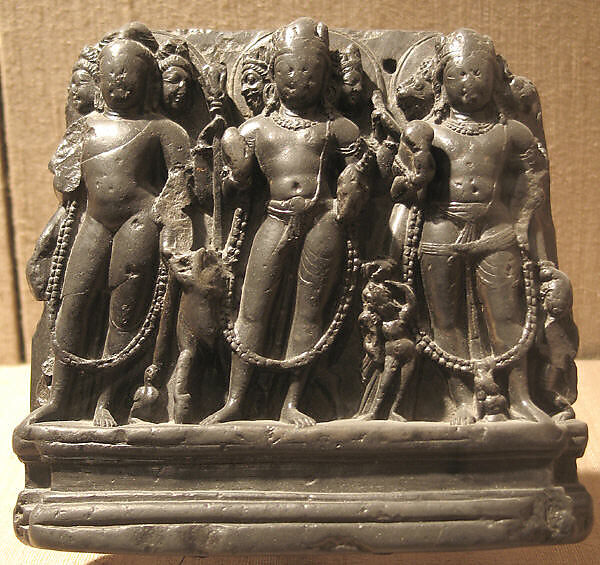
Picture: The Brahmanical Triad: Brahma, Shiva and Vishnu, Kashmir, eighth–ninth century, stone; Met 1985.85. A contextual illustration of Kashmiri sacred art, not a portrait of Abhinavagupta.
The Metropolitan Museum of Art, Purchase, Lita Annenberg Hazen Charitable Trust Gift, in honor of Cynthia and Leon Polsky, 1985, 1985.85; public domain. Image record, Public domain (Met Open Access).
The round picture in the lists of the personalities is cropped from it.