




9 min read
First Programmer
Ada Lovelace
author: High Priest Zevios Metathronos
Imagination Given a Method
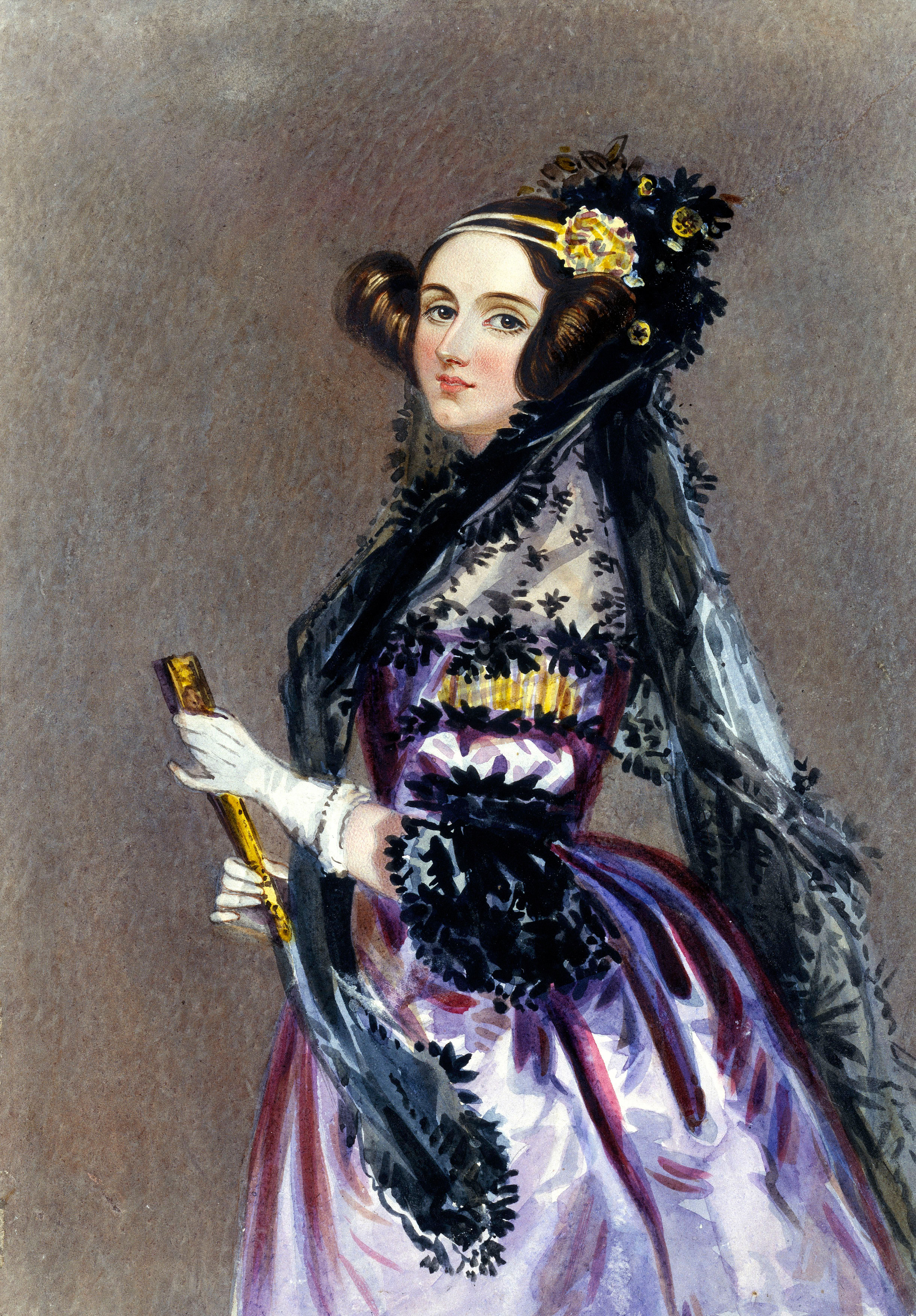
Dates: 1815–1852 CE
Period: Imperial period (1804–1900)
Ada Lovelace, the daughter of Lord Byron, was schooled in mathematics from girlhood. In 1843 she translated L. F. Menabrea's French memoir on Charles Babbage's Analytical Engine and added her own notes, about 3 times the length of the memoir.1
Those notes are her attainment. Babbage designed the machine and Menabrea described it, but Lovelace worked out how it could compute the Bernoulli numbers, and she saw that it could handle “symbols, letters and even musical notes” as well as numbers. The engine was never built; had it been, it would have been a general-purpose computer.2
Zevism honours her in 2 ways. As a translator she was a keeper of the source, carrying another man's design across a language and adding what it lacked. As a mathematician she carried number, the gift of Theuth, into the arts of Athena and the Muses.
LIFE AND CONTEXT
She was born Augusta Ada Byron in London on 10 December 1815, the daughter of the poet Lord Byron and Annabella Milbanke. On 25 April 1816 Byron went abroad, and she never saw her father again. Her mother had her taught mathematics as a discipline for the mind. In 1829 she caught measles and took a long time to recover.3
In 1833 she was presented at court, and that summer she met Charles Babbage. The next year she met the polymath Mary Somerville, who became one of her tutors.4
She married William King, 8th Baron King, in 1835, and he was made Earl of Lovelace in 1838. From about July 1840 to January 1842 she studied university mathematics by post with Augustus De Morgan, the logician. She was studying, the Science Museum notes, “at a time when women rarely had access to such subjects.”5
The notes on the Analytical Engine came out in 1843 in the 3rd volume of Richard Taylor's Scientific Memoirs. In her last years she gambled on horses and pawned some of her jewels to pay for it; she owed £2,000 when she died. Cancer killed her on 27 November 1852, at 36.4
Her work, in the Science Museum's words, “was not fully appreciated until the advent of electronic computing a century later.” Even then some historians doubted her mathematics, and some suggested Babbage had written the paper himself. Christopher Hollings, Ursula Martin and Adrian Rice answered both claims in 2017 from the Lovelace family papers in Oxford's Bodleian Library.6
ATTAINMENTS
- She translated Menabrea's memoir, first printed in the Bibliothèque Universelle de Genève in October 1842, and added 7 notes lettered A to G. They run to about 3 times the length of the original.7
- Her notes worked out how the engine would compute the Bernoulli numbers, which MacTutor calls “what many consider to be the first ever computer program.” Babbage had offered to do that algebra; she sent it back to him, “having detected a grave mistake.”8
- She defined its work in general terms: “By the word operation, we mean any process which alters the mutual relation of two or more things.” The engine, she wrote, is “an embodying of the science of operations, constructed with peculiar reference to abstract number as the subject of those operations.”9
- She explained how a card or set of cards could be brought back “any number of times successively in the solution of one problem,” so that a short series of instructions could be repeated.10
- She described the engine as a machine for any symbols whose relations could be stated exactly. It “might act upon other things besides number, were objects found whose mutual fundamental relations could be expressed by those of the abstract science of operations.”11
- She named music as the test case: if the relations of pitched sounds could be so expressed, “the engine might compose elaborate and scientific pieces of music of any degree of complexity or extent.”12
- Between 1840 and 1842 she worked through algebra, trigonometry, functional equations, infinite series, the calculus, differential equations and complex numbers with De Morgan. The correspondence survives as 63 letters, 43 of them hers.13
KEY STORIES
The Engine in Babbage's Studio
Ada Byron was 17 when she met Charles Babbage at a party on 5 June 1833. 2 weeks later she and her mother went to Babbage's London studio, where his Difference Engine was on display.8
Sophia Frend, daughter of William Frend, watched the girl at the machine. She'd later marry Augustus De Morgan, and her account survives: Miss Byron, “young as she was, understood its working, and saw the great beauty of the invention.”8
Mary Somerville, whom Ada met the following year, sent her mathematics books, advised her on study, set her problems and discussed Babbage's work with her. When Babbage moved on to the Analytical Engine, a design regulated by punched cards on the principle of Jacquard's loom, she had the training to follow him.8
A decade after that visit she'd write the difference between the 2 machines into her notes. The Difference Engine, she said, could “do nothing but add.” With the Analytical Engine, “the bounds of arithmetic were however outstepped the moment the idea of applying the cards had occurred.”9
A Correspondence Course in Calculus
In the summer of 1840 Lady Lovelace began what Oxford's historians call a “correspondence course” on the calculus with Augustus De Morgan. The exchange ran for about 18 months. Hollings, Martin and Rice put the letters into a corrected order, and reading them in sequence they rejected earlier claims that her mathematics was inadequate.14
Her letters are frank about the work. She found that “the curious transformations many formulae can undergo” were among the chief difficulties. She valued her own errors: “I often gain more from the discovery of a mistake of this sort, than from 10 acquisitions made at once.” Once she reported, “All is prosperous. The Mathematics & Mr De Morgan going on very well indeed.”15
In January 1844 De Morgan wrote to her mother. Her power of thinking, he said, “has been something so utterly out of the common way” that had a young beginner about to go to Cambridge shown the same powers, he'd have prophesied they would make him “an original mathematical investigator, perhaps of first rate eminence.” The 3 historians who re-read the letters in 2017 concluded that by early 1842 she had “a solid grounding in several areas of what was then university-level mathematics.”15
Notes 3 Times the Length
When Lovelace told Babbage she'd translated Menabrea's memoir, he pushed her further. He recalled the conversation in his memoirs: “I asked why she had not herself written an original paper on a subject with which she was so intimately acquainted?” Then came the proposal: “I then suggested that she should add some notes to Menabrea's memoir; an idea which was immediately adopted.”8
They talked over examples. “I suggested several, but the selection was entirely her own,” Babbage wrote. He'd offered to do the algebra for the Bernoulli numbers himself, to save her the trouble. “This she sent back to me for an amendment, having detected a grave mistake which I had made in the process.”8
The finished notes went far past Menabrea. Babbage's engine was to be regulated by punched cards, on the principle Jacquard had devised for his loom, and Lovelace saw what that meant: “The Analytical Engine weaves algebraical patterns just as the Jacquard loom weaves flowers and leaves.” Athena, in Zevist terms, had found a new loom.16
THE ZEVIST READING
Zevism holds that one must return to the source, and it honours translators as keepers of the source. Lovelace's great work began as a translation. She took a memoir written in French by General Menabrea about an English machine and made it exact in English. Then she added what only a mind at home in the design could add. That's the transmitter's office done at its highest level: the source kept whole and carried further.
Her subject belongs to Theuth. In Plato's Phaedrus the Egyptian God invents number and calculation, geometry and astronomy, and letters.17 Lovelace joined 2 of those gifts. She saw that a machine built for number could work on any symbols, letters included, once their relations were stated.
Her image for it belongs to Athena. The Homeric Hymn to Aphrodite says the Goddess “teaches tender maidens in the house and puts knowledge of goodly arts in each one's mind.”18 A woman taught at home by tutors, and later by letter, wrote that the engine weaves algebra as a loom weaves flowers. Weaving is among Athena's crafts, and the loom is its oldest machine for keeping order among many threads.19 Lovelace joined that art to number, and her music passage reached toward the Muses.
The Temple reads such a joining of intelligence to the order of number as a step on the path Plato set, ὁμοίωσις θεῷ κατὰ τὸ δυνατόν, likeness to the divine “as far as possible.”20 She didn't live to see the engine built. Her method survives as she wrote it, an order of operations set down exactly enough for a machine to follow.
NOTES
1 Science Museum Group, “Ada Lovelace, 1815–1852”; O'Connor and Robertson, “Augusta Ada King, Countess of Lovelace,” MacTutor.
2 Science Museum Group; Hollings, Martin and Rice, Historia Mathematica 44, 2017.
3 Science Museum Group; O'Connor and Robertson, MacTutor.
4 O'Connor and Robertson, MacTutor; Science Museum Group.
5 Science Museum Group; Hollings, Martin and Rice, 2017.
6 Science Museum Group; Oxford Mathematical Institute, “Exploding the myths of Ada Lovelace's mathematics,” 2017.
7 Menabrea, Sketch of the Analytical Engine, with notes by the translator, 1843; O'Connor and Robertson, MacTutor.
8 O'Connor and Robertson, MacTutor.
10 Lovelace, Note C.
11 Lovelace, Note A, quoted by Digital Humanities at Oxford, 2015.
12 Digital Humanities at Oxford.
13 Hollings, Martin and Rice, Historia Mathematica 44, 202–231.
14 Oxford Mathematical Institute, 2017; Hollings, Martin and Rice, Historia Mathematica 44.
16 O'Connor and Robertson, MacTutor; Menabrea, Sketch, Note A.
18 Homeric Hymn to Aphrodite 7–15, tr. H. G. Evelyn-White.
19 Theoi, “Athena”.
BIBLIOGRAPHY
Science Museum Group, “Ada Lovelace, 1815–1852”, collection biography and timeline.
J. J. O'Connor and E. F. Robertson, “Augusta Ada King, Countess of Lovelace”, MacTutor History of Mathematics, University of St Andrews; with Babbage's recollection from Passages from the Life of a Philosopher and Sophia Frend's account of 1833.
L. F. Menabrea, Sketch of the Analytical Engine Invented by Charles Babbage, tr. with notes by the translator (Ada Lovelace), Taylor's Scientific Memoirs 3, 1843; transcription at Fourmilab; Note A.
Christopher Hollings, Ursula Martin and Adrian Rice, “The Lovelace-De Morgan mathematical correspondence: A critical re-appraisal”, Historia Mathematica 44.3, 2017, pp. 202–231, DOI 10.1016/j.hm.2017.04.001.
Oxford Mathematical Institute, “Exploding the myths of Ada Lovelace's mathematics”, 21 June 2017.
Digital Humanities at Oxford, “Music and Machines”, 9 March 2015; passages from Note A.
Plato, Phaedrus 274c–275b, and Theaetetus 176a–b, Perseus Digital Library.
Homeric Hymn to Aphrodite 7–15, H. G. Evelyn-White translation, Theoi Classical Texts Library; Theoi, “Athena”.
CREDIT
Image: Alfred Edward Chalon, watercolour portrait of Ada Lovelace, 1840. Public domain; verified Commons file record.

Alfred Edward Chalon, Ada Lovelace (1840), via Wikimedia Commons; public domain. Image record, Public domain: PD-Art; author died1860; pre1931 publication.
The round picture in the lists of the personalities is cropped from it.