





| Language / Culture | Name of Agni | Attestation |
|---|---|---|
| Sanskrit | अग्नि (Agni) | Rigveda (1500-1200BCE) |
| Hittite | dAkni | CTH 13 Hittite inscription (1620–1590 BCE) |
| Chinese | 火天 (Huotian) | 舍頭諫太子二十八宿經 (307–313 CE) |
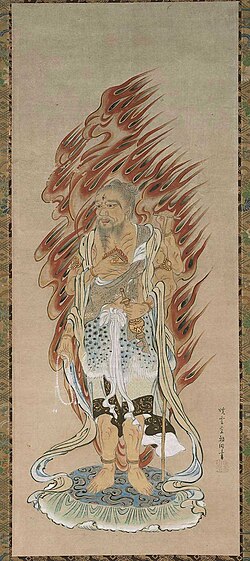
| Japanese | 火天 (Katen) | Ennin (810s-864 CE) |
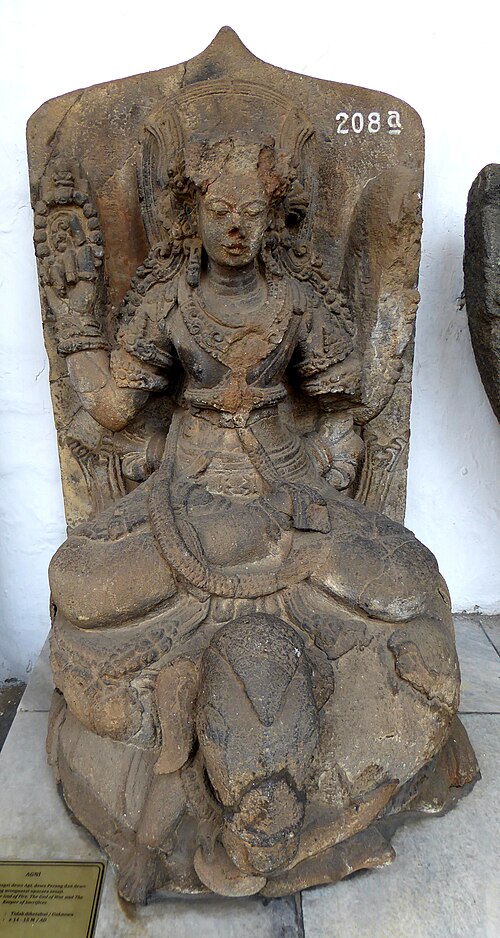
| Old Balinese | Hyang Api | Bebetin A I inscription, no. 002 (896 CE) |
25 min read
AGNI
author: High Priest Zevios Metathronos
co-author: Novice Priest Karnonnos
Hieratic Information about Agni
| Divine Names | |
|---|---|
| Agni (अग्नि) | the ancient Vedic name of the Fire |
| Vaiśvānara | the universal fire of all humankind |
| Jātavedas | the knower of all created beings |
| These hieratic names carry strong spiritual resonance and are recommended for summoning and invocation practices. | |
| Divine Symbols | |
| |
| Divine Numbers and Attributes | |
| Sacred Numbers | 3 (the three fires), 7 (the seven tongues) |
| Sacred Direction | the South-East |
| Sacred Chakra | Maṇipūra (the navel) |
| Sacred Animal | the Ram |
| Element | Fire |
| Divine Forces | |
| |
| Important Titles | |
| |
| Names Across Civilizations | |
| Vedic | अग्नि (Agni) |
| Hittite | Akni |
| Latin (cognate) | ignis |
I. Etymology
The name Agni simply means 'fire'. The earliest attested use of his name in an Indian context is from the ancient Rigveda.1
Surprisingly, the earliest likely attestation of Agni as a theonym is not from India, but in Hittite cuneiform material from Ḫattuša (Boğazköy), in central Turkey, a remnant of the Mitanni civilization that worshipped Indian gods, whose worship was continued by the Hittites and the Hurrians that the Hittite Empire was in conflict with. The name appears as Akni, written with the cuneiform sign whose value can be read ak or ag; scholars therefore cite the form as dAgni or dAkni when the divine determinative is present.2
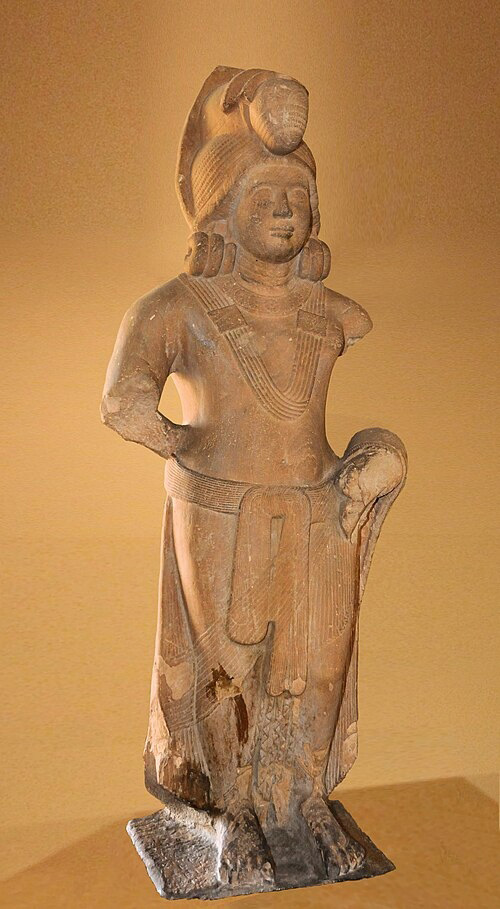
The cleaner early attestation is in Hittite ritual material where the divine name is written with the divine determinative. KUB 8.28 has dA-ag/k-ni-ish, translated by Oettinger as “Agnii will devour,” and KBo 11.14, a thirteenth-century BCE ritual text, has the formula that the ritual patron should escape “from the mouth of Agni", connecting it to Vedic contexts quite strongly. In India, the first attested use is on the statue of the Agnipani from 100BCE of Mathura, which has an inscription deciphered by Sonya Rhie Quintanilla to be dedicated to Agni.3,4
In Vedic etymologies, such as the Nikurta of Yaska, the word is associated with the Sanskrit word agri, first or foremost. The triplicity of Agni, a common theme, is also emphasized by the Nikurta, as it claims the name in itself and in its connection to agri conveys the three states of motion, shining and leading, the triangular characteristics of fire. Yaska also records an etymology relating Agni to unctuousness, non-moistness.5
Conveying a more complex and meditative meaning, the Shatapatha Brāhmaṇa conveys that Prajāpati produces Agni from his mouth, and Agni is born first among the gods, therefore he is called Agni, mystically equivalent to Agri, “the foremost.”6,7,8 In later traditions there are other complex etymologies relating Agni to the Manipura chakra, which are discussed in the eighth section.
In Chinese, his name 火天 (Huotian, literally 'fire god') appears in the Chinese translation of the work of Dharmaraksha by the name of Shardulakarnavadana from the third century. This form also gave rise to the Japanese form, 火天 (Katen) in Ennin's own extrapolation the Soshitsujimyōshindai, an esoteric Buddhist work.9,10,11,12
In the Indonesian archipelago, he is referred to as Hyang Api (fire deity) first around 896CE in an inscription from Bali.13
Sources: the Rigveda; Otten and Mayrhofer, Der Gott Akni in den hethitischen Texten, (1965); Bawanypeck and Steitler, The Terrible Mouth of Agni; Quintanilla, History of Early Stone Sculpture at Mathura, (2007); Yāska, Nirukta; the Śatapatha Brāhmaṇa; Mayrhofer, Etymologisches Wörterbuch, s.v. agni, (1992–2001); Macdonell, A Vedic Reader, (1917); Dharmaraksha, 舍頭諫太子二十八宿經 (trans.); Ennin, 蘇悉地妙心大; Roelof, Prasati Bali (1954)1,2,3,4,5,6,7,8,9,12,13
II. Vedic Role
Rig Veda
Primary is the one adjective that describes the Vedic role of the fire god in the sacred Vedas too. The entire text is set up as a ritual that begins with him placed as the priest gazing back at the worshipper. He is the patron deity of its first text, the Rigveda, and so he is the first stark divine force to be invoked, the first word of the entire text; Agni is the Door to the Vedas.1,14
Agni invites the gods by singing the hymns. His function as the divine personification of the Hotr, the priest, is to reside over the fire of the yajna, the fire ritual. Through this, through divine inspiration, he is also a law-giver. The Rig Veda is his representative text, as three other priests would often be conjoined to ancient rituals; the Adhvaryu who cited the Yajurveda after building the altar, the Udgata associated with the melodic hymns of the Samaveda, and the Atharveda's representative, the supervisor, the Brahma, who corrected the other three.15
The holy texts go on to describe Agni's functions both as a divine messenger and the central point of all life. In the guise of the flame billowing up to the heavens, he is an eternal traveller between the realms of the divine and mundane. Agni is both macrocosmic and microcosmic. Even in a meager shrine of a household, he exists. Ghee and grains are given to him to consume, a sacrificial rite of ritualized domesticity. Keeping people warm enough to survive and their bodies themselves filled with enough energy to act is an inherent aspect of Agni that mirrors the maintenance of his divine spark in the Rigveda. Agni is also referenced as a devourer of enemies of the holy, the great one who scourges them until they are mere ash.16
One side of his that is also outlined is his tie to death, which in modern Hinduism is interpreted strongly in the context of the ritual of cremation. The hymn of 10.16 asks Agni to not simply destroy the departed with his flame, but to mature him and send him to realm of the Fathers. The flame refines the soul of man like glass, the subtle and the gross are disassociated. The cinders of well-worn life give way to the flame of another life, one of the greater mysteries of existence.14
Assimilation into the general mass of gods is another aspect that is shown repeatedly. He is identified with the whole divine host from Indra to Aditi; he is identified as the mouth of all of the divine. Later texts like the Nikurta, extrapolating on the Vedas, state:5
“Agni is all the deities.”
Yaska, Nirukta 7.4 (trans. Sarup)
Indra and Agni are described as being twins whose nature is functionally inseparable. The fire god is also listed with Indra and Surya as a perpetual trinity of gods who create, perserve and destroy, later linked with the AUM mantra itself. As a whole, there are over 200 hymns that praise Agni in the Rig Veda. His name or synonyms appear in nearly a third of the total 1,028 hymns in the Rigveda, making him a most important Vedic deity.17
Yajurveda
In the Krishna Yajurveda (the Black Yajurveda), Agni is described as the protector of the eye in the first book of the recension of Taittirīya Saṃhitā, 1.1.13. In later Indian expositions on the elements, the element of fire that bears his name is assigned to the sense of sight. Meditative aspects are relayed strongly by certain passages, such as 1.2.2, invoking Agni for purpose, impulse, wisdom, thought, consecration, and penance. It contains the formula "To Agni Vaishvānara, hail".18
The Shukla Yajurveda (the White Yajurveda) begins by listing the ritual impedements to Agni's service like the kindling-brand and butter, offering sacrificial oil to Agni Jātavedas, magnifying his presence with brands and sacred oil, eventually asking the 'sweet' Agni to accept the kindling-sticks. He is named as the light of the heavens, the protector of bodily health and life-giver, and the ineffable lord of the home.19
Samaveda
As the Samaveda was designed to be sung and is mostly identical to the Rigveda, it is highly relevant to Agni. The bulk of its verses are drawn from the Rigveda and set to melody, and a great share of them are the Agni hymns of the first and the ninth books, so that the fire god is sung more than almost any other deity in the chant.20 The opening of the collection is addressed to him under the call Agna ā yāhi, "Agni, come," and the singers name him the guest of every house and the bearer of the offering to the gods.20 The melodic setting turns the ritual invocation into praise proper, and the Sāmavedic Agni is the fire whose light is drawn out in song rather than kindled in silence.21
Atharvaveda
The Atharvaveda touches strongly on Agni's social aspect as patron of royalty, as a destroyer of the wicked and the pestilential who harm civilization, and as a vessel for the prayers of the holy whose role is described both in the cities and in the household. He is considered one of the most important Vedic gods to maintenance of anything structural. The most important aspect of this context emphasizes the role of Agni Vaishvānara as lord of light, the spark of endless life, the turner of the seasons, sacrifice, and lord presiding over all that is and will be. Agni is said to be the sun directly.22
The sections of 1.28.1–4 show Agni as a fiend-slayer, caster out of disease, and burner of Yātudhānas. The warrior Maruts of 5.3.1-11 ask for his protection in battle alongside Indra. The active side of Agni makes him exhibit power, splendor, and might. He is identified in this guise, too, with the aggressive and cyclonic Rudra. But the identification with Rudra 'in the fire' is also shown to be more abstract; the two are said to reside in every plant, in every herb, in every flood, coexisting as a state of vying forces, subtle in the case of plants and herbs rather than dramatic like the flood. The contrast of fire and water is touched upon, but so is their all-consuming nature in dynamic form.22
As with the Rig Veda, the mouth of Agni is a typical theme. The Atharvaveda sections 7.1.1–2 affirm his link to the primary prayer, all speech and knowledge through the verbal vehicle. His eloquence and inscrutability resides in the pages of the Atharvaveda. The 6.49.1–3 sections show him engaging in riddles and wordplay; by no means is the element of fire only a banausic force associated with maintenance and manufacture, it is an intellectual and perplexing one that dances, contorts.23
Fire spirits invisible to the human eye are said to be under his domain. Sorcerers who wish to harm the initiate are consumed whole by his flames.23
III. Epithets
| Epithet | Meaning | Domain |
|---|---|---|
| वैश्वानर (Vaishvanaraḥ) | Universal Fire | Cosmic and universal fire; fire shared by all humankind |
| होता (Hota) | The Invoking Priest | Primary Priest |
| पुरोहित (Purohitah) | The Priest Set in Front | Household and ritual leadership |
| ऋत्विज् (Rtvij) | The Priest of the Rite | Correct ritual performance |
| जातवेदस् (Jatavedas) | Knower of All Created Beings | Ritual omniscience, cosmic knowledge, all-knowing fire |
| गृहपति (Grhapatih) | Lord of the House | Domestic hearth, household cult, sacred center of the home |
| दूत (Dutah) | Messenger | Bearer of offerings, mediator between men and gods |
| तनूनपात् (Tanunapat) | Son of Himself | Specialized Apri form |
| नराशंसः (Narsshamsah) | Praised by Men | Specialized Apri form |
Sources: the Rigveda, Maṇḍala 1 Sūkta 1, Maṇḍala 2 Sūkta 1, and Mandala 1 Sūkta 59, Vedic Heritage Portal; the Aufrecht/GRETIL Ṛgveda; Macdonell, A Vedic Reader for Students, (1917); Monier-Williams, A Sanskrit-English Dictionary, relevant entries, (1899).1,8,24,25
IV. The Southwestern Guardian
Like the majority of Vedic deities we know of, in the Vedic period, the worship of the deity of the flame was primarily altar-based, not temple-based. The sacred place was made through yajña, the consecrated altar, and the living fire itself.15
The south-western direction is considered to be the natural preserve of Agni in scripture, and he occupies a place in most major temples on the south-western side of the complex dating back to the ancient Gupta period, particularly ones of Shiva concerned with fire. Temples such as Kanjanur Agniswarar and other Agneeswarar temples preserve Agni in their name and mythology, although they are dedicated to Shiva himself. A possibility remains that the sacred complexes of the flame god were assimilated to the latter, but it is more likely these temples were made with Shiva in mind and with Agni as a pertinent aspect.26
A unique example in more abstract form is the Arunachaleswarar Temple at Tiruvannamalai in southern India dedicated to Shiva and Parvati, and the primeval form Annamalaiyar. The foundation of the temple's myth is in the Shiva Purana, where the Trimurti argue over their supremacy. Shiva took the form of the jyotrlinga (a massive column of light) and struck the ground, then took the form of fire itself on the hill. Agni is represented in the abstract, while the linga is known as the Agni Linga. In Tamil convention, the Arunachalesvara Temple corresponds to the Manipura chakra, associated with the solar plexus (naabhi moolam). This temple is rather ancient, as the core of the current masonry temple is from the 9th century Chola Empire, with major later expansions,27,28
In modern India, the majority of rites to Agni are conducted at temples devoted to other gods.26
V. Fire
One of the great questions in the Vedic philosophical literature is on the nature of fire itself. Fire is not always visible, but it can always be reliably known to be spring into presence with the right conditions. Flame sparks anywhere in the known universe, and this fact was recognized by the rishis of the Veda long before modern scientific expositions on the nature of physics, the nature of space and on the nature of friction existed. Agni's own emergence from the primordial, unknowable Purusha is likened to the spontaneous or mechanical appearance of fire in commentary after commentary. In fact, it is often repeated that there is only the Purusha and Agni.29
The birth of Agni from the devouring Prajapati is treated in a similar way. He is first-born and agri because fire is the first awakened consciousness in the sacrificial cosmos.6
As stated above, it is this mechanism of flame and its apparent nonexistence that is taken to be allegorical of life and death, or what is visible about the body and deeply invisible about the state of the soul. The existence of fire as a vehicle of light that when not directly witnessed still leaves flickering shadows is another aspect related to the meditative contemplation on this element.30
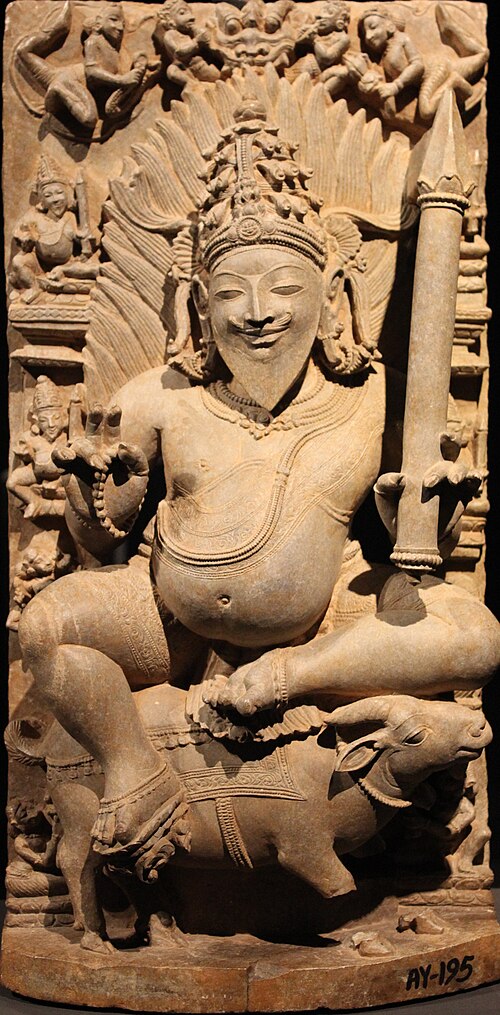
VI. Symbolism of Agni
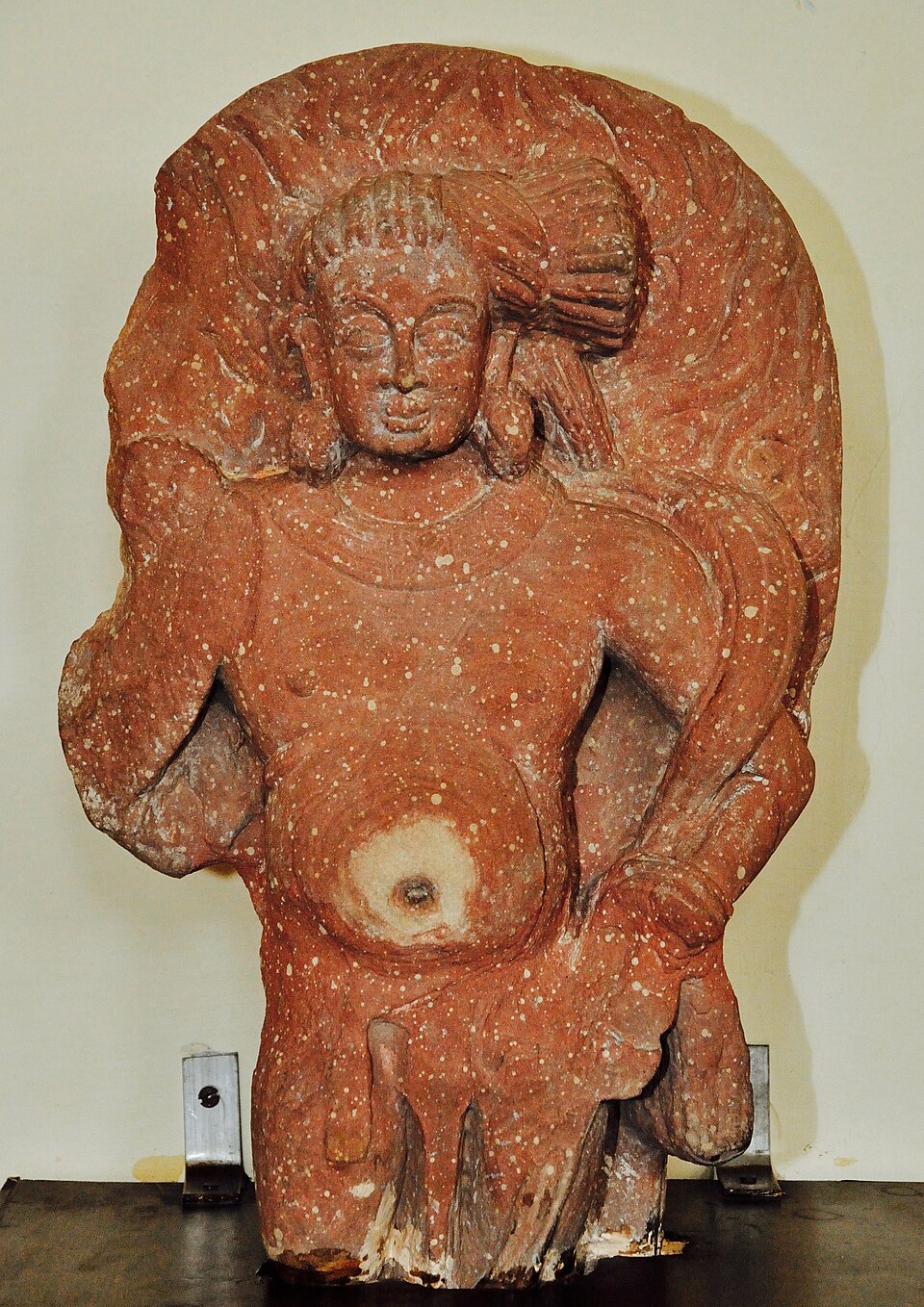
Agni is represented in statuary dating from the late Vedic period, first discovered near Mathura, and is one of the most conspicuously represented Vedic-era deities that survive in art today, his prominence perhaps surprising so for an abstract elemental deity. One form of his representation or an associated fire divinity is the Agnipani statue. He is sometimes shown with a turban (uṣṇīṣa) and earrings made of three fruits, with an aureole of many distinctively and finely carved flames at the back of the head. Linked to the rituals of the Vedas, he often carries a water vessel (कमण्डलु or kamandalu).
His statues and representations on coinage are noted to show a particular influence from Hellenistic sculpture, though there are many native Indian aspects, such as the frontal, fleshy Yaksha body-type, the flame-shaped aureole incised with individual tongues of fire, and the fruit-cluster earrings and turban of the indigenous nature-spirit tradition.4,31 A sacred thread is worn on his body, which appears to indicate the Solar Chakra (Manipura).
Other forms show Agni beside his son Skanda (Karttikeya), a pairing found already in sculpture of about the first century CE, where the fire god is the divine father who bore the burning seed of the war god.32
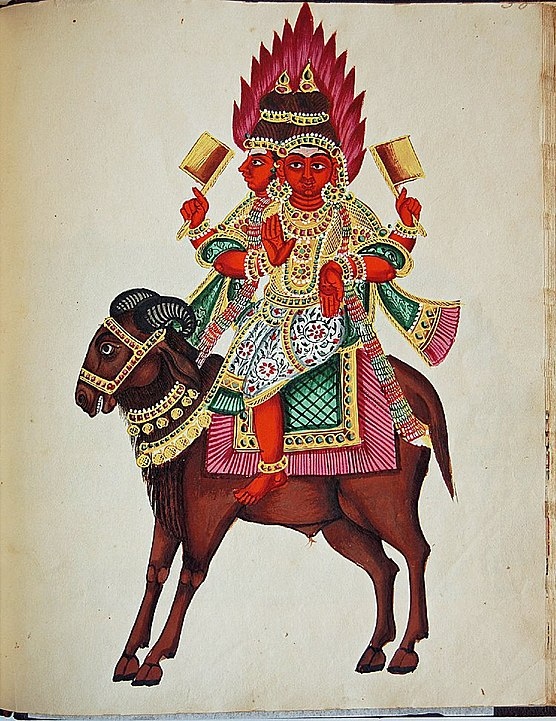
His later symbolism beginning with the 16th century is the most modern kind of representation, though it varies quite considerably according to regional interpretation, style of the artist and cult as with all Indian deities. Most conventionally, although the ram as his mount is maintained, the halo is represented as an overt flame, his skin is ember red, and he often possesses seven arms. The characteristic three heads of Agni are taken to refer to the sun, lightning and earthly flame.
A rosary is held in his hand in commemoration of his ancient meditative nature. He may also hold a torch, an ax or spear, a spoon or other impediments. A particularly common convention since the Middle Ages is to pair Agni in scenes with Svaha, his wife, both because of the tie of Agni to marriage rituals and because the two are symbolic of meditative pursuits before the divine.31,33,34
VII. Ancient and Modern Ritual
Marriage
The Saptapadi or Seven Steps is an important Hindu marriage ritual. With the fire god as their witness, a couple completes seven walked circuits (phera) around a fire. The bride usually walks the first four circuits, with the groom walking the odd number of circuits, three. The rite is completed after the seven circuit. Vows made in the presence of the fire god are considered utterly unbreakable, and may be made at the couple's discretion. The seven steps represent:35
- Nourishment: To provide for the household and share food and strength.
- Strength: To develop physical, mental, and spiritual strength.
- Prosperity: To prosper together and acquire wealth through righteous means.
- Happiness: To acquire knowledge, harmony, and mutual love.
- Family: To be blessed with a healthy, contented family and raise virtuous children.
- Longevity: To pray for a long, joyful life together.
- Companionship: To remain loyal, lifelong companions and best friends.
Cremation
The last of the Hindu rite of passages, Antyesti or the funeral, returns the body to Agni as it is through this flame that each person experiences the divine at death because, like the altar's fires, it is by the heat that the deceased will be consumed upon the funeral pyre. Just as those fires bore sacrifices upwards, they now carry the deceased one up into the world of the fathers. A description of an older version of the funeral can also be seen in the Rigveda. In a prayer to Agni (in which the mourners implore Agni not to incinerate or devour the deceased completely but to "ripen" him and lead him to the world of the fathers), a hymn in the 10th book is described in terms of the previous parts.14,36,37
The philosophy of the two paths of the dead is bound to the same god. The Chandogya Upanishad divides the road of the soul after death into the way of the gods, the Devayana, which is the path of flame, and the way of the Fathers, the Pitryana, which is the path of smoke, so that Agni is the fork at which the two journeys part. His seven tongues, named in the Mundaka Upanishad as Kali, Karali, Manojava, Sulohita, Sudhumravarna, Sphulingini, and Vishvaruci, are the flames into which the offering, and at the last the offered body, is given.38
Holi
The Holi celebration begins with a fire ritual called the Holika Dahana, also referred to as “the burning of Holika” which takes place during the last (full moon) night of the month of Phalguna. After sunset, a large bonfire is lit and then people gather around it in anticipation of the color plays that will take place the next day. This bonfire serves as an example of the triumph of devotion over arrogance and the coming back of the warmness of spring over the coldness. It can be seen as a representation of the action of Agni, the flame that separates the faithful from the evil ones and purifies the old year. In addition to being a symbol for his role in separating good from evil and purification, the flame itself is representative of Agni's grace in providing light during times when there may be no other source available and as such represents his ability to provide heat for growth.39,40
VIII. Manipura Chakra
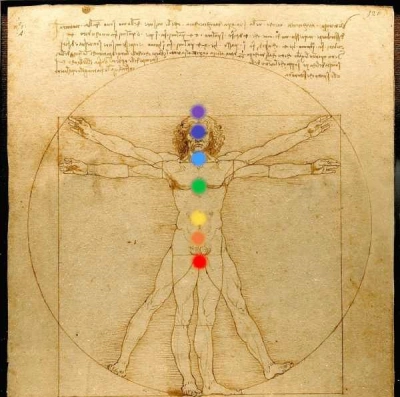
The location of the Solar Chakra or Manipura Chakra is sacred to Agni, as explained, because on the most basic level it deals with the consuming fire that drives digestion. It is the furnace through which we physiologically process food and turn it into waste. The Shiva Samhita speaks of its fiery nature, the third lotus at the navel which it calls Manipuraka, with its ten spokes or petals. Meditation there is said to bring freedom from disease, power over death, knowledge of hidden treasures, and other siddhis connected syntactically to the Rigvedic conceptions of Agni as a life force who aids all these things.41,42
IX. The Nature of the Cosmic Fire
The relation to Agni to the other sun gods is one of the questions that some segments of ancient Indian literature devotes itself to in attempting to explain. The Nirukta has it that Agni's station is on earth, while Vayu and Indra occupy the midspace and Surya the skies. The Brahmanas take this in a distinctive direction by stating that the entire pupose of the Agnihotra is that the sun and earthly fire exchange their light. At sunset the burning one "enters the ahavaniya" so the household fire keeps the sun overnight, never entirely relinquishing its luminous essence.5
Agni is light, light is the sun / the sun is light, light is Agni.
The differentiation occurs from the original point of fire into vaishnavara (the fire of all men), the Jatavedas (knower of births), the three fires of ritual (garhaapatya, ahavaniya, dakshina) and the flesh-devouring kravyad, the funeral pyre flame. The Vaishnavara in the Chandogya Upanishad is treated as a cosmic fire that is the self extending from earth into the heavens and cosmos. Brhaddevata on the other hand explicitly distinguishes between which areas of rule Agni pertains to and which Surya presides over, outlining that many of Agni's functions are relevant to human usage.38,43
Sources and Bibliography
- Rigveda. “Ṛgveda Śākala Saṃhitā” (Maṇḍala 1 Sūkta 1; Maṇḍala 2 Sūkta 1; Maṇḍala 1 Sūkta 59; and related sūktas). Vedic Heritage Portal. Accessed June 1, 2026. https://vedicheritage.gov.in/. Sections cited: the opening Agni hymn, Agni as first word of the Rigveda, and the Agni sūktas of Maṇḍalas 1 and 2.
- Otten, Heinrich, and Manfred Mayrhofer. “Der Gott Akni in den hethitischen Texten und seine indoarische Herkunft.” Orientalistische Literaturzeitung 60 (1965): 545–552. Sections cited: the divine name Akni/Agni in Hittite cuneiform and its Indo-Aryan origin.
- Bawanypeck, Daliah, and Charles W. Steitler. “The Terrible Mouth of Agni: A Comparison Between a Ritual Formula in Hittite and Vedic.” In studies on Hittite and Vedic ritual language. Sections cited: KUB 8.28, KBo 11.14, Oettinger’s reading “Agni will devour,” and the formula of the mouth of Agni.
- Quintanilla, Sonya Rhie. History of Early Stone Sculpture at Mathura: ca. 150 BCE–100 CE. Leiden: Brill, 2007. Sections cited: the Agnipani statue (Mathura Museum GMM 87.146, ca. 100 BCE), the flame aureole with incised tongues, the Yaksha body-type, and the dedicatory inscription to Agni.
- Yāska. The Nighanṭu and the Nirukta. Translated by Lakshman Sarup. Delhi: Motilal Banarsidass, 1967. Sections cited: the derivation of Agni from agri (“foremost”), the threefold etymology of motion, shining, and leading, the etymology of unctuousness, and the formula “Agni is all the deities” (Nirukta 7.4).
- Śatapatha Brāhmaṇa. The Śatapatha-Brāhmaṇa, According to the Text of the Mādhyandina School. Translated by Julius Eggeling. 5 vols. Sacred Books of the East 12, 26, 41, 43, 44. Oxford: Clarendon Press, 1882–1900. Sections cited: Prajāpati producing Agni from his mouth, Agni as first-born of the gods, and the mystical equation of Agni with agri.
- Mayrhofer, Manfred. Etymologisches Wörterbuch des Altindoarischen. 3 vols. Heidelberg: Carl Winter, 1992–2001. Entries cited: agni and the Indo-Iranian and Indo-European vocabulary of fire.
- Macdonell, Arthur Anthony. A Vedic Reader for Students. Oxford: Clarendon Press, 1917. Sections cited: the “Agni” selections, the Agni hymns, and the epithets Hotṛ, Jātavedas, and Vaiśvānara.
- Dharmarakṣa 竺法護, trans. “舍頭諫太子二十八宿經” (Shetou jian taizi ershiba xiu jing). In Taishō shinshū daizōkyō 大正新脩大藏經, vol. 21, no. 1301, esp. 415b7–8. Edited by Takakusu Junjirō 高楠順次郎 and Watanabe Kaigyoku 渡辺海旭. Tokyo: Taishō Issaikyō Kankōkai, 1924–1932. Sections cited: the Chinese rendering of Agni as 火天 (Huotian) in the third-century translation of the Śārdūlakarṇāvadāna.
- Lu, Lu. “Translating Medicine Across Cultures: The Divergent Strategies of An Shigao and Dharmarakṣa in Introducing Indian Medical Concepts to China.” Religions 16, no. 7 (2025): 844. https://doi.org/10.3390/rel16070844. Sections cited: Dharmarakṣa’s translation strategy and his rendering of Indian divine and technical names into Chinese.
- Mei, Naiwen 梅迺文. “竺法護的翻譯初探” [A Preliminary Investigation of Dharmarakṣa’s Translations]. 中華佛學學報 (Chung-Hwa Buddhist Journal) 9 (1996): 49–64. Sections cited: the corpus and method of Dharmarakṣa’s translation work.
- Ennin 圓仁. “Soshitsujimyōshindai” 蘇悉地妙心大. In Taishō shinshū daizōkyō 大正新脩大藏經, vol. 75, no. 2387, esp. 43b1–2. Edited by Takakusu Junjirō 高楠順次郎 and Watanabe Kaigyoku 渡辺海旭. Tokyo: Taishō Issaikyō Kankōkai, 1924–1932. Sections cited: the Japanese form 火天 (Katen) derived from the Chinese in Ennin’s esoteric Buddhist work.
- Goris, Roelof. Prasasti Bali. Vol. 1, Inscripties voor Anak Wunggu: Inleiding, Transcripties, Inscripties in het Sanskrit. Bandung: N.V. Masa Baru, 1954. Sections cited: the Old Balinese name Hyang Api in the Bebetin A I inscription (no. 002, 896 CE) and no. 005 (Bangli, Pura Kehen A).
- Griffith, Ralph T. H., trans. The Hymns of the Ṛgveda. 2nd ed. Benares: E. J. Lazarus, 1896. Sections cited: Ṛgveda 1.1, the funeral hymn 10.16, Agni as messenger and Hotṛ, and the fire that ripens the dead.
- Staal, Frits. Agni: The Vedic Ritual of the Fire Altar. 2 vols. Berkeley: Asian Humanities Press, 1983. Sections cited: the four officiating priests (Hotṛ, Adhvaryu, Udgātṛ, Brahman), the altar-based cult, and the living sacrificial fire.
- Jamison, Stephanie W., and Joel P. Brereton, trans. The Rigveda: The Earliest Religious Poetry of India. 3 vols. Oxford: Oxford University Press, 2014. Sections cited: Agni as devourer of the enemies of the holy, the macrocosmic and domestic fire, and the divine messenger.
- Findly, Ellison Banks. “Agni.” In The Encyclopedia of Religion, edited by Mircea Eliade. New York: Macmillan, 1987. Sections cited: the some two hundred hymns to Agni, his presence in nearly a third of the Rigveda, and the Indo-European inheritance.
- Keith, Arthur Berriedale, trans. The Veda of the Black Yajus School Entitled Taittiriya Sanhita. 2 vols. Harvard Oriental Series 18–19. Cambridge, MA: Harvard University Press, 1914. Sections cited: Taittirīya Saṃhitā 1.1.13 (Agni protector of the eye), 1.2.2, and the formula “To Agni Vaiśvānara, hail.”
- Griffith, Ralph T. H., trans. The Texts of the White Yajurveda; or, Vājasaneyi Saṃhitā. Benares: E. J. Lazarus, 1899. Sections cited: the opening kindling of Agni Jātavedas, the sacrificial oil and kindling-sticks, and Agni as light of heaven and lord of the home.
- Griffith, Ralph T. H., trans. The Hymns of the Sāmaveda. Benares: E. J. Lazarus, 1893. Sections cited: the Sāmavedic reuse of the Agni hymns of the first and ninth books, the call Agna ā yāhi, and Agni as guest and offering-bearer.
- Caland, Willem. Die Jaiminiya-Saṃhitā mit einer Einleitung über die Sāmaveda-Literatur. Breslau: M. & H. Marcus, 1907. Sections cited: the melodic setting of the Sāmavedic chant and the sung invocation of Agni.
- Whitney, William Dwight, trans. Atharva-Veda Saṃhitā. Revised and edited by Charles Rockwell Lanman. 2 vols. Harvard Oriental Series 7–8. Cambridge, MA: Harvard University, 1905. Sections cited: Agni Vaiśvānara as lord of light and the seasons, Agni as the sun, the fiend-slayer of 1.28.1–4, the Maruts of 5.3, and the identification with Rudra in plants and floods.
- Bloomfield, Maurice, trans. Hymns of the Atharva-Veda. Sacred Books of the East 42. Oxford: Clarendon Press, 1897. Sections cited: Agni and the primary prayer (7.1.1–2), the riddles and wordplay of 6.49, and the burning of sorcerers and Yātudhānas.
- Ṛgveda. Based on Theodor Aufrecht, ed., Die Hymnen des Rig Veda, 2nd ed. (Bonn, 1877). Digitized in GRETIL by Barend A. van Nooten and Gary B. Holland; revised by Detlef Eichler. Accessed June 6, 2026. https://gretil.sub.uni-goettingen.de/. Sections cited: the Sanskrit text of the Agni hymns underlying the epithets.
- Monier-Williams, Monier. A Sanskrit-English Dictionary. Oxford: Clarendon Press, 1899. Entries cited: Agni, Vaiśvānara, Hotṛ, Purohita, ṛtvij, Jātavedas, Gṛhapati, Dūta, Tanūnapāt, and Narāśaṃsa.
- Kramrisch, Stella. The Hindu Temple. 2 vols. Calcutta: University of Calcutta, 1946. Sections cited: the southwest orientation of the fire deity, the placement of Agni in the temple plan, and the altar-to-temple transition.
- The Śiva Purāṇa. Translated by a Board of Scholars. 4 vols. Ancient Indian Tradition and Mythology 1–4. Delhi: Motilal Banarsidass, 1970. Sections cited: the contest of the Trimūrti, the jyotirliṅga of light, and the Agni Liṅga at Aruṇācala.
- Michell, George. The Hindu Temple: An Introduction to Its Meaning and Forms. Chicago: University of Chicago Press, 1988. Sections cited: the ninth-century Chola core of the Aruṇācaleśvara temple at Tiruvannamalai and its later expansions.
- Ṛgveda 10.90 (Puruṣa Sūkta). In Griffith, The Hymns of the Ṛgveda. Sections cited: the cosmic Puruṣa and the emergence of Agni, and the pairing of Puruṣa and Agni in the sacrificial cosmos.
- Kaelber, Walter O. Tapta Mārga: Asceticism and Initiation in Vedic India. Albany: State University of New York Press, 1989. Sections cited: the meditative contemplation of fire, the hidden and manifest flame, and the allegory of life and death.
- Rao, T. A. Gopinatha. Elements of Hindu Iconography. Vol. 2, pt. 2. Madras: Law Printing House, 1916. Sections cited: the āgamic prescriptions for the image of Agni, the ram mount, the flame aureole, the sacred thread, and the consorts Svāhā and Svadhā.
- Harle, J. C. The Art and Architecture of the Indian Subcontinent. 2nd ed. New Haven: Yale University Press, 1994. Sections cited: the early Mathura images of Agni, the pairing of Agni with the young Skanda in first-century sculpture, and the Hellenistic influence on Mathura art.
- Daniélou, Alain. The Myths and Gods of India: The Classic Work on Hindu Polytheism. Rochester, VT: Inner Traditions, 1991. Sections cited: the three heads of Agni as sun, lightning, and terrestrial fire, the seven tongues, and the ram.
- Rao, T. A. Gopinatha, and later iconographic handbooks on the Navagraha and Dikpāla images. Sections cited: the medieval and early-modern conventions of the seven-armed, ember-red Agni with flame halo and the pairing with Svāhā.
- Kane, Pandurang Vaman. History of Dharmaśāstra. Vol. 2, pt. 1. Poona: Bhandarkar Oriental Research Institute, 1941. Sections cited: the Saptapadī, the seven steps and their vows, the circumambulation of the fire, and Agni as witness of marriage.
- Kane, Pandurang Vaman. History of Dharmaśāstra. Vol. 4. Poona: Bhandarkar Oriental Research Institute, 1953. Sections cited: the Antyeṣṭi funeral rites, cremation as the final sacrifice, and Agni as the deity of the pyre.
- Knipe, David M. “Sapiṇḍīkaraṇa: The Hindu Rite of Entry into Heaven.” In Religious Encounters with Death, edited by Frank E. Reynolds and Earle H. Waugh. University Park: Pennsylvania State University Press, 1977. Sections cited: the kravyād flesh-eating fire distinguished from the sacrificial fire in the cremation rite.
- Olivelle, Patrick, trans. The Early Upaniṣads: Annotated Text and Translation. New York: Oxford University Press, 1998. Sections cited: the Chāndogya Upaniṣad 5.10 on the Devayāna and Pitṛyāna, and the Muṇḍaka Upaniṣad 1.2.4 naming the seven tongues of Agni.
- McKean, Lise, and studies of the Holikā Dahana bonfire. In The Encyclopedia of Hinduism, edited by Denise Cush et al. London: Routledge, 2008. Sections cited: the Phālguna full-moon bonfire, the burning of Holikā, and the reading of the rite as the triumph of devotion and the turning of spring.
- The Viṣṇu Purāṇa. Translated by H. H. Wilson. London: John Murray, 1840. Sections cited: Hiraṇyakaśipu and Prahlāda, the boon of Holikā, and the deliverance of the devotee from the fire.
- The Śiva Saṃhitā. Translated by Rai Bahadur Srisa Chandra Vasu. Allahabad: Panini Office, 1914. Sections cited: the Maṇipūraka lotus at the navel, its ten petals, its fiery nature, and the siddhis of meditation upon it.
- White, David Gordon. The Alchemical Body: Siddha Traditions in Medieval India. Chicago: University of Chicago Press, 1996. Sections cited: the Maṇipūra as the fire-centre of digestion and inner heat and its place in the subtle body.
- Macdonell, Arthur Anthony, ed. and trans. The Bṛhad-Devatā Attributed to Śaunaka. 2 vols. Harvard Oriental Series 5–6. Cambridge, MA: Harvard University Press, 1904. [Extension of Yāska's threefold division across the Ṛgvedic pantheon.