




| Language | Name of Amon Ra | Attestation |
|---|---|---|
| Egyptian | Jmn-Rꜥ (𓇋𓏠𓈖𓁩𓇳) | Column of Intef II Wanakh (2112 BC-2063 BC) |
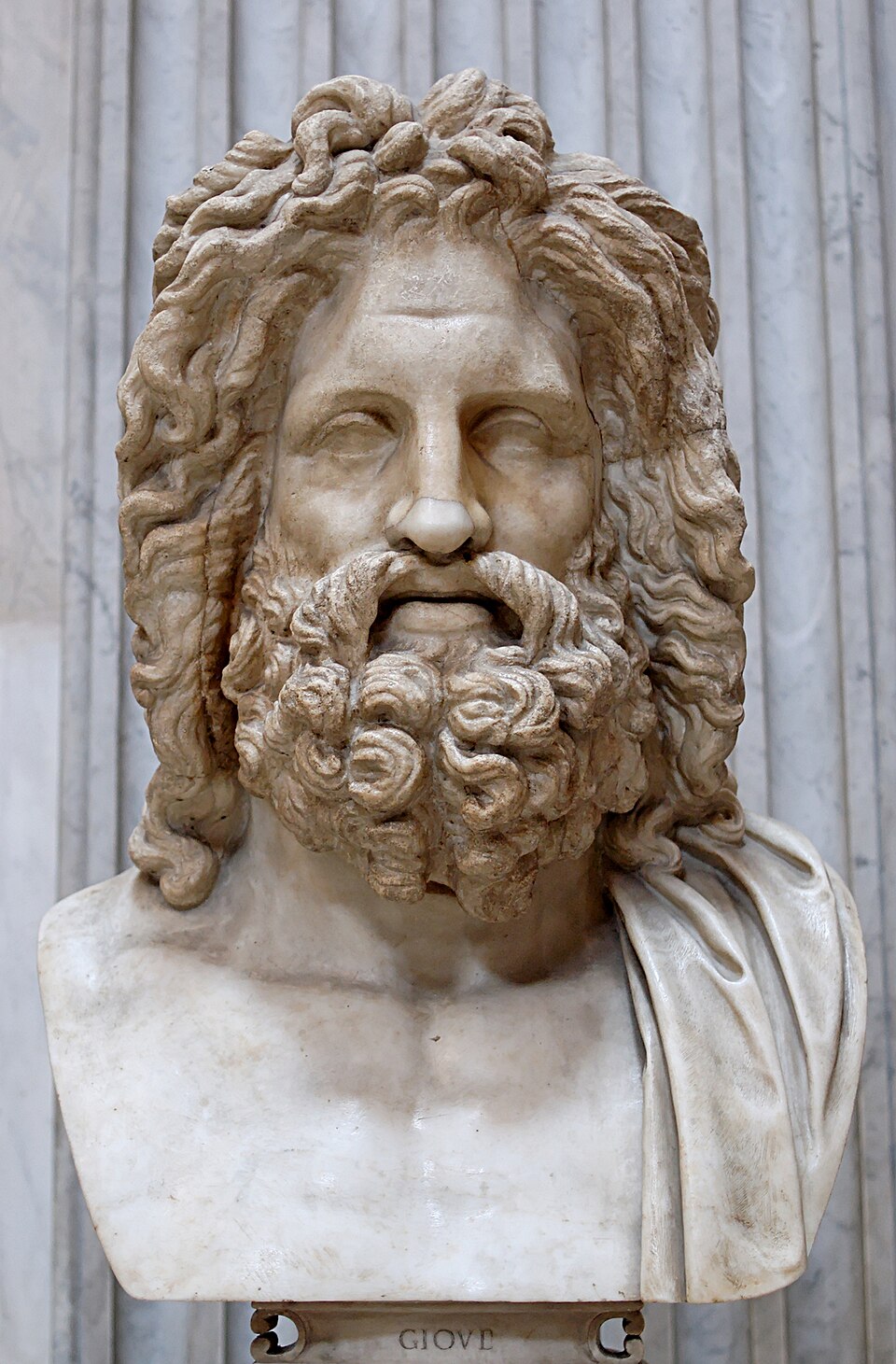
| Greek | Zeus Ammon (Ζεὺς Ἄμμων) | Pindar (5th century BCE) |
21 min read
AMON RA
author: High Priest Zevios Metathronos
co-author: Novice Priest Karnonnos
I. Names
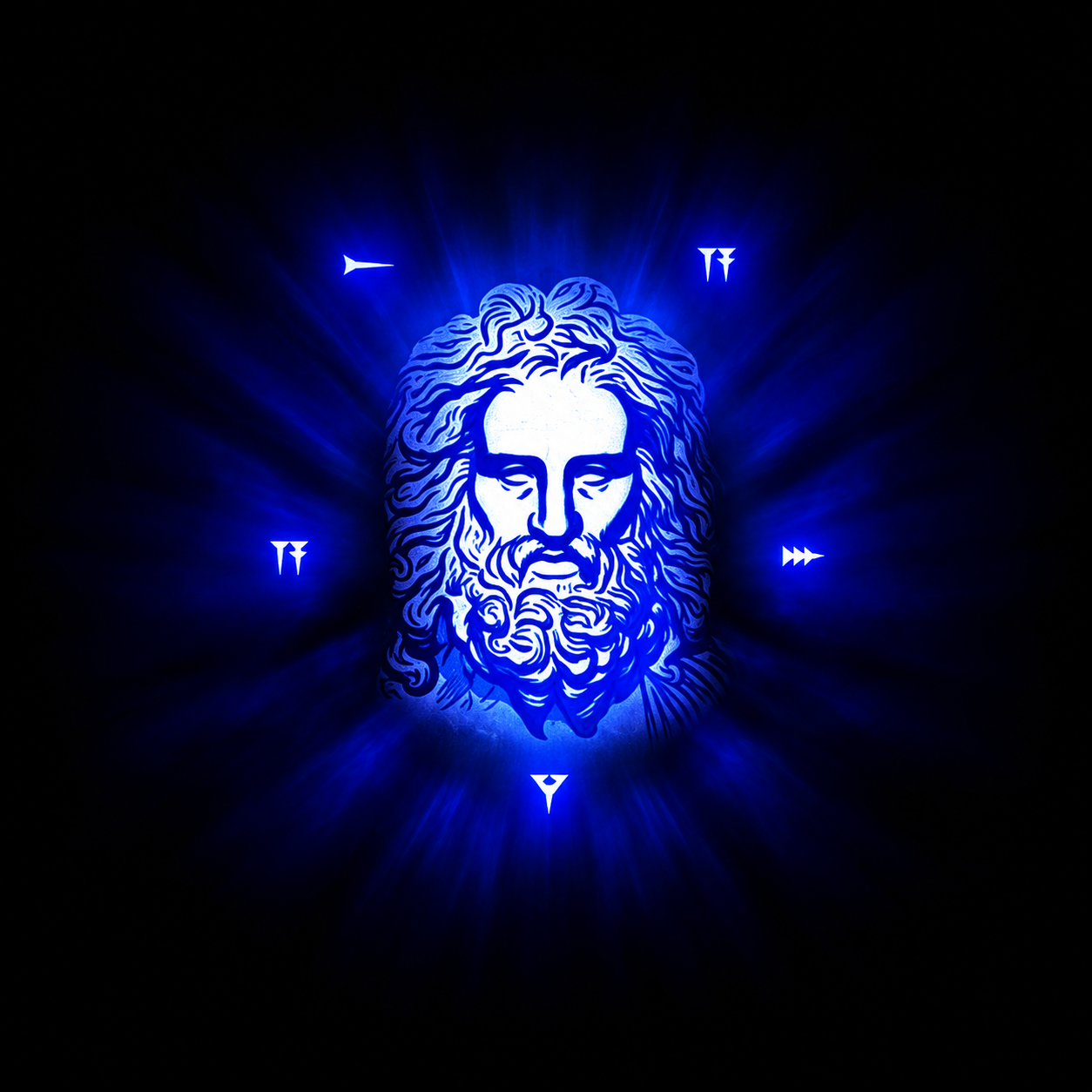
As explained in the Ritual, his name is a compound of the three gods Amon-Ra-Ptah. The compound first occurs and is first attested in in Intef II Wanakh's reign.1
There are many ways to write the name. His hieroglyphs are the reed leef, the game board, the water ripple (I-M-N, jmn), the sitting Amon (which can function as a determinative for Amon alone) and the solar disk that shows the addition of Ra to the title.
Sources: The Metropolitan Museum of Art, Stela of King Intef II Wahankh; Pindar, Pythian Odes, 1997.1,2
II. Amon Ra: the Aspect
Amon Ra, a divinity channeling the powers of the God of Gods in solar aspect, has rather mysterious attributes. As the shining force whose symbolism overlaps with that of Amon (Zeus), Ra (Apollo) and Ptah (Hephaestus), Amon Ra is one of the more cryptic of the gods to interpret
The earliest secure surviving attestation of the compound name Amon-Ra (Jmn-Rꜥ) is the octagonal sandstone column of Intef II Wahankh from Karnak in the 11th Dynasty, First Intermediate Period, roughly ca. 2108–2059 BCE. Martina Ullmann renders the inscription as beginning “Jmn-Rꜥ nb pt”, aka “Amon-Ra, Lord of Heaven", while the text states “Antef II erected a building for Amon-Ra” at Karnak. The syncretic identity does not appear in the ancient Pyramid Texts, where Amon is referred to alone. Neither does he appear in the Coffin Texts that appear in the next centuries around the Middle Kingdom.1,3,4,5,6
It is unknown why the compound form appeared. During Intef II Wahankh's reign, the Egyptian polity was split between several competing states of rivalling legitimacy. The form of Amon and Ra together may have been a way for Thebes to assert a coherent idea of Egypt itself over its rivals. This would explain why Amon Ra is associated more blatantly with the Pharaohs in a public context, whereas Amon possessed a more hidden cult. Martina Ullman emphasized the fusion of the Egyptian leadership with visible large-scale buildings of temple complexes in Thebes; the god of Thebes, Amon, became integrated with the solar cult of the rulers, Ra, hitting a visible and conclusive pattern by Senusret I's reign.3,7
Another major Egyptologist, Jan Assman, believes that Amon Ra's standard theological basis came with the worship rituals of the Middle Kingdom rather than anything prior or afterwards and that his worship has to be understood as a theological revolution, not merely as something political between dynasties, which is why the Middle Kingdom corpus tries to "fill the hyphenated formulation [Jmn-R']... with content."8
So, while he was one of the most prominent Gods of Egypt, time and error led to confusion about his identity. For scholars, the traditions of Egyptologists and all those attempting to understand the mysteries of the great civilization of the Nile, it has always been difficult to untangle some of the fods as the distinctive entities they are, with most people simply arising at the conclusion that Amon Ra was only a synthesis of the two most important gods (that is, Amon and Ra) for the Egyptian people. That idea is 'true' in a sense, but also a misleading conclusion that foregoes the truth that he is a distinctive entity who interprets these powers in a unique manner.
Aggravating all attempts to understand what is happening is that Amon Ra simply was represented in the Goetia and other enemy works as Amon or Aamon. Therefore, what is of absolute importance is to clarify who Amon Ra is. The Lord of the Light firstly occupied a preeminent role in the Egyptian pantheon as being the continual creator of everything visible and perceptible, in contrast to the world we cannot really see. The major truth of this echoed from the temples that Amon Ra gives form to the world from the higher and mysterious parts of the universe, shown allegorically in hymns such as this excerpt:
He opened speech from within the stillness: and he opened each eye, letting it see; He began sounds while the world was silent, and his unchallenged victory-shout encircled the earth.
Leiden Papyrus
In the royal context, Amon Ra occupied a heightened role in the Pharaonic cult from the end of the Middle Kingdom after the Egyptians had vanquished the invading Hyksos and banished them from the realm, placing their new capital at Thebes. The start of the New Kingdom to the beginning of the Late Kingdom was the period where his worship reached its zenith. Throughout this era, endless artefacts, writings and civic projects bear his divine name, and his cult spread from the place of government to practically every city of the empire.
Although it has been explained in the Names of Zeus that Amon, the Hidden Power, was tied to the Pharaohs as the ultimate arbiter of the world and the power behind the monarch's throne, Amon Ra took a more direct role as the personification of the Pharaoh's endowed majesty and right to rule which all of the people could see, standing side-by-side with the ruler. At the apex of Egypt's power as a civilization, it is true that the Lord of Karnak was the major light of the world.2
III. The Epithets of Amon Ra
| Epithet | Meaning | Domain |
|---|---|---|
| Jmn-Rꜥ nb pt | Amon-Ra, Lord of Heaven | Cosmic sovereignty, solar kingship |
| Jmn-Rꜥ nsw nṯrw | Amon-Ra, King of the Gods | Supreme leadership |
| Jmn-Rꜥ nb nswt-tꜣwy | Amon-Ra, Lord of the Thrones of the Two Lands | Egypt, spiritual allegory |
| Jmn-Rꜥ ḫnty Jpt-swt | Amon-Ra, Foremost of Karnak | Theban state cult, Karnak primacy |
| Jmn-Rꜥ nṯr ꜥꜣ | Amon-Ra, the Great God | Foremost of the Gods |
| Jmn-Rꜥ ḥry-tp nṯrw | Amon-Ra, Chief of the Gods | Divine hierarchy, theological supremacy |
| Jmn-Rꜥ nb Ḥb | Amon-Ra, Lord of Hibis | Kharga Oasis cult |
| Jmn-Rꜥ wsr-ḫpš | Amon-Ra, Mighty of Scimitar | Victory, royal might |
| Jmn-Rꜥ kꜣ-mwt.f | Amon-Ra Kamutef, Bull of His Mother | Self-generation, royal potency |
| Jmn-Rꜥ sḏm nḥwt | Amon-Ra Who Hears Prayers | Popular piety, oracle |
| Jmn-Rꜥ Ḏsr-st | Amon-Ra Djeser-set, Amon-Ra of the Sacred Place | Medinet Habu |
Sources: University of Memphis, Amun-Re and the Theban Triad, 2026; McClain, The Cosmogonical Inscriptions of Ptolemy VIII Euergetes II and the Cultic Evolution of the Temple of Djeser-set, 2011; Grand Egyptian Museum, Votive Stela of Ramose and Wepmose, 2026; Gallet, Karnak: The Temple of Amun-Ra-Who-Hears-Prayers, 2013; Klotz, Adoration of the Ram: Five Hymns to Amun-Re from Hibis Temple, 2006.10,11,12,13,14
IV. Temples of Amon Ra
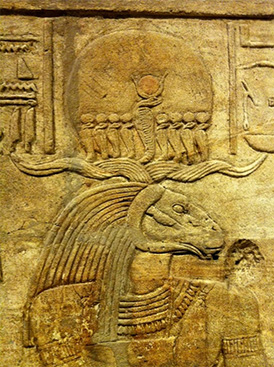
Amon Ra in ram-headed form equated with Khnum,
with nine serpents of enlightenment
with nine serpents of enlightenment
Amon Ra had a cult of great importance and his temples reflected the royal ideology in Egypt. A persistent mythology of pharaonic cult laid down its own claims that Amun-Ra himself could be the true father of the pharaoh, a theological claim that presented it as bodily generated or directly authorized by the god. Hatshepsut, for example, enthusiastically and pointedly embraced this convention by adorning her mortuary temple at Deir el-Bahri with the tale that Amun had visited her mother Ahmose in the form of Thutmose I before Hatshepsut’s conception.15,16
Other pharaohs also claimed Amun-Ra’s paternity in unique ways, such as Amenhotep III, whose divine birth was represented in the Birth Room at Luxor Temple, and Ramesses II, whose Ramesseum chapel also depicted his divine conception and birth. The mere evocation of his name could grant immense legitimacy, and this legitimacy was materially tied to Egypt’s sacred architecture, especially Karnak, Luxor Temple, Deir el- Bahri, and the royal monuments that staged the king’s relation to Amon-Ra.17,18,19
Karnak (Thebes)
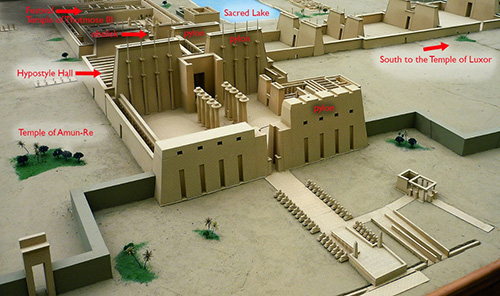
Temple of Amon Ra, Karnak
Along with the Theban complexes of Amon, many of the great temples of Thebes, particularly the holy district of Karnak, were devoted to Amon Ra also. The main sacred area of the city is located within the massive Karnak Temple complex. The Precinct of Amon Ra, shown above, is the largest and most significant part of the entire temple. The central part of the precinct was the great temple. Karnak became a central focus piece of royal theology because the worship of the sun god was a visible manifestation of the Pharaoh's rule. Modern architectural study has been prone to stress that the temple of Amon-Ra at Karnak was expanded, rebuilt, quarried, restored and reinterpreted for more than 1,500 years, so its “origin” was a continuous growth into what it became.20
The great east-west axis moved inward through pylons and courts toward the tenebrous divine core where the god’s image was at rest. According to Egyptologists he famous Great Hypostyle Hall, largely a work of Seti I and Ramesses II, even turned stone columns into a colossal papyrus marsh, making the temple interior resemble the first created world emerging from the waters; allegory of creation. The sanctuary was the god’s place on earth, the place where he was awakened, fed, clothed, perfumed, carried in procession and renewed. The Festival Hall or Akh-menu of Thutmose III, built east of the main axis, added another major element that is perhaps most revealing; it celebrated royal jubilees and victory and made Amon-Ra the divine recipient of empire, tribute and time itself by having a recorded list of Pharaohs and cataloging the greatness of Egypt.21,22
The eastern temple called the Temple of Amon-Ra-Who-Hears-Prayers was made to reflect a more accessible form, directed toward ordinary petition from the people. Amon Ra was integrated with Ptah more blatantly in accordance with his full name and Ptah's status as petitioner. This adjacent temple was built by Ramesses II to help his people.23
Hibis
The Hibis temple came rather late, and it was situated in the Kharga Oasis amidst the desert, in an area the Egyptians called 'the plough.' The choice of area is unusual. Karnak seemed to have left a strong imprint on this temple. Persian rule over Egypt seemed to prompt large scale embellishments to this temple since the decorations at Hibis are unusually rich, rather theologically dense, and betray other elements of extreme piety. All evidence attests to its creation by Darius the Great, but Psamtik II may have started the construction.24,25,26
Its walls preserve five long hymns to the sun god, which David Klotz describes as the longest monumental hymns to Amon-Ra ever carved in hieroglyphs. Persian money may have sponsored large additions to the temple since the hymns were inscribed under Darius I, they drew on New Kingdom materials, and they later influenced the Ptolemaic-Roman hymnology at Esna. The temple's sanctuary and its naos contain references to hundreds of separate gods, showing the status of Amon-Ra as universal lord. Both Amun of Hibis and Amun of Karnak were represented within the sanctuary, as was the great triad of Thebes; Amon, his mother Mut and the moon god Khonsu.13
Soleb and Nubian temples
Numerous Nubian temples of varying size existed. Temples at Amada, Kawa, Soleb and other areas show vestiges of Egyptian building in the area, but the most important site was Soleb which Amenhotep III consecrated and built as a major large temple complex made of sandstone as a monument partially to his own deification. The famous statue of Amon Ra as a ram protecting the Pharaoh probably comes from this complex. The area of Soleb also functioned as a great necropolis.27,28
At Sedeinga, a companion temple was built by Amenhotep III to Tiye as a manifestation of the Eye of Ra. Soleb served an imperial function as archeologists found inscriptions attesting to the amount of nations the Egyptians had conquered and a list of military prisoners by characteristic; the temple was designed to show Pharaonic power.29,30,31,32
Another important temple was the Great Temple of Abu Simbel on the border zones of Nubia, but Amon Ra was only one of four gods worshipped there alongside the two others of the Theban triad and Montu. A group of Meroeite and Kushite temples at Sanam, Meroe, Naqa and Dangeil also worshiped the sun god.33,34,35,36,37
With stunning grandeur, these monuments served continually as the primary religious center for worship of the God of the Sun. The continuing sustenance of Egypt itself was held to be the exact reflection of the Pharaoh's abdomen, allegorical of the powers of creation. His titles, such as, 'shines as Re, yet is hidden...' show a very distinct side relating to creative faculties and apotheosis.38
V. Wealth: the Luster of the Sun
Majesty was not the only area of life his worship pertained to. It is important to understand that Amon Ra was highly associated with active wealth as a concept and was esteemed as the god who could grant both the proper use of wealth and the pathway to favor from the highest echelons. Numerous sacred texts from Egypt point towards his ability to grant money and success in business matters. The existence of physical gold suggested the spiritual gold found on the path of the initiate, particularly when engraved into the soul time after time as a perpetual resource. Blessings sourced from Egypt invoke and evoke his name for this purpose, which shows that the people of all classes seeking occult engagement equated the deity with finding gold on that path as well.39,40
At the same time, during the New Kingdom, he came to be regarded as the righteous protector of the impoverished and the downtrodden. Beneficiary acts and poor relief of the Egyptian temples were associated with his mercy. Morality tales show individuals in dire straits who ask for his protection, such as the tale of the priest stranded at sea recorded in the Tale of Wenamun. The perception of Amon Ra as a deity who would help the multitude resulted in a more personal worship of devotion after the expulsion of the Hyksos, in distinct contrast to the hieratic and veiled worship of Amon41:
[Amun] who comes at the voice of the poor in distress, who gives breath to him who is wretched...
Stela of Nebre from Deir al-Medina, trans. Lichtheim
His worship was particularly prominent among the aristocracy. Amon Ra did not just symbolize the pursuit of money itself, instead his worship signified the need to use the powers of reason (nous), effort and patience to gain lasting and fruitful wealth, instead of immense riches or relief being bestowed randomly by the fickle powers of fate. The association with the pursuit of wealth through such endeavors links his powers to the mysterious, heavenly and unpredictable attributes of Amon (Zeus) in a solar, manifested form, combined with the rational and ordering power of Ra and the petitioning and creative faculty of Ptah.44
VI. Health and Plague
Very notably, health concerns among regular Egyptians sometimes prompted worshipers to plead for his intercession and invocation. The healing powers of Amon Ra were tied to the sustenance of the life force as represented in the serpent, and they were often related to the power of healing children, in particular. An informing example housed in the Museum of Berlin pertains to the modest craftsman named Nebre who praised Amon Ra for healing his son's long-term illness:
the one who comes at the cry of the poor; when I cry out to you in affliction, you come and I am saved…
Stela of Nebre from Deir al-Medina, trans. Lichtheim
In this, there was a darker, punitive and dualistic side to the God, who could be prompted to help only after being strongly merciless in his initial judgement:
Great of punishment, mightier than Sekhmet like a raging fire, sublime in mercy, caring for those who praise him, who turns (from his wrath) to heal the suffering. Ramesside Hymn, New Kingdom Papyrus, trans. Assman
As far as psychological matters are concerned, Amon Ra rules over pivotal aspects of self-awareness and individuation. This punitive-and- merciful side of him shows the role he plays in guarding the wise, the aware and the somber who are able to reflect accurately upon their acts, both good and bad, opposed to those who drown in chaos with an unmoored mind. This part of his powers is linked to the cleansing powers of fire, and it ties strongly into the force of serpent energy flowing unobstructed.
VII. Prophecy
The association with prophecy is a persistent theme in his worship. The reason his diviners were consulted typically involved people who wanted to know what to do in active sense. Oracle-seekers wished for rational solutions when given certain divine omens by him, which even had ceaseless distinctive categories. He is closely associated with Ra and Horus, and the two falcon gods are the subordinate powers of Apollo, which is one of the reasons the falcon-headed imagery is used liberally45:
A Hymn to Amen-Rā, the Bull, dweller in Anu, chief of all the gods, the beneficent god, beloved one, giving the warmth of life to all, beautiful cattle. […] Power made by Ptah. Beautiful child of love. […] Traverser of the celestial heights in peace. Hymn to Amon Ra (trans. Budge)
Therefore, part of the secret behind Amon Ra's functions lies in his materialization of what Amon governs, giving it solar form through the breath of life and a visual presence comprehensible to all. Titles from the Hymn of Amon Ra found in the Leiden Papyrus such as 'the one god who made himself into the multitude' indicate the ways he is persistently involved in the creation of human beings. Corollary to this is his other association is with Ptah (Hephaestus) with the symbolism of being first-born. Ptah fashioned the bodies of human beings as the master work of the Gods on earth, while Amon Ra breathes the breath of life into all people, marking the final stage of reincarnation. The full title of this God is Amon Ra Ptah with a threefold division of powers that apply to the expanse of the universe.46
VIII. Symbolism
The symbolism of Amon Ra is a difficult subject to breach. The situation necessitates us to say what occurred here, yet even in Egypt itself, the spiritual code of the Lord of the Two Lands was itself hidden.
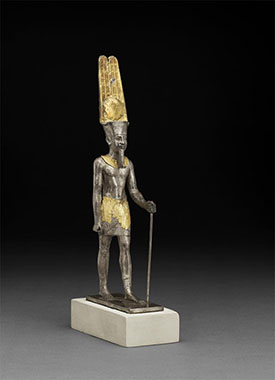
Gold plated Amon Ra statuette from Thebes
(© The Trustees of the British Museum.
Shared under a Creative Commons Attribution-NonCommercial-Share
Alike 4.0 International (CC BY-NC-SA 4.0) licence)
(© The Trustees of the British Museum.
Shared under a Creative Commons Attribution-NonCommercial-Share
Alike 4.0 International (CC BY-NC-SA 4.0) licence)
A symbol in Egypt could have a multiplicity of meanings. What that means is that a symbol anyone can see could have different meanings to:
The same symbol thus could carry many different meanings. A painting of Amon on the tombs could represent both Amon and Amon Ra at the same time, but aspects of the interpretation (i.e. the crown both wear) could mean distinctive things depending on whether the person is beholding Amon or Amon Ra.
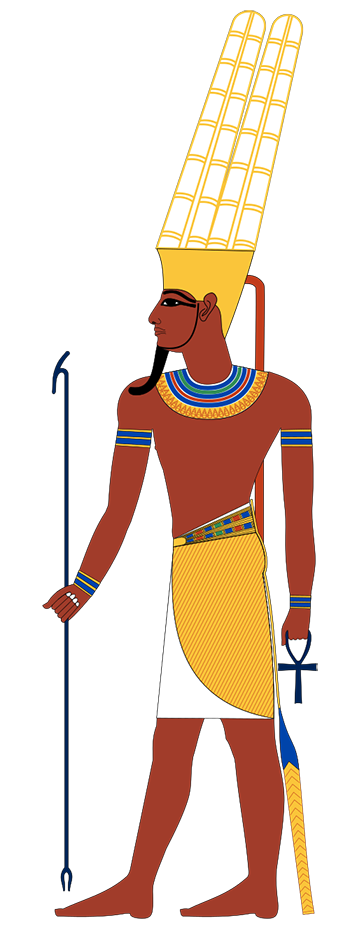
Amon Ra
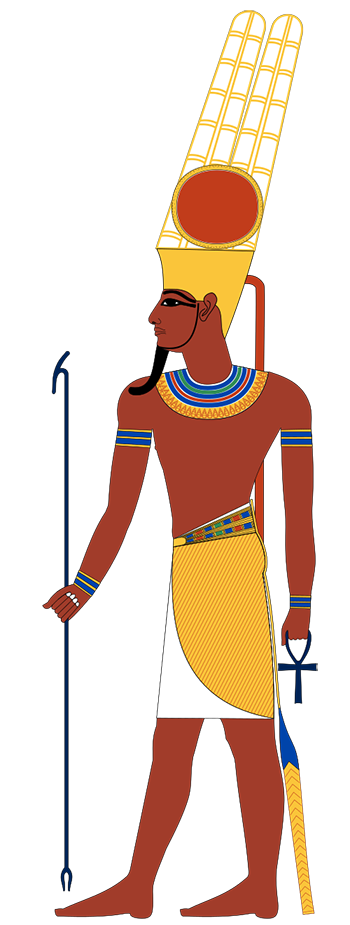
Amon Ra with Solar Disk
This type of representation of Amon could be both, as could the blue or green skinned variation. In the case of Amon Ra, there is a distinct visual syllabary in terms of how one can interpret the image. Note, for instance, the right-angled belt fastened to where the Solar Chakra is. Amon Ra carries the ankh as do many gods, but in this case, the ankh assumes very primary importance. As is said above, he is the deity with the power to breathe life into all living things. The midsection of the Ankh with the loop coming out of it is also representative of the Solar Chakra and his powers to activate this process of evolution.
The golden headdress or tiara shows the power of kingship and life, as well as the incredible wealth of the Pharaoh and power of the Sun. The shuti feathers represent the active side of what is seen and unseen, the dual realms of life, but that Amon Ra is involved in making the unseen a material reality, linking him to the foremost feather. Certain representations, such as Amon with the sun in his headdress like the above image, generally only concern Amon Ra. The falcon-headed variant of Amon endowed with the head of Ra is always of him.47
He is also referred to as the firstborn, the beautiful child and the son. The imagery of being the son of Zeus shows that the manifestation of the highest God is being brought from heaven to earth through his decrees and powers. Egyptian belief considered the sun as not simply rising every morning, but outright being reborn, with Ra beginning the day young and ending it old (something reflected in the famous Riddle of the Sphinx). He is also commonly paralleled visually with Khnum in having powers over life and the imagery of the serpent, often represented too as four-headed in this guise. For this reason, like Amon alone, the Lord of the Light is represented in the form of a ram. Khnum is the ultimate originator of biological life, but Amon Ra breathes life into each life itself.
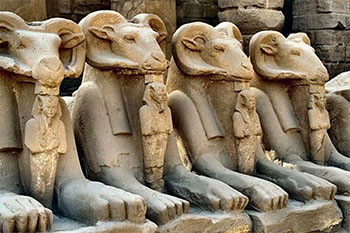
Four ram-headed sphinxes representing Amon Ra
at the Precinct of Amon Ra in Karnak, Thebes
at the Precinct of Amon Ra in Karnak, Thebes
IX. Occult
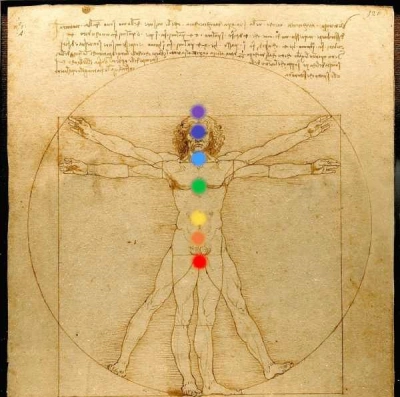
Amon Ra rules over many aspects of the Solar Chakra and its equivalent powers. He rules over the fiery and purifying phase of any initiate pursuing advancement, particularly as the powers of the Solar Chakra are activated. His powers relate to the faculty of creation and inspiration, and this is another semantic code for the 'son' who is born from all effort. He is also a guardian of the Base and Crown Chakras as they relate to the serpentine powers.
Sources and Bibliography
- The Metropolitan Museum of Art. “Stela of King Intef II Wahankh.” The Met Collection.
- Pindar, Olympian Odes. Pythian Odes, ed. and trans. William H. Race, Loeb Classical Library 56 (Cambridge, MA: Harvard University Press, 1997), Pythian 4.14–16.
- Ullmann, Martina. “Thebes: Origins of a Ritual Landscape.” In Sacred Space and Sacred Function in Ancient Thebes, edited by Peter F. Dorman and Betsy M. Bryan, 3–25. Studies in Ancient Oriental Civilization 61. Chicago: Oriental Institute of the University of Chicago, 2007.
- Dorman, Peter F., and Betsy M. Bryan, eds. Sacred Space and Sacred Function in Ancient Thebes: Occasional Proceedings of the Theban Workshop. Studies in Ancient Oriental Civilization 61. Chicago: The Oriental Institute of the University of Chicago, 2007.
- Allen, James P., trans. The Ancient Egyptian Pyramid Texts. Writings from the Ancient World. Atlanta: Society of Biblical Literature, 2005.
- Faulkner, Raymond O., trans. The Ancient Egyptian Coffin Texts. 3 vols. Warminster: Aris & Phillips, 1973–1978.
- Wilkinson, Richard H. The Complete Gods and Goddesses of Ancient Egypt. London: Thames & Hudson, 2003. See especially 92–93 and 201.
- Assmann, Jan. The Search for God in Ancient Egypt. Translated by David Lorton. Ithaca, NY: Cornell University Press, 2001. See especially 163–64, 187–91.
- Foster, John L., trans. Hymns, Prayers, and Songs: An Anthology of Ancient Egyptian Lyric Poetry. Edited by Susan Tower Hollis. Writings from the Ancient World 8. Atlanta: Scholars Press, 1995.
- University of Memphis. “Amun-Re and the Theban Triad.” Karnak Great Hypostyle Hall Project. Accessed May 2, 2026. https://www.memphis.edu/hypostyle/meaning_function/amun-re.php
- McClain, J. Brett. “The Cosmogonical Inscriptions of Ptolemy VIII Euergetes II and the Cultic Evolution of the Temple of Djeser-set.” In Perspectives on Ptolemaic Thebes: Papers from the Theban Workshop 2006, edited by Peter F. Dorman and Betsy M. Bryan, 69–96. Studies in Ancient Oriental Civilization 65. Chicago: Oriental Institute of the University of Chicago, 2011.
- Grand Egyptian Museum. “Votive Stela of Ramose and Wepmose.” GEM Collection. Accessed May 2, 2026. https://gem.eg/en/collection/artefacts/votive-stela-of-ramose-and-wepmose
- Gallet, Laetitia. “Karnak: The Temple of Amun-Ra-Who-Hears-Prayers.” In UCLA Encyclopedia of Egyptology, edited by Willeke Wendrich. Los Angeles: University of California, Los Angeles, 2013.
- Klotz, David. Adoration of the Ram: Five Hymns to Amun-Re from Hibis Temple. Yale Egyptological Studies 6. New Haven, CT: Yale Egyptological Seminar, 2006.
- Spier, Jeffrey, Timothy Potts, and Sara E. Cole, eds. Beyond the Nile: Egypt and the Classical World. Los Angeles: J. Paul Getty Museum, 2018.
- Metropolitan Museum of Art. “Hatshepsut’s Mother, Queen Ahmose.” Accession no. 30.4.142. The Metropolitan Museum of Art.
- Bell, Lanny. “Luxor Temple and the Cult of the Royal Ka.” Journal of Near Eastern Studies 44, no. 4 (1985):
- Chicago House. “News & Notes 90.” News & Notes, Oriental Institute, University of Chicago, no. 90. Chicago: Oriental Institute, 1981.
- Sullivan, Elaine. “Karnak: Development of the Temple of Amun-Ra.” In UCLA Encyclopedia of Egyptology, edited by Willeke Wendrich. Los Angeles: University of California, Los Angeles, 2010. https://escholarship.org/content/qt1f28q08h/qt1f28q08h.pdf
- McClain, J. Brett, and Peter J. Brand. Welcome to the Great Hypostyle Hall of the Temple of Karnak. Karnak Great Hypostyle Hall Project, University of Memphis.
- Brand, Peter J. The Monuments of Seti I: Epigraphic, Historical and Art Historical Analysis. Probleme der Ägyptologie 16. Leiden: Brill, 2000.
- Blyth, Elizabeth. Karnak: Evolution of a Temple. London: Routledge, 2006.
- Gallet, Laetitia. “Karnak: The Temple of Amun-Ra-Who-Hears-Prayers.” In UCLA Encyclopedia of Egyptology, edited by Willeke Wendrich. Los Angeles: University of California, 2013.
- Winlock, Herbert E. The Temple of Hibis in el Khargeh Oasis. Part I: The Excavations. Publications of the Metropolitan Museum of Art Egyptian Expedition 13. New York: Metropolitan Museum of Art, 1941.
- Cruz-Uribe, Eugene. “Kharga Oasis, Late Period and Graeco-Roman Sites.” In Encyclopedia of the Archaeology of Ancient Egypt, edited by Kathryn A. Bard, 406–8. London: Routledge, 1999.
- Colburn, Henry P. “Kharga Oasis.” Encyclopaedia Iranica.
- Ullmann, Martina. “Egyptian Temples in Nubia during the Middle and the New Kingdom.” In Handbook of Ancient Nubia, edited by Dietrich Raue, 511–40. Berlin: De Gruyter, 2019; Egyptian Ministry of Tourism and Antiquities. “Amada Temple.”
- UNESCO World Heritage Centre. “The Temple of Soleb.” Tentative Lists, submitted February 1, 2022. https://whc.unesco.org/en/tentativelists/6596/
- Museo Egizio. “Statue Depicting Amon as a Ram Protecting a Figure of King Amenhotep III.” Cat. 836. Museo Egizio Collection Online. https://collezioni.museoegizio.it/en-GB/material/Cat_836
- Francigny, Vincent, Romain David, and Alex de Voogt. Soleb & Sedeinga. Paris: Elnour, 2014; Discover Sudan! Archaeological and Cultural Tours. “Sedeinga.” https://discoversudan.de/en/travel/sudan/locations/sedeinga
- Kennedy, Titus. “The Land of the š3sw (Nomads) of yhw3 at Soleb.” Dotawo: A Journal of Nubian Studies 6 (2019): 175–92; Adrom, Faried, and Matthias Müller.
- Fleming, Daniel E. Yahweh before Israel: Glimpses of History in a Divine Name. Cambridge: Cambridge University Press, 2020.
- Sullivan, Elaine. “Karnak: Development of the Temple of Amun-Ra.” In UCLA Encyclopedia of Egyptology, edited by Willeke Wendrich. Los Angeles: University of California, Los Angeles, 2010.
- Rocheleau, Caroline M. Amun Temples in Nubia: A Typological Study of New Kingdom, Napatan and Meroitic Temples. BAR International Series 1850. Oxford: Archaeopress, 2008, table of contents/gazetteer entries for Sanam Abu Dom, Dangeil, Meroe, and Naga.
- Institute of Fine Arts, New York University. “Excavations at Sanam, Sudan.” Accessed May 2, 2026. https://ifa.nyu.edu/study/archaeology/sanam.html
- Sweek, Tracey, Julie R. Anderson, and Satoko Tanimoto. “Architectural Conservation of an Amun Temple in Sudan.” Journal of Conservation and Museum Studies 10, no. 2 (2013): 8–16. https://doi.org/10.5334/jcms.1021202
- Grzymski, Krzysztof. “The Amun Temple at Meroe Revisited.” Sudan & Nubia 21 (2017): 134–47; ICOMOS. “Island of Meroe: Evaluation.” World Heritage Committee, 2011. https://whc.unesco.org/document/152412
- Assmann, Jan. Egyptian Solar Religion in the New Kingdom: Re, Amun and the Crisis of Polytheism. Translated by Anthony Alcock. London: Kegan Paul International, 1995.
- Foster, John L., trans. Hymns, Prayers, and Songs: An Anthology of Ancient Egyptian Lyric Poetry. Writings from the Ancient World 8. Atlanta: Scholars Press, 1995, 58–65, “The Cairo Hymns to Amun-Ré.”
- Lichtheim, Miriam, trans. “Prayers Used as School Texts.” In Ancient Egyptian Literature. Volume II: The New Kingdom, 105–6. Berkeley: University of California Press, 1976; Breasted, James Henry. Development of Religion and Thought in Ancient Egypt. New York: Charles Scribner’s Sons, 1912, 350–51.
- Lichtheim, Miriam, trans. “The Report of Wenamun.” In Ancient Egyptian Literature. Volume II: The New Kingdom, 224–30. Berkeley: University of California Press, 1976.
- Ägyptisches Museum und Papyrussammlung, Staatliche Museen zu Berlin. Stela of Nebre, Berlin 20377. Nineteenth Dynasty. See Miriam Lichtheim, trans., “The Prayers to Amun,” in Ancient Egyptian Literature. Volume II: The New Kingdom, 105–7. Berkeley: University of California Press, 1976.
- Van den Dungen, Wim. “Amun: Unbegotten Preexistence Double-Concealed in Transcendence and Immanence and the Unity of Ancient Egyptian Theologies.” MAAT: Ancient Egyptian Religion and Philosophy. https://www.maat.sofiatopia.org/amun.htm
- Teeter, Emily, and Janet H. Johnson, eds. The Life of Meresamun: A Temple Singer in Ancient Egypt. Oriental Institute Museum Publications 29. Chicago: Oriental Institute of the University of Chicago, 2009.
- Budge, E. A. Wallis, trans. “Hymn to Amen-Rā,” in The Literature of the Ancient Egyptians (London: J. M. Dent & Sons, 1914), 214–19.
- Zandee, Jan. De Hymnen aan Amon van Papyrus Leiden I 350. Leiden: E. J. Brill, 1948; Assmann, Jan. “Monotheism and Polytheism.” In Civilizations of the Ancient Near East, edited by Jack M. Sasson, 1:17–31. New York: Charles Scribner’s Sons, 1995; Assmann, Jan.
- Egypt Exploration Society. “The Royal Crowns of Egypt.” Egypt Exploration Society, March 7, 2019. https://www.ees.ac.uk/resource/the-royal-crowns-of-egypt.html; Ogden, Jack.