




9 min read
Father of Tragedy
Aeschylus
author: High Priest Zevios Metathronos
The Sacred Labour of Making Peace Endure
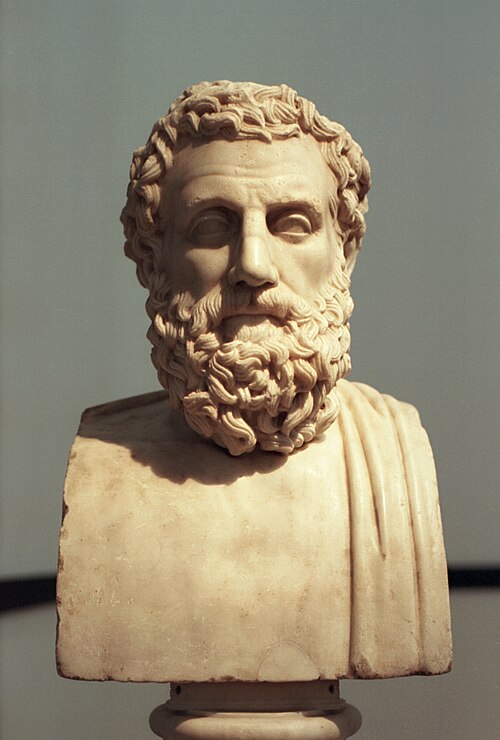
Dates: Approximately 525/524–456/455 BCE.
Period: Classical (500–334 BCE).
Aeschylus of Eleusis fought the Persians at Marathon and wrote for the theatre of Dionysus at Athens. His Loeb editor calls him “the dramatist who made Athenian tragedy one of the world's great art forms.” He wrote about 80 plays, and 7 survive complete.1
His greatest single work is the Oresteia, which won first prize at the City Dionysia of 458 BCE. Across 3 tragedies it follows a chain of killings in the house of Atreus until Athena stops it with a court of law.2
Zevism reads Aeschylus as a poet of Zeus and of Dike. His Agamemnon chorus calls on Zeus as the God who “sets mortals on the path to understanding,” and his Athena replaces the blood feud with a judgment given under oath: Ma'at restored in a house that Izfet had ruled.
LIFE AND CONTEXT
He was born in the deme of Eleusis. The anonymous Life of Aeschylus calls him “the son of Euphorion, brother of Cynegirus and one of the Eupatrids,” the old nobility of Athens.3 The Oxford Classical Dictionary dates his life to 525/4–456/5 BCE, and his Loeb editor notes that he “witnessed the establishment of democracy at Athens.”4
Pausanias heard how the calling came. “Aeschylus himself said that when a youth he slept while watching grapes in a field and that Dionysus appeared and bade him write tragedy.” At daybreak he obeyed the vision, tried his hand, “and hereafter found composing quite easy.”5
The Suda says he first competed at 25 and wrote elegies and 90 tragedies. It gives him 28 victories, then adds: “Some say it was thirteen.” The Life counts 70 dramas, about 5 satyr plays and 13 wins. The totals differ, and the Loeb editor settles on about 80 plays.6
When the Persians came, he stood in the line. The Life says he fought at Marathon “together with his brother, Cynegirus,” and at Salamis with his youngest brother, Ameinias. Pausanias adds the sea fight at Artemisium.7
He changed the form of the stage itself. Aristotle records: “Aeschylus first introduced a second actor; he diminished the importance of the Chorus, and assigned the leading part to the dialogue.”8 He also stood trial for revealing the rites of the Mysteries, and Aristotle cites his defence as the standard excuse of a man who “did not know it was a secret.”9
Sicily drew him west. Hieron of Syracuse hosted Aeschylus, Pindar and Bacchylides at his court.10 The Life gives 2 reasons for leaving Athens: vexation at a defeat by the young Sophocles, or losing to Simonides in an elegy for the dead of Marathon.11
ATTAINMENTS
- He wrote about 80 plays, and 7 survive complete. The Life credits him with 13 victories; the Suda gives 28.12
- He added the 2nd actor to tragedy, cut back the chorus and made spoken dialogue the main business of the play.13
- His Persians of 472 BCE set the recent war on stage, and it's “the only surviving Greek historical drama.”14
- The Oresteia won first prize in 458 BCE with Agamemnon, Libation Bearers and Eumenides; its satyr play, Proteus, is lost.15
- For Hieron's new city of Etna he staged Women of Etna, “divining a good life for those who settled the city.”16
- He fought for Athens in the Persian wars, at Marathon and in the naval battles at Artemisium and Salamis.17
- His tomb at Gela became a shrine of his art. The Life records that anyone “professionally involved in tragedy” who visited it “would offer sacrifices and declaim his dramas.”18
KEY STORIES
Cynegirus at the Persian Ships
Aeschylus and his brother Cynegirus stood in the Athenian ranks at Marathon.19 By the end of the fighting the Persians were back at their ships and pulling away from the shore.
The Suda tells what Cynegirus did there. “He grasped hold of the ship of the Persian admiral, which was already in flight, and had his right hand cut off; so he grasped it with his left, and when that too was cut off he fell and died.”20
Aeschylus came home without his brother. He'd go on to write about 80 plays, win prize after prize and see his work staged in Sicily. Decades later, the epitaph on his tomb would name Marathon and nothing else he'd done.
Salamis on the Stage at Athens
In 472 BCE Aeschylus brought the war he'd fought into the theatre. Persians is set “before the Council-Hall of the Persian Kings at Susa,” with the tomb of Darius in view. Queen Atossa, the mother of Xerxes, waits for news of the fleet.21
A messenger arrives and tells the battle from the losing side. He describes the Greek oars striking the water after their paean, and he repeats the shout that rose from the Greek ships: “Advance, ye sons of Greece, from thraldom save / Your country, save your wives, your children save, / The temples of your gods, the sacred tomb / Where rest your honour'd ancestors.”
Then the ghost of Darius rises at his tomb. The dead king blames his son, who'd hoped “To bind the sacred Hellespont, to hold / The raging Bosphorus, like a slave, in chains,” and who “deem'd, vain mortal! that his power / Should rise above the gods.”22 The Athenian audience heard their own victory as a Persian lament, and they heard its cause named as a mortal's reach against the Gods.
Athena Casts the Deciding Vote
The Oresteia opens with Agamemnon murdered by his wife and closes with their son, Orestes, pursued by the Erinyes for killing his mother. In Eumenides he reaches Athens, and Athena calls the citizens together: “Hear now my ordinance, people of Attica, as you judge the first trial for bloodshed.”23
She founds the court on the Areopagus as a body “untouched by greed, worthy of reverence, quick to anger, awake on behalf of those who sleep, a guardian of the land.” Apollo argues for Orestes, the Erinyes for the murdered mother. The jurors vote, and Athena adds her own: “I shall cast my vote for Orestes.” The count comes out even. “This man is acquitted on the charge of murder, for the numbers of the casts are equal.”24
The Erinyes rage at the verdict. Athena answers with an offer: a home in Athens and honours from its people. They accept, turn their curses into blessings on the land and are led away by torchlight. The final song proclaims that “Zeus who sees all and Fate have come down to lend aid.”25 In Zevist terms, Athena gave the old powers of vengeance a seat and a duty inside the order of Zeus.
The Eagle over Gela
In Sicily, the Life says, Aeschylus was “greatly honored by the tyrant Hieron and the citizens of Gela.” He'd been warned by a prophecy: “a heavenly missile will kill you.”26
The missile came from an eagle. It “had seized a tortoise, but was not strong enough to break open its prey, so dropped it on the rocks to crush its shell. But the tortoise fell on the poet's head and killed him.” The Suda tells the same end.27
The epitaph on his tomb said nothing of tragedy: “This memorial holds Aeschylus the Athenian, son of Euphorion, who died in grain-bearing Gela. The grove of Marathon could speak of his famous courage and the Mede with thick long hair who knows of it.”18 Pausanias noticed the silence. Aeschylus, he wrote, “recorded at the prospect of death nothing else,” only his name, his father, his city and his witnesses at Marathon.17
THE ZEVIST READING
The chorus of Agamemnon sings the clearest statement of Aeschylus's theology. It calls on Zeus “if by this name it pleases him to be invoked,” and names his law: “Zeus, who sets mortals on the path to understanding, Zeus, who has established as a fixed law that ‘wisdom comes by suffering.’”28 Zevism reads this as a map of the path. Zeus lays the road, and the mortal climbs it toward the divine mind through what he endures and learns. The Temple calls the end of that road ὁμοίωσις θεῷ, likeness to the divine.
The Oresteia shows Ma'at and Izfet at work in one family. Each killing in the house of Atreus demands the next, and that chain is Izfet, disorder feeding on itself. Athena's court ends it with an oath, a vote and a verdict the city will keep. Persians names the same danger on the scale of empires: a king who chains the sea and thinks his power “should rise above the gods” has set himself against the order of the cosmos, and Salamis is the answer.
The tradition also assigns to Aeschylus Prometheus Bound, though its authorship is disputed. There the Titan says of mortals: “numbers, too, chiefest of sciences, I invented for them, and the combining of letters, creative mother of the Muses' arts.” He sums it up: “every art possessed by man comes from Prometheus.”29
The Temple counts Aeschylus's own art among those gifts. Pausanias heard that Dionysus himself sent the young man to tragedy, and the Life says the tragedians of later generations honoured his tomb with offerings. His plays were performed as worship at the festival of Dionysus, and Zevism receives them as worship still.
NOTES
1 Harvard University Press, Aeschylus I, ed. and tr. A. H. Sommerstein.
2 Mitchell-Boyask, Aeschylus's Oresteia, Oxford Bibliographies.
3 Life of Aeschylus 1, Living Poets, Durham University.
4 OCD, “Aeschylus”; HUP, Aeschylus I.
6 Suda, αι 357, Living Poets; Life 13.
8 Aristotle, Poetics 4, tr. Butcher.
9 Aristotle, Nicomachean Ethics 3.1, tr. Ross; Living Poets, Aeschylus: A Guide to Selected Sources.
11 Life 8.
12 HUP, Aeschylus I; Life 13.
14 HUP, Aeschylus I.
15 Mitchell-Boyask, Oxford Bibliographies.
16 Life 9.
17 Pausanias 1.14.5.
18 Life 11.
19 Life 4.
20 Suda, κ 2695, tr. David Whitehead.
21 Aeschylus, Persians, tr. Potter; HUP, Aeschylus I.
24 Eumenides 704–706, 734–753.
26 Life 10.
27 Life 10; Suda, αι 357.
28 Agamemnon 160–183, tr. Smyth.
29 Prometheus Bound 459–461, 505–506, tr. Smyth.
BIBLIOGRAPHY
Harvard University Press, Aeschylus I: Persians. Seven against Thebes. Suppliants. Prometheus Bound, ed. and tr. Alan H. Sommerstein, Loeb Classical Library, 2009; publisher's description.
Robin Mitchell-Boyask, Aeschylus's Oresteia, Oxford Bibliographies in Classics; public introduction.
Oxford Classical Dictionary, “Aeschylus, Athenian tragic dramatist”; life dates.
Anonymous, Life of Aeschylus 1, 4, 8–11, 13, and Suda αι 357, translated on Living Poets, Durham University; with Sarah Burges Watson, Aeschylus: A Guide to Selected Sources.
Suda, κ 2695, “Kynegeiros”, tr. David Whitehead, Suda On Line.
Pausanias, Description of Greece, tr. W. H. S. Jones, Theoi Classical Texts Library: 1.14.5; 1.21.2.
Aeschylus, Persians, tr. Robert Potter, Internet Classics Archive, MIT.
Aeschylus, Agamemnon 160–183, Eumenides 681–1047 and Prometheus Bound 459–461, 505–506, tr. Herbert Weir Smyth, Theoi Classical Texts Library.
Aristotle, Poetics 4, tr. S. H. Butcher, Project Gutenberg; Nicomachean Ethics 3.1, tr. W. D. Ross, Internet Classics Archive, MIT.
Encyclopaedia Britannica, “Hieron I”.
CREDIT
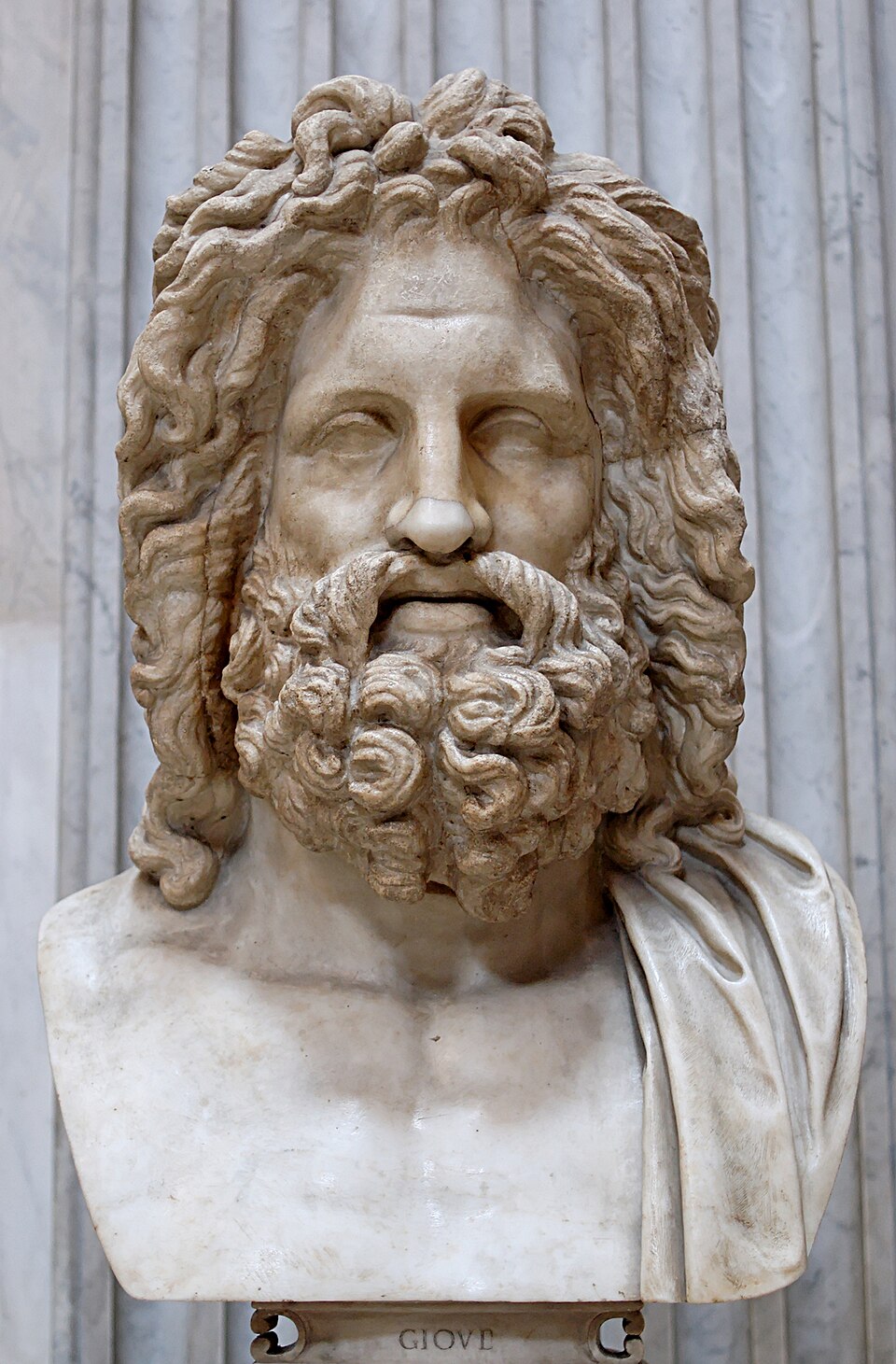
Picture: Roman portrait identified as Aeschylus, after a later Greek original; Naples National Archaeological Museum. Photograph by Zde.
Zde; CC BY-SA 4.0; Wikimedia Commons. Image record, CC BY-SA 4.0.

The round picture in the lists of the personalities is cropped from it.