




| Language or Culture | Name | Earliest Secure Attestation |
|---|---|---|
| Etruscan | 𐌖𐌋𐌐𐌀 (Apulu) | San Antonio sanctuary (sixth century BCE) |
11 min read
APULU
author: High Priest Zevios Metathronos
co-author: Novice Priest Karnonnos
Hieratic Information about Apulu
| Divine Symbols | |
|---|---|
|
I. The Name
Aptly named as "the Etruscan Apollo," Apulu represents one of the most obvious examples in the entire pantheon of a Greek deity who was adopted into an entirely new culture with his original Greek identity intact. Written as apulu, with syncopation aplu, this name simply means the Greek name for Apollo (Apollon).1
According to the Bonfantes, the god was introduced into Etruria from Latiium via a Latin center (most likely) at Praeneste (modern day Palestrina), thus the god reached Italy through Latium. Curiously, the spelling is closer to Thessalian "Apullun" than to the Attic "Apollo", which would fit with an earlier and indirect borrowing but also points to a possibility of contact through Thessaly.
The deity in question is morphologically masculine, as he is the son of Tinia and Letun, twin to Artume. There are no certain references to the name of the deity prior to the sixth century BCE where they occur with certainty in written form. During the sixth, fifth and fourth centuries BCE., there are several epigraphic dedications from the shrine of San Antonio at Caere that have the abbreviation "Apol" and during the fourth century BCE a similar dedication has "Apl", which was taken by Giovanni Colonna to be an example of the shortened form of the Etruscan "Aplu" as seen on Greek inscriptions.2,3
Sources: the Bonfantes for the name, its syncopation, and the route through a Latin center;1 de Grummond and Simon for the parentage;2 Colonna for the Caere dedications and the reading of apl.3
II. The God on the Roof at Veii
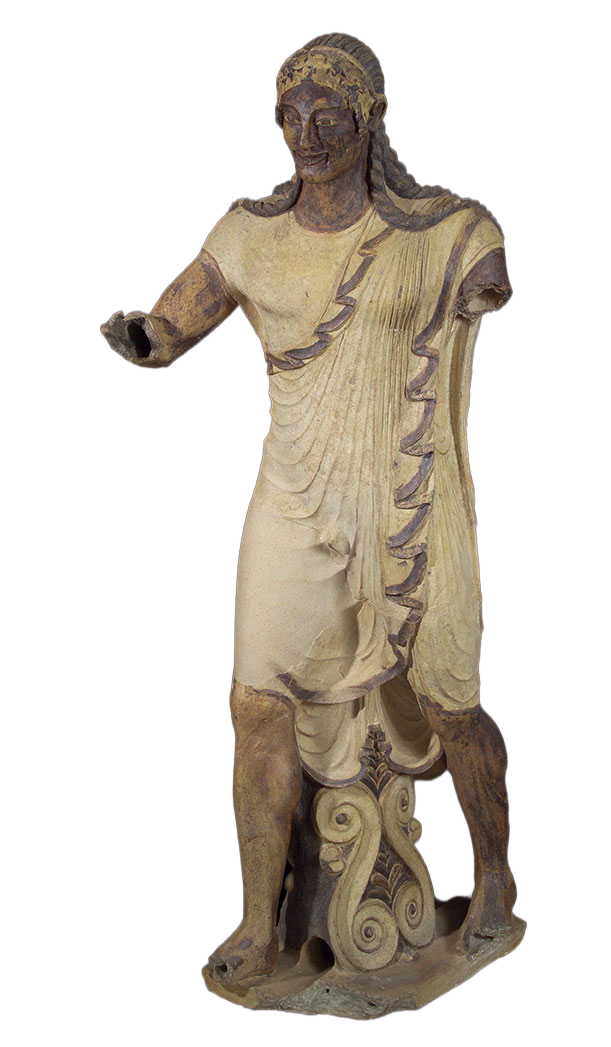
Apulu of Veii, National Etruscan Museum, 510-500BCE
The statue of Apulu is different from all other statues of the Etruscan gods because its best-known image is not a reverse mirror but a s culpture, one of the greatest pieces of Etruscan art. The Apollo of Veii is a painted terracotta sculpture. The Apollo of Veii is around six feet tall. It was created at pproximately 510-500 BCE, placed atop the highest point of the Portonaccio Temple's roof. The fragments were recovered in 1916. Today, the Apollo of Veii can be viewed at the Villa Giullia in Rome.4,5
The statue itself stood within a large number of life-sized statues which lined the ridge of the roof. These were meant to tell the story of a battle between Apulu and Hercle for control of the Ceryneian hind (a golden horned deer) that Hercle had stolen during one of his twelve labors. In this depiction, Apulu advances, clad and ready to attack Hercle who stands opposite him. This scene represents Apulu right before he confronts Hercle, and thus symbolizes the way the Etruscan people viewed him..4
The Portonaccio Temple seemingly belonged to Mnevra rather than Apulu, meaning the scene has to be interpreted in this type of context.4
III. His Attributes and Titles
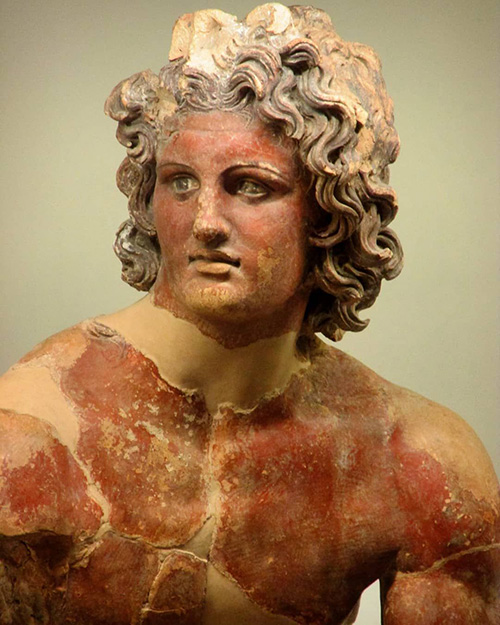
Apulu of Scasato, Museo Etrusco Villa Giulia, 310-300BCE
Iconography
The images of Apulu on mirrors and sculpture show him as a beardless young man with long hair who is either naked or partially clothed, wearing laurel leaves in his crown and holding a laurel branch, or a staff and occasionally a bow. In comparison to the Greek image of Apollo where the kithara is dominant, it is less prominent in Etruscan representations and when used, this instrument is more commonly depicted with Artume.6,7
IV. The Places of Worship
Apulu is one of the better-attested Etruscan gods in their cult.
Caere and Pyrgi
At Caere, an area called the sanctuary of San Antonio provided the sixth-to-fourth century B.C. dedications with abbreviations for both apol and apl. Colonna’s study of this area provides information regarding divination as well as worship of Rath (a name by which Apulu was also known) as a god. Apulu is present at Caere’s port city of Pyrgi, in the southern sanctuary, where he is referred to as Śuri in conjunction with Cavtha. It is here that the names of Shuri and Apulu are documented together, providing one of the most significant links to the solar litany of Etruscan gods..7,8
Veii
The Portonaccio sanctuary at Veii, built about 510 BCE on a terraced plateau outside the city walls, was the setting of the roof-group with the Apollo of Veii, and it honored Apulu alongside Menrva and Hercle. Outside the sanctuary lay a stone drain for libations and a sacred pool, and the whole complex was arranged for a cult conducted, in the older Etruscan manner, as much in the open air as within a building. The sanctuary was, however, dedicated to Mnevra (Athena) from the evidence.4
Gravisca
At Gravisca, the Greek-facing seaport of Tarquinia where Turan was worshipped as the Etruscan Aphrodite, Apulu had a presence as well. The emporion sanctuary there, frequented by East Greek traders, received the famous aniconic votive to Apollo of Aegina set up around 500 BCE by the merchant Sostratos, and the god's worship at the port is part of the same Greek-Etruscan exchange that brought his name and cult north.4,7
Mount Soracte and the Faliscan Border
The oracular and fiery cult on Mount Soracte, treated above, lay on the Faliscan and Sabine border north of Rome. It had kept its Etruscan god alive under Latin names into Roman times as Apollo Soranus. A dedication to Sanctus Soranus Apollo, found near Falerii, shows the cult still living in the imperial period.5,9
IV. Apulu, Śuri, and the Solar Gods of Etruria
Usil, the Sun Itself
Usil the Etruscan sun god represents the sun as an object in the sky like Helios and Sol. His depiction includes a fiery nimbus and riding in a solar chariot. In addition to being depicted in these ways, he is represented on the Liver of Piacenza, along with being shown driving the chariot of the sun.11,12
Shuri, the Dark Sun
Shuri is the Etruscan god in whom the sun turns dark. His name has been read as meaning "the black," and he is a god of the underworld, of fire, of the volcano, and of the sun at once, worshipped as pater Śuri, father Shuri, in votive inscriptions across Etruria. His cult center was Mount Soracte, north of Rome, a limestone ridge honeycombed with karst cavities and volcanic vents that the ancients took for mouths of the underworld. Erika Simon records that the god was well known in Etruria, that the Etruscan name of Viterbo, Surrina, derives from him, and that Mount Soracte, where Soranus was venerated, carries his name as well.7,11,13
The Romans later identified Shuri with Apollo Soranus, along with his locale having many items to 'Apol' and other abbreviations. They also identified him with Dis Pater, their native underworld god, and his symbolism is similar to that of Vejovis.5,7,9,14
The Fire-Walkers of Soracte
The most obvious evidence of the sun god's influence during this time is an annual ritual as every year, a group of families named the Hirpi Sorani or “the Wolves of Soranus,” would climb up to Mount Soracte. These families would then proceed to walk across burning hot coal embers at the base of a large pyre of pine logs while carrying around entrails of sacrificed animals. They managed to do all of this without getting burned. According to Pliny, these rituals were rewarded by having no military obligation, and therefore were exempted from this responsibility by decree of the Roman Senate. Virgil described this act of walking across the flames in the mouth of a warrior crying out to Apollo, who guards Soracte, who feeds on pine which has been piled upon it and set aflame. Servius commented on the passage describing the flames being walked across by explaining that the ritual was done in order to appease Soranus (whom he calls Dis Pater).5,9,14
The god fueled by flames represents both a solar and volcanic power; the wolves represent creatures of the underworld; the flames that the wolves step upon are those that come from the fiery peak of the volcano and also represent a mouth to the dead; and finally there is Soranus (to the Romans), Shuri (to the Etruscans) and Apulu (when interpreted as Apollo) at the center of this fiery rite.
VI. Apulu on the Mirror
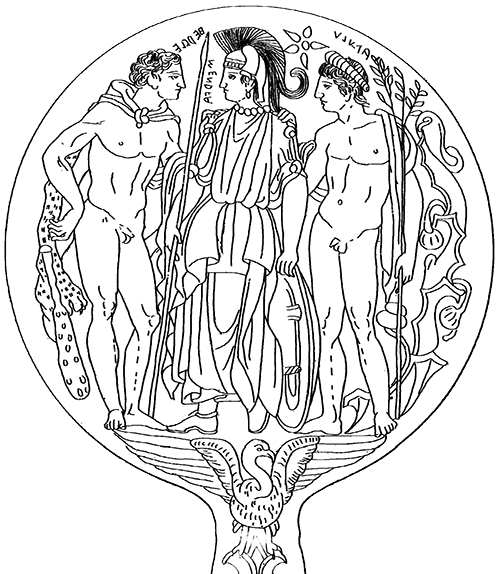
Etruscan bronze mirror, Hercle, Menvra and Apulu, 325–300 BCE
The Fufluns Scene
He appears with his brother in a familial Etruscan scene that has no Greek model: on a fourth-century mirror Semla holds a thyrsus and kisses the young Fufluns while Aplu stands by with his laurel branch and a small silenus plays the pipe. The scene shows how fully Apulu was woven into the native family of Tinia and Semla, standing witness. Some scholars think this indicates a tradition where Apulu was also the son of Semla rather than Letun in Etruria, but this is unknown.13
The Seer Cacu
The distinctively Etruscan scene depicted on the mirrors of the fourth and third century BCE is one of the young seer Cacu singing with the lyre, and his brothers Caile and Avle Vipinas creeping upon him in order to catch him. The Apollo depicted in this scene belongs to the world of prophecy. Since the Etruscan religion centered around divination and magic, they seemingly placed Greek god of the oracle into the context of both their prophets and their own "science" of signs. The mirrors depicting Cacu and the oracular cult of Rath at Caere are probably two sides of the same coin.3,7
Sources and Bibliography
- Bonfante, Giuliano, and Larissa Bonfante. The Etruscan Language: An Introduction. Rev. ed. Manchester: Manchester University Press, 2002. Cited page: 194, for the name Apulu and its syncopated form Aplu as a rendering of Greek Apollon, the transmission through a Latin center probably at Praeneste rather than directly from Greece, and the nearness of the form to the Thessalian Apullun.
- de Grummond, Nancy Thomson, and Erika Simon, eds. The Religion of the Etruscans. Austin: University of Texas Press, 2006. Cited for Apulu as the son of Tinia and Semla, brother of Fufluns and twin of Aritimi, and for his absence from the Liver of Piacenza.
- Colonna, Giovanni. "Divinazione e culto di Rath/Apollo a Caere (a proposito del santuario in loc. S. Antonio)." Archeologia Classica 52 (2001): 151–73. Cited for the dedications at the San Antonio sanctuary at Caere giving the abbreviated apol across the sixth to fourth centuries and the later apl, read as the Etruscan Aplu, and for the divination and cult of Apulu under the name Rath at Caere.
- Carlucci, Claudia. "Veio, Portonaccio." In Etruschi: Le antiche metropoli del Lazio, edited by Mario Torelli and Anna Maria Moretti Sgubini. Verona: Mondadori Electa, 2008. Cited for the Apollo of Veii as a life-size painted terracotta of c. 510–500 BCE from the roof of the Portonaccio temple, discovered in fragments in 1916 and now in the Villa Giulia, attributed to the workshop of Vulca, and belonging to a roof-group enacting the contest of Apulu and Hercle over the Ceryneian hind, in a sanctuary dedicated to Menrva.
- Pliny the Elder. Natural History. Translated by H. Rackham et al. 10 vols. Loeb Classical Library. Cambridge, MA: Harvard University Press, 1938–63. Cited: 35.157, for Vulca of Veii summoned to Rome to make the terracotta cult statue of Jupiter for the Capitoline temple; 7.19, for the Hirpi Sorani near Mount Soracte walking unscorched over the charred pile of burning pine at the yearly sacrifice and their consequent exemption from military and other burdens by decree of the Senate, and for the Latin identification of Soranus with Dis Pater.
- de Grummond, Nancy Thomson. Etruscan Myth, Sacred History, and Legend. Philadelphia: University of Pennsylvania Museum of Archaeology and Anthropology, 2006. Cited for Apulu's domains of light, sun, prophecy, healing, plague, and music, his iconography as a laurel-crowned beardless youth with staff and bow, the comparatively muted kithara, and his creatures the wolf and serpent.
- Simon, Erika. "Gods in Harmony: The Etruscan Pantheon." In The Religion of the Etruscans, edited by Nancy Thomson de Grummond and Erika Simon, 45–65. Austin: University of Texas Press, 2006. Cited page: 59, for Śuri as a god well known in Etruria and worshipped as father Śuri, the derivation of Surrina (Viterbo) and of Mount Soracte from his name, the veneration of Soranus there (with Virgil, Aeneid 11.785), Colonna's convincing equation of Aplu with Śuri, and the shared wolf attribute with Aita.
- Colonna, Giovanni. "L'Apollo di Pyrgi, Śur/Śuri (il «Nero») e l'Apollo Sourios." Studi Etruschi 73 (2009 [2010]): 101–34. Cited for the reading of Śuri as "the black," the argument that Apulu and Śuri are one chthonic-solar god, the association of the names Śuri and Apulu on the Pyrgi inscriptions, the worship of Śuri with Cavtha in the southern sanctuary at Pyrgi, and the connection to the Apollo Sourios.
- Virgil. Aeneid. In Virgil, translated by H. Rushton Fairclough, revised by G. P. Goold. 2 vols. Loeb Classical Library 63–64. Cambridge, MA: Harvard University Press, 1999–2000. Cited: 11.785–88, for Arruns's prayer to Apollo as guardian of Soracte, fed on the heaped burning pine, whose worshippers plant their soles in the fire; with Servius ad loc. for the fire-walking as a propitiation of Soranus identified with Dis Pater, and for the dedication to Sanctus Soranus Apollo near Falerii (CIL XI 7485).
- Turfa, Jean MacIntosh, ed. The Etruscan World. Routledge Worlds. London and New York: Routledge, 2013. Cited for Usil as the Etruscan sun-god equivalent to Helios and Sol, his pairing with the dawn-goddess Thesan in the chariot, his name on the Liver of Piacenza, and the solar character attributed to Catha.
- de Grummond, Nancy Thomson. "For the Mother and for the Daughter: Some Thoughts on Dedications from Etruria and Praeneste." In ΧΑΡΙΣ: Essays in Honor of Sara A. Immerwahr, edited by Anne P. Chapin, 351–70. Hesperia Supplement 33. Athens: American School of Classical Studies at Athens, 2004. Cited for Usil's close association with Thesan, unusually intimate for a sun-and-dawn pairing, and for the discussion of Catha as "daughter of the sun" and "eye of the sun."
- de Grummond, Nancy Thomson. "Moon over Pyrgi: Catha, an Etruscan Lunar Goddess?" American Journal of Archaeology 112, no. 3 (2008): 419–28. Cited for the debate over whether Catha (Caθa, Cavtha) is a solar or a lunar goddess, and for her presence at Pyrgi alongside Śuri.
- de Grummond, Nancy Thomson. "Semla." In The Religion of the Etruscans, edited by Nancy Thomson de Grummond and Erika Simon, 63–64. Austin: University of Texas Press, 2006. Cited for the fourth-century BCE mirror on which Semla, holding a thyrsus, kisses the young Fufluns while Aplu stands by with a laurel branch and a young silenus plays the aulos.
- Servius, In Vergilii Aeneidem commentarii, on Aeneid 11.785, ed. Georg Thilo (Leipzig: Teubner, 1884).