



| Language | Name of Argus Panoptes | Attestation |
|---|---|---|
| Epic Greek | Ἄργος/Ἀργειφόντης | Homeric Hermes as Ἀργειφόντης, “Argus-slayer” (850 BCE onwards) |
| Classical Greek | Ἄργος (Πανόπτης) | Hesiod (850 BCE onwards) |
| Latin | Argus | Ovid (8CE) |
15 min read
ARGUS PANOPTES
author: High Priest Zevios Metathronos
co-author: Novice Priest Karnonnos
I. The Name
Argus Panoptes has some etymological discussion tied to his name. The Greek form is Ἄργος Πανόπτης, “Argus the All-Seeing.” The second element, Πανόπτης, is the most transparent part of the name: it is formed from πᾶν, “all,” and the seeing-root connected with ὄψομαι, “I shall see,” so that πανόπτης means “all-seeing.” Liddell–Scott–Jones gives πανόπτης as “all-seeing,” and explicitly notes its use of Argus in Aeschylus.1 It is first used in a fragment of Hesiod represented in Euripides' Phoenissae.2
The first element, Ἄργος, is less safely explained as a personal name. It overlaps in form with Ἄργος, the city and land of Argos, and with Greek ἀργός, which can mean “bright, gleaming, white,” though it also has a separate sense “idle” in other contexts. For the giant, he is the watchman whose vision goes everywhere.3
In myth, Argus Panoptes is the guardian set by Hera over Io after Io is transformed into a cow. Aeschylus presents the name-function very clearly in the Suppliant Women: Hera places “the all-seeing one” over the cow, and the speaker identifies him as Argus, a child of Earth, slain by Hermes.3
πάνοπτην οἰοβούκολον τίνα λέγεις; What sort of all-seeing single-herdsman do you mean?
The earliest possible literary layer is indirect: Homer repeatedly calls Hermes Ἀργειφόντης, an epithet traditionally understood as “Argus-slayer" so the idea of Hermes as the killer of Argus was already attached to Hermes in early Greek epic diction.4 The earliest more explicit surviving account is usually placed in the fragmentary epic Aegimius, attributed in antiquity to Cercops of Miletus. There Argus is not yet a fully “hundred-eyed” monster as he is described as having four eyes, looking every way, and never sleeping while he keeps watch over Io.5
And Hera set a watcher upon her, great and strong Argus, who with four eyes looks every way. Sleep never fell upon his eyes, but he kept sure watch always.
Later mythographers regularized and expanded this figure. Apollodorus says that Argus, “the one called all-seeing,” had eyes over the whole of his body, killed the bull ravaging Arcadia, killed a cattle-stealing satyr, and also slew Echidna while she slept.6 Ovid gives the most famous Roman version: Argus has a hundred eyes, Mercury kills him, and Juno places his eyes into the peacock’s tail.7
Sources: Liddell, Henry George, Robert Scott, Henry Stuart Jones, and Roderick McKenzie. A Greek-English Lexicon. 9th ed. Oxford: Clarendon Press, 1940, s.v. “πανόπτης,” “ἀργός”;1Hesiod. Aegimius. Fragment 294 Merkelbach–West = fragment 230 Most, quoted in the scholia to Euripides, Phoenissae 1116. In Greek Epic Fragments: From the Seventh to the Fifth Centuries BC, edited and translated by Martin L. West, Loeb Classical Library 497. Cambridge, MA: Harvard University Press, 2003. Passage: fr. 230 Most / fr. 294 M-W, schol. Eur. Phoen. 1116.2 Aeschylus. Suppliant Women. Translated by Herbert Weir Smyth. Cambridge, MA: Harvard University Press, 1926, 303–305;3 Homer. The Iliad. Translated by A. T. Murray, revised by William F. Wyatt. Cambridge, MA: Harvard University Press, 1999, 2.103;4 Apollodorus. The Library. Translated by Sir James George Frazer. Cambridge, MA: Harvard University Press, 1921, 2.1.3;6 Ovid. Metamorphoses. Translated by Frank Justus Miller, revised by G. P. Goold. Cambridge, MA: Harvard University Press, 1977, 1.624–723.7
II. The Giant
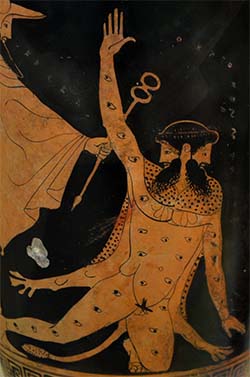
Argus is a marked instance in mythology of the principle that nothing escapes the eyes of the Gods; they are pan-optical. His appointment as an agent of Hera covered in eyes that could see from all directions when guarding the captive Io is a resoundingly bold, otherworldly and strange image of the ancients to us, yet it was one that sated their creative as well as philosophical appetites.5 The mythology of Io’s capture often had elements that evoked horror, such as Aeschylus in his tragedy, Prometheus Bound7, which claimed the “myriad-eyed herdsman” made her shudder because his far-reaching, crawling vision could pursue her even in his death (properly speaking, a code for possessing astral sight). By playwrights, Argus was considered one of Hera’s instruments of divine retribution.5, 9 The goddess had multiple such attendants,10 but Argus was valued by her.
III. Ancient Myth
Hermes is called the Argus-slayer, Argeiphontes, even in the ancient Iliad4 and Odyssey.12 The mythology of Argus is also a standard convention in plot from early periods. Io, a Priestess of Hera, has an intimate relation with Zeus. She is transformed into a cow either by him or the enraged Hera. In the former rendition, Zeus could not hide Io and Hera begged him to give her over as a gift; in other versions where she transforms Io herself, she commands Argus to keep watch to prevent the girl from seeing him.14 In later Roman sources, Juno contrives to make Io complete tasks in bovine form at the giant's bidding: "At Argus’ bidding must she go on paths unknown, over rocks, through monster-haunted wilds, tarrying oft, alas! and struggling with prayers and words fast locked within her breast..."15 Io is henceforth imprisoned at the Grove of Hera. Early sources include the Hesiodic fragments (Aegimius fragment 5–6, frr. 130–132 M.-W., preserved in scholiasts), which call him “panoptes” (“all-seer”) with eyes across his body, and note Hera set him to watch Io.2, 16 It was said that because Argus Panoptes had slain a raging bull and even the she-monster Echidna,17 Hera considered him a suitable custodian of the cow of Zeus; other accounts claim he was valued as the most precious of Hera's attendant creatures because he never slept.15 The giant approached his mistress's task responsibly. He never took his eyes off Io. During the day, he tended Io, transformed into a cow, and in the evening, tied with a rope, he locked her in a stable where she could only trace words with her hooves. When the girl's father, Inachus, realized what was happening and grieved over his daughter, Argus separated them.7, 18 Zeus, seeing the plight of his beloved, was moved to anger. On Zeus' enraged orders, Hermes, by outsmarting the giant with his flute or another device, kills Argus “by the cast of a stone”, gaining the epithet.
Argonautica, Valerius Flaccus15
She accosts Jove thus : ‘Give me the untamed heifer that feeds on Argos' fertile plains and is just showing the horns of the infant moon; give her as a gift to thy dear bride. Myself now will I choose fit pastures and choicest fountains for my pet.’ What ruse could Jove find to say her nay? What trickery, once found, could he have maintained? She, possessed of the gift, straightway sets Argus on guard; Argus as guardian pleases her, for everywhere on his head are sleepless eyes, as though a Lydian bride should bedeck her web with flecks of purple. At Argus' bidding must she go on paths unknown, over rocks, through monster-haunted wilds, tarrying oft, alas! And struggling with prayers and words fast locked within her breast . . . But she, when her limbs trembled aweary of her wandering or when now chilly evening sped down from heaven's height--ah! How often laid she her body on a stone, or when long thirst made her faint, what pools did her lips drink, what pastures graze, how oft did her white shoulders quail before the lash! Nay, too, as daring death she planned to leap from some lofty height, swift did Argus drive her down to the vale beneath, and cruelly saved her at his queen's behest: when on a sudden a hollow flute pipes out a measure of Arcady,, and the winged Cyllenian [Hermes], hastening to obey his sire, draws nigh, and tuning his oft reed to melody cries, ‘Wither away? Where roamest thou? Ho there! Give heed to my music!’ Following Argus close he notes that all his eyes are already languishing and seeking after sweet slumber, and in the midst of his song out he flashes his swift blade.
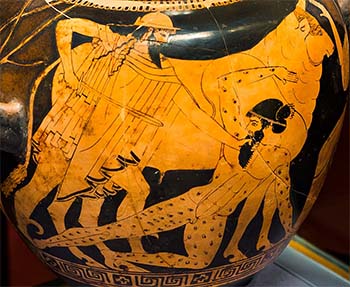
Acusilaus simply says he was born from the earth.19 Elsewhere, the giant was considered to be the son of Arestor20 by Pherecydes of Athens in his mythological collection, preserved in fragment by Apollodorus. Pherecydes confirms that Hera appointed this Argus to guard Io after Zeus transformed her into a white heifer, who then tied the cow to an olive tree located in the grove of the Mycenaeans. When Hermes was sent by Zeus to steal the heifer, he was unable to do so secretly because a bird named Hierax informed Argus of the plot. Consequently, the sneaky Hermes killed Argus by distracting him with his music and casting a stone at him. Asclepiades of Tragilus' more tragic account sometimes used in Greek drama diverges; Argus, the son of the first king of Argos named Inachus, is the sibling of Io, and hence his death is all the more galling.21 In Ovid's most famous retelling, Hermes disguises himself as a shepherd and plays the syrinx (panpipes).7 He tells the story of Pan and Syrinx to lull all one hundred of Argus's eyes to sleep. Once Argus is fully unconscious, Hermes beheads him with a curved sword, the harpe.In Prometheus Bound, the death is not graphically described, but Argus’s "ghost" or "image" continues to haunt Io. This implies a violent end that left his spirit restless, often interpreted as a sudden ambush. The Iliad nor Odyssey does not describe the mythology, but later commentaries on the Iliad speculating on the epithet Argeiphontes suggested that Hermes used his powers as "oneirpompos" (conductor of dreams) and golden caduceus to magically seal Argus's eyes in sleep before killing him.22
IV. Heavenly Sight
After Argus is slain, Hera transfers him to the eyes of the peacock, or simply transforms his dying body into a peacock.23 In other depictions, the peacock is formed as a token of Hera's deep respect for the giant.24
The divine entity behind the story of Argus, known in the Goetia as Agares, represents the ability of achieving heavenly sight. This does not just deal with the ability to merely see the astral realm itself, but to be able to pull on unfathomable levels of presentience, wisdom and other things; to see everything from a perspective that benefits the previously limited mind of the initiate, to be able to interpret the astral rather than fall victim to its strange forces. In the mythology, Argus is overturned from the body of a material giant by the divine mind, his formidable presence slinking away into the stark eyes of Hera’s peacock feathers.
On Argus, High Priest Zevios Metathronos25
HPS Maxine has mentioned in one of her posts many years ago, that Agares was known as the Guardian or Patron Deity of Argos. Argos used to be both the name of a location [one of the most ancient cities in Europe] and a dynasty of Ancient Greek kings, who were called the Argead Dynasty. Alexander the Great was also descended from this dynasty. As these rulers went North, they created the House of Macedonia, a local kingdom in this place.
The Argead Dynasty was also named the "Danaaedes" Dynasty, which means "Those of Danaan", which is very much close to the Tuatha De Danaan in the Irish history. Among the mythical forefathers of the Ancient Greeks were from many locales, as the Gods have seeded humans in many places since the Golden Age was a global civilization. Ancients also openly do state they are from the Gods themselves, it was known back then to all Ancient people worldwide that we descend from the Gods and not from any "apes". The descendants of their people were the "Great Ones" of history, here from the Golden Age, to create many cities and to populate the earth in the coming centuries until this very day.
Argus is of the Rank of "Watchers", which means He is a very advanced entity. He is a God. The myth around him having a hundred eyes, is symbolic about the power of the Ascended Serpent and the ability to see the Astral Realm that one is bestowed through this. In the myth, Argus is "slain" and then becomes "Eyes on the peacock tail", the holy animal of Hera, which is a code for the expanded perception one attains when they advance the Third Eye.
V. Philosophical Viewpoints
Hermetic, Gnostic and magical texts treated the incident with some interest. For example, the Liber Hermetis alludes to Hermes vanquishing a many-eyed beast as a myth, an image of Logos piercing illusion from earthly entrapment.26 Thus, Argus’s defeat is analogous to an initiate’s shedding illusions. Hermeticists extrapolated this further: Argus’s body became a peacock, the symbol of immortality symbol, and a token of the illuminated soul taken from the earthly giant. Plotinus uses the epithet 'Panoptes' to describe one of the functions of the world soul.27 Cornelius Agrippa’s De Occulta Philosophia (1533) likens Argus to astrological eye-constellations guarding hidden knowledge,28 and alchemical writers treated Argus as a symbol of salve et coagula. Carl Jung noted that ancient sources often identified Argus with the starry heaven29. Of these sources, Macrobius associates him with the sky:
Saturnalia, Macrobius30
... in this story, Argus is the firmament, strewn with the brilliance of stars, which seem to contain some image of the heavenly eyes. […] So, this cycle of the sky, adorned with the lights of the stars, is then considered to be destroyed by Mercury, when the Sun during the daytime, eclipsing the stars, as if destroys them, depriving mortals of their contemplation by the power of its light.
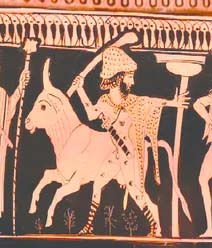
In addition, Io is taken to be the ancestor of the Daneads above. Argus is rhetorically represented as bull-like, not just because he guards the cow Io, but because he killed the rampaging bull and wore its hide.10 His association with the eyes of the peacock's tail also give a strong link to that regal animal. If taken in a purely moral direction, the story is also meant to represent on a moral level that unjust desires like the captivity of the innocent Io and unnecessary surveillance can lead to brutal and excessive ends if used wrongly. Such an interpretation lends itself to the infamous Panopticon of Jeremy Bentham31, an idea that has provoked much debate for and against over the centuries. The captivity of Io can only be undone by the pure Mind of the Gods, namely Hermes, whose pure-mindedness also envelops a form of willing to bend all rules and trickery to get one wants. Fundamentally the point of the story is not truly negative; the function of Argus is a positive one in that the giant is protective of an immature faculty under the bounds of Time itself. This is another stark reminder from mythology, much like the tale of Icarus, to not go too fast in attempting advancement.
Bibliography:
1. Liddell, Henry George, Robert Scott, Henry Stuart Jones, and Roderick McKenzie. A Greek-English Lexicon. 9th ed. Oxford: Clarendon Press, 1940, s.v. “πανόπτης,” “ἀργός”.
2. Hesiod. Aegimius. Fragment 294 Merkelbach–West = fragment 230 Most, quoted in the scholia to Euripides, Phoenissae 1116. In Greek Epic Fragments: From the Seventh to the Fifth Centuries BC, edited and translated by Martin L. West, Loeb Classical Library 497. Cambridge, MA: Harvard University Press, 2003. Passage: fr. 230 Most / fr. 294 M-W, schol. Eur. Phoen. 1116.
3. Aeschylus. Suppliant Women. Trans. by Herbert Weir Smyth. Cambridge, MA: Harvard University Press, 1926, 303–305;
4. Homer. The Iliad. Trans. by A. T. Murray, revised by William F. Wyatt. Cambridge, MA: Harvard University Press, 1999, 2.103
5. Apollodorus. The Library. Trans. by Sir James George Frazer. Cambridge, MA: Harvard University Press, 1921, 2.1.3
6. Ovid. Metamorphoses. Trans. Frank Justus Miller, revised by G. P. Goold. Cambridge, MA: Harvard University Press, 1977, 1.624–723.
7Festa, Anna. “Euboean Hera.” Greek, Roman, and Byzantine Studies 60, no. 4: 595–623, 2020
8Aeschylus. Prometheus Bound. In Aeschylus I: Persians, Seven against Thebes, Suppliants, Prometheus Bound. Translated by Herbert Weir Smyth. Loeb Classical Library 145. Cambridge, MA: Harvard University Press, 1926.
9Lucian. Dialogues of the Gods. In Dialogues of the Dead; Dialogues of the Sea-Gods; Dialogues of the Gods; Dialogues of the Courtesans. Translated by M. D. MacLeod. Loeb Classical Library 431. Cambridge, MA: Harvard University Press, 1961.
10Pirenne-Delforge, Vinciane, and Gabriella Pironti. “Hera.” In The Oxford Classical Dictionary. Oxford: Oxford University Press, 2017.
11Hesiod. The Aegimius, fragment 5. In Hesiod: The Homeric Hymns and Homerica. Translated by Hugh G. Evelyn-White. Loeb Classical Library 57. Cambridge, MA: Harvard University Press, 1914.
12Homer. The Odyssey. Trans. by A. T. Murray. Revised by George E. Dimock. Loeb Classical Library 104–105. Cambridge, MA: Harvard University Press, 1995.
13Lucian. Dialogues of the Dead. In Dialogues of the Dead; Dialogues of the Sea-Gods; Dialogues of the Gods; Dialogues of the Courtesans. Translated by M. D. MacLeod. Loeb Classical Library 431. Cambridge, MA: Harvard University Press, 1961.
14Aeschylus. Suppliant Women. In Aeschylus I: Persians, Seven against Thebes, Suppliants, Prometheus Bound. Translated by Herbert Weir Smyth. Loeb Classical Library 145. Cambridge, MA: Harvard University Press, 1926.
15Valerius Flaccus. Argonautica. Translated by J. H. Mozley. Loeb Classical Library 286. Cambridge, MA: Harvard University Press, 1934.
16Nikolaev, Alexander. “Ten Thousand Eyes: The Story of Ἄργος Μυριωπός.” Greek, Roman, and Byzantine Studies 55, no. 2 (2015): 343–359. Passage on the Hesiodic Aegimius fragment: pp. 345–346, citing Hesiod fr. 230 Most = fr. 294 Merkelbach–West, scholion to Euripides, Phoenissae 1116.
17Hesiod. Theogony. In Hesiod: Theogony, Works and Days, Testimonia. Edited and translated by Glenn W. Most. Loeb Classical Library 57. Cambridge, MA: Harvard University Press, 2018.
18Jacobson, Howard. “Recognition and Silence.” Classical Quarterly
19Apollodorus. The Library quoting fragments of Genealogies by Acusilaus
20Ibid., Apollodorus, quoting fragments of Pherecydes of Athens
21Ibid., quoting fragments of Tragodoumena by Asclepiades of Tragilus
22Eustathius of Thessalonica. Commentarii ad Homeri Iliadem Pertinentes ad Fidem Codicis Laurentiani Editi. Edited by Marchinus van der Valk. 4 vols. Leiden: Brill, 1971–1987.
23Nonnus. Dionysiaca. Translated by W. H. D. Rouse. Mythological introduction and notes by H. J. Rose. Notes on textual criticism by L. R. Lind. 3 vols. Loeb Classical Library 344, 354, 356. Cambridge, MA: Harvard University Press, 1940–1942.
24Schwartz, Eduard, ed. Scholia in Euripidem. Vol. 1. Berlin: Georg Reimer, 1887.
25High Priest Zevios Metathronos. On Argus. Temple of Zeus, 2024.
26Gundel, Wilhelm, ed. Neue astrologische Texte des Hermes Trismegistos: Funde und Forschungen auf dem Gebiet der antiken Astronomie und Astrologie. Abhandlungen der Bayerischen Akademie der Wissenschaften, Philosophisch-Historische Abteilung, n.s., no. 12. Munich: Verlag der Bayerischen Akademie der Wissenschaften, 1936.
27Plotinus. Ennead, Volume III: Enneads III.1–9. Translated by A. H. Armstrong. Loeb Classical Library 442. Cambridge, MA: Harvard University Press, 1967.
28Agrippa von Nettesheim, Heinrich Cornelius. Three Books of Occult Philosophy. Translated by James Freake. Edited and annotated by Donald Tyson. St. Paul, MN: Llewellyn Publications, 1993.
29Jung, C. G. The Structure and Dynamics of the Psyche. Translated by R. F. C. Hull. Edited by Gerhard Adler and Michael Fordham. 2nd ed. Vol. 8 of The Collected Works of C. G. Jung. Bollingen Series 20. Princeton, NJ: Princeton University Press, 1969.
30Macrobius. Saturnalia. Edited and translated by Robert A. Kaster. 3 vols. Loeb Classical Library 510–512. Cambridge, MA: Harvard University Press, 2011.
31Bentham, Jeremy. Panopticon; or, The Inspection-House. London: T. Payne, 1791.