





| Language / Culture | Name of Brihaspati | Attestation |
|---|---|---|
| Vedic Sanskrit | Brihaspati (बृहस्पति) | Rigveda (c. 1500–1200 BCE) |
16 min read
BRIHASPATI
author: High Priest Zevios Metathronos
co-author: Novice Priest Karnonnos
I. The Name of Brihaspati
Brihaspati is closely related to Brahman. The earliest known attestation of the theonym is in the Rigveda Samhita, the oldest Sanskrit text, composed in the latter half of the second millennium BCE.
In Rigveda 2.23.1, the form brahmaṇnspata is transparently parsed in the padapatha as brahmanah | pate, meaning “O lord of Brahman." Brahman here means sacred utterance. The same hymn is traditionally divided between verses addressed to Brahmanaspati and verses addressed to Brihaspati.1,2
The Nirukta of the great grammarian Yaska gives the clearest indigenous etymology. Brihas-pati is “the supporter of the great,” while Brahmanas-pati is “protector of Brahma”. The Nirukta also connects Brihaspati with sacred speech by explaining a Vedic passage in which he grants speech to Devapi. Later Sanskrit lexicography preserved a traditional-style paraphrase, bṛhataḥ vācaḥ patiḥ, “lord of great speech”.3,4
Sayana's commentary on the Aitareya Brahmana interprets Brihaspati as the priestly principle among the gods. The root √bṛh or bṛṃh means “to grow, increase, expand,” and related glosses include “grow great or strong”, coherently aligning with the planet Jupiter.5
Sources: Ṛgveda, “Rig Veda. Mandala 2. Sukta 23,” digital text with Devanagari and transliteration, Sri Aurobindo site; Thomas, Vedic Hymns: Translated from the Rigveda, (1923); Yāska, Nirukta, translated by Lakshman Sarup; Monier-Williams, A Sanskrit-English Dictionary, (1899); Keith, Rigveda Brahmanas: The Aitareya and Kauṣītaki Brāhmaṇas, (1920)1,2,3,4,5.
II. Brihaspati in the Vedas
Rigveda
Brihaspati appears around fifty times in the Rigveda alone, from Book One (1.8.2) to Book Twenty (20.137.9). One of the most important excerpts is 2.23.1–19 where Brihaspati is called “Father of all sacred prayer", establishing his connection with divine sound. He is equivocated with being the head of a liturgy, and his tongue is described as pleasant and eloquent.1, 6, 7
Later books treat him as a cosmic god who props up the ends of the earth, creating thunder and driving away all darkness. His powers are so extensive that he can break all rocks, their split sides caving to reveal abundance and greatness, such as the hidden cows of plentitude inside. This is representative in total of the planetary values of sound and magical power that results from vibration.7, 8
This rock-breaking belongs to the oldest layer of his myth. In the account preserved at Rigveda 4.50, Brihaspati with his cry splits the stone stronghold of Vala and drives out the cattle penned within, so that the hidden dawns and the waters are set free. The Aṅgirasas sing at his side, and the released herd is at once literal wealth and the light of morning.6, 8
The Rigveda also portrays Brihaspati as a household god who props up wealth through prayer and intercession to him.7, 9
The tenth book preserves the hymn most often read as a meditation on sound itself. In Rigveda 10.71, the origin of speech is described as a naming, when the wise fashioned language by the mind and sifted the pure from the impure as grain is sifted through a sieve. Brihaspati stands at the head of this act, so that the lord of the great utterance is also the god who first set names upon things.10
Samaveda
In the Samaveda, he is invoked to make Kakṣīvant Aushija, an ancient Vedic sage, a powerful chanter of the soma. Additionally, the major blessing formula is given in verse 1875:11
स्वस्ति नो बृहस्पतिर्दधातु
may Brihaspati bestow welfare on us...
Samaveda, 4.9.3.9.311
Yajurveda
In the clerically-oriented Yajurveda, Brihaspati takes on a role proximate to holy functions of a priest. He is referred to as the Brahman priest of the sacrifice. The sacrifice is proclaimed to him, and the cosmic god is asked to extend and restore the rite uninjured.12
In the distribution around Indra, Mitra and Varuṇa are the Hotar-priests, Bṛhaspati is the Chanter, and the Ashvins are Adhvaryus. Again, the relation to sound expressed through the mouth in a holy way is deeply paramount. The god is also described in a hopeful way as the healer of the entire world who protects it from all strife.13
In these liturgical books the god is bound ever more tightly to the office of the purohita, the domestic priest who goes before the king, so that no sacrifice is held to stand complete without him.12,13
Atharvaveda
The Atharvaveda gives Brihaspati a relation to magic in itself where he is invoked in a ritual to overpower an evil spirit through mastery. A charm for a sick man (7.53.1) says that Bṛhaspati freed him from the underworld of Yama and the Ashvins aided this endeavor by chasing Death away. He also assists in marriage rites, binding the hubsand to his wife for prosperity.14
The role he possesses becomes cosmogonic in nature: he is called the world's sole ruler, working through the sage Atharvan who notes the Veda down carefully from memory.14
III. The Epithets of Brihaspati
Some of Brihaspati's epithets overlap with Brahmanspati.1,6
| Epithet | Meaning | Domain |
|---|---|---|
| Brahmanaspati (ब्रह्मणस्पति) | Lord of Sacred Formulation | Priestly power, invocation |
| Gaṇapati (गणपति) | Lord of the Hosts | Presiding divinity of the invoking companies and ritual assembly |
| Jyeṣṭharājaṃ Brahmaṇām (ज्येष्ठराजं ब्रह्मणाम्) | Foremost King of Sacred Formulations | Supremacy over prayer, priestly precedence |
| Kavim Kavīnām (कविं कवीनाम्) | Sage among Sages | Teaching the Gods, sacred intelligence |
| Upamashravastamam (उपमश्रवस्तमम्) | Most Renowned | Ritual fame, divine prestige |
| Janita Brahmanam (जनिता ब्रह्मणाम्) | Begetter of Sacred Formulations | Source of prayer, origin of liturgical speech |
| Rakshohanam (रक्षोहनम्) | Slayer of Rakshas | Apotropaic force, destruction of hostile beings |
| Gotrabhidam (गोत्रभिदम्) | Breaker of the Enclosure | Release of wealth, breaking obstruction |
| Svarvidam (स्वर्विदम्) | Finder of Heaven | Recovery of light, opening the luminous world |
| Triṣadhasthaḥ (त्रिषदस्थ) | Established in the Three Seats | Triple ritual, AUM |
| Mandrajihvam (मन्द्रजिह्वम्) | Chanting-tongued | Sound, mantra |
| Vacaspati (वाचस्पति) | Lord of Speech | Sound, mantra |
| Girpati(गीर्पति) | Lord of Utterance | Sound, mantra |
Sources: Rigveda, “Rig Veda. Mandala 2. Sukta 23,” digital text with Devanagari and transliteration, Sri Aurobindo site1; Thomas, Vedic Hymns: Translated from the Rigveda with Introduction and Notes (1923); Rigveda, “Rig Veda. Mandala 4. Sukta 50,” digital text with Devanagari and transliteration, Sri Aurobindo site; Rigveda, “Rigveda, Shakala Samhita, Mandala 07 Sukta 097,” Vedic Heritage Portal; Rigveda, “Rig Veda. Mandala 10. Sukta 71,” digital text with Devanagari and transliteration, Sri Aurobindo site; Ṛgveda, based on Theodor Aufrecht, ed., Die Hymnen des Rig Veda, 2nd ed. (Bonn, 1877), digitized by Barend A. van Nooten and Gary B. Holland and revised by Detlef Eichler, GRETIL digital text; Amarasiṃha, Amarakośa 1.3.223–224, GRETIL digital text of Nāmaliṅgānuśāsana; Apte, Vaman Shivaram, The Practical Sanskrit-English Dictionary, Digital South Asia Library / derivative lexical interfaces, s.v. “वाचस्पति”1,2,8,9,10,15,16,17.
IV. The Sacred Presence of Brihaspati
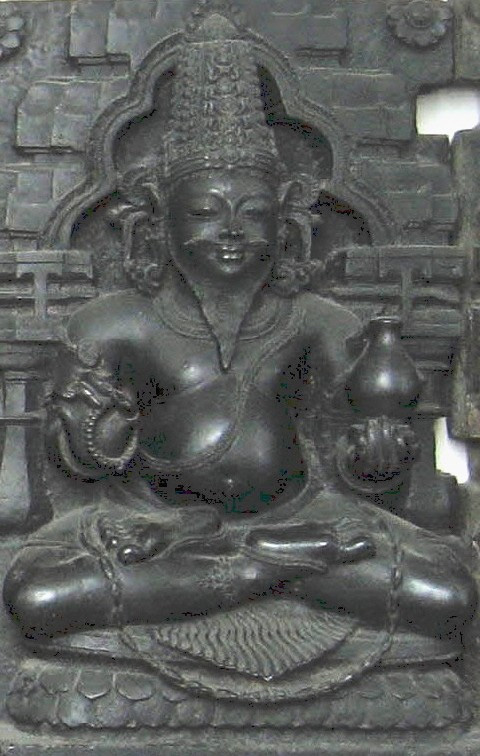
Brihaspati represents a god associated with the act of chanting and the ritual of offering rather than the general physical space of the shrine. There are no structures left to us from the earliest layers of his worship as with most Rigvedic deities. At some point after these early layers, the stone statues of Brihaspati began to be erected because the priests of the many gods became the Gurus (the planetary rulers) of their respective planets. As such, they joined the eight other Grahas (planetary deities), each having their statues placed along the walls or courtyard of temples built during the medieval period.6
One of the very few shrines associated specifically with Brihaspati is located at Alangudi in the Kaveri River delta in Tamil Nadu. This shrine is well-known as part of the Navagraha Pilgrimage route which includes it as the Guru Sthalam, the seat of Jupiter. Primarily speaking this is a temple dedicated to Shiva as Apatsahayeswarar (“help in adversity”), as Shiva is said to have appeared in this form while he consumed the poisoned nectar churned out of the ocean of milk. Since this Shiva Shrine at Tiru Irum Poolai has been mentioned in a hymn written by the saint Campantar in the seventh century CE, it is considered one of the Paadal Petra Sthalams, those temples which have been consecrated by the Shaivite canon of the Tamil people. 18
As one of the nine Navagraha Temples found in the Kaveri River Delta region, devotees visit Alangudi to offer reverence to Brihaspati. In addition to being one of the Navagraha temples, devotees come to Alangudi to honor Brihaspati through his association with Dakshinamurthy, the teacher facing south, who represents Brihaspati. Devotees attend Alangudi primarily during the guru peyarchi, the time when Jupiter moves from one of the zodiac signs into another. During this period, devotees seek blessings from Brihaspati concerning knowledge, marriage and prosperity.19
The present site is attributable to the sixteenth-century Nayaks over an older Chola Empire foundation, and the site is administered today by the Hindu Religious and Charitable Endowments department of Tamil Nadu. Beyond Alangudi, Brihaspati's temple presence is mostly limited to an image among images within panels depicting the nine Grahas, which can be seen in both Shaivite and Vaishnavite temples throughout India, where Brihaspati is revered and worshiped on his designated day.19
V. Brihaspati: Teacher of the Gods
The post-Rigvedic literature introduces a unique aspect to Brihaspati: he is the teacher, the guru of the gods. He receives knowledge from Brahma in the Riktantra Pratisakhya, knowledge he passes on to the great Indra, reaching the Bharadvajas, the rishis and finally the brahmanic scholars. Knowledge cascades downwards through the medium of sound like water.20
Lord Brahmā addressed Bṛhaspati, “Bṛhaspati addressed Indra, Indra addressed Bhāradvāja, Bhāradvāja addressed the sages, and the sages addressed the brāhmaṇas.”
Rik Tantra 1.420
The great sage Patañjali says that Brihspati taught Indra the word-by-word “recitation of words” for a thousand divine years and still did not reach the end; the finer point is that grammar cannot simply list every word. The greater point is that speech is limitless and sacred, as is the sound at the core of the universe, of which speech is a faint emanation and a microcosm at the same time.21
Some later expositions connect Brihaspati to the feminine deities, like in the Devī Bhāgavata Purāṇa. Indra asks Brihaspati about the science of all words. He cannot answer until worshipping and meditating on the nature of Sarasvati.22
Mahabharata
In the Mahabharata, the god of Sacred Sound teaches Indra how to treat an adversary. Conciliatory gestures, secrecy and how to spot the signs of duplicitous men are highlighted in his explanation. In Anushasana Parva 76, he taught King Mandhatr the reciprocity of giving alms.23
The Anushsana Parva 111–113 relates this to death with a long series of questions on the process by which a person can show piety after death. Yudhisthira (one of the five brothers known as the Pandava) asked Brihaspati, the greatest of all teachers, about this process. Brihaspati told Yudhisthira the importance of acting righteously and spending your earthly wealth to promote something divine; he explained the elementary basis of judgment and it relationship to Yama's realm.23
Bhagavata Purana
Brihaspati advises Indra and the gods during Bali’s rise. Indra and the devas approach their guru to ask why Bali has become irresistible. The reverend guru explains that Bali has been empowered by the Bhirgus, says only Hari can defeat him, and instructs the gods to leave heaven and wait for the right timing. This aspect of Brihaspati weds his divine function of sound to the idea of when it is ever best to use its precious faculty.24
VI. Navagraha of the Planet Jupiter
Brihaspati is known most as the Navagraha of Jupiter, its planetary spirit par excellence. The name of the planet was given his name in ancient Sanskrit, as the first clear surviving use of the divine sage as the planet Jupiter is in the early Indian astral text Gargiyajyotisha in the first century CE. In the Taittiriya Samhita, Brihaspati is made regent of Tishya which is a Nakshatra.13,25
The logic of his identification owes to being the priest among the gods. Jupiter is the planet of priestly speech and higher learning. The eloquence of the deity is highlighted, as is his luminosity, something that Vedic manuals describing Jupiter's appearance can perhaps be compared in content to.25
His joy and abundance are considered characteristic of the planet too, as it endows humans with both. The divine guru is reflective of its other title, Guru. The weekday Thursday is Brihaspatisvara or Guruvara, literally the day of Jupiter.4,25
VII. Symbolism
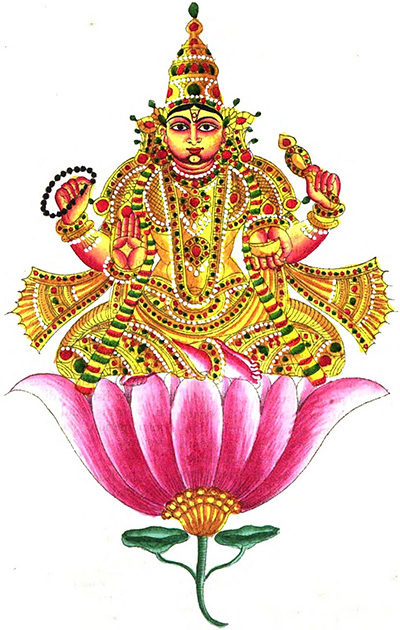
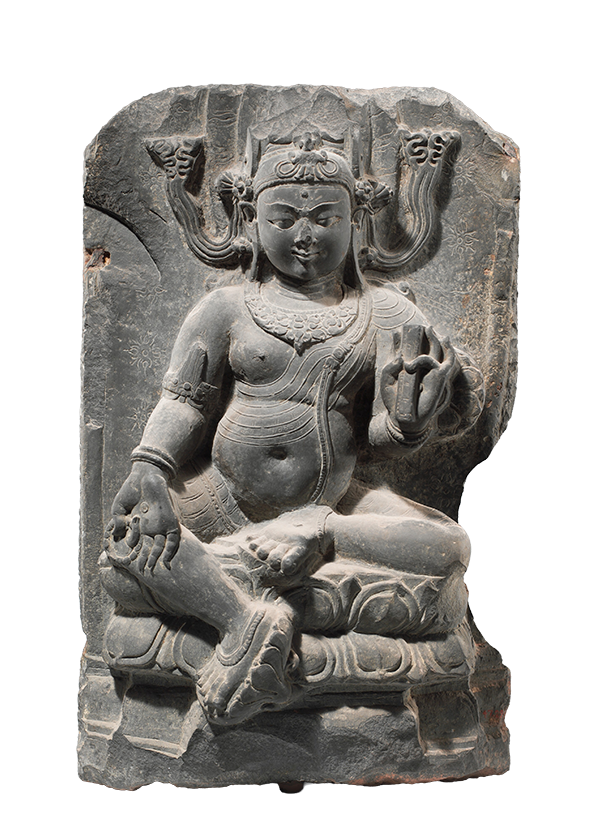
Brihaspati is often represented with a body of luminescent gold, wielding a staff, rosary and water pot in his hands, the visual marks of the prototypal Brahmanic priest. His head can be covered with a halo of stars. Quite often he is depicted with a white elephant as his divine steed in modern depictions, befitting of the guru status he has and symbolic of Indian kingship too. He is also represented with the lotus.26,27
In medieval temple depictions, he appears with the other planetary Grahas in a sequence, often as the fifth. Again, he is represented as being like the archetypal priest, sometimes clutching a manuscript.27
The making of his image was governed, like that of all the planetary gods, by the śilpa texts and the astral manuals. The Bṛhat Saṃhita of Varahamihira, compiled around 500 CE, treats the fashioning of divine images and the marks proper to each figure, fixing their proportions and enjoining that the graha deities be shown as dignified men, clothed and adorned, bearing the water pot and the rosary; it is to this iconometric tradition that the later planetary canon looks back.28
The Vishnudharmottara Puranaa, in the image-making chapters of its third book, likewise assigns Bṛhaspati the emblems of the Brahman priest, the akshamala and the kammanda, and has him among the grahas in the lotus posture with a hand raised in the boon-giving mudra.29
The iconography of Jupiter was consistently depicted as being in some way "golden" across the iconographic prescriptions in both the Puranic texts (such as the Matsya Purana) and the Shritattvanidhi. Jupiter's depiction is also consistent with regard to his possession of the rosary, the staff, and the water vessel, and thus the various depictions were all ultimately based on an image of a single deity. Further still, he is always shown with a halo surrounding his head; it is always the four-handed form of the deity who is depicted like this.30, 31, 26
VIII. The Battle of the Gurus
Of all the mythological episodes involving Brihaspati, his endless cosmological fight with the force of Shukra (Venus) leading the Asuras is the most evocative. Shukra knows one major detail of how to revive the dead, something that Brihaspati does not know and sends his son, Kacha, to learn.23
Kacha serves Shukra as a disciple for a thousand years; the Asuras kill him repeatedly. The final time they burn him, mix his ashes into wine, and make Śukra drink him. Brihaspati's side prevails in the end by not issuing endless bloodshed like the Asuras, but by inquiring through pain to receive knowledge.23
In the sky, the same rivalry endured, for Bṛhaspati and Shukra are Jupiter and Venus, the two preceptors, the guru of the gods and the guru of the asuras, set forever on opposite sides of the heavens in Indian thought.25
Sources and Bibliography
- Ṛgveda. “Rig Veda. Mandala 2. Sukta 23.” Digital text with Devanagari and transliteration. Sri Aurobindo site. For the parsing of brahmaṇaspati in the padapatha and the division of the hymn between Brahmaṇaspati and Bṛhaspati.
- Thomas, Edward J. Vedic Hymns: Translated from the Rigveda with Introduction and Notes. London: John Murray, 1923. For the note identifying Bṛhaspati/Brahmaṇaspati as “lord of prayer or spell.”
- Yāska. The Nighaṇṭu and the Nirukta. Translated by Lakshman Sarup. Delhi: Motilal Banarsidass, 1967. For the derivations of Bṛhaspati and Brahmaṇaspati and the granting of speech to Devāpi.
- Monier-Williams, Monier. A Sanskrit-English Dictionary. Oxford: Clarendon Press, 1899. Entries cited: bṛh, bṛhaspati, brahmaṇaspati, vācaspati, and guru; and the paraphrase bṛhataḥ vācaḥ patiḥ.
- Keith, Arthur Berriedale, trans. Rigveda Brahmanas: The Aitareya and Kauṣītaki Brāhmaṇas of the Rigveda. Harvard Oriental Series 25. Cambridge, MA: Harvard University Press, 1920. For Sāyaṇa's reading of Bṛhaspati as the priestly principle among the gods.
- Macdonell, Arthur Anthony. Vedic Mythology. Grundriss der Indo-Arischen Philologie und Altertumskunde 3.1.A. Strassburg: Karl J. Trübner, 1897. For Bṛhaspati/Brahmaṇaspati, the Vala myth, the divine purohita, and the god's frequency in the hymns.
- Griffith, Ralph T. H., trans. The Hymns of the Rigveda. 2nd ed. Benares: E. J. Lazarus, 1896. For the Bṛhaspati hymns, especially 2.23, 4.50, and 7.97, and his role as father of prayer, breaker of the rock, and household intercessor.
- Ṛgveda. “Rig Veda. Mandala 4. Sukta 50.” Digital text with Devanagari and transliteration. Sri Aurobindo site. For the Vala myth and the release of the cattle.
- Ṛgveda. “Rigveda, Shakala Samhita, Mandala 07 Sukta 097.” Vedic Heritage Portal. For Bṛhaspati beside Indra and his household aspect.
- Ṛgveda. “Rig Veda. Mandala 10. Sukta 71.” Digital text with Devanagari and transliteration. Sri Aurobindo site. For the origin of speech and the naming of things.
- Griffith, Ralph T. H., trans. The Hymns of the Sāmaveda. Benares: E. J. Lazarus, 1893. For the invocation on behalf of Kakṣīvant Aushija and the welfare-formula for Bṛhaspati.
- Griffith, Ralph T. H., trans. The Texts of the White Yajurveda; or, Vājasaneyi Saṃhitā. Benares: E. J. Lazarus, 1899. For Bṛhaspati as the Brahman priest of the sacrifice and the restoration of the rite uninjured.
- Keith, Arthur Berriedale, trans. The Veda of the Black Yajus School Entitled Taittiriya Sanhita. 2 vols. Harvard Oriental Series 18–19. Cambridge, MA: Harvard University Press, 1914. For the priestly distribution among the gods and the regency of Tiṣya.
- Whitney, William Dwight, trans. Atharva-Veda Saṃhitā. Revised and edited by Charles Rockwell Lanman. 2 vols. Harvard Oriental Series 7–8. Cambridge, MA: Harvard University, 1905. For Atharvaveda 7.53 and the marriage and sovereignty charms invoking Bṛhaspati.
- Ṛgveda. “Ṛgveda.” Based on Theodor Aufrecht, ed., Die Hymnen des Rig Veda, 2nd ed. (Bonn: Adolph Marcus, 1877), digitized by Barend A. van Nooten and Gary B. Holland and revised by Detlef Eichler. GRETIL digital text. For the base Sanskrit text of the epithet verses.
- Amarasiṃha. Nāmaliṅgānuśāsana [Amarakośa]. 1.3.223–224. GRETIL digital text. For the lexical synonyms of Bṛhaspati.
- Apte, Vaman Shivaram. The Practical Sanskrit-English Dictionary. Digital South Asia Library. S.v. “वाचस्पति.” For Vācaspati and related titles.
- Campantar. Tēvāram (First Tirumurai). In Tēvāram: Hymnes śivaïtes du pays tamoul, edited by T. V. Gopal Iyer and François Gros. Pondichéry: Institut Français de Pondichéry, 1984–1991. For the seventh-century hymns on the Shiva shrine at Tiru Irum Poolai (Alangudi) and its status as a Paadal Petra Sthalam.
- Government of Tamil Nadu, Hindu Religious and Charitable Endowments Department. “Arulmigu Apatsahayeswarar Temple (Guru Sthalam), Alangudi.” Official temple record. For the Guru Sthalam, the Navagraha pilgrimage, the guru peyarchi observance, and the Chola and Nayak history of the temple.
- Ṛktantra: A Prātiśākhya of the Sāmaveda. Edited by Surya Kanta. Lahore: Mehar Chand Lachhman Das, 1933. Section cited: 1.4, the descent of knowledge from Brahmā through Bṛhaspati to Indra and the sages.
- Patañjali. The Vyākaraṇa-Mahābhāṣya of Patañjali. Edited by F. Kielhorn. 3 vols. Bombay: Government Central Book Depot, 1880–1885. Section cited: the Paspaśāhnika, on Bṛhaspati's instruction of Indra in the recitation of words.
- The Śrīmad Devī Bhāgavatam. Translated by Swami Vijñānānanda. Allahabad: Sudhindra Nath Vasu, 1921–1923. For Indra's inquiry into the science of words and the meditation on Sarasvatī.
- Vyāsa. The Mahabharata. Translated by Kisari Mohan Ganguli. Calcutta: Bharata Press, 1883–1896. Sections cited: the Ādi Parva account of Kacha, Devayānī, and the Sañjīvanī, and Anuśāsana Parva 76 and 111–113 on charity and the fate of the soul.
- The Bhāgavata Purāṇa. Translated by Ganesh Vasudeo Tagare. Ancient Indian Tradition and Mythology. Delhi: Motilal Banarsidass, 1976–1978. Section cited: Book 8, Bṛhaspati's counsel to Indra during the rise of Bali.
- Pingree, David. Jyotiḥśāstra: Astral and Mathematical Literature. A History of Indian Literature VI.4. Wiesbaden: Otto Harrassowitz, 1981. For the identification of Bṛhaspati with the planet Jupiter, the early astral texts, and the planetary week.
- Coulter, Charles Russell, and Patricia Turner. Encyclopedia of Ancient Deities. Jefferson, NC: McFarland, 2000. Entry cited: Bṛhaspati, on the golden body, the halo, and the emblems held by the god.
- Rao, T. A. Gopinatha. Elements of Hindu Iconography. 2 vols. Madras: Law Printing House, 1914–1916. For the Navagrahas, the sequence of the nine, and the iconography of Bṛhaspati as priest with manuscript.
- Varāhamihira. Bṛhat Saṃhitā. Translated by M. Ramakrishna Bhat. Delhi: Motilal Banarsidass, 1981. For the image-making prescriptions and proportions of the planetary deities.
- Viṣṇudharmottara Purāṇa. Part III. Translated by Priyabala Shah. Baroda: Oriental Institute, 1958. For the image of Bṛhaspati among the grahas, his priestly emblems, and posture.
- Kṛṣṇarāja Woḍeyar III. Śrītattvanidhi. Vol. 3. Mysore: Oriental Research Institute, University of Mysore, 2004. For the Navagraha imagery and the four-armed golden figure of Guru/Bṛhaspati.
- Matsya Purāṇa. Translated by A Taluqdar of Oudh. Sacred Books of the Hindus 17. Allahabad: Pāṇini Office, 1916–1917. For the chariot of Bṛhaspati drawn by pale horses.