Eros
author: High Priest Zevios Metathronos
co-authors: Karnonnos, Arcadia
The knowledge presented contains information for those who want clarification on the God of Love known as Eros.
Hieratic Information about Eros
| Names |
|---|
| 650BCE | Eros |
|---|
| Divine Names |
|---|
|
The Eros Ritual above involves communion with the mysterious god of love and union of the mind.
EROS
Eros is the boy-like God of Love in Greek conception whose use of the arrow endowed any individual with love. The god Eros is known as Zepar in the
Goetia; another aspect of his is Zephyrus, the God of the western wind, who in the mythology is represented as the father of Eros with Iris.12
As is commonly known, Eros represented the erotic principle. He is often represented as a boy with wings who smites people into being love-afflicted
with his arrows. Antiquity, of course, occasionally represented this lustful aspect in poems, literature and mythology, mostly in the Roman form of
Cupid, since textual references to Eros usually have a mystical quality. The other genealogy of Eros makes him the son of Ares and
Aphrodite.3 Yet Plutarch pointed out that Eros is not really about lust, but the principle that achieves spiritual and physical union through
sexuality as a function:
The Dialogue on Love, Plutarch2
ἀλλ᾿ ὅμως τὸ μέγα τοῦτο καὶ θαυμαστὸν Ἀφροδίτης μὲν ἔργον Ἔρωτος δὲ πάρεργόν ἐστιν Ἀφροδίτῃ συμπαρόντος· μὴ συμπαρόντος δὲ κομιδῇ τὸ γινόμενον ἄζηλον
ἀπολείπεται καὶ ἄτιμον κἄφιλον. ἀνέραστος γὰρ ὁμιλία καθάπερ πεῖνα καὶ δίψα πλησμονὴν ἔχουσα πέρας εἰς οὐδὲν ἐξικνεῖται καλόν· ἀλλ᾿ ἡ θεὸς Ἔρωτι τὸν
κόρον ἀφαιροῦσα τῆς ἡδονῆς φιλότητα ποιεῖ καὶ σύγκρασιν
And yet this great and wondrous thing is, to be sure, the work of Aphrodite and only a by-work of Eros, when Aphrodite is accomplied by him. If he is
not present, what comes about leaves altogether a murky residue, without honor, and without affection.
For intercourse without Eros, like hunger and thirst whose end is mere satiety, reaches nothing noble. But the Goddess, by removing the surfeit from
pleasure through Eros, turns it into affection and a true mingling (union).
This principle is affirmed several times in this writing, which is decorated with other specific examples. He was considered to be the child or page of
Aphrodite who enforced all her decrees, but he frequently came up with his own schemes. A witty story4 involves Eros complaining to his
mother that he was stung by a hive of bees when trying to wrest honey from them, protesting that such small animals can cause such pain. Aphrodite
replies that Eros does not know how similar he is to them, since love is eminently cruel. The effects of his arrows were not always immediate and could
be after the fact, as long as the wound was open or poisoned. In the Metamorphoses, Eros is the primary agent of Aphrodite's tragedy5; he
kisses his mother sweetly while one of his bows juts downwards, piercing her breast and causing her to fall in love with Adonis. In the Dionsyiaca,6
Eros caused Dionysus to fall deeply in love with Aura, sending him on a rampage across the earth. He was also the ultimate cause of one of the darkest
Greek tragedies, the love of the Colchian princess and sorceress Medea for the argonaut Jason.7
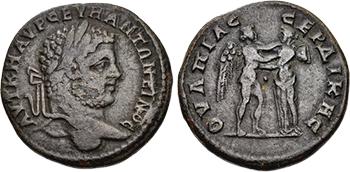
Eros and Psyche coin, minted during Caracalla's reign
The major myth is that of Eros (Cupid) and Psyche from the Metamorphoses of Apuleius8, where Aphrodite, who was jealous of the mortal
princess Psyche's beauty, bids her to make Eros give her passion for the ugliest man in the world. Eros, tipping his arrow into the pool of
bitterness, carries out the job while Psyche sleeps, but when she awakens, the girl startles him, prompting him to injure himself with his own
love arrow. As the princess was no longer wanted, her parents desperately consulted the Oracle of Apollo:
Metamorphoses, Apuleius: 8
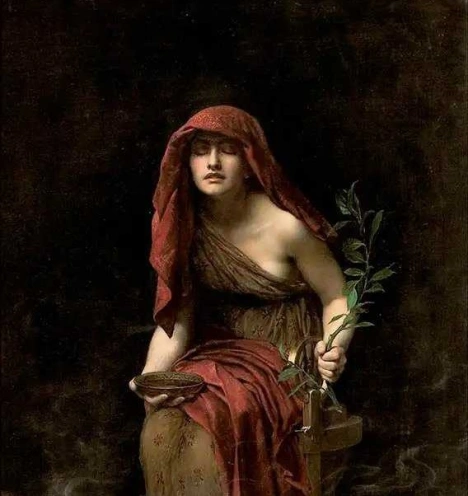
Her parents, afraid that they had unwittingly incurred the anger of the Gods, consulted the oracle of Apollo, and received this answer, "The
virgin is destined for the bride of no mortal lover. Her future husband awaits her on the top of the mountain. He is a monster whom neither Gods
nor men can resist."
Psyche throws herself off a mountain, after which the gentle wind deity Zephyrus catches her and brings her to a glittering palace. She is
courted by an invisible presence at night whom she becomes infatuated with, while the invisible servants give her almost everything her heart
desires. Separated from her parents and siblings, the princess grows depressed. She begs her husband (Eros) to bring her siblings to her, and
he, knowing the future at hand, accedes to her request. The jealous siblings who desire Eros for themselves tell her he is a devastating serpent
and evil monster troubling the people of the valley who will consume her at night. They tell her to shine a lamp on him while he sleeps and to
arm herself with a knife; when Psyche does this, Eros, a beautiful youth, flees in dejection, and when the sisters of Psyche attempt to court
Eros, Zephyrus does not catch them and they are dashed to pieces onto the rocks below.
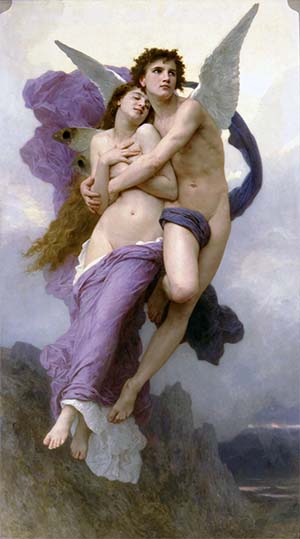
The Abduction of Psyche, William-Adolphe Bouguereau
The absence of Eros devastates Psyche, making her look from place to place wandering the entire planet dejectedly, before coming to the Temple of
Demeter, who tells her she must be brave and pass the trials of Aphrodite. Aphrodite, still in contempt of the girl's beauty and further angered by
nursing the heartbreak of her son, imposes four strict and borderline impossible-by-design tasks on her, which the young girl is able to complete, save
the last. On this occasion, the great goddess tasks her with retrieving a box of Persephone's beauty. The underworld deity provides her with the object;
Psyche, loudly exclaiming she will do anything to win Eros' love, looks into the box Persephone gives her, putting her into an eternal sleep. The boy
god, finally realizing her love for him in his descent, revives her by closing the box, and tells her to complete the infernal task. She does so and
achieves apotheosis, becoming a goddess on the whim of Zeus who wins the consent of Aphrodite, and so Psyche is united with Eros forever. In alternative
primordial myths dating from Greek antiquity, Eros was held to have been created as a basic principle of existence after several others:
The Birds, Aristophanes: 9
At the beginning there was only Chaos, Night, dark Erebus, and deep Tartarus. Earth, the air and heaven had no existence. Firstly, blackwinged Night
laid a germless egg in the bosom of the infinite deeps of Erebus, and from this, after the revolution of long ages, sprang the graceful Eros with
his glittering golden wings, swift as the whirlwinds of the tempest. He mated in deep Tartarus with dark Chaos, winged like himself, and thus
hatched forth our race, which was the first to see the light.
And so, a prominent running joke in Antiquity was that Eros was in fact one of the oldest and most terrifying of the Gods, or in Plutarch's words, 'the
most grim' (δεινότατον θέων), despite his sweet, boyish appearance:
Dialogues of the Gods, Lucian: 10
Eros:
Even if I have done something wrong, Zeus, please forgive me, for I'm only a child, and still without sense.
Zeus:
You a child, you Eros, who are far older than Iapetus! Just because you have no beard or grey hairs, do you really think you should be considered a
babe in arms, you old villain?
His powers were so total that even the Gods could fall victim to his cunning juvenile wiles, and even the frozen heart of Hades was made to melt by his
arrows. The limitations of Eros only extended to the virgin goddesses - Athena, Hestia, and Artemis - who could repel his powers as oath-sworn.
Phaedra, Seneca the Younger: 11
He [Eros] smites maids' breasts with unknown heat, and bids the very Gods leave heaven and dwell on earth in borrowed forms.
The Dialogue on Love, Plutarch: 2
For in sowing a sweet harvest in the desire of a man's heart, as Melanippides puts it, he (sc. Eros) mingles what is most pleasant with what is
finest.
In Thespiae, the city state hosted the festivities of Eros known as the Eroditia, which is known from Athenaeus' plays and Pausanias' travels through
Greece.1314 The Eroditia featured musical and gymnastic contests, the reconciliation of married couples in an auspicious manner,
worship of Eros in the sacred gymnasium, horse and chariot races, and more. The gymnastic portion even had the Greek martial arts of pankratium
featured. The festival's roots are often linked to the myth of Narcissus who was punished by Eros for spurning someone with cruelty,15 and
whose death led the people of Thespiae to establish the worship of Eros as a form of atonement. The Eroditia was held every five years and it was
treated with great ceremony across Greece, being famous as a particularly jovial day. It was typical for Spartans to sacrifice to Eros before battle in
order to affirm their comradeshi, and similar stories are told about the warriors of Crete.14 Charmus of Kolyttus also erected an altar to
Eros in Athens, which became one of the major sites of his worship.1314
Most objects involving Eros found from the ancient world are intaglios (gems), rings and other kinds of worn materials.16 Naturally, he was
very much associated with love magic and charms of genuine affection. Occasionally, he was shown on flasks, such as a Hellenistic Egyptian
representation of Eros with a lotus flower.17 Researchers, writing on magical gems, noted a whole group of stones where Eros or Psyche are
tied, kneeling, or otherwise bound, and explicitly connects them to love-binding magic (καταδέσεις) known from the Greek Magical
Papyri.1819 An extremly common convention is objects, floor coverings and even statues of a large frequency showing Eros riding a
lion wielding a whip, but sometimes a dolphin, a deer, Aegipan or other animals, often amidst a starry sky.2021
SYMBOLISM OF EROS
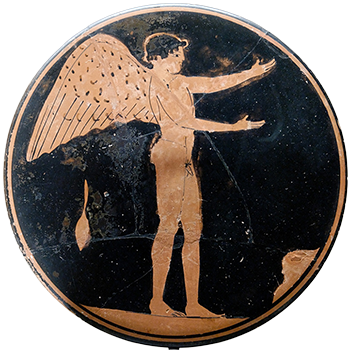
Eros, Attic red-figure bobbin, ca. 470 BC–450 BC, Louvre
Eros was typically in large scale represented as a pubescent young boy with wings, often with arms outstretched, unlike Cupid, his Roman counterpart, who
was more often represented as a putto amorino in toddler-like form. The pubescent appearance of this God is meant to signify the erotic drive
beginning to merge with the mental faculty in the soul (Psyche), and the rapid changes in the body at this age occurring as a result of transition from
the child to adult state. It is also the age when magic becomes operable, and when an individual truly starts to be able to interpret glimpses of divine
things and to love others outside one's family. Stylistic representations of Eros in statues tend to portray his facial features inbetween those of Ares
and Aphrodite, with a certain solemnity. Occasionally, more like Cupid, he is represented as an infant, or being tended to by Aphrodite, particularly on
coins, amulets and statuettes. The symbolism of Eros as appearing to be an innocent child is a hint to the innocent result of reproduction.
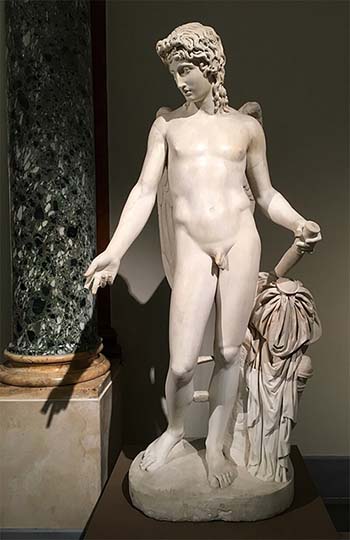
Eros farnese, Roman copy of a work thought to be the Thespian Eros by Praxiteles
He always carried a bow and two sets of arrows,5 one set of which made from gold which could fill the target with feelings of maniacal love,
and the other, far more sparingly used set made of lead that would be used to inspire rancorous hatred. Euripides, alternatively, portrays the arrows as
causing endless happiness or perpetual ruin for the person so struck.22 Thus, it could be said that Eros was not only a God of Love, but a
God of Hate as well. The bow and arrows of course represent the incumbent ability to operate magic, yet they represent many things in turn. An
unadroitly and unaptly fired bow will just land anywhere, possibly leading to disaster, including mentally-speaking. The shape of the bow is reminiscent
of the shape of the lungs and larynx too, and the bow can take on a heart shape as well. The word Eros means 'desire', which could be equated with any
sort of desire, not only of a romantic, carnal or erotic nuance. Metaphysically, Eros was considered to be between the states of Ponos (plentitude) and
Penia (poverty)23 because of this symbolism of desire as a potential act lying between the acquired and the needed, as a result these
two beings were also sometimes considered to be his parents. As a Daemon, Eros is considered to help humanity towards the divine.
All desire in nature is a manifestation of Eros, including evolution and the biological drives that cause animals to propagate, yet it also had the
meaning of creation in the sense that it is love that compels us to create anything meaningful, lasting and ultimately desirable.
On Eros, High Priest Zevios Metathronos24
In Ancient Greek, the "eros" means love, but it also means "when the minds come in contact". [...] All of this, came from the mistranslation of two
words, one being "Eromenos", which means "The one who goes toward" and "Erastes" which means "The one on whom another is moving toward". From the
root word "Er", we also have the word for "Ermes" that deals with the mind and the connection of the mind.
The word for 'discourse' or 'dialogue' (Erotos) also related to him, because the erotic principle strongly related to communication, conveying a union of
minds rather than beings set against each other. Extending this to the mental faculty, he could be symbolic of the desire to know and the emphasis of
knowledge which is a nuance of the word 'eros' that is totally lost on modern people. One of the forgotten meanings of the term erotic was to
demonstrate the urge towards growth of the mind in order to achieve higher union with the soul. >This is the meaning of the Symposium23 and
Phaedrus of Plato, which established the concept of Eros (Ἔρως) as far more than mere romantic desire. He is portrayed as a cosmologically significant
force that mediates between the human and divine realms, his teleological function being to drive all souls toward immortality and the vision of true
Beauty. Souls gain or lose their wings depending on their exposure to divine beauty and truth:
Phaedrus, Plato25
… by these [divine realities] the wings of the soul are nourished and grow, but by vileness and evil they are destroyed.
The hidden message of Eros is also a contemplative one, to desire ultimate beauty in order to reacquaint oneself with the ideal divine source. However,
because the arrows of Eros can hit anyone, the deception of any physically beautiful appearance often goes awry and leads to unexpected
consequences.
Part 5, Third Ennead, Plotinus26
The universe is a living Eros.
For Platonists, Eros is also held to be the heartbeat of the universe as this binding mechanism, and much of the romantic symbolism of the heart is
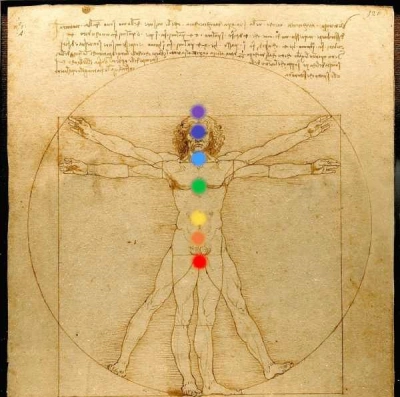
related to this. Being where others are tied, the Middle Chakra relates to beings outside oneself. It is through the access of the 'heart of the head'
(ida and pingala), as well as the activation of three Highest Chakras, where true love and compassion overflows; one achieves inner union by uniting the
higher and lower realms. Eros is elevated to a cosmic principle that holds the entire universe together, as elaborated by Emperor Julian.27
Proclus28 held that love is binder of the universe that creates increasing harmony and unity. As one scholar summarizes his view, "love is a
power of reality that is not restricted to particular occurrences but transcends them all." It is through this force that one is able to access the Gods
from the remote material realm and, in Plotinus' account, is the primary reason the soul wishes to incarnate away from matter, which makes it a precious
symbol.
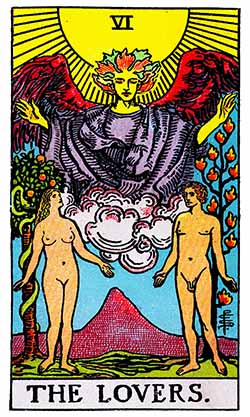
The Major Arcana card of Eros is, perhaps unsurprisingly, the Lovers. In the most typical type of reading, the Lovers typically represents a great
relationship forming, the blossoming of one's sexual life or the incoming of a soulmate. Sometimes, it has the platonic dimension of finding a good
friend. On a more subtle and pressing level its presence indicates to the querent that two people learning something together or forming any kind of
partnership in certain situations can be better than one, as it is known from studies that two people who put their minds towards something can often
learn twice as fast as one alone. However, in line with Eros, the card of the two lovers can indicate the more abstract achievement of inner union being
in sight and the pursuit of this involving difficulties. The heavenly messenger being placed between the earth and the divine sun is an indication of
the daemonic nature of Eros.
Bibliography:
1Fragment 327, Alcaeus
2The Dialogue on Love, Plutarch
3Fragment 575, Simonides of Ceos
4Idyll XIX, Theocritus
5Metamorphoses, Ovid
6Dionysiaca, Nonnus
7Argonautica, Apollonius of Rhodes
8Metamorphoses, Apuleius
9The Birds, Aristophanes
10Dialogues of the Gods, Lucian
11Phaedra, Seneca the Younger
12Fragment 23, presumed to be by either Sappho or Alcaeus
13Description of Greece, Pausanias
14Deipnosophistae, Athenaeus
15Narratives, Conon
16Ancient Greek Love Magic, Christopher Faraone
17Gandharan Artists and Artesans, Representations of an Era of Religious Images, Archaelogia Afghana, eds Alexandra Vanleene, Arnaud
Marguier, Vydhegi Brice
18Relations Between Magical Texts and Magical Gems Recent Perspectives, Paolo Vitellozzi
19(Re)Interpreting Magical Gems, Ancient and Modern, Officina Magica, IJS Studies in Judaica, Volume: 4, Simone Michel
20Striding lion with Eros child (one of a pair), National Museum of Asian
Art, Smithsonian
21Ancient Magic Gem Engraved with Eros and „Voces Magicae“, The
Archaeology of Ancient Magic: Academic Research for a Broad Audience
22Iphigenia at Aulis, Euripides
23Symposium, Plato
24On Eros, High Priest Zevios Metathronos
25Phaedrus, Plato
26Enneads, Plotinus
27Hymn to King Helios, Emperor
Julian
28Commentary on the First Alcibiades, Proclus