



| Language or Culture | Name | Attestation |
|---|---|---|
| Etruscan | Hercle | A contraction of Greek Herakles by loss of the interior vowels |
| Phoenician (at Pyrgi) | Melqart, the Tyrian god the Greeks equated with Herakles | Etruscan port of Pyrgi |
13 min read
HERCLE
author: High Priest Zevios Metathronos
co-author: Novice Priest Karnonnos
Hieratic Information about Hercle
| Divine Symbols | |
|---|---|
|
I. The Name
The Etruscan version of Heracles has the most distinct identity of all the Greek figures taken into the Etruscan pantheon; as a hero, Hercle was introduced to the Rasenna as the greatest of the Greek heroes. The Etruscans elevated this status to that of a god with divine powers and numbered the hero among the gods that were part of the cosmological system in a way that the Etruscans would allow few other borrowed deities to do.1,2
The name is written hercle, and in a scatter of variants across the inscriptions: hercl, herecele, hercele, herkle, and the syncopated hrcle. All render the Greek Herakles, contracted in the Etruscan mouth by the loss of the middle vowels.1 The path of the name matters for more than philology, because it was through Etruscan that Herakles became the Latin Hercules: the Roman name is a borrowing from the Etruscan form, not an independent taking from the Greek, so that the god the Romans swore by at every street corner carried an Etruscan contraction in his very name.1
The Greek name means "the glory of Hera," and it is one of the aspects of Etruscan religion that they made their own counterpart, Uni, grant him apotheosis in a very explicit manner. Indeed, his worship is old. The name and image appear in Etruria from the late sixth century BCE and grow only more common, and the god is one of the most frequently represented figures in the whole of Etruscan art, especially on the engraved bronze mirrors where so much of the lost mythology survived.3
Sources: the Bonfantes for the name, its variants, the syncope, and the transmission of Hercules into Latin through Etruscan; Krauskopf for the god's standing among the powers of the pantheon; de Grummond for his prominence in art and the match of name and myth.1,2,3
II. His Place in the Divine Family
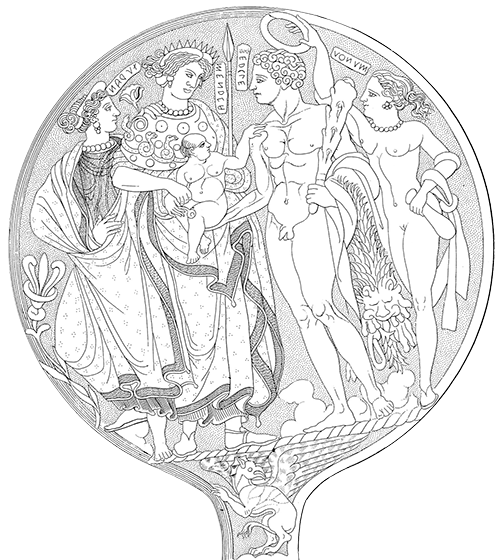
Hercle keeps the Greek parentage of Herakles and is given an Etruscan family besides. He is the son of the sky-god Tinia, who is Zeus, by a mortal woman, the Alcmene of the Greek story; and so he enters the world, as in Greece, half divine and half human, the god's son who must earn the rest of his divinity.2,3
What Etruria adds is a second mother and a family of his own among the gods. The goddess Uni, the Etruscan Hera and Juno, becomes his adoptive mother, the reverse of the enemy she is to Herakles in Greece, and takes him into the divine household; the story of how she does it is the great Etruscan contribution to his legend, told in the next section.3 In many mirror scenes his consort is Menrva, the Etruscan Minerva, a pairing with no basis in the Greek myths, where Athena is Herakles's helper and patron but never his wife; the Etruscans drew the two protector-figures together into a couple.3 And the pair appear as the foster-parents of a strange winged child named Epiur, whom Hercle presents to the assembled gods on several mirrors, a figure who has no Greek counterpart at all and whose meaning is still argued.3
This is the first sign of how far the Etruscans took him. They did not merely borrow Herakles and his labors; they naturalized him, gave him a wife, a foster-son, and an adoptive mother, and wove him into the domestic life of their gods until he belonged there as fully as any power born divine.3
III. The Nursing of Hercle and the Winning of Godhood
The single most important thing the Etruscans made of Herakles is a myth of his divinization, and it survives on one of the most famous of all Etruscan mirrors.
The Mirror from Volterra
On a bronze mirror from Volterra, of the late fourth century BCE and now in Florence, a grown and bearded Hercle kneels or leans to the breast of the enthroned goddess Uni and drinks her milk, while other gods stand witness and Tinia points to an inscribed tablet that explains the scene. Its inscription says eca sren tva iχnac hercle unial clan θrasce, which scholars translate as meaning to says "This is how Hercle became the son of Uni".3,4
An Etruscan Myth
The scene has both a Greek root and an Etruscan branch. While the Greeks said Hera nursed the young Heracles at Zeus' behest (or as told by Hermes) so that he would receive divine milk and thus achieve immortality, the spilling of the milk creating the Milky Way, the Greeks told the story in such a way that Hera was deceived and once she discovered what she was nursing, she threw the infant away. The Etruscans retained the core of the idea, namely the divine milk which grants godhood and transformed every other part of the story. In the Etruscan version Uni offers her breast willingly while Hercle has arrived to her as an adult; and the act of nursing takes on all the characteristics of a formal adoption, witnessed by the entire court of heaven. Scholars have concluded that this scene is an original Etruscan creation, with no known Greek prototype.3,4
The problem with this context, however, is that many regional variations of Greek art influenced the Etruscans, making us unable to know whether this is a variation of a myth from Greece, an Etruscan innovation, or even one from the Phoenicians that the Etruscans held court with.
The Hero Who Became a God
Apotheosis was a theme of Hercle that the Etruscans seemed to hold dearest. The image of the scene goes beyond the individual mirror. For the Etruscans, Hercle was the blatantly prototype of a person raised from a mortal to a god, the person who through his actions, and through the grace of the gods, moved from being human to being divine. Therefore he was the exclusive god of the Etruscan aristocrats; the latter read in his ascension an expectation for themselves: the noble deceased, who had sought out and succeeded in the endeavors of this world could expect, as did Hercle, to become part of the eternal.
The final images on the mirrors, which show a flying figure of victory called Mean (or) Munthuch placing a crown upon Hercle's head, have the same implication, the hero is acclaimed at the time when he is entering into godhood. While the Greek Heracles achieved a position on Olympus as a prize at the end of a hero's path, the Etruscan Hercle seems to have been signmarked as the process holder more blatantly, that is, from striving as mortals to living eternally as gods.3
IV. His Attributes and Titles
Hercle carries the recognizable equipment of Herakles and takes on, in Etruria, a range of divine functions wider than the Greek hero's ones that seemed to influence the way in which Roman Hercules could be portrayed later. For example, Hercle seems to have been the patron of the aristocracy given certain symbolism in Ertrucan art..6,7
V. The Adventures on the Mirror-Back
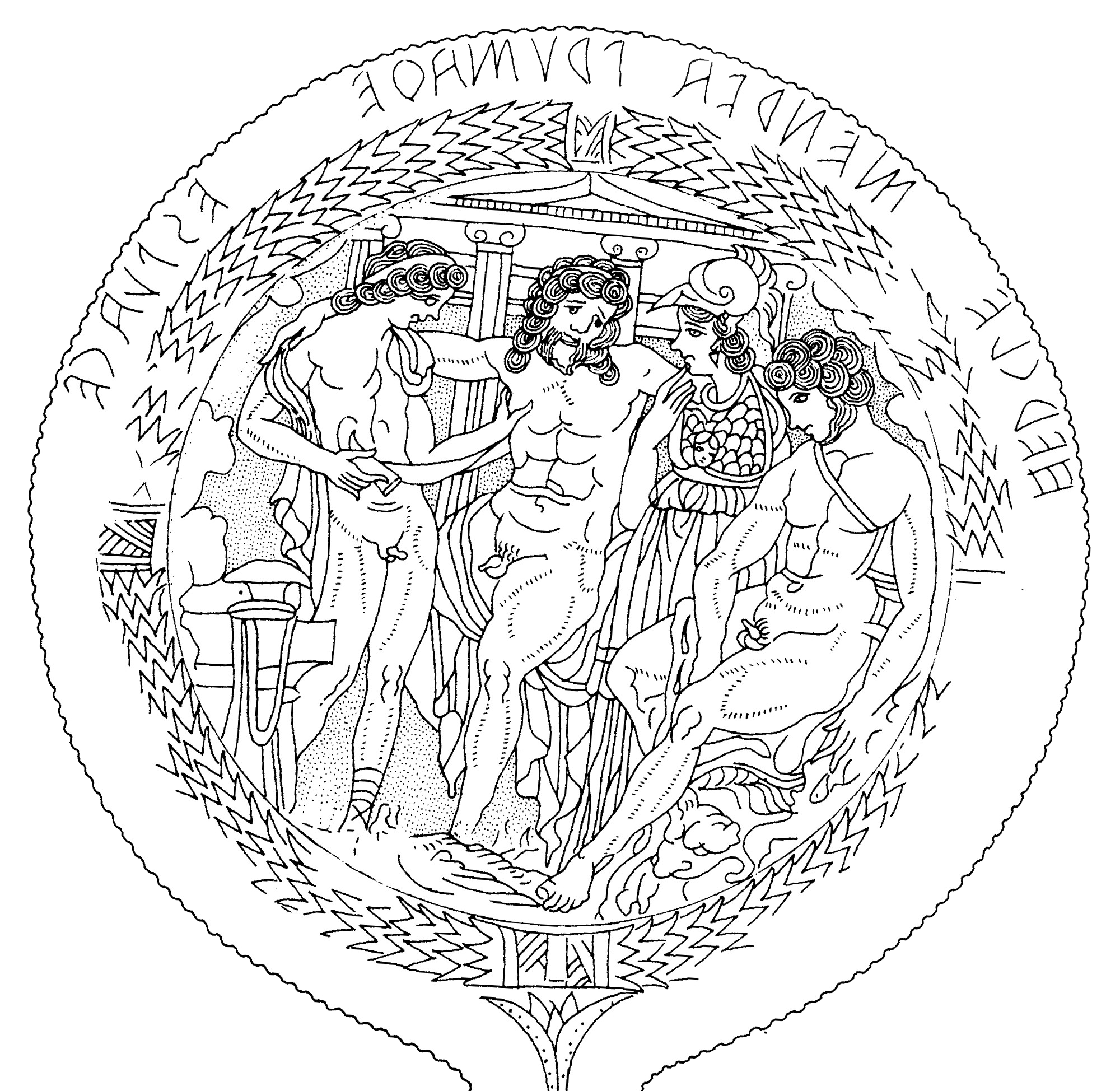
The Etruscan versions of these stories, however, were not preserved in writing like those of ancient Greeks. Therefore, the myths of Hercle must be interpreted using imagery (the majority being the images etched on the back of bronze mirrors), particularly those images dividing into two categories; the "labors" and the "adventures." 8,9
The Labors and the Combats
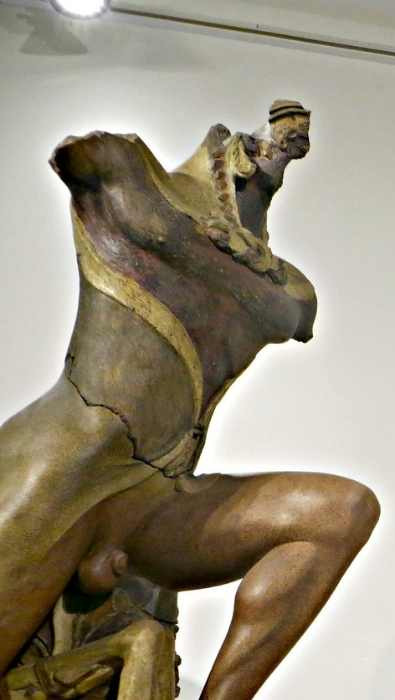
The Greek labors are present and popular. Hercle wrestles the Nemean lion, fights the many monsters, and struggles with Apulu over the Ceryneian hind, the scene the Veii roof-group enacts. He is above all a fighter, and the Etruscans loved him as the strong protector who stands between the ordered world and the monstrous. His combats decorate mirrors, gems, and the roofs and pediments of prospective sanctuaries.3,9
The Seizing of Mlacuch
The second category includes adventures that are entirely unique to Etruscan mythology and are therefore absent in any Greek sources. One adventure, the seizing of Mlacuch, the abduction of a woman that has no extant parallel in Greek myth, is mysterious.9,10
The Presentation of Epiur
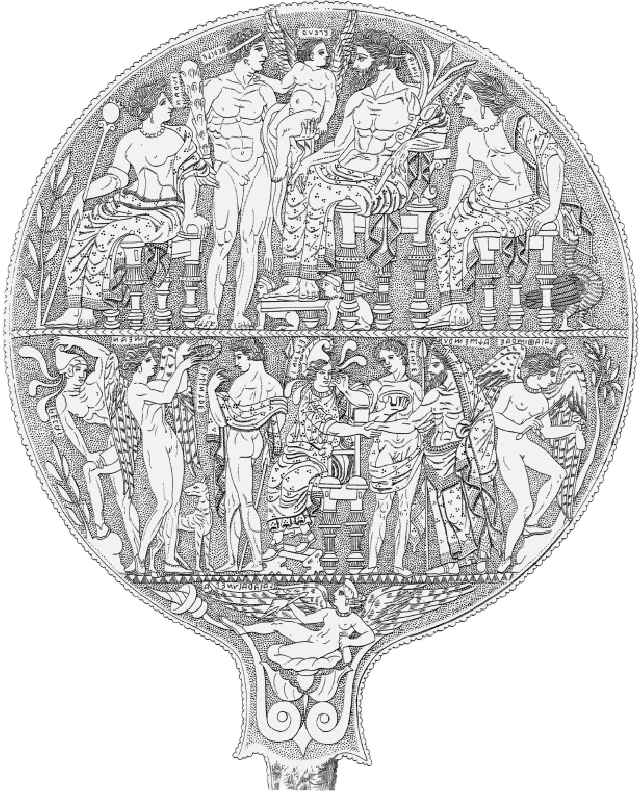
The most confusing depiction of Hercle as a member of a uniquely Etruscan mythology is that of the presentation of the child Epiur. The presentation of Epiur is illustrated on a large two-register mirror from Vulci and other similar mirrors. In each illustration Hercle is depicted holding a small, winged male child. Each child has the visage of a mature adult male. Hercle is presenting this child to an assembly of deities. On one mirror the deity is presented as Tinia; on another as Menrva while figures representing Victory are crowning both Hercle and the gods in attendance.
Epiur is inscribed above the child but his identity remains unclear. Scholars have debated the possible meanings of Epiur, including interpreting him as a god of the future, an embodiment of prophecy or the destiny that the gods decide upon for humanity; the man-faced infant represents the future. Whatever the case may be, it is evident that Hercle has been granted entry into the councils of the gods and is being given a divine child and thus stands among the powerful forces as one of them.3
The Seer Cacu
Hercle belongs also to the Etruscan world of prophecy through the scenes of the young seer Cacu, who sang to the lyre while the brothers Caile and Avle Vipinas creep up to seize him.
Cacu is represented as a figure who possesses knowledge regarding the prophetic arts in these illustrations. Later, when Roman mythology developed around the same legend, Cacu probably evolved into Cacus, a monster killed by Hercules at the eventual site of Rome.3,6,0
VI. His Cult, His Sanctuaries, and the God on the Liver
Hercle was not only a figure of story. He was a god who received cult, and the evidence for his worship, long thinner than the flood of images, has grown with excavation.
The Sanctuaries and the Oracle
Inscriptions attesting the existence of Hercle have been found throughout Etruria and specifically in a large number of them at Caere, where an important shrine dedicated to Hercle, provided a significant part of the inscriptions. That shrine clearly represents a developed cult with its own rituals and offerings. It is worth noting that one characteristic of that cult, was its prophetic nature. As such, people would consult the god for answers to their questions and thus the places of worship became places of divination as well as places of thanks-giving. With respect to his cult throughout Italy, the protective function he possessed for the benefit of living individuals, that allowed him to be helpful to them, remained consistent. He protected springs, roads and boundaries, and was a merchant's patron whose altars were located at market crossroads and river fords..5,6,7
The God on the Liver of Piacenza
The definitive proof of Hercle's status as a full deity is the bronze model of a sheep's liver discovered in the vicinity of Piacenza, which is the diviner's instrument upon which the names of the gods are written in reference to the zones of the sky which they rule. On this model, Hercle's name, Hercle, is written along with those of other deities.
Hercle a position within Etruscan religion was clearly high. The Liver is a cosmographic plan representing both the universe and the divine forces that govern it. Many major gods depicted in paintings do not appear on this model. Among these are Apulu (the Etruscan Apollo), Menrva, and Turan. hercle appears on the bronze among the cosmic rulers. Thus, we can say that the bronze Liver provides concrete proof in metal form of how thoroughly they had deified him.11,12
Pyrgi and the Phoenician God
At Pyrgi, Caere's seaport, the Etruscan cult encountered the Phoenician world as king Thefarie Velianas' famous golden tablets record a dedication to the Phoenician goddess Astarte (equated with Uni) and therefore the sanctuary attracted trade routes from all over the western Mediterranean. The Phoenicians introduced their own god Melqart (Lord of Tyre) whom the Greeks had long associated with Herakles and hence at this single intersection point were together as three aspects of a single figure: the Greek hero, the Etruscan god, and the Phoenician deity, an example of how extensively and by how many paths the cult of the lion-wearing god had gone down.6,10
The Great Altar at Rome
Southward, the same god arrived in Rome by the oldest possible routes. The Ara Maxima, or the Greatest Altar, was located in the Forum Boarium (the cattle market) near the river Tiber and one of the earliest places of worship for the city; its rituals were well-established even before the Roman historians began writing about them.1,6,7
Sources and Bibliography
- Bonfante, Giuliano, and Larissa Bonfante. The Etruscan Language: An Introduction. Rev. ed. Manchester: Manchester University Press, 2002. Cited for the name Hercle and its variants (hercl, herecele, hercele, herkle, hrcle) as a syncopated rendering of Greek Herakles, and for the transmission of the Latin name Hercules into Latin through the Etruscan form rather than directly from the Greek.
- Krauskopf, Ingrid. "Gods and Demons in the Etruscan Pantheon." In The Etruscan World, edited by Jean MacIntosh Turfa, 513–38. Routledge Worlds. London and New York: Routledge, 2013. Cited for Hercle's standing among the powers of the Etruscan pantheon, the mortal parentage from Tinia, and in particular for the presence of Hercle's name on the Liver of Piacenza among the ruling gods, where many major deities of the pictorial tradition (Aplu, Menrva, Turan) are absent.
- de Grummond, Nancy Thomson. Etruscan Myth, Sacred History, and Legend. Philadelphia: University of Pennsylvania Museum of Archaeology and Anthropology, 2006. Cited for Hercle's prominence in Etruscan art, the match of the name "glory of Hera" with the Etruscan myth, the adoption by Uni, the pairing with Menrva, the foster-child Epiur and the presentation scenes, the crowning scenes with Mean and Munthuch, the seer Cacu, the aristocratic identification with his apotheosis, and the interpretation of the nursing scene as an Etruscan creation without Greek model.
- Fiesel, Eva. "The Hercules Legend on the Etruscan Mirror from Volterra." American Journal of Philology 57, no. 2 (1936): 130–36. Cited for the Volterra mirror and its inscription, eca sren tva iχnac hercle unial clan θrasce, read as "this image shows how Hercle became the son of Uni," and for the discussion of the closing verb as denoting both becoming a son and being suckled.
- Jannot, Jean-René. Religion in Ancient Etruria. Translated by Jane K. Whitehead. Madison: University of Wisconsin Press, 2005. Cited for the inscribed dedications to Hercle and the sanctuary at Caere, the oracular character of his Etruscan cult, and his guardian functions over springs, roads, boundaries, and commerce.
- Dionysius of Halicarnassus. Roman Antiquities. Translated by Earnest Cary. 7 vols. Loeb Classical Library. Cambridge, MA: Harvard University Press, 1937–50. Cited: 1.39–40, for the founding of the Ara Maxima in the Forum Boarium, the killing of Cacus at the future site of Rome, and the antiquity and Greek-rite character of the cult.
- Livy. History of Rome. Translated by B. O. Foster. Loeb Classical Library. Cambridge, MA: Harvard University Press, 1919. Cited: 1.7, for the reception of Hercules at the site of Rome, the establishment of the Ara Maxima, the sacrifice performed in the Greek manner, and the standing of the altar as the oldest foreign cult adopted by the Romans.
- de Grummond, Nancy Thomson. "The Etruscan Mirror." Notes in the History of Art 4, no. 2/3 (1985): 26–35. Cited for the engraved bronze mirrors as the primary surviving source for Etruscan mythology in the near-total loss of Etruscan literature.
- van der Meer, L. Bouke. Interpretatio Etrusca: Greek Myths on Etruscan Mirrors. Amsterdam: J. C. Gieben, 1995. Cited for the division of Hercle's mirror-scenes into Greek labors and native Etruscan adventures, the seizing of Mlacuch as a scene without Greek parallel, and the reading of the combat and seer scenes.
- Haynes, Sybille. Etruscan Civilization: A Cultural History. Los Angeles: J. Paul Getty Museum, 2005. Cited for the mirror of about 500 BCE showing Hercle seizing Mlacuch, and for the cult context of the god at the Etruscan cities and the port of Pyrgi.
- van der Meer, L. Bouke. The Bronze Liver of Piacenza: Analysis of a Polytheistic Structure. Amsterdam: J. C. Gieben, 1987. Cited for the inscription of Hercle's name among the deities distributed across the regions of the bronze liver, and for the structure of the Liver as a model of the cosmos and its ruling powers.
- Maggiani, Adriano. "Qualche osservazione sul fegato di Piacenza." Studi Etruschi 50 (1982): 53–88. Cited for the reading and distribution of the divine names on the Liver of Piacenza, including the compartment naming Hercle.