




| Language / Culture | Name of Hercules | Attestation |
|---|---|---|
| Old Latin | Hercole | CIL 12.61 (270-230BCE) |
31 min read
HERCULES
author: High Priest Zevios Metathronos
co-author: Novice Priest Karnonnos
I. Names
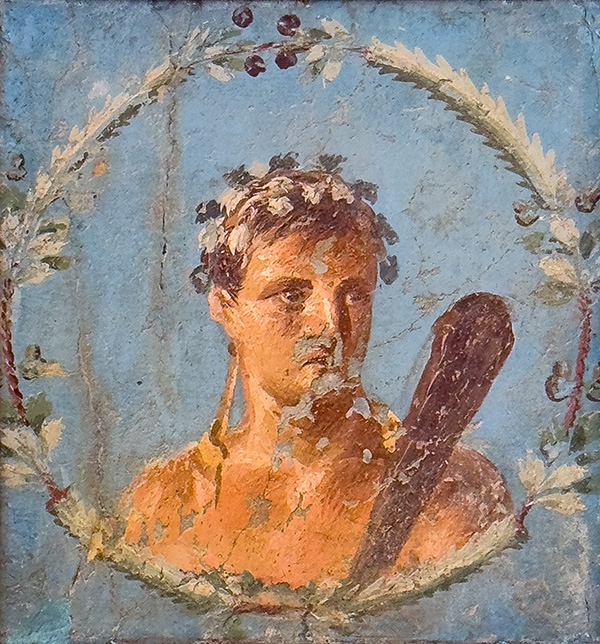
The Latin name for the god did not come to Rome from the Greeks directly. Ἡρακλῆς (Herakles, "the glory of Hera"), had come to Latium via Etruria, where we find the syncopated form Hercle on bronze mirrors and votive bronzes from the fifth century BCE onwards. Michiel de Vaan and Ernout and Meillet have considered Latin Hercules as a loanword of that Etruscan form instead of the Greek one. 1,2,3
Nancy Thomson de Grummond has documented the Etruscan examples of Hercle, appearing in scenes unknown to Greek mythology; being suckled by the vaunted Uni as an adult and adopted into the company of immortals. The Etruscan aristocracy claimed him as the model for a mortal raised by his own actions. When Rome got their hands on the hero, they followed that sort of design.4
The foreign adaptastion aside, the earliest Latin attestations of the name are all votive and attest to an old form of worship. John Penney discusses the archaic dedication of the brothers Cestius: Q. K. Cestio Q. f. Hercole donu dedero (CIL 12.61) in which the dative Hercole retains the vowel of the Etruscan form before the paradigm of Herculi established in Classical Latin.5
The earliest closely datable literary attestation is an oath. Plautus, writing between roughly 205 and 184 BCE, swears by the god constantly in the forms hercle, mehercle and edepol hercle, and the frequency shows that the name was already worn smooth by ordinary use before Latin literature began. A god whose name has become an interjection is a god long since domesticated.6
Roman antiquarians never resolved how many individuals bore the name. Cicero lists six figures known as hercules in the theological survey of 45 BCE; he distinguishes the son of Jupiter and Alcmena from those claiming to be Egyptian, Cretan, & Indian; Varro reports roman cult practices without harmonizing them; and plurality of hercules was consensus among scholars of late Republic.7,8
The great roman altar preserved archaisms as Macrobius transcribes ritual detail of the Ara Maxima where ritual practice was conducted head uncovered like that used by Greeks. Dionysius of Halicarnassus reports the same practice as evidence for a foreign origin of the cult.9,10
Sources: de Vaan and Ernout and Meillet for the etymology and the route of borrowing; Bonfante and Bonfante and de Grummond for the Etruscan forms; Penney for the archaic Latin dedication; Plautus for the earliest datable literary use; Cicero, De natura deorum; Degrassi, Inscriptiones Italiae;1,2,3,4,5,6,7,11,12
II. The Roman History of Hercules Worship
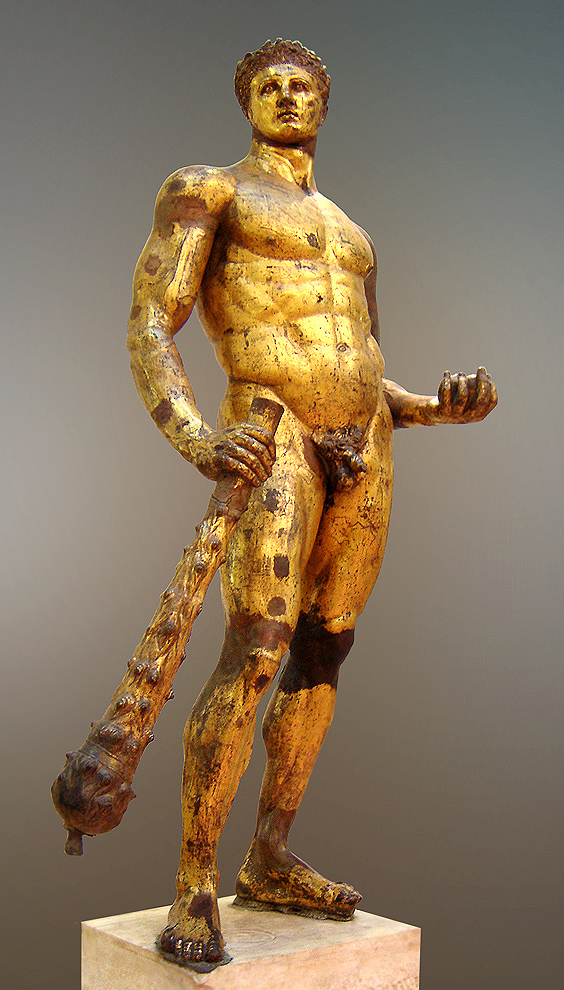
The Ara Maxima
Livy claimed that the Romans contended that Hercules had been present in the city before there was a city. He claims that while Hercules was driving the cattle of Geryon, he stopped in the valley which would become the Forum Boarium, lost his beasts to the thief Cacus, killed him, and was welcomed by the Arcadian, Evander, who founded the Ara Maxima at the spot. Virgil also elucidates on the same story as part of Aeneas' journey through the city in the Eighth Book of the Aeneid. The story is part of the ceremony which has Aeneas being observed when he arrives at the site of Rome.13,14
The altar had characteristics which were recorded as evidence of its age. No woman could participate in the sacrifice, no other deity was mentioned in the rite, the head was bare instead of veiled during sacrifice, and Pliny claims that neither flies nor dogs were according to popular opinion inclined to go inside the precinct. Plutarch collected the same irregularities as questions to which no Roman could give an answer.9,15,16
The Potitii and the Pinarii
In ancient times the cult was maintained by two noble families, the Potitii and the Pinarii as their private preserve, according to Livy. The Potitii were permitted to serve at the altar by hereditary right but had to exclude themselves from the intestines because they had arrived too late to join in the first festival; and so it continued until 312 b.c., when Appius Claudius Caecus as public censor compelled the Potitii to instruct public slaves in the rite and within a year both the Gens Potitia and Appius Claudius himself were extinct, having fallen victim to their sacrilege.13,17
Historians felt that this transaction represented a larger movement where Roman family cults were incorporated into state machinery with adverse consequences. Rome took possession of its oldest altar and told itself a terrible story about what price it paid for doing so. 17,18
The Tithe and the Bankers
From then on, Hercules would be the god to whom Romans would pay a portion of what they earned called the decuma herculius. Whether it was merchants or generalissimos, there are numerous instances of a tithe offered to Hercules and they would eat the share at a public banquet. Plutarch describes a banquet that Sulla held with some of the money he had set aside for such offerings; Macrobius preserves for us a description written by an antiquarian regarding this practice. Filippo Coarelli has suggested that this is due to the commercial nature of the Forum Boarium and harbor near which stood the altar of Hercules.9,19,20
Republic and Empire
Temple building to Hercules followed Roman victory. Marcus Fulvius Nobilior dedicated the temple of Hercules of the Muses after his triumph over Ambracia in 187 BCE, the round marble temple in the Forum Boarium rose about 120 BCE, and Pompey attached his name to a further Herculean shrine too.20,21,22
Under the empire hercules moved outward with legions and merchants. Stefan Ritter traced imagery of Hercules through art of Rome. Mary Beard, John North and Simon Price include Hercules in a small group of deities like Hermes whose worship has been documented in every province of Rome. The river market altar became a world wide cult of hercules.23,24
III. Epithets
The Roman epithets of Hercules describe functions and owners rather than myths. Georg Wissowa observed that the titles cluster around victory, guardianship and commerce, which is what a god worshipped at a cattle market and a triumphal route would be asked to supply. Jean Bayet argued that this practical titulature is the most Roman thing about him.22,25
Two of Hercules' titles carried the official state cult. Hercules Invictus was responsible for the Ara Maxima (the altar) and the Roman calendars, while Hercules Victor was responsible for the circular temple in the Forum Boarium (market), and the large stepped sanctuary at Tibur with an image of him in the city, dressed in the attire of a victorious general.9,11,20
A second category of titles belong to Roman families and Roman patrons. Hercules Pompeianus, Hercules Sullanus and Hercules of the Muses are all named after men who rebuilt or constructed their temples. This practice clearly shows that a Roman nobleman had no qualms about attaching his gens to a god. In fact, ownership of a cult was a way of advertising.20,26
The third category consists of those from outside of Italy. Hercules Magusanus in Batavia (modern-day Holland), Hercules Saxanus in the quarries of the Rhineland (Germany), Hercules Gaditanus at Gades (Spain), and Hercules Curinus in the Paeligni region (Italy), show how a provincial deity was associated with a Latin title. Ton Derks showed for the Lower Rhine that the resulting god was neither solely Roman nor exclusively indigenous. Interpretatio was a means of translating gods into one another, it was not simply a translation error.12,27
| Epithet | Meaning | Domain |
|---|---|---|
| Hercules Invictus | Hercules the Unconquered | Magnum Opus, Labors |
| Hercules Victor | Hercules the Victor | Magnum Opus, market |
| Hercules Triumphalis | Hercules of the Triumph | Roman Triumph |
| Hercules Magnus Custos | Hercules the Great Guardian | Protection of the City |
| Hercules Musarum | Hercules of the Muses | Poetry, the Fasti |
| Hercules Olivarius | Hercules of the Oil Merchants | Trade, tithing |
| Hercules Pompeianus | Hercules of the Pompeii | Family patronage |
| Hercules Comes | Hercules the Companion | Imperial coinage, the Emperor's escort |
| Hercules Conservator | Hercules the Preserver | Imperial coinage, maintenance of state |
| Hercules Defensor | Hercules the Defender | Military Defense |
| Hercules Saxanus | Hercules of the Quarry Stone | Quarrymen and legionary work parties, Germania |
| Hercules Magusanus | Bavarian Hercules | Lower Rhine, auxiliary units |
| Hercules Gaditanus | Hercules of Gades | Geryon, Pillar-cult |
| Hercules Curinus | Hercules under a Paelignian title | Sulmo and the central Apennines |
| Hercules Augustus | August Hercules | Provincial imperial cult |
Sources and first attestations: Invictus and Victor in the Roman calendars and the Forum Boarium temples, Degrassi, Inscr. Ital. 13.2, with Coarelli; Magnus Custos, Ovid, Fasti 6.209–212; Musarum, Ovid, Fasti 6.797–812, with Pliny; Pompeianus, Vitruvius 3.3.5; Comes and Conservator in the imperial coinage catalogued by Mattingly and Sydenham; Magusanus and Saxanus in the Rhineland dedications discussed by Derks; Gaditanus in the Spanish evidence discussed by Rives; Wissowa and Bayet for the analysis of the whole titulature.9,11,12,15,20,21,22,25,26,27,28,29
IV. Temples and Sacred Sites of Hercules
| Sites of Hercules | Place | Description | Importance | Date Recorded |
|---|---|---|---|---|
| Ara Maxima Herculis Invicti | Rome, Forum Boarium | Open altar, Greek rite, head uncovered | Oldest cult of the god at Rome; tithe banquets; women excluded | Livy 1.7; Dionysius 1.39–40; rite reformed 312 BCE |
| Round Temple of Hercules Victor (Olivarius) | Rome, Forum Boarium | Twenty Corinthian columns, Pentelic marble, no podium | Earliest surviving marble building in Rome; oil merchants' dedication | c. 120 BCE; standing today |
| Temple of Hercules Pompeianus | Rome, Forum Boarium near the Circus Maximus | Tuscan manner; a statue by Myron | Family patronage attached to an older foundation | Vitruvius 3.3.5; Pliny, Natural History 34.57 |
| Temple of Hercules Musarum | Rome, Circus Flaminius | Housed the Muses taken from Ambracia and the shrine of Camenae | Displayed the consular fasti; later enclosed by the Porticus Philippi | Dedicated after 187 BCE; Ovid, Fasti 6.797–812 |
| Temple of Hercules Magnus Custos | Rome, near the Circus Flaminius | Site unrecovered; rebuilt on Sibylline instruction | Festival of 4 June; statue decreed by the decemvirs in 189 BCE | Ovid, Fasti 6.209–212; Livy 40.51 |
| Aedes Herculis Sullani | Rome, Esquiline | Shrine associated with the dictator | Still listed among the city's monuments in late antiquity | Late republican; regionary catalogues |
| Sanctuary of Hercules Victor | Tibur (Tivoli), Latium | Vast terraced complex on substructures, theatre and portico | Largest Herculean sanctuary in Italy; wool trade and flocks | Later 2nd to early 1st century BCE |
| Sanctuary of Hercules Curinus | Sulmo, territory of the Paeligni | Terraced hillside sanctuary with porticoes | Chief cult of Hercules in the central Apennines | 2nd–1st century BCE |
| Temple of Hercules Gaditanus | Gades, Hispania Ulterior | Ancient sanctuary identified with Phoenician Melqart | Visited by Roman commanders; patronised under Trajan and Hadrian | Roman literary notices from the late Republic onward |
| Sanctuary of Hercules Saxanus | Brohltal, Germania Inferior | Quarry sanctuary served by legionary work parties | Densest concentration of military dedications to the god | 1st–2nd century CE |
Sources: Livy and Dionysius of Halicarnassus for the Ara Maxima; Coarelli, Il Foro Boario, and Richardson for the Forum Boarium temples; Vitruvius and Pliny for the Pompeian temple and its statuary; Ovid, Fasti, for the Muses and the Great Guardian; Coarelli, Lazio, for Tibur and Sulmo; Derks for the Rhineland quarry sanctuary; Rives for Gades.10,12,13,15,20,21,26,27,28,30
V. Hercules as Model for Sporting Heroes
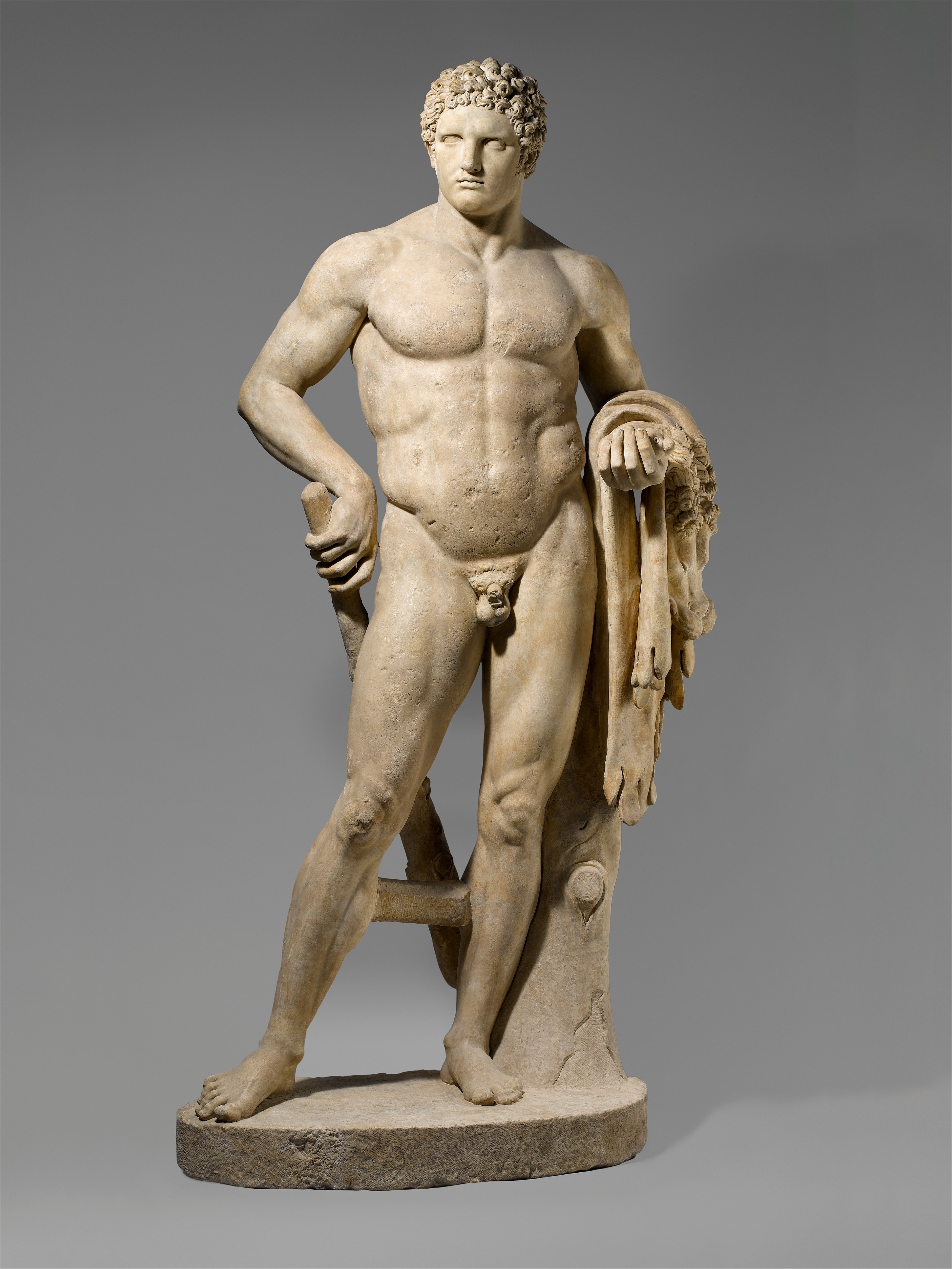
The international organization of athletes of the Roman world also identified themselves through Hercules. The international association of competitors called itself the Sacred Traveling Association Devoted to Herakles, kept their archives at Rome, and received charters from Roman Emperors; Peter Frisch wrote about the papyri that show how Hadrian and Antoninus Pius confirmed their rights and location near the Baths of Trajan. The strongest man in mythology became the registered sponsor/patron of a professional athletic organization.31,32
Zahra Newby has demonstrated just how completely he supported them visually. Statues of Hercules stood in both gymnasia and imperial thermae, the public baths. Men trained in front of statues of Hercules in the palaestrae and thermae, since he represented laborious effort; and the colossal Weary Hercules signed by Glykon that was found in the Baths of Caracalla is perhaps the best preserved example of this practice.33,34
The Roman festival calendar gave Greek athletics a Latin home. Augustus founded the Sebasta at Naples in 2 CE on the Olympic model, Domitian established the Capitoline contest at Rome in 86 CE, and Jason König has examined the literature these institutions generated, in which the athlete's training is habitually described in the vocabulary of Herculean labour. Rome imported the gymnasium along with its patron.33,35
The moral content of the model is labour rather than strength. Karl Galinsky observed that the Roman Hercules is defined by endurance and by tasks completed, so that the athlete who invoked him was claiming discipline rather than brute force. Effort is the whole of the lesson.36
VI. Roman Poets and Hercules
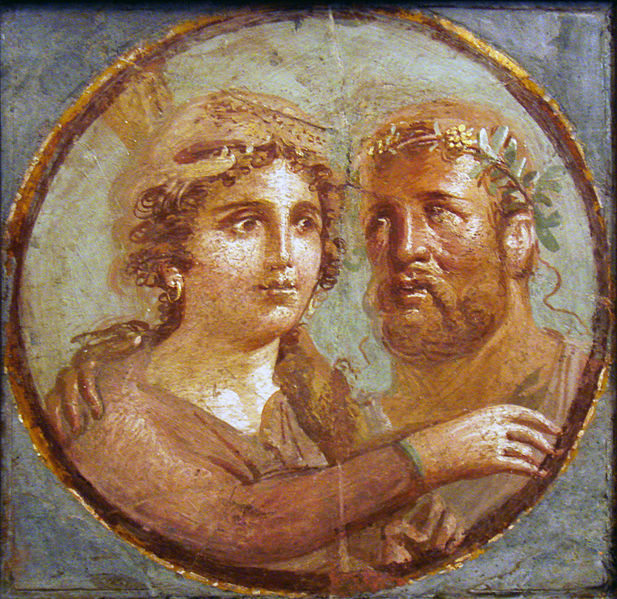
Virgil assigned Hercules a foundational position in the Roman landscape. The killing of Cacus occurs in Book VIII of the Aeneid as the first liberation of the site of Rome and, according to Philip Hardie, serves as a cosmological triumph of order over chaos that anticipates the achievements of Augustus14,37
In comedy, Propertius took the same altar and made a farce out of all of it because in the ninth elegy of his fourth book the thirsty god, fresh from killing Cacus, was refused water by the priestess of the Bona Dea. Curiously, he retaliates by excluding women from his own rite forever, or so the justification for the prohibition goes.38
Ovid adapted the figure to the mechanism of the calendar and to the mechanism of metamorphosis. While providing the date of the Ara Maxima and of the temple of the Muses in the Fasti, he gives the shirt of Nessus, the pyre on Mount Oeta and the apotheosis wherein his mortal portion is consumed by fire in Book IX of the Metamorphoses.21,39
Horace made him the paradigmatic model for measuring a ruler as his odes locate Hercules among those mortals who won immortality through labor and compare him to Augustus when he returns from Spain. This sort of comparison is presented as a demand rather than flattery.40
Among the Stoics, Seneca developed two tragedies featuring Hercules. In Hercules Furens he depicts the hero being destroyed by the insanity which followed upon his own triumph, and in the Hercules on Oeta transcribed under his own name, he narrates at length the hero's death and deification; Karl Galinsky interprets both works as testaments of the Stoic hero pushed beyond his own bounds.36,41
Then Statius wrote two poems: one for the sea-side temple of Hercules erected by Pollius Felix and another for the bronze figurine of Hercules at table owned by Novius Vindex; and Martial praises the same miniature masterwork, while Silius Italicus begins his Punica with the Spanish shrine of Hercules and concludes its Book XV with Scipio's dilemma between Virtue and Pleasure.42,43,44
VII. Hercules and Roman Rulers
The pattern begins with the greatest of the republican commanders. Livy records the aura of the divine that attached to Scipio Africanus, and Silius Italicus later gave him a formal choice between Virtue and Pleasure modelled on the fable of Prodicus, so that the conqueror of Hannibal was shown to posterity as a Roman Hercules at the crossroads..44,45
Sulla and Pompey with their dictatorial ambitions used the god in a more cynical manner as Plutarch describes the tithe Sulla paid at the Ara Maxima and the vast public feast that consumed it, while Pompey attached his name to a Herculean temple in the Forum Boarium and celebrated his triumphs along the route the god's altar commanded. A Roman noble displayed his fortune by giving a tenth of it away in the god's name.19,20
Augustus preferred Apollo and permitted the comparison nonetheless. Horace welcomes him home from the Spanish campaign in the manner of Hercules returning from the same country, and J. Rufus Fears traced how such associations were converted into the formal language of imperial virtues. The comparison was made by the poets and left uncollected by the prince.40,46
Trajan brought the Spanish god into the centre of imperial coinage. Hercules Gaditanus appears on the issues of an emperor born in Baetica in Hispania. The types of Hercules the Companion and Hercules the Preserver run through the second and third centuries as statements that the labor of defending borders and ruling well was a difficult task29,46
At the end of Rome, the name was attempted to be used in power plays as Diocletian took the title Jovius. He Maximian the title Herculius, dividing the empire between the god who commands and the god who executes. Scholars of late Rome like Roger Rees have shown how carefully the theology was tied in public to the administrative structure, for better or for worse.47
VIII. The Army
Hercules was among the commonest gods on the military frontiers and it appears soldiers chose him as a great deity to emulate. Eric Birley's survey of the religion of the Roman army found him second only to Jupiter Optimus Maximus in the dedications of officers and units. Other historians show the pattern across the western provinces.48,49
The Rhineland produced the densest evidence. Hercules Saxanus received dedications from legionary detachments quarrying stone in the Brohl valley, and Hercules Magusanus was worshipped by Batavian auxiliaries and by the local aristocracy who supplied them; Ton Derks has demonstrated that the cult served as the meeting point between a native ancestral figure and the Roman military career. The god was the bargain struck between an empire and its recruits.12,49
Britain supplies the same evidence at the far edge. Altars to Hercules stand among the garrison dedications collected in the Roman Inscriptions of Britain, set up by prefects and centurions in the forts of the northern frontier alongside those to Jupiter and to the emperor's spirit. Frontier religion was practical, personal and paid for out of pocket.48,50
The reason for the preference is stated in the imagery rather than in any text. Stefan Ritter has traced the military versions of the type, in which the club and the lion skin become emblems of endurance under order, and the titles Defensor and Invictus attach themselves to the same figure. Virtus was the soldier's word, and Hercules was its picture.23,46
IX. The Popularity of the Cult Across the Empire
Dionysius of Halicarnassus states that scarcely a place in Italy could be found where Hercules was not beloved. Every province of Rome seemed to be dedicated to him in some form. Jörg Rüpke's survey of Roman religion placed Hercules among the handful of deities attested continuously and endlessly from Britain to Syria. He required no priesthood, no temple and no calendar to receive a vow; ultimately, though, to a learned eye, he also represented the hope of apotheosis.10,51
In the west he absorbed local powers wholesale. In addition, historians note the extent to which Batavaian and Gallic elite figures would adopt Roman divine names for their own religious practices. That applied to African provinces as well. Hercules is often depicted alongside Liber Pater as an ancestral deity of Lepcis Magna. These regional pairings were transported to Rome itself by the Severans of Libya.12,27,52,53
Spain produced the most well-known shrine of Hercules (Gades) as well as the western-most ocean border. Visitors to the Gades temple recognized it as the western most holy site within the known world associated with the Geryon tale even though it was nominally founded as a shrine to Melqart. It attracted military leaders and emperors providing the Empire with images of boundaries crossed. The deity Hercules defined the end-of-the-world boundary and earned thanks for crossing it.27,44
Beyond the western borders of the Empire, Hercules continued to be worshiped. Many deities of the east were assimilated into the interpretation of being Hercules or Hermes. Tacitus reported that German warriors invoked Hercules as the "first of bold heroes" when going into battle, for instance.52,54
X. Stoicism
The philosophical Hercules begins as a myth, systematized into a dogma of sorts. Xenophon preserved the legend of Prodicus in which Hercules encounters Virtue and Vice at a cross-roads and selects the difficult path. Cicero translated this story into Latin moral philosophy as the paradigmatic example of each young man's decision regarding the course of his life, a strong influence on the Stoics. 55,56
Seneca used Hercules as the quintessential example of wisdom as his essay on the Constancy of the Wise Man invokes Hercules as an exemplar of one who endured no labor. His treatise on Benefits depicts his journeys as service to humanity (as opposed to seeking honor). Furthermore, Seneca's Tragedies test the dogma to its limits. It should not surprise us that the strongest expression of it and the most incisive critique are attributed to the same writer, as Seneca was interested in testing moral limits.41,57
Maybe Epictetus provides perhaps the most radical representation. He represents Hercules as one who fulfilled Zeus' will without complaint, possessed nothing, felt at home wherever he went because he believed that Zeus was the Father of all people, and was summoned to join the noblest company after clearing the earth of what defiled it. To endure in obedience is a goal.58
Allegory elevated him from example to principle. Cornutus interpreted Hercules as Reason, that pervading all things and imparting vigor to every part of Nature; while Dio Chrysostom identifies Hercules as the exemplary ruler, who rules through labor rather than through pleasure. This concept did not begin with the Stoics. Ragnar Höistad has documented that the entire tradition extends back to the Cynic teachers from whom the Stoics derived this theme. 59,60,61
Marcia Colish and Emma Stafford have both demonstrated how much of subsequent European moral thought passed through this portal; since the heroic laborer who gains immortality through his service was available to Christian writers as a figure to both viciously condemn and emulate at once. While the imagery of a strongman in lionskin and club survived long after the altars disappeared, a god who ascended to Heaven by virtue of uncompleted labors is the kind of god that the Romans found the most glorious. As Hercules Invictus he bore his oldest title, which was given to him by the Ara Maxima prior to Rome building its walls.36,62,63
XI. Festivals
| Hercules Ritual Days | Place | Description | Importance | Date Recorded |
|---|---|---|---|---|
| Sacrifice at the Ara Maxima | Rome, Forum Boarium | 12 August, the god's principal Roman day | Greek rite, head uncovered, women excluded, feast on the spot | Roman calendars, Degrassi Inscr. Ital. 13.2 |
| Herculi Invicto ad Circum Maximum | Rome, Circus Maximus quarter | 13 August, entry adjoining the Ara Maxima day | State sacrifice to the Unconquered | Fasti Antiates and Allifani, in Degrassi |
| Hercules Magnus Custos | Rome, Circus Flaminius | 4 June, dedication day of the temple | Rite founded on Sibylline instruction | Ovid, Fasti 6.209–212 |
| Hercules and Ceres | Rome | 21 December, joint entry in the calendars | Sacrifice of a pregnant sow, loaves and wine | Roman calendars, in Degrassi; Scullard |
| The decuma and the polluctum | Rome and the Italian towns | Non-calendrical tithe of profit or spoil | Public banquet consuming a tenth; vowed by traders and generals | Plutarch, Sulla 35; Macrobius 3.6, 3.12 |
| Hercules Victor at Tibur | Tibur, Latium | Sanctuary festival with theatre and market | Regional gathering of the flock owners of the Anio valley | Later 2nd to early 1st century BCE |
Sources: Degrassi, Inscriptiones Italiae 13.2, for the calendar entries of 12 and 13 August, 4 June and 21 December; Ovid, Fasti, for the Great Guardian; Scullard for the reconstruction of the festival year; Plutarch and Macrobius for the tithe and its banquets; Coarelli, Lazio, for the sanctuary festival at Tibur.9,11,19,21,30,64
Sources and Bibliography
- Michiel de Vaan. Etymological Dictionary of Latin and the Other Italic Languages. Leiden Indo-European Etymological Dictionary Series 7. Leiden: Brill, 2008. S.v. Hercules. For the treatment of the Latin name as a borrowing of the Etruscan form rather than of Greek Ἡρακλῆς directly.
- Alfred Ernout and Antoine Meillet. Dictionnaire étymologique de la langue latine: Histoire des mots. 4th ed., revised by Jacques André. Paris: Klincksieck, 2001. S.v. Hercules. For the phonetic argument that the Latin form passed through Etruscan, and for the survival of the archaic vocalism in the oath forms.
- Giuliano Bonfante and Larissa Bonfante. The Etruscan Language: An Introduction. 2nd ed. Manchester: Manchester University Press, 2002. For the Etruscan form Hercle and the syncope that produced it from the Greek name.
- Nancy Thomson de Grummond. Etruscan Myth, Sacred History, and Legend. Philadelphia: University of Pennsylvania Museum of Archaeology and Anthropology, 2006. For Hercle on the engraved mirrors, the scene of his adoption by Uni, and the Etruscan aristocratic use of the hero as the pattern of a mortal raised by his own deeds.
- John H. W. Penney. "Archaic and Old Latin." In A Companion to the Latin Language, edited by James Clackson, 220–35. Chichester: Wiley-Blackwell, 2011. For the archaic dedication of the brothers Cestius, Q. K. Cestio Q. f. Hercole donu dedero, and the discussion of its morphology and dative form.
- Plautus. Amphitryon. The Comedy of Asses. The Pot of Gold. The Two Bacchises. The Captives, and subsequent volumes. Edited and translated by Wolfgang de Melo. Loeb Classical Library 60–61, 163, 260, 328. Cambridge, MA: Harvard University Press, 2011–2013. For the constant oath forms hercle, mehercle and edepol hercle, the earliest closely datable literary attestation of the name in Latin.
- Cicero. On the Nature of the Gods. Academics. Translated by H. Rackham. Loeb Classical Library 268. Cambridge, MA: Harvard University Press, 1933. See De natura deorum 3.42. For the enumeration of six distinct figures bearing the name and the separation of the son of Jupiter and Alcmena from the rest.
- Varro. On the Latin Language. Edited and translated by Roland G. Kent. Loeb Classical Library 333 and 334. Cambridge, MA: Harvard University Press, 1938. For the antiquarian notices of the Roman cult usages, reported without harmonisation.
- Macrobius. Saturnalia, Volume II: Books 3–5. Edited and translated by Robert A. Kaster. Loeb Classical Library 511. Cambridge, MA: Harvard University Press, 2011. See 3.6 and 3.12. For the Greek rite at the Ara Maxima performed with the head uncovered, the prohibitions attached to the altar, and the antiquarian discussion of the tithe.
- Dionysius of Halicarnassus. Roman Antiquities. Translated by Earnest Cary. 7 vols. Loeb Classical Library. Cambridge, MA: Harvard University Press, 1937–1950. See 1.39–40. For the arrival of the god in the valley of the Forum Boarium, the foundation of the altar, the Greek character of the rite, and the statement that scarcely a place in Italy could be found where the god was not honoured.
- Attilio Degrassi, ed. Inscriptiones Italiae. Vol. 13, fasc. 2, Fasti anni Numani et Iuliani. Rome: Libreria dello Stato, 1963. For the surviving Roman calendars and their entries for 12 and 13 August, 4 June and 21 December, including the formula Herculi Invicto ad Circum Maximum.
- Ton Derks. Gods, Temples and Ritual Practices: The Transformation of Religious Ideas and Values in Roman Gaul. Amsterdam Archaeological Studies 2. Amsterdam: Amsterdam University Press, 1998. For Hercules Magusanus among the Batavians, Hercules Saxanus in the Rhineland quarries, and the argument that the resulting cult was neither wholly Roman nor wholly native.
- Livy. History of Rome, Volume I: Books 1–2. Translated by B. O. Foster. Loeb Classical Library 114. Cambridge, MA: Harvard University Press, 1919. See 1.7.3–15. For the cattle of Geryon, the theft by Cacus, the reception by Evander, the foundation of the Ara Maxima, and the hereditary service of the Potitii and the Pinarii.
- Virgil. Eclogues, Georgics, Aeneid: Books 1–6, and Aeneid: Books 7–12. Translated by H. Rushton Fairclough. Revised by G. P. Goold. Loeb Classical Library 63–64. Cambridge, MA: Harvard University Press, 1999. See Aeneid 8.184–279. For the Cacus episode narrated to Aeneas at the altar on the god's own feast day.
- Pliny. Natural History, Volume III: Books 8–11, and Volume IX: Books 33–35. Translated by H. Rackham. Loeb Classical Library 353 and 394. Cambridge, MA: Harvard University Press, 1940–1952. See 10.79, 34.57 and 35.66. For the belief that neither flies nor dogs entered the precinct of the Ara Maxima, the statue by Myron in the Pompeian temple, and the paintings and statuary connected with the temple of the Muses.
- Plutarch. Moralia, Volume IV: Roman Questions. Translated by Frank Cole Babbitt. Loeb Classical Library 305. Cambridge, MA: Harvard University Press, 1936. See Roman Questions 60 and 90. For the collection of unexplained peculiarities of the altar, including the exclusion of women and the naming of no other deity.
- Livy. History of Rome, Volume IV: Books 8–10. Translated by B. O. Foster. Loeb Classical Library 191. Cambridge, MA: Harvard University Press, 1926. See 9.29.9–11. For the transfer of the rite from the Potitii to public slaves by the censor Appius Claudius Caecus in 312 BCE, the extinction of the gens within the year, and the censor's blindness.
- Eric M. Orlin. Temples, Religion, and Politics in the Roman Republic. Mnemosyne Supplements 164. Leiden: Brill, 1997. For the republican movement by which family cults were absorbed into the machinery of the state, and for the politics of temple vowing and dedication.
- Plutarch. Lives. Translated by Bernadotte Perrin. 11 vols. Loeb Classical Library. Cambridge, MA: Harvard University Press, 1914–1926. See Sulla 35 and Antony 4. For the tithe paid at the Ara Maxima and the public banquet that consumed it, and for the Antonian claim of descent from a son of Hercules.
- Filippo Coarelli. Il Foro Boario: Dalle origini alla fine della Repubblica. Rome: Quasar, 1988. The standard study of the quarter. For the commercial character of the cattle market and river harbour, the topography of the Ara Maxima, the round temple, and the Pompeian foundation.
- Ovid. Fasti. Translated by James G. Frazer. Revised by G. P. Goold. Loeb Classical Library 253. Cambridge, MA: Harvard University Press, 1931. See 1.543–586, 6.209–212 and 6.797–812. For the Cacus narrative, the dedication day of Hercules the Great Guardian on 4 June, and the temple of Hercules of the Muses with the Camenae and the fasti.
- Jean Bayet. Les origines de l'Hercule romain. Bibliothèque des Écoles françaises d'Athènes et de Rome 132. Paris: de Boccard, 1926. The foundational modern study. For the reconstruction of the Italic and Etruscan background of the Roman cult and for the argument that the practical titulature is its most Roman feature.
- Stefan Ritter. Hercules in der römischen Kunst von den Anfängen bis Augustus. Archäologie und Geschichte 5. Heidelberg: Verlag Archäologie und Geschichte, 1995. For the development of the Roman iconography, including the military versions in which the club and lion skin become emblems of endurance under order.
- Mary Beard, John North, and Simon Price. Religions of Rome, Volume 1: A History. Cambridge: Cambridge University Press, 1998. For the place of Hercules among the very small number of deities attested across every province of the empire.
- Georg Wissowa. Religion und Kultus der Römer. 2nd ed. Handbuch der Altertumswissenschaft V.4. Munich: C. H. Beck, 1912. For the observation that the Roman epithets cluster around victory, guardianship and commerce rather than around myth.
- L. Richardson Jr. A New Topographical Dictionary of Ancient Rome. Baltimore: Johns Hopkins University Press, 1992. For the Roman temples of Hercules, their patrons and their recorded or unrecovered sites, including the Sullan shrine on the Esquiline.
- J. B. Rives. Religion and Authority in Roman Carthage from Augustus to Constantine. Oxford: Clarendon Press, 1995. For the African evidence in which Hercules stands beside Liber Pater as an ancestral god, and for the provincial pattern of identification with Melqart.
- Vitruvius. On Architecture, Volume I: Books 1–5. Translated by Frank Granger. Loeb Classical Library 251. Cambridge, MA: Harvard University Press, 1931. See 3.3.5. For the temple of Hercules Pompeianus described as built in the Tuscan manner.
- Harold Mattingly and Edward A. Sydenham. The Roman Imperial Coinage. London: Spink, 1923–1994. Vols. 2–5. For the reverse types Hercules Gaditanus, Hercules Comes and Hercules Conservator, and for the Herculian issues of the tetrarchic period.
- Filippo Coarelli. Lazio. Guide archeologiche Laterza 5. Rome: Laterza, 1982. For the terraced sanctuary of Hercules Victor at Tibur with its substructures, theatre and portico, and for the sanctuary of Hercules Curinus at Sulmo.
- Peter Frisch. Zehn agonistische Papyri. Papyrologica Coloniensia 13. Opladen: Westdeutscher Verlag, 1986. For the documents of the international athletic association styled the sacred travelling guild devoted to Herakles, including the imperial letters confirming its privileges and its headquarters at Rome.
- Onno M. van Nijf. "Local Heroes: Athletics, Festivals and Elite Self-Fashioning in the Roman East." In Being Greek under Rome: Cultural Identity, the Second Sophistic and the Development of Empire, edited by Simon Goldhill, 306–34. Cambridge: Cambridge University Press, 2001. For the organisation of professional athletes under the god's patronage and their relations with Roman authority.
- Zahra Newby. Greek Athletics in the Roman World: Victory and Virtue. Oxford: Oxford University Press, 2005. For Herculean statuary in palaestrae and imperial bath complexes, and for the moral vocabulary attached to athletic effort in the Roman period.
- Francis Haskell and Nicholas Penny. Taste and the Antique: The Lure of Classical Sculpture, 1500–1900. New Haven: Yale University Press, 1981. For the colossal Weary Hercules signed by Glykon and recovered from the Baths of Caracalla, and for the history of its fame.
- Jason König. Athletics and Literature in the Roman Empire. Greek Culture in the Roman World. Cambridge: Cambridge University Press, 2005. For the literature generated by the Greek-style contests of the Roman period and the habitual description of training in the vocabulary of Herculean labour.
- G. Karl Galinsky. The Herakles Theme: The Adaptations of the Hero in Literature from Homer to the Twentieth Century. Oxford: Blackwell, 1972. The standard synthesis. For the Roman emphasis on endurance and completed tasks rather than brute strength, and for the reading of the Senecan tragedies as the Stoic hero tested past the limit of his doctrine.
- Philip Hardie. Virgil's Aeneid: Cosmos and Imperium. Oxford: Clarendon Press, 1986. For the Cacus episode read as a cosmic victory of order over chaos prefiguring the work of Augustus.
- Propertius. Elegies. Edited and translated by G. P. Goold. Loeb Classical Library 18. Cambridge, MA: Harvard University Press, 1990. See 4.9. For the thirsty god refused water by the priestess of the Bona Dea and the comic aetiology of the exclusion of women from his rite.
- Ovid. Metamorphoses, Volume II: Books 9–15. Translated by Frank Justus Miller. Revised by G. P. Goold. Loeb Classical Library 43. Cambridge, MA: Harvard University Press, 1916. See 9.1–272. For the shirt of Nessus, the pyre on Oeta and the apotheosis in which the mortal part is burned away.
- Horace. Odes and Epodes. Edited and translated by Niall Rudd. Loeb Classical Library 33. Cambridge, MA: Harvard University Press, 2004. See Odes 3.3, 3.14 and 4.5. For Hercules among the mortals who earned heaven by labour and for the welcome of Augustus returning from Spain in the god's manner.
- Seneca. Tragedies, Volume I: Hercules. Trojan Women. Phoenician Women. Medea. Phaedra, and Volume II: Oedipus. Agamemnon. Thyestes. Hercules on Oeta. Octavia. Edited and translated by John G. Fitch. Loeb Classical Library 62 and 78. Cambridge, MA: Harvard University Press, 2002–2004. For the madness that follows triumph in the Hercules Furens and the death and deification in the Hercules Oetaeus transmitted under his name.
- Statius. Silvae. Edited and translated by D. R. Shackleton Bailey. Revised by Christopher A. Parrott. Loeb Classical Library 206. Cambridge, MA: Harvard University Press, 2015. See 3.1 and 4.6. For the seaside temple of Hercules built by Pollius Felix and the bronze Hercules at table owned by Novius Vindex.
- Martial. Epigrams, Volume II: Books 6–10. Edited and translated by D. R. Shackleton Bailey. Loeb Classical Library 95. Cambridge, MA: Harvard University Press, 1993. See 9.43 and 9.44. For the epigrams on the same small bronze celebrated by Statius.
- Silius Italicus. Punica. Translated by J. D. Duff. 2 vols. Loeb Classical Library 277 and 278. Cambridge, MA: Harvard University Press, 1934. See 1.505–555, 3.1–60 and 15.18–128. For the sanctuary at Gades, the god's western labours, and the choice of Scipio between Virtue and Pleasure modelled on the fable of Prodicus.
- Livy. History of Rome, Volume VII: Books 26–27. Translated by Frank Gardner Moore. Loeb Classical Library 367. Cambridge, MA: Harvard University Press, 1943. See 26.19. For the aura of the divine that Roman tradition attached to Scipio Africanus.
- J. Rufus Fears. "The Cult of Virtues and Roman Imperial Ideology." In Aufstieg und Niedergang der römischen Welt II.17.2, edited by Wolfgang Haase, 827–948. Berlin: Walter de Gruyter, 1981. For the conversion of divine associations into the formal language of imperial virtues, and for virtus as the quality the Herculean types were designed to state.
- Roger Rees. Diocletian and the Tetrarchy. Debates and Documents in Ancient History. Edinburgh: Edinburgh University Press, 2004. For the titles Jovius and Herculius, the division between the god who commands and the god who executes, and the matching of the theology to the administrative structure.
- Eric Birley. "The Religion of the Roman Army: 1895–1977." In Aufstieg und Niedergang der römischen Welt II.16.2, edited by Wolfgang Haase, 1506–41. Berlin: Walter de Gruyter, 1978. For the survey of military dedications in which Hercules stands second only to Jupiter Optimus Maximus.
- Oliver Stoll. "The Religions of the Armies." In A Companion to the Roman Army, edited by Paul Erdkamp, 451–76. Malden, MA: Blackwell, 2007. For the pattern of military cult across the western provinces and the place of Hercules within it.
- R. G. Collingwood and R. P. Wright. The Roman Inscriptions of Britain. Vol. 1, Inscriptions on Stone. Oxford: Clarendon Press, 1965. For the altars to Hercules set up by prefects and centurions in the forts of the northern frontier.
- Jörg Rüpke. Religion of the Romans. Translated and edited by Richard Gordon. Cambridge: Polity Press, 2007. For the survey of Roman religion in which Hercules appears among the deities attested continuously from Britain to Syria.
- Greg Woolf. Becoming Roman: The Origins of Provincial Civilization in Gaul. Cambridge: Cambridge University Press, 1998. For the provincial pattern by which local elites adopted Roman divine names for their own cults, and for interpretatio as a method of recognition.
- Anthony R. Birley. Septimius Severus: The African Emperor. 2nd ed. London: Routledge, 1988. For Hercules and Liber Pater as the ancestral gods of Lepcis Magna and their promotion at Rome by the Severan house.
- Tacitus. Agricola. Germania. Dialogue on Oratory. Translated by M. Hutton and W. Peterson. Revised by R. M. Ogilvie, E. H. Warmington and Michael Winterbottom. Loeb Classical Library 35. Cambridge, MA: Harvard University Press, 1914. See Germania 3 and 9. For the report that the Germans sang of Hercules as the first of brave men on going into battle.
- Xenophon. Memorabilia. Oeconomicus. Symposium. Apology. Translated by E. C. Marchant and O. J. Todd. Revised by Jeffrey Henderson. Loeb Classical Library 168. Cambridge, MA: Harvard University Press, 2013. See Memorabilia 2.1.21–34. For the fable of Prodicus in which the young hero meets Virtue and Vice at the crossroads.
- Cicero. On Duties. Translated by Walter Miller. Loeb Classical Library 30. Cambridge, MA: Harvard University Press, 1913. See De officiis 1.118. For the transmission of the Prodican choice into Latin moral philosophy as the pattern for a young man's choice of a life.
- Seneca. Moral Essays, Volume I and Volume III. Translated by John W. Basore. Loeb Classical Library 214 and 310. Cambridge, MA: Harvard University Press, 1928–1935. See De constantia sapientis 2.1 and De beneficiis 1.13.3. For the hero unbroken by any labour and for his wanderings presented as service to the human race rather than glory sought for himself.
- Epictetus. Discourses. Translated by W. A. Oldfather. 2 vols. Loeb Classical Library 131 and 218. Cambridge, MA: Harvard University Press, 1925–1928. See 2.16.44, 3.24.13–16 and 3.26.31–32. For the hero who did the will of Zeus, owned nothing, was at home everywhere, and cleared the earth of what infested it.
- Cornutus. Greek Theology, Fragments, and Testimonia. Edited and translated by George Boys-Stones. Writings from the Greco-Roman World 42. Atlanta: SBL Press, 2018. See chapter 31. For the allegorical explanation of the god as the reason running through all things and giving nature its strength.
- Dio Chrysostom. Discourses 1–11. Translated by J. W. Cohoon. Loeb Classical Library 257. Cambridge, MA: Harvard University Press, 1932. See Oration 1. For the hero presented as the model of the ruler who governs by labour rather than by pleasure.
- Ragnar Höistad. Cynic Hero and Cynic King: Studies in the Cynic Conception of Man. Uppsala: Bloms, 1948. For the derivation of the philosophical hero from Cynic teaching before its adoption by the Stoics.
- Marcia L. Colish. The Stoic Tradition from Antiquity to the Early Middle Ages. 2 vols. Studies in the History of Christian Thought 34–35. Leiden: Brill, 1985. For the transmission of the Stoic moral hero into later European thought and its reception by Christian writers.
- Emma Stafford. Herakles. Gods and Heroes of the Ancient World. London: Routledge, 2012. For the long reception of the labouring hero who earns immortality by service, and for the Roman and post-Roman phases of that reception.
- H. H. Scullard. Festivals and Ceremonies of the Roman Republic. London: Thames and Hudson, 1981. For the reconstruction of the festival year and the discussion of the Herculean entries in the calendars.