HORUS
author: High Priest Zevios Metathronos
co-author: Novice Priest Karnonnos
Hieratic Information about Horus
| Divine Names |
|---|
- Hrw (𓅃)
- Horus (Ὧρος)
- Harpocrates (Ἁρποκράτης)
|
| These hieratic names carry strong spiritual resonance and are recommended for summoning and invocation practices. |
| Divine Symbols |
|---|
- Eye of Horus (Wadjet)
- Uraeus
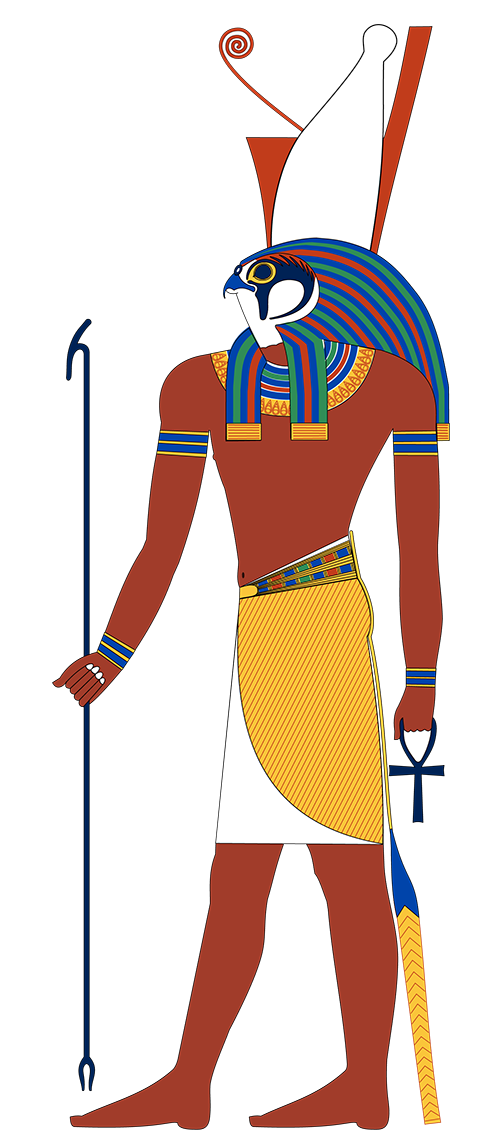
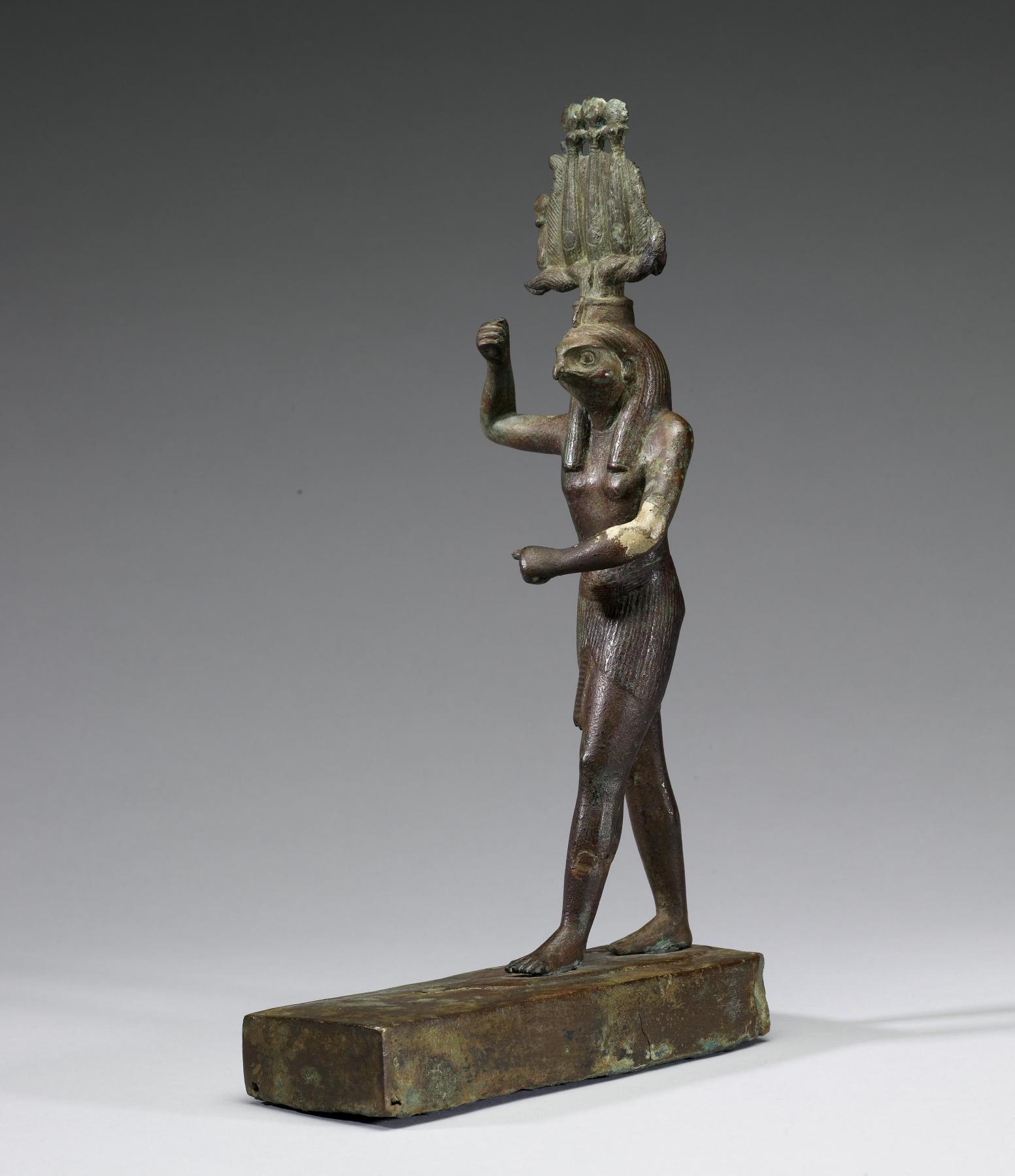
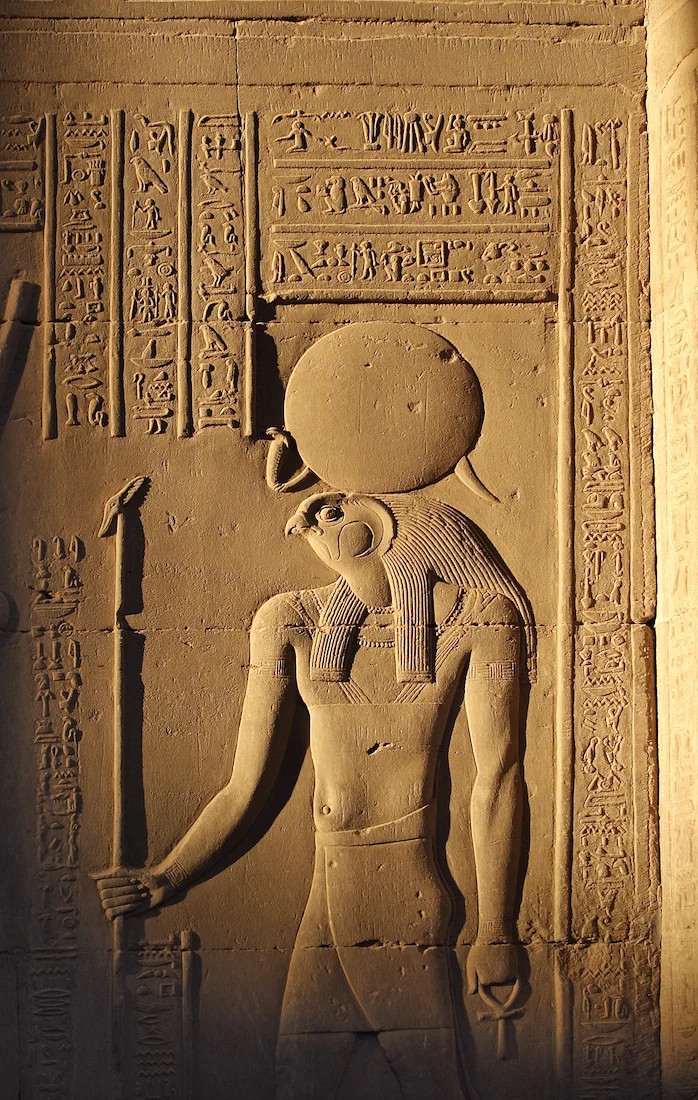
- The Falcon
- The Two Crowns
- The Lion
- Was Scepter
- The Sun
|
| Divine Numbers and Attributes |
|---|
| Sacred Numbers | 40, 50, 60 |
|---|
| Runes | Thurisaz, Tiwaz, Sowilo (in order of importance) |
|---|
| Zodiac Sign of Power | Aries |
|---|
| Sacred Animals | The Great Eagle, the Bull, the Hawk, the Serpent |
|---|
| Element | Fire, Aether |
|---|
| Divine Forces |
|---|
- The Visible
- The Manifest
- Order and Motion
- Divine Light
- Civilization
- Destruction of Izfet
|
| Important Titles |
|---|
- Lord of the Sky
- Son of Isis
- The Child
- Uniter of the Two Lands
- of the Two Horizons
- Protector of his Father
- of the Two Eyes
|
| Names Across Civilizations |
|---|
| Egyptian | Hrw (𓅃) |
|---|
| Greek | Horos (Ὧρος) |
|---|
I. The Name
The falcon symbol is older in Egypt than the name of Horus. The god's name is written with the hawk-sign, conventionally transliterated
Ḥr or Ḥrw and vocalized in modern usage as Hor, Har, Heru or Horus, it is one of the oldest divine names in the human record.
The theonym is built on a stem ḥaru-, to which the Afroasiatic nominative marker attached as a final glide, giving the writing Ḥrw that the
Old Kingdom scribes preferred.1, 2
Conventional Egyptologists still struggle to understand the root of Horus. Two candidate theories are possible and appear to be respectable
grammatically. The name may derive from the
preposition ḥr, "upon" or "above," which aligns with "the One on High," or from the verb ḥrj, "to be distant,", allowing for the "the Distant One." Antonio Loprieno from the University of
Basel believes that both may be at work in a single name, since the falcon is the animal that is furthest away and
a watcher straddling the skies in Egyptian mythology regardless.1,3
Royalty being the essential reason that his divine markers in writing are attested and alluded to makes the presence of Horus, like that of Ra, a difficult labyrinth to decipher when trying to find out what came first. The earliest writings of the falcon-sign that anyone can point to are the names of the Pharaoh. The contested case with Horus is Iry-Hor of the early thirty-second century BCE, whose name, a falcon above a mouth-sign, appears on more than twenty pottery jars from tomb B1/B2 at Umm el-Qaab in Abydos.4
Toby Wilkinson, for example, refused that sort of identification in 1993, arguing that no serekh accompanied the signs, that the group meant "property of the Pharaoh" and
named no Pharaoh whatsoever. Werner Kaiser and Günter Dreyer saw the same signs as "Companion of Horus." The matter was largely closed
in 2012 so far, when Pierre Tallet and Damien Laisney published a rock inscription from the Wadi 'Ameyra in the southern Sinai in which the name of
Iry-Hor is there beside an archaic serekh and beside a reference to Memphis. The god's name, on the present evidence, is attested
in writing from around 3200 BCE. The earliest sure occurrences of it belong to men.5, 6
Horus Ka and Narmer both write their names in the serekh with the falcon perched above the
palace facade, and on the great ceremonial palette recovered by James Quibell and Frederick Green from the Main Deposit at Hierakonpolis the
falcon holds a captive marsh-dweller by a rope.
Behind these Pharaohs the Turin Canon places the Šmsw-Ḥr, the Followers of Horus, a line of predynastic rulers whom the Egyptians themselves
could no longer date.4, 7
By the Ptolemaic period, the theonym was rendered as Ὧρος in Greek. It generates a whole family of theophoric names that the Greeks were content to transliterate rather
than translate, among them Ἁρσιῆσις (Harsiesis), Ἁροήρις (Haroiris) and Ἁρποκράτης (Harpokrates, Harpocrates), the latter coming to designate the child-like form of Horus. Coptic preserves the divine name chiefly inside personal names, in the form
ϩⲱⲣ (Hor). Edfu, the god's great house, was known to the Greeks as Ἀπόλλωνος πόλις μεγάλη, the Great City of Apollo.8
As for what the ancients thought the name meant, the surviving explanations consist of one Egyptian account and two Greek ones by priests privy to Egyptian holiness. Plutarch connects Horus with ὥρα, the
seasonable tempering of the surrounding air, and so makes the god a climate, but he connects this to a further Neoplatonic analogy. In the geometric chapter Plutarch reports that the Egyptians also call Horus by a name he
renders as "seen" (the theonym Min) on the reasoning that the world is a perceptible and visible thing (De Is. et Os. 56, 374B). He equates
the god Min who is often thought of as a separate god to Horus with ὁρώμενον (oromenon), 'that which is seen'.
Herodotus does not explain the name at all; he simply
equates Horus with Apollo and says he was the last of the gods to reign in Egypt, and has him depose Typhonus. Manetho, writing as
an Egyptian priest for a Greek Pharaoh, places Horus at the end point of the dynasty of gods, immediately before the human Pharaoh begin.9, 10, 11
In Meroe, Horus was named Ara (𐦠𐦫), first securely and completely attested on the Arnekhamani sistrum in writing.12
Sources: Loprieno, Ancient Egyptian: A Linguistic Introduction;
Erman and Grapow, Wörterbuch der aegyptischen Sprache; Faulkner, A Concise Dictionary of Middle Egyptian; Wilkinson, Early Dynastic Egypt; Quibell and Green, Hierakonpolis; Crum, A Coptic Dictionary; Herodotus, Histories1,2,3,4,7,8,10,12
II. Horus of Egypt
Horus can be found on a great number of walls throughout the Old Kingdom's funerary corpus and is often found in the context of repairing order.
The Pyramid Texts do not describe the history behind the events of his birth, his hiding or his youth. They merely assume he has had this
divinity from the beginning. Therefore, the deceased Pharaoh is Osiris, the living son of the deceased Pharaoh is Horus, and the
entire process of offerings were made for the purpose of giving back to the father all that which had been taken from him.13,14
Utterance 356 is an account by the office of the son of Osiris. When Horus arrived, he compelled Thoth to drive back the followers of Set who had
usurped Osiris' throne and made the heart of the usurper afraid; He restored to the dead man his two divine sisters and his rank. The passage contains
both a legal restoration of Osiris and a bodily resurrection for him. Geb saw that Osiris was qualified and put him in his proper position from the
instigation of his son, the heroic Horus.
O Osiris N., Horus has come that he may seek thee. He has caused that Thot turn back for thee the Followers of Set, and that he bring them
to thee all together. He has made the heart of Set timid. Thou art greater than he; thou didst come forth before him; thy qualifications
are better than his. Geb has seen thy qualifications; he has put thee in thy place. Geb has brought to thee thy two sisters, to thy side,
Isis and Nephthys.
Utterance 356, §§ 575a–577a, Pyramid Texts, trans. Mercer13
Utterance 369 also conveys this concept through the eye. In this instance Horus does not only retaliate. He gives part of himself to the
deceased. The gift which Horus provides the deceased is sight. The eye is given to the deceased for them to see with. As such, an additional name
of the eye, the Opener of the Way, is obtained by virtue of this act.
O Osiris N., stand up. Horus has caused thee to stand up. Geb has caused Horus to see his father in thee. Horus has given his eye to thee,
that thou mayest see with it. Horus has opened thine eye for thee, that thou mayest see with it, in her name of "Opener of the way." Thine
enemy is smitten by the children of Horus.
Utterance 369, §§ 640a–643b, Pyramid Texts, trans. Mercer13
The Egyptian offering ritual is built on this gift repeating it hundreds of times. In the offering list of Unas every item handed to the
dead man is spoken of as the Eye of Horus, so that the bread, the linen, the natron, the incense and the eye-paint are all one thing under
many names. The wine is the Eye, the cloth is the Eye, the green cosmetic rubbed on the face is the Eye. This is the core of what Horus is tied
to as the Wadjet.14
The four canopic gods appear here already as his children who render him assistance. Utterance 580 assigns the interior of the sacrificial ox to "those four gods, the
sons of Horus, his beloved, Ḥꜣpi, Imś.ti, Dwꜣ-mw.t.f and Ḳbḥ-śn.w.f, which places the guardians of the viscera in his household from the
Fifth Dynasty onwards.13
He has a variety of other roles. The Akhet or sky-zone he becomes a guide to the Pharaoh in. He gathers the limbs of the decreased and then
he opens the Mouth. The Pharaoh himself is identified as being Horus in being the manifestation of his sacred Father, the divine intellect through
whom Egypt's entire wheel turns.
The Middle Kingdom as a whole incorporates the divine childhood into the history of Horus. In The Coffin Texts, the god is born in secrecy and
carried with a fearful heart as he hatches under protection. The most famous one is The Falcon Spell No. 148. Here, Isis tells the gods about
her being pregnant and proclaims that there will be an arrival of a divine falcon. This spell has survived on the outside of Nakhti's coffin,
at this time housed in The Louvre. The middle section describes how the yet-to-be-born child boasts of his future.15,16
jnk ḥr ms.n ꜣst jry mkt.f m ẖnw swḥt nj ꜣd wj hh n(j) r(ꜣ).ṯn nj pḥ.n wj ḏdt.ṯn r.j
I am Horus, born of Isis, whose protection was made within the egg; the fiery breath of your mouths does not attack me, and what you say
against me does not reach me.
Coffin Texts, Spell 148, coffin S1P (Louvre E 11981), lines 121–12216
Spell 312 gives the long dialogue of Horus and Osiris across the boundary of death, and it passed almost intact into Spell 78 of the Book of
the Dead, which is a measure of how satisfactory the Egyptians found it. Spell 112 of the Book of the Dead preserves the
injury: Set in the form of a black pig assaults Horus' eye, and the wound is put into the mouth of Ra himself. Between the Old
Kingdom and the Middle Kingdom the avenger acquires an infancy, and it is the infancy that later cult builds towards.15,17,18
As with many other gods, there are indications that the cult of Horus became more accessible to the elites, but this is also materially rooted in his case. The Eye of Horus begins to appear with great frequency on coffins and sarcophagi. The Met Museum believes that the wedjat element combined any protective force with the idea of an opening through which the deceased could communicate with the outside world and see the eastern sunrise that the Pyramid Texts had long established as the boundary zone of the falcon.19
The great expansion of the temples of Horus began in the Middle Kingdom, particularly under Senusret I, who endeavored to give the worship of the gods their great homes.
The cult of Ra-Horakty spread strongly at the start of the New Kingdom. Even the Sphinx was interpreted as Horemarkhet (the Horus of the Horizon), such as in The Dream Stela of Thutmose IV, where it promises eternal monarchical rule if it clears away the sand from its midst. After the figure was used wrongly in the Amarna regime's early years, it was revitalized after the vile incident.
Horus became associated with the militarized cult of the Pharaohs in the New Kingdom after Egypt had disposed of its foreign rulers and in a distinct context after Akhenaten had been disposed of, adhering more closely to the royal program in clear contexts of the state. Many elaborate temples to Horus also began to appear in the frontier zones of Nubia, such as the important temple at Buhen.
At the same time, the characterization of the sun god as a child began to become more of a hallmark of Egyptian religious thought, evidenced by the amount of magical texts showing the healing of Horus by his mother, and more local forms of the falcon god began to proliferate within Egypt, so it was in the Third Intermediate period that the litany of Horus-the-Child types of divine representation began to become a major feature of Egyptian belief.20
His cult also became more intimate and tied to the home by the end of the New Kingdom and into the Third Intermediate Period, being increasingly divorced from a volatile political order. With Egypt increasingly occupied by a litany of foreign powers, the worship of Isis and Horus as mother and child is increasingly the subject of excavation and historical finds.21
Kushite Pharaohs and later kings in their state itself instituted an archaic form of Horus imagery based on ancient models. For example, the double-crown imagery was revived for state functions, which was married to a new kind of representation of Horus on the crocodile in a Nubian bronze. Statuary depicting Horus under their preference often goes back to Old Kingdom block art.22,23
The most distinctive Late Period development is the spread of Horus cippi, typically the Horus-on-the-Crocodiles stelae. These show the divine child standing on crocodiles and grasping dangerous animals such as snakes and scorpions for magical reasons. The Met states that water poured over such cippi was believed to heal injuries from snakes or scorpions.24,25
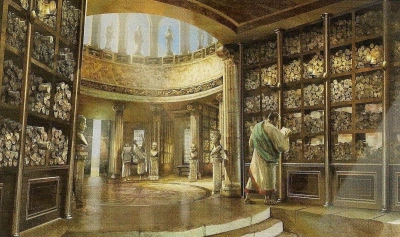
The Ptolemaic Dynasty inaugurated a gargantuan building program focusing around the renewal of the temples of Horus, tied strongly in theme to similar renovations of the sacred complexes of his mother, Isis, and his wife, Hathor. The revitalization of Edfu was started by Ptolemy III Euergetes; he standardized the 365 day calendar and reformed the priesthood heavily, building the Library at Alexandria as an attendum to the Serapeum there.26,27
Edfu shows major influence from earlier periods of Egyptian history, including its complex and arcane use of language combined with modern forms. The vast amount of ritual scenes, offering formulae, local theology, mythic battle texts, sacred geography, architectural theology, festival texts, processions, cosmogony, and temple descriptions demonstrate its extreme importance. Well into the Roman period, new additions were made.28
The worship of Horus as the divine child Harpocrates also increasingly spread into the Greek islands and cities, becoming enshrined in Rome from the first century BCE. The mass production of objects involving Harpocrates across the Mediterranean shows an extreme level of day-to-day engagement with the god, but it was a cult that spread further north, even into the Germanic provinces. Peter Satterthwaite even attributes Harpocrates as influencing religious artistic forms in the entire area.29,30,31,32
III. The Epithets of Horus
No other Egyptian god possessed so many functions. The Lexikon der ägyptischen Götter
und Götterbezeichnungen gathers hundreds of forms.
Sources: Leitz, Lexikon der ägyptischen Götter und Götterbezeichnungen, for the Egyptian title-forms and their
attestations; Wilkinson, The Complete Gods and Goddesses of Ancient Egypt, for the principal forms and their
domains; Hart, The Routledge Dictionary of Egyptian Gods and Goddesses, s.v. "Horus," for the local
falcons.33,34,35
IV. The Temples of Horus
Horus was the god of the person sitting on the throne as well as thrones being present all over the land. He had his temples along the entire length of Egypt; from the swamps of the Delta where, in mythos, the falcon child was placed for safe keeping to the fortresses of Nubia where the garrison soldiers prayed to an increasingly localized. Amongst these, however, Edfu towers above its peers as the most intact temple surviving from Ancient Egyptian Religion.
The earliest roots of Edfu are old. The Edfu settlement was the main city of the second Upper Egypt nome and a significant center for the area. Parts of the town that date back to the late Old Kingdom lie near the east side of the mound; the mound is also east of where the Ptolemaic Temple is located, while to the south there is one small pyramid associated with Huni, otherwise found in six other areas of Egypt.36,37,38
The construction of the current temple of Edfu began with laying the first stone on the 23rd August 237 BC by King Ptolemy III Euergetes. It was placed on top of an older temple that had a pylon wall dating back to the Ramesside period which is located to the east, but at an angle to the newer layout. The new temple was inaugurated on 10th September 142 BC during the visit of Ptolemy VIII. In addition to this, there were two further dedications; one in 70 BC, and the other when the doors made of cedar wood were donated for the temple in 57 BC by King Ptolemy XII Neos Dionysos.26,39
The Temple is approximately 140 meters long (front to rear) and covers an area of approximately 7,000 square meters. Suiting the arc of Ra-Horakhty, it was built on an east-west axis as opposed to north-south. The pylon measures nearly 36 meters in height and is one of the tallest in Egypt. There are four grooves on each side for flag staffs that measure 40 meters tall and there are four stories of rooms and chambers in each tower. In front of this structure is a forecourt that contains a paving made of stone with 32 columns. After the forecourt come two Hypostyle Halls, followed by the Offering Chamber, and then the Sanctuary holding the black granite naos of Nectanebo II.39,40
The sheer amount of written material that can be recovered from Edfu is what sets it apart. A French archeologist, Émile Chassinat, was able to publish all the inscriptions at Edfu in fourteen different volumes, which constitutes the most extensive collection of theology available for examination from an ancient Egyptian temple. As such, there exists within this one location the full complement of building texts, the festival calendar, the myth of the Winged Disk, the Sacred Drama of the Harpoon and the Temple's account as the "Island of Creation" upon which the falcon rested for the first time among the reeds.26,41
Nekhen (Hierakonopolis) is an extremely ancient site. The Predynastic Temple mound at Nekhen housed the "Main Deposit" along with its most notable artifacts, The Narmer Palette and the Scorpion macehead. More importantly, it preserved ritualistic items that carried the symbol of the Falcon Standards for each of the three phases of Naqada, one of the earliest eras in Ancient Egypt's history, possibly suggestive of an older identity of Horus. During the 6th Dynasty, an impressive hammer gold representation of the Falcon god's head with Obsidian Eyes and Plumed Diadem was created.7,34
However, the falcon of Nekhen is called Nḫny, the Nekhenite, so in the end it remains debated whether
this was originally Horus under a local title or a separate falcon god absorbed by him at an early date. Nekhenite is still a title used by him. Conversely, it appears Isis was worshipped at Nekhen as is attested in the Stela of Horemkhauef reflecting the requisition of a cult image of her and Horus, which is suggestive of his cult being active there.34,35,42
The first small temple at Buhen dates back to the Middle Kingdom. Horus, Lord of Buhen is already attested as the principal local deity in the reign of Senusret I. During the Second Intermediate Period, the kings of Kush around Kerma created a new center of worship in what was called the Northern temple with the assistance of the Egyptian commander and architect Sepedhor.43,44,45
Around the New Kingdom, inside the great fortress at the Second Cataract, Hatshepsut and Thutmose
III built a great South temple (an example of a Thutmoside ambulatory temple) constructed in sandstone to Horus of Buhen, which was dismantled and carried to Khartoum before the waters of the High Dam closed over the
site. There were two other temples nearby, namely Horus of Miam had his house at Aniba, and Horus of Baki had his own at Quban.46,47,48
The ddouble Temple at Kom Ombo is split in two from one end to the other; half is dedicated to Sobek, the other is dedicated to Haroeris, who was an aspect of Horus the Elder, with both deities having their own sanctuaries, doors and separated elements.. Theological texts edited by Adolphe Gutbub show Haroeris as a sky and battle god with his own wife, Tasenetnofret, and son Panebtawy. In this sense he had an entirely separate family, independent of the family of Osiris.
Near Alexandria, the great Hellenistic complex of Dendera that in many ways was a counterpart to Edfu belonged to the consort of Horus, Hathor, but she is the wife of the Behdetite and the mother of Harsomtus. Her temple is also on the northern pole of
the greatest festival in the Horus calendar. The temple on the island of Philae was a temple of Isis where Horus is depicted being nursed in its mammissi. The birth
houses themselves, at Edfu, at Dendera and at Philae, are a Ptolemaic institution of the first importance. François Daumas believed they existed to portray the arrival of the divine son.49,50,51
V. The Divine Child
At least some of the Old Kingdom literature referenced the acting heir, the litigant before the Ennead, the avenger who tore Set asunder. The vulnerable baby found floating on the marsh water are examples of what would develop into a later narrative. The New Kingdom passed through time and Ḥr-pꜣ-ẖrd rose to prominence to be eventually one of the most venerated deities throughout Egypt during the Late and Ptolemaic eras. Perhaps there existed an extended period of planned development or "theological evolution", but the possibility of non-survival of Old and Middle Kingdom artefacts makes this an open question.52, 53
It is said Horus was hidden in Ꜣḫ-bἰt (Chemmis in Greek), a papyrus thicket in the Delta near Buto, where Isis concealed the infant from Set. Herodotus was
shown the site and reports a floating island, on which Leto, whom he takes for the nurse of Apollo, hid the child from Typhon in his Greek interpretation.10
Horus was bitten, stung, poisoned, and paralyzed; he was shown battling snakes and all manner of beasts intent on destroying him. In the meantime, the sun remains motionless in the sky, awaiting Thoth's arrival to deliver the magic words that will heal him after his fight. It was in this violent environment that the entire healing worship of Horus developed, and this is illustrated by thousands of objects called cippi (otherwise called Horus stela) featuring the naked infant standing on top of crocodiles with snakes, scorpions, lions and oryxes clutched in each fist and the Bes dwarf mask on top of his head.54
The Metternich Stela is the largest of the group, a large piece of greywacke measuring 33 inches (about 84 cm) high. This was created during the time of the Late period Pharaoh, Nectanebo II, and can be found today at New York City's Metropolitan Museum of Art. The stela was created for a man named Esatum who worked as a priest. He may have written down these spells on this stela based upon what he had seen at the site where Mnevis Bulls were buried in Heliopolis. There are thirteen different magic spells that are found on this stela. Archaeologists believe when they poured water onto the carvings and then used the water to drink, it would deliver their spell.55
Texts on such stelae often include a reference to transforming water poured over the stela into a curative libation. An image of the infant
Horus on the front beneath a Bes-image is shown subduing dangerous animals.
Metropolitan Museum of Art, on the genre of the cippus55
The range of visual imagery to follow is staggering. The child sits cross-legged (naked) with his index finger at his lip and the youth lock on each side of his head. He sits upon the knees of Isis, who has a exposed breast to offer him, in a version of this type that Vincent Tran Tam Tinh documented as Isis Lactans and was carried throughout the entire Mediterranean during the expansion of her cult into the Roman Empire. Every year Horus was reborn in front of the masses within the mammisi while singing and dancing occured in the forecourt.51,53,56
VI. The Contendings of Horus and Set
Horus and Set were said in Egyptian myth to have fought bitterly. The Pyramid Texts of the Old Kingdom, from approximately 2353–2323 BCE, already reference the fight between Horus and Set in rather graphic detail. Set is said to have trampled the Eye of Horus, who then recovers it and emasculates his rival. The Teti section announces their 'contending' over it.
Following on from this by many years, the Lahun Papyrus is the next text to elucidate about the nature of their bitter struggle from the late Middle Kingdom. The principal fragments are now in the Petrie Museum as UC 32158 and UC 32150a, possibly with UC 32148b. It describes the unwelcome overtures of Set to Horus and other novel elements, but it does not preserve the entire narrative.57,58,59
The long quarrel between Horus and Set is contained most promienntly in one text, Papyrus Chester Beatty I, written in the Twentieth Dynasty and published by Alan Gardiner in
1931. The Contendings of Horus and Seth is really at its core a strange document: it is a sacred story told with the timing of a farce. Readers
have argued for a century about whether the Egyptians were laughing at their gods, laughing with them, or doing something the modern reader
has no category for.60,61
The tribunal of the Ennead sits for eighty years and cannot decide. Ra favors Set on the ground of strength, the other gods favor Horus on
the ground of divine right. The deadlock is broken only by letters like one from the goddess Neith, who awards the office to Horus while insisting that Seth be
compensated, and one from Osiris in the West, who reminds the court that he commands the messengers who take away the hearts of gods and
men.61
Between the hearings the two gods fight. The fights are essentially grotesque. Set tears out the eyes of Horus and buries them, and Hathor heals them
with the milk of a gazelle. Set attempts the humiliation of his nephew, and the goddess of magic, Isis, turns the assault back upon him through the lettuce
that he eats, so that the fluid of Horus answers from inside the body of Set when the gods call it. They race competitively in boats of stone, and Horus
cheats. The verdict is finally given for the son of Isis, and Ra takes Set up into the sky to be the thunder.
The Temple of Zeus explains the allegory behind the Contending. It is at the core a Titanic struggle regarding forces of ascent and entropy. Some Egyptologists understood the mechanism Herman te Velde insisted that Set is the god of confusion rather than a devil, and that Egypt needed him: the two gods are bound together at
the throne, tying the papyrus and the lotus around the sign of union on the sides of the royal seat.62, 63
VII. The Eye
The wḏꜣt (wadjet), the Eye of Horus, takes its name from the word for what is whole and sound, being a representation of serpentine completion. The eye is torn out,
divided, scattered and then made whole again by Thoth. It is in the state of its solar restoration, never in the state of injury, that the Egyptians
wore it. Amulets in this shape appear from the late Old Kingdom and were still being made under the Romans, which gives the symbol
a working life of two and a half thousand years.34
The way in which the Wadjet functioned is explained cursorily by the Egyptians from the New Kingdom. The two eyes of the falcon are the sun and the moon. The moon is the wounded one, waning under the assault of Set and healed at the full.
Here an honest caution is owed to the reader: no text unambiguously equates the eyes of Horus with the sun and the moon before the New Kingdom,
and the tidy scheme found in every popular book is a construction of the later tradition.34
Mathematical elements are present in the symbol itself, including fractions. In 1911 Georg Möller proposed that the six component strokes of the wḏꜣt hieroglyph were the
origins of the hieratic signs for the submultiples of the heqat measure, so that the pupil stood for one quarter, the eyebrow for one eighth,
and so on down to one sixty-fourth. Alan Gardiner enshrined the idea in his Grammar, with the charming coda that the six fractions
sum to only sixty-three sixty-fourths, and that the missing part was supplied by Thoth through magic.63,64
The Eye was also associated with its patron goddess, Wadjet, the cobra of Lower Egypt. Wadjet is often shown as the Nurse of Horus in Egyptian statuary, complementary to the imagery of Isis and Hathor, and in his own interpretation of Egyptian religion, Herodotus identified her with Leto, the mother of Apollo and Artemis. Even the main temple of Wadjet at Buto was strongly decorated with scenes celebrating Horus.
VIII. The Living Horus
The serekh is the oldest of the royal devices as a panelled palace facade with the king's name written inside it and with the falcon standing on the
roof.4 The Horus name is accordingly actually the oldest of the royal names, older than the cartouche, older than the title of Son of Ra, and
to it the Egyptians later added the Horus of Gold name, in which the falcon perches upon the sign for gold. The king does not petition Horus.
The king, while he lives, is Horus.
The theology of this is set out on the Shabaka Stone, a slab of black granite in the British Museum on which a Twenty-fifth Dynasty king had
copied what he claimed was a worm-eaten document of great antiquity. Geb divides the land between the two contenders, Upper Egypt
to Set and Lower Egypt to Horus, and then reverses himself and awards the whole of it to Horus, the son of his son. The union is made at
Memphis, at the Balance of the Two Lands, where the two halves of the country are weighed against each other and found equal. The Shabaka Stone is important to both Horus and Ptah.66, 67
Some Egyptologists saw patterns in how the Living Horus operated in line with the Pyramid Texts. Every death of the Pharaoh is a death of Osiris, every accession is an accession of Horus, and the
succession is therefore not an interruption in the divine order but the form in which the divine order operates.68 Egypt could
survive the death of any particular Pharaoh because Horus is always the one who is arriving. In Egypt the throne was a theology before it was ever just a royal unit.
IX. The Falcon
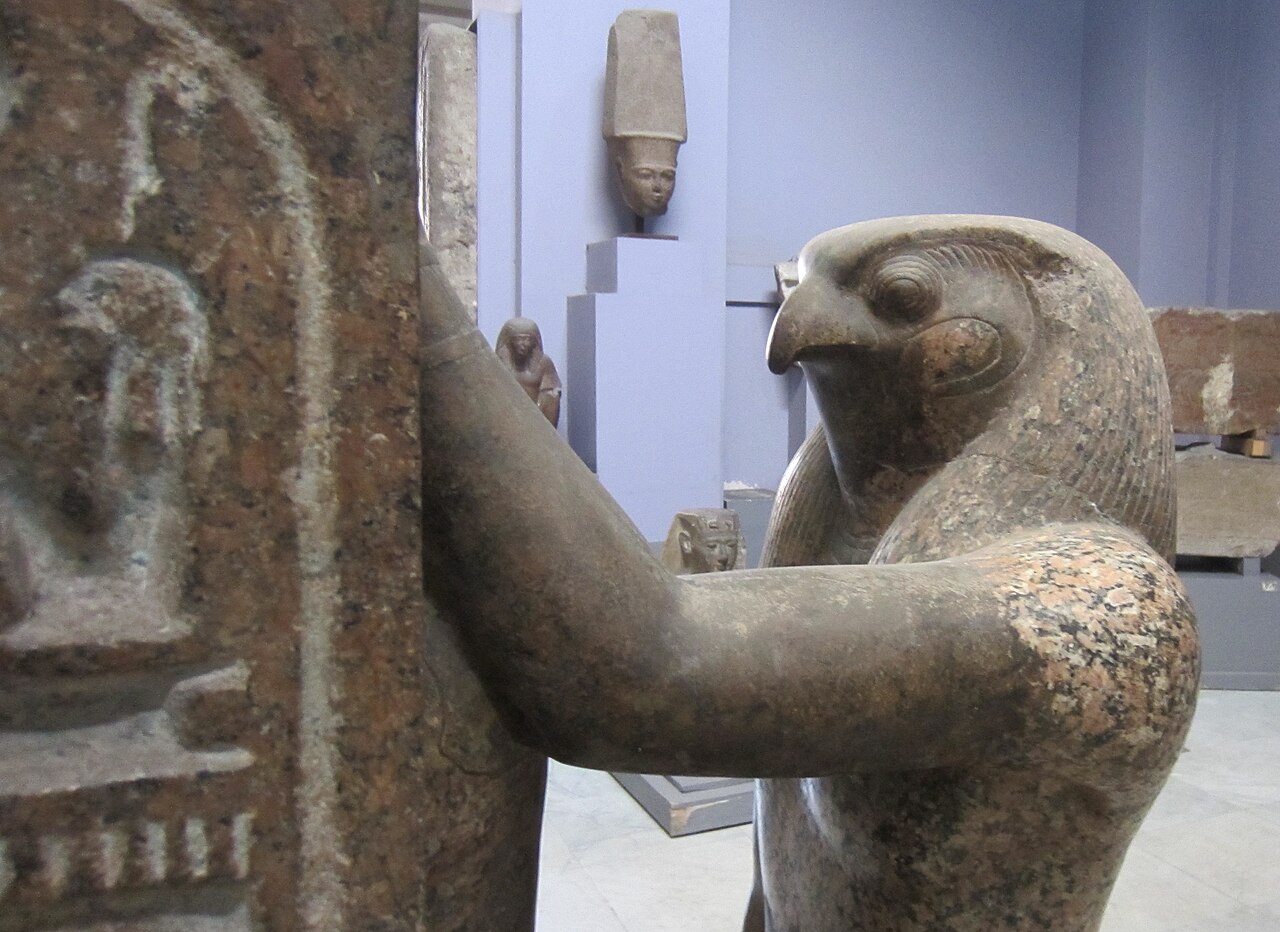
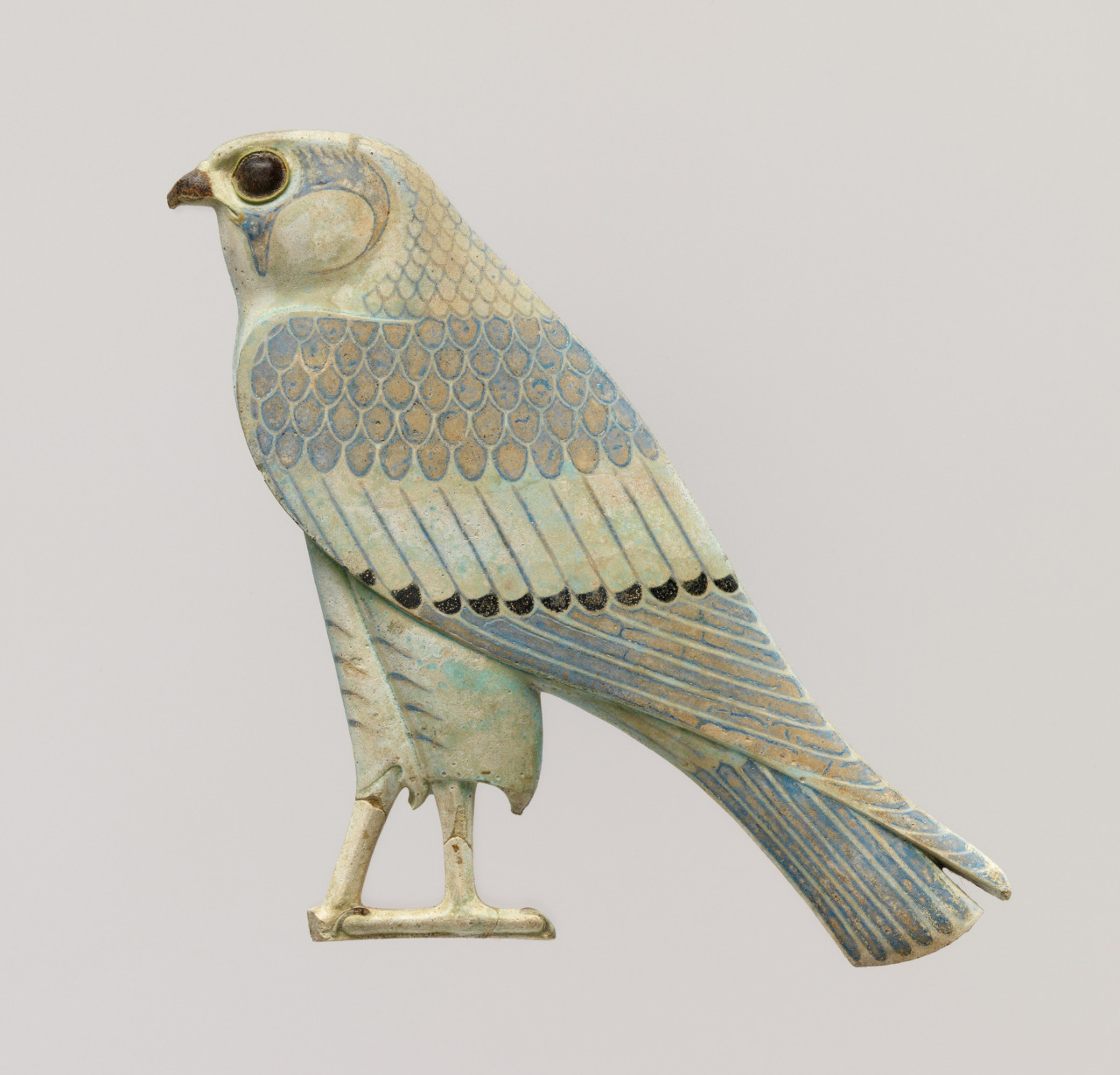
It is very likely that the Horus bird depicted by ancient Egyptian artists was either the Lanner Falcon (Falco biarmicus) or Peregrine Falcon (Falco peregrinus) since both species are known to breed in Egypt. As such, it can be said that these birds were well-known to the artists who created the images depicting the Horus symbolism. It is evident that they had sufficient knowledge of the two species to represent the Horus imagery realistically. These features include the cere (the fleshy growth above the upper mandible), the hooked shape of the bill and finally, the dark stripe found on the face below the eye, which is represented in the image of the wḏꜣt as a curled marking. 34
Wild peregrine falcons have been observed approaching relatively small avian prey from distances of up to about 1,500 meters, nearly a mile.69,70 The falcon also has two fovae, areas of the sharpest central vision, in contrast to that of humans who only have one. The fovae are symbolic of the Eye of Horus and Ra. Falcons also have plumage to reduce sun blare and process visual information at around 129Hz, making movement perception far more acute and blur in motion far less prominent.71,72 The therian symbolism is not a mistake, the Horus animal is a microcosm of the god.
The most eloquent statement of this in Egyptian sculpture is the seated Khafre of the Fourth Dynasty, where the falcon stands behind the Pharaoh's
head and folds its wings around the back of his skull. The bird is holding him. From the
Sixth Dynasty comes the gold head from Nekhen already mentioned, and the two objects together span the whole Old Kingdom conception: the god
embraces the king, and the god has a face of beaten gold and eyes of black glass.34
Horus of Behdet appears over nearly every temple doorway in Egypt as a sun disk with outstretched wings and two uraei. Some texts from Edfu itself
explain the image with a myth. The god takes the form of the winged disk in order to fly down upon the enemies of Ra and destroy them. Those who escape become the crocodiles and hippopotami of the marsh, which is why the harpoon is needed to destroy them. Horus was a religious guardian over any ubiquitous sacred boundary, his talons ready to tear at iniquity.26,73
The celestial forms of Horus include Harakhty (Horus of the Two Horizons), the fusion of Horus with the solar deity Ra forming Ra-Harakhti; and Harmachis (Horus in the Horizon), the title given by the New Kingdom to the Great Sphinx at Giza. Thutmose IV placed a granite stele in front of the paws of the Sphinx that recorded a dream in which he believed the buried god had granted him a promise of kingship if he would remove the sand covering his shoulders. Christiane Zivie-Coche demonstrated how all of the Giza Plateau was reassigned based on that concept.34,74
X. Harpocrates
The Greeks discerned that two Horuses existed. The adult falcon they translated into a system, calling him Apollo, so that Behdet became
Apollonopolis and the god of Edfu was understood under a Greek name. The infant Horus they took in a separate direction. They took Ḥr-pꜣ-ẖrd into
their own mouths as Ἁρποκράτης, Harpocrates, a Hellenized version of the child god.10, 52, 75
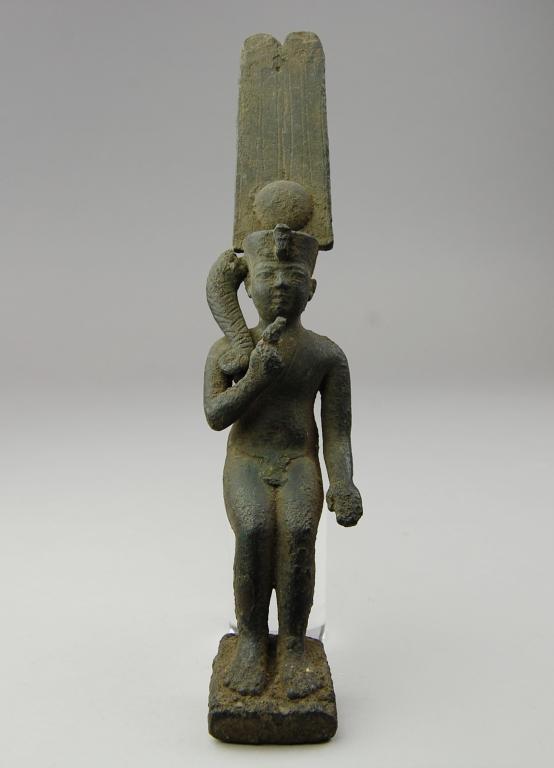
In a wider context, Egyptian art shows the divine child with one finger raised to his lips.
Hieroglyphs always replicated the symbol to indicate a child in this way. The hieroglyph of the seated infant with his hand to his mouth, catalogued by Gardiner as sign A17, is the
determinative of childhood and youth.64
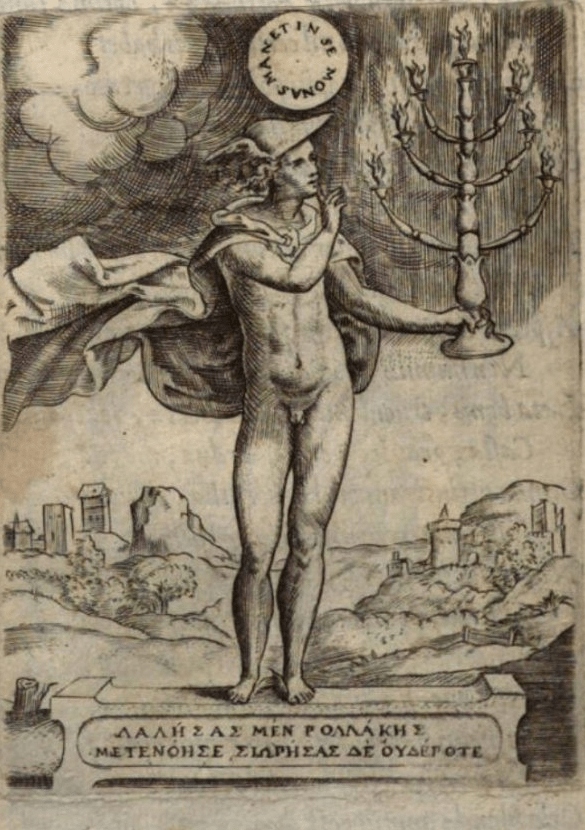
The Greeks and the Romans read it as silence. Ovid places him in the procession of Isis in the Metamorphoses
as the one "who presses back the voice and with his finger urges silence." Augustine reports the same interpretation with contempt
and uses it to convict the whole Egyptian religion. Many centuries after his heyday, Harpocrates the god of silence even was depicted on Renaissance emblem
books and Baroque-era ceilings.76, 77
Plutarch provides certain subtle descriptions of both the god and how he was expressed. He states within the sixty eighth chapter of Isis and Osiris, that Harpocrates is certainly neither an immature or incomplete infant god nor merely a patron deity of beans; but as the rectifier of "immature, defective, and unclear thinking about the gods by mankind", reflecting his likeness to himself. The finger positioned upon the lips is indicative of restraint, rather than pure silence.9
The cult of Harpocrates itself was vast in scope. Harpocrates entered the Alexandrian Triad beside Serapis and Isis and travelled with them everywhere the mystery religion
went, into the holy island of Delos, Pompeii, Rome and other Italian locales, even into Gaul and the Rhine frontier. He survives in thousands of terracottas and bronzes: a boy with
the side-lock, the Egyptian double crown, a cornucopia in his arm, sometimes seated on a lotus, sometimes carrying the club of
Herakles. He appears constantly on magical gems, where the finger and the lotus were worked into invocations.75, 78
XI. Plutarch and the Elder Horus
The essay on Osiris and Isis was written by Plutarch, the senior priest of Apollo, for a priestess resident at Delphi named Clea. He had undertaken much research and corresponded with Egyptian priests one-on-one. The theology of Plutarch is distinct: Osiris is Nous or pure intellect, unmixed Logos; Isis is the receptive and creative principle, the container of the Timaeus dialogue of Plato; Typhon is the unorderly and non-rational Soul; and Horus, being born from the combination of both other entities, is the order and perceptibility of the world itself as an image of the intelligible.9, 79
The images from it with which the sensible and corporeal is impressed... are not permanently lasting, but disorder and disturbance overtakes
them, being driven hither from the upper reaches, and fighting against Horus, whom Isis brings forth, beholden of all, as the image of the
perceptible world.
Plutarch, De Iside et Osiride 54 (373B), trans. Babbitt80
Ḥr-wr, Haroeris, the Elder Horus, is a ancient Egyptian
god attested from the Old Kingdom. He was enthroned in his own half of the temple at Kom Ombo (otherwise the preserve of Set) with his own consort and his own son, honored at
Letopolis as the falcon of the eyes. The Egyptians did distinguish an elder falcon from the son of Isis.6,33
The Egyptian Haroeris is a sky god and a warrior, generally
reckoned a son of Ra or a child of Geb and Nut, and in no Egyptian text is he a premature cripple, a first draft of the cosmos, or the
offspring of Osiris and Isis coupling inside the body of their mother. The lameness that Plutarch attaches to the elder god
belongs, in Egypt, to the child of the cippi, who is poisoned and paralysed in the marsh. It is important to remember that the blurring between the two forms of Horus recalls Greek overlapping myths about Dionysus and other divine figures.18,33,49,54
Within this scheme the elder Horus performs a specific philosophical task. In the twelfth chapter Plutarch reports that on the second of the
epagomenal days Arueris was born, "whom they call Apollo, and some call him also the elder Horus," conceived by Isis and Osiris while the two
were still in the womb of Rhea. In the fifty-fourth chapter he tells us what that means: before the world was made visible, Nature
brought forth of itself a first creation that was imperfect, and this is why the god was said to be born in darkness and lame, and there was
then no world, only an image and outline of a world to be. Then: "But this Horus is himself perfected and complete."9, 80
The younger Horus is subjected to the same treatment. He is charged with being illegitimate by Typhon because he is not perfect like Osiris and contaminated with matter. But in the same narrative he is defended by Hermes, who is Reason. Harpocrates, born prematurely and weak in the lower limbs, becomes the imperfect first attempt at speaking about the
gods, something that Plutarch states is the primary reason he is shown with the hushing gesture. The summary of Plutarch is a Middle Platonist interpretation of Egyptian religion.9, 80
But in the same narrative he is defended by Hermes, who is Reason. He states that Nature shows becoming is as valid as perfect being. He separates imperfection from illegitimacy. The world is a defective or deformed model, yet still a true-born son, which ties the present test of fate into the crippled Horus motif. It limits evil to outside the universe, because it is actually Typhon's defectiveness (Izfet) that can cause the world to be defiled rather than the physical substance in itself, leaving material as appropriate matter for Reason to shape, and limiting debasement to excesses and disorders.
Plutarch then discerns a third kind of Horus of eternal victory, the perfected type, the finished visible cosmos, one who has mastered Typhon's powers and has brought the origin (Osiris) and Recipient (Isis) into the best level of development. This he links to the hypotenuse of a right-angled triangle.
Historical consensuses lack the vocabulary to understand the allusion Plutarch is drawing as a metaphysical interpretation. John Gwyn Griffiths, who edited On Isis and Osiris and who wrote the standard study of the Horus and Set conflict, is the fairest judge available, and for him the
Egyptian data in Plutarch are frequently sound, his informants were real, but the conclusion is that the metaphysics of Plutarch are his own ones. Daniel Richter has put
the matter more sharply, reading the essay as a work of Platonist theology that uses Egyptian religion as a vocabulary.9,18,81,82
The problem with this skepticism is that much of Plutarch's work was grounded in discussion with Egyptian priests, and that he as a senior priest of Apollo was strongly familiar with solar theology and the mathematical parallel being drawn. The festival of Horus is a clue that shows that Plutarch was attesting to something resident in Egyptian religion. The
Egyptians did believe that the ordered world is under permanent assault, that the assault is beaten back by the accession of Horus, and that
this has to be done again every year in a real building with real harpoons. The celebrations tied to that were known as the Festival of Victory.
XII. The Festivals of Horus
The festival calendar of Edfu is the fullest record of its kind to survive from Egypt, and it is one of the great gifts of the Ptolemaic
temples to modern scholarship who wish to understand Egypt.26,82,83
Sources: Plutarch, De Iside et Osiride 52 (372B); Cauville, Dendara: Les fêtes d'Hathor; Daumas, Les mammisis des temples égyptiens; Alliot, Le culte d'Horus à Edfou au temps des Ptolémées; Fairman, Worship and Festivals in an Egyptian Temple; Fairman, The Triumph of Horus; Coppens, Temple Festivals of the Ptolemaic and Roman Periods9,51,66,82,83,84
The Beautiful Meeting of Hathor is an example. An image of the goddess Hathor traveled from Dendera by boat for 14 day, stopping along the way at each port, and at Edfu it met Horus as he emerged from his house. The two images were then carried in procession into their respective temples. The people remained outside the temple grounds for another fortnight while they ate, drank, and sang, and also made pilgrimages across the deserts to the tombs of their ancestors.50,82
The Coronation of the Sacred Falcon is the most political. On the first day of Tybi a living falcon, reared inside the temple precinct, was
chosen by the oracle of the god as his heir, displayed to the crowd from the bridge between the two pylon towers, and then carried inside and
crowned. The pylon was built to imitate the horizon. Every year the
kingship of Horus was renewed in a bird, in public, and the display was legible from the far side of the courtyard.83,84
The Festival of Victory was the festival connected directly to the Contending itself. In the second month of Peret the sacred drama was performed, the text of which Herbert Fairman
reconstructed and published as the oldest complete play surviving anywhere in the world.73 Ten harpoons are cast; a hippopotamus,
the animal of Seth, is struck in the neck, in the flank, in the head; the reader recites, the chorus answers, and the whole company shouts the
line that carries the play.
Grasp firmly the harpoon, breathe the air in Chemmis, O lord of Mesen, captor of the Hippopotamus, creator of joy, goodly Falcon who boards his
boat and takes to the river in his war-galley... Hold fast, Horus, hold fast!
The Triumph of Horus, Edfu, trans. Blackman and Fairman73
XIII. The Falcon After Egypt
Under Theodosius, all true religious sites were officially forbidden. The older religions had retreated to the far southern parts of Egypt by this time, cut off from Rome, and the priestly organizations continued there for another century. The final hieroglyphic inscriptions in the world were made in 394CE by a man called Esmet-Akhom in Philae), and the Isis cult in that location persisted into the 6th century until Justinian who had reconquered part of southern Egypt suppressed it.85, 86
The majority of vandalism at Edfu occurred at the hands of Christians. Crosses were carved into the reliefs, the ceiling of the sanctuary was burned black by fire in a failed attempt to destroy everything, while the faces of the gods were chiseled from the walls wherever a person could reach. Houses were built atop the temple when the desert and Nile silt buried the temple up to 12 meters deep. In 179,8 only the top portion of each pylon was visible over the village. It took Auguste Mariette until 1860 to start unearthing it. The sand that consumed Edfu allowed for us to read it, and Horus was buried in the Egyptian sands where he remained safe.39
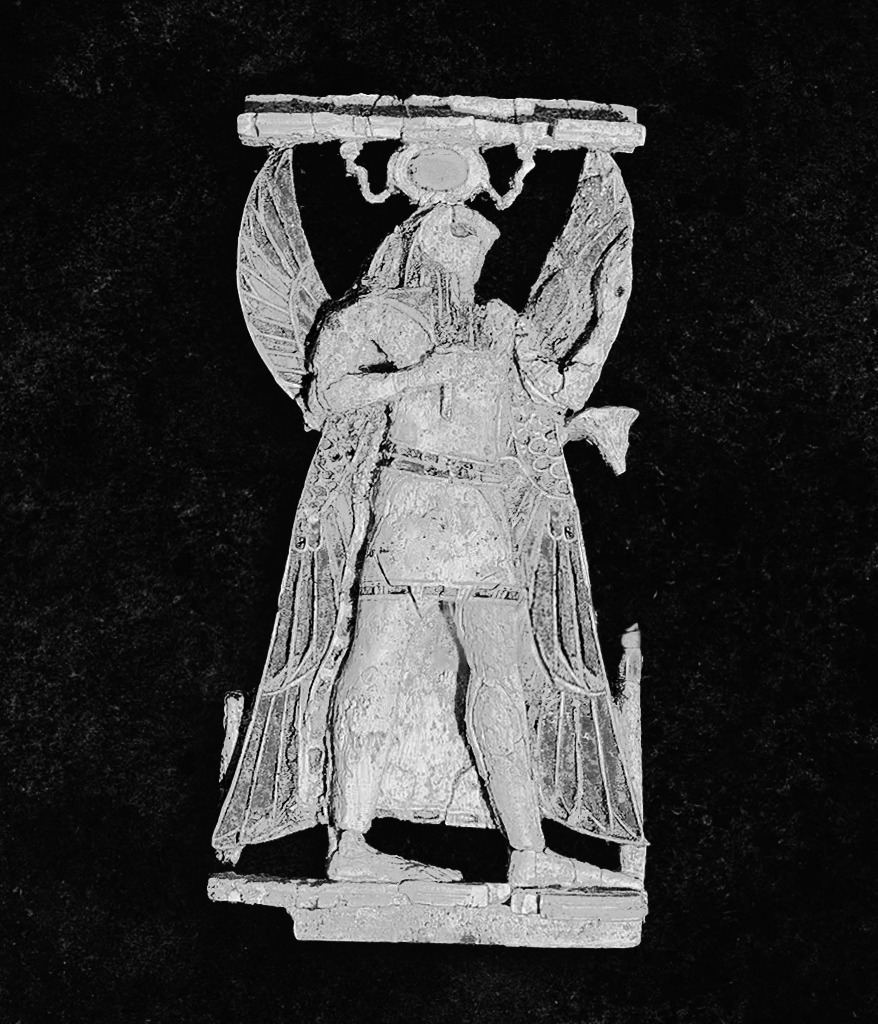
One object from the very end of the story deserves particular attention. In the Louvre there is a sandstone fenestrella of the fourth century
CE, once part of a window, on which a falcon-headed god in Roman military dress sits on horseback and drives a spear into a crocodile.
Charles Clermont-Ganneau published it in 1876 and argued that here was the ancestor of Saint George. The god is Horus, the crocodile
is Set.87, 88, 89
Sources and Bibliography
- Loprieno, Antonio. Ancient Egyptian: A Linguistic Introduction. Cambridge: Cambridge University Press, 1995. For the stem ḥaru- and the derivation of the theonym from ḥr ("above") or ḥrj ("to be distant").
- Erman, Adolf, and Hermann Grapow. Wörterbuch der aegyptischen Sprache. 5 vols. Leipzig: J. C. Hinrichs, 1926–1931, s.v. ḥr.
- Faulkner, Raymond O. A Concise Dictionary of Middle Egyptian. Oxford: Griffith Institute, 1962, s.v. ḥrw.
- Wilkinson, Toby A. H. Early Dynastic Egypt. London: Routledge, 1999. For the serekh, the Horus name, and the Followers of Horus in the Turin Canon.
- Wilkinson, Toby A. H. "The Identification of Tomb B1 at Abydos: Refuting the Existence of a King 'Ro/Iry-Hor.'" Journal of Egyptian Archaeology 79 (1993): 91–93.
- Tallet, Pierre, and Damien Laisney. "Iry-Hor et Narmer au Sud-Sinaï (Ouadi 'Ameyra): Un complément à la chronologie des expéditions minières égyptiennes." Bulletin de l'Institut français d'archéologie orientale 112 (2012): 381–398.
- Quibell, James E., and Frederick W. Green. Hierakonpolis. 2 vols. Egyptian Research Account 4–5. London: Bernard Quaritch, 1900–1902. For the Main Deposit and the Narmer Palette.
- Crum, Walter E. A Coptic Dictionary. Oxford: Clarendon Press, 1939. For the Coptic form ϩⲱⲣ in personal names.
- Plutarch. De Iside et Osiride. Edited and translated with an introduction and commentary by J. Gwyn Griffiths. Cardiff: University of Wales Press, 1970. See chapters 12 (355D–E), 19 (358E), 38 (366A), 52 (372B), 54–55 (373B–C), 65 (377B), 68 (378C).
- Herodotus. The Persian Wars. Translated by A. D. Godley. 4 vols. Loeb Classical Library. Cambridge, MA: Harvard University Press, 1920–1925. See 2.144 and 2.156 for Horus as Apollo and the floating island of Chemmis.
- Manetho. Aegyptiaca. In Manetho, translated by W. G. Waddell. Loeb Classical Library 350. Cambridge, MA: Harvard University Press, 1940. For Horus at the close of the dynasty of gods.
- Breyer, Francis. Schrift und Sprache in Nubien: Studien zum Napatanischen, Meroitischen und Altnubischen. Meroitica 29. Wiesbaden: Harrassowitz Verlag, 2022. For the Meroitic name of Horus (Ara) on the Arnekhamani sistrum.
- Mercer, Samuel A. B. The Pyramid Texts in Translation and Commentary. 4 vols. New York: Longmans, Green, 1952. Utterances 356 (§§ 575–577), 369 (§§ 640–643) and 580 (§ 1548).
- Allen, James P., trans. The Ancient Egyptian Pyramid Texts. 2nd ed. Writings from the Ancient World 23. Atlanta: SBL Press, 2015. For the offering ritual of Unas and the Eye of Horus formulae.
- Faulkner, Raymond O., trans. The Ancient Egyptian Coffin Texts. 3 vols. Warminster: Aris & Phillips, 1973–1978. Spells 148 and 312.
- Thesaurus Linguae Aegyptiae. Coffin Texts, Spell 148, coffin S1P (outer coffin of Nakhti, Musée du Louvre E 11981), lines 121–122. Accessed July 14, 2026.
- Faulkner, Raymond O., trans. The Ancient Egyptian Book of the Dead. Edited by Carol Andrews. London: British Museum Press, 1972. Spells 78 and 112.
- Griffiths, J. Gwyn. The Conflict of Horus and Seth from Egyptian and Classical Sources. Liverpool: Liverpool University Press, 1960.
- Metropolitan Museum of Art. "Coffin of Ameny." The Metropolitan Museum of Art Collection Online. Middle Kingdom, ca. 1981–1802 BCE. Accessed July 14, 2026.
- Taylor, John H. "The Third Intermediate Period." In The Oxford History of Ancient Egypt, edited by Ian Shaw, 324–363. Oxford: Oxford University Press, 2000.
- Metropolitan Museum of Art. "Stela of Horemkhauef." The Metropolitan Museum of Art Collection Online. Middle Kingdom, early Dynasty 13. Accessed July 14, 2026.
- Metropolitan Museum of Art. "Rishi Coffin." The Metropolitan Museum of Art Collection Online. Second Intermediate Period–early New Kingdom. Accessed July 14, 2026.
- Kessler, Dieter. Die heiligen Tiere und der König. Wiesbaden: Harrassowitz, 1989.
- Ritner, Robert K. "Horus on the Crocodiles: A Juncture of Religion and Magic in Late Dynastic Egypt." In Religion and Philosophy in Ancient Egypt, edited by William Kelly Simpson, 103–116. Yale Egyptological Studies 3. New Haven: Yale Egyptological Seminar, 1989.
- Lloyd, Alan B. "The Late Period, 664–332 BC." In The Oxford History of Ancient Egypt, edited by Ian Shaw, 364–387. Oxford: Oxford University Press, 2000.
- Chassinat, Émile. Le temple d'Edfou. 14 vols. Mémoires publiés par les membres de la Mission archéologique française au Caire. Cairo: Institut français d'archéologie orientale, 1897–1934.
- Kurth, Dieter. The Temple of Edfu: A Guide by an Ancient Egyptian Priest. Cairo: American University in Cairo Press, 2004.
- Wilson, Penelope. A Lexicographical Study of the Ptolemaic Texts in the Temple of Edfu. PhD diss., University of Liverpool, 1991.
- Savvopoulos, Kyriakos. "Popular Divine Imagery in Hellenistic and Roman Alexandria: The Terracotta Figurines Collection of the Patriarchal Sacristy in Alexandria." Annual of the British School at Athens 114 (2019): 317–368.
- Tran tam Tinh, V., Bertrand Jaeger, and Serge Poulin. "Harpokrates." In Lexicon Iconographicum Mythologiae Classicae, vol. 4.1, 415–445, and vol. 4.2, 242–266. Zurich and Munich: Artemis, 1988.
- Witteyer, Marion. Das Heiligtum für Isis und Mater Magna: Texte und Bilder. Mainz am Rhein: Philipp von Zabern, 2004.
- Satterthwaite, Peter. "A Harpocratic Attis? Thoughts on a New Discovery from Roman Mainz." Latomus 80, no. 2 (2021): 385–396.
- Leitz, Christian, ed. Lexikon der ägyptischen Götter und Götterbezeichnungen. 8 vols. Orientalia Lovaniensia Analecta 110–116, 129. Leuven: Peeters, 2002. For the Horus titles and their attestations.
- Wilkinson, Richard H. The Complete Gods and Goddesses of Ancient Egypt. London: Thames & Hudson, 2003. For the forms of Horus, the wedjat, and the Nekhen falcon head.
- Hart, George. The Routledge Dictionary of Egyptian Gods and Goddesses. 2nd ed. London: Routledge, 2005, s.v. "Horus."
- Moeller, Nadine. The Archaeology of Urbanism in Ancient Egypt: From the Predynastic Period to the End of the Middle Kingdom. Cambridge: Cambridge University Press, 2016.
- Moeller, Nadine, and Gregory Marouard. "Excavation on the Old Kingdom Settlement at Tell Edfu." Oriental Institute News & Notes 244 (2020): 10–17.
- Marouard, Gregory, and Hratch Papazian. "The Edfu Pyramid Project: Recent Investigation at the Last Unexplored Provincial Step Pyramid." Oriental Institute News & Notes 213 (2012): 3–9.
- Wilkinson, Richard H. The Complete Temples of Ancient Egypt. London: Thames & Hudson, 2000. For Edfu, Kom Ombo, and the burial and excavation of the Edfu temple.
- Institute for the Study of Ancient Cultures, University of Chicago. "Temple of Horus." Tell Edfu Project. Accessed July 14, 2026. For the dimensions of the temple, the pylon, and the forecourt.
- Kurth, Dieter. Treffpunkt der Götter: Inschriften aus dem Tempel des Horus von Edfu. Zurich: Artemis, 1994.
- Hayes, William C. "Ḥoremkha'uef of Nekhen and His Trip to Iṯ-Towe." Journal of Egyptian Archaeology 33 (1947): 3–11.
- Emery, Walter B., H. S. Smith, and A. Millard. The Fortress of Buhen: The Archaeological Report. Excavation Memoir 49. London: Egypt Exploration Society, 1979.
- Ullmann, Martina. "Egyptian Temples in Nubia during the Middle and the New Kingdom." In Handbook of Ancient Nubia, edited by Dietrich Raue, 511–540. Berlin: De Gruyter, 2019.
- Smith, H. S. The Fortress of Buhen: The Inscriptions. Excavation Memoir 48. London: Egypt Exploration Society, 1976; and Torgny Säve-Söderbergh, "A Buhen Stela from the Second Intermediate Period (Khartûm No. 18)," Journal of Egyptian Archaeology 35 (1949): 50–58.
- Caminos, Ricardo A. The New-Kingdom Temples of Buhen. 2 vols. Archaeological Survey of Egypt 33–34. London: Egypt Exploration Society, 1974.
- Ullmann, Martina. "Ritual Landscape in Nubia during the New Kingdom: The Example of Miam/Aniba." In Ritual Landscape and Performance: Proceedings of the International Conference on Ritual Landscape and Performance, Yale University, September 23–24, 2016, edited by Christina Geisen. Yale Egyptological Studies 13. New Haven, CT: Yale Egyptology, 2020.
- Ullmann, Martina. "Überlegungen zur kultischen Strukturierung Nubiens im Neuen Reich." In 7. Ägyptologische Tempeltagung: Structuring Religion, Leuven, 28. Sept.–1. Okt. 2005, edited by René Preys. Königtum, Staat und Gesellschaft früher Hochkulturen 3.2. Wiesbaden: Harrassowitz, 2009.
- Gutbub, Adolphe. Textes fondamentaux de la théologie de Kom Ombo. Bibliothèque d'étude 47. Cairo: Institut français d'archéologie orientale, 1973. For Haroeris, Tasenetnofret, and Panebtawy.
- Cauville, Sylvie. Dendara: Les fêtes d'Hathor. Orientalia Lovaniensia Analecta 105. Leuven: Peeters, 2002.
- Daumas, François. Les mammisis des temples égyptiens. Paris: Les Belles Lettres, 1958.
- Sandri, Sandra. Har-pa-chered (Harpokrates): Die Genese eines ägyptischen Götterkindes. Orientalia Lovaniensia Analecta 151. Leuven: Peeters, 2006.
- Budde, Dagmar. "Child Deities." In UCLA Encyclopedia of Egyptology, edited by Willeke Wendrich. Los Angeles: UCLA, 2010.
- Sternberg-el Hotabi, Heike. Untersuchungen zur Überlieferungsgeschichte der Horusstelen: Ein Beitrag zur Religionsgeschichte Ägyptens im 1. Jahrtausend v. Chr. Ägyptologische Abhandlungen 62. Wiesbaden: Harrassowitz, 1999.
- Metropolitan Museum of Art. "Magical Stela (Metternich Stela)." Accession no. 50.85. Fletcher Fund, 1950. The Metropolitan Museum of Art Collection Online. Accessed July 14, 2026. Greywacke, H. 83.5 cm, reign of Nectanebo II, commissioned by the priest Esatum.
- Tran Tam Tinh, Vincent. Isis lactans: Corpus des monuments gréco-romains d'Isis allaitant Harpocrate. Études préliminaires aux religions orientales dans l'Empire romain 37. Leiden: Brill, 1973.
- Griffith, Francis Llewellyn. Hieratic Papyri from Kahun and Gurob (Principally of the Middle Kingdom). London: Bernard Quaritch, 1898.
- Petrie Museum of Egyptian Archaeology. “Fragmentary Papyri with Part of the Tale of Horus and Seth, UC 32150a.” UCL Collections Online.
- Petrie Museum of Egyptian Archaeology. “Papyrus Fragment with Part of the Tale of Horus and Seth, UC 32158.” UCL Collections Online.
- Gardiner, Alan H. The Library of A. Chester Beatty: The Chester Beatty Papyri, No. I. London: Oxford University Press, 1931.
- Lichtheim, Miriam. Ancient Egyptian Literature. Vol. 2, The New Kingdom. Berkeley: University of California Press, 1976, 214–223. For the translation of The Contendings of Horus and Seth.
- te Velde, Herman. Seth, God of Confusion: A Study of His Role in Egyptian Mythology and Religion. Probleme der Ägyptologie 6. Leiden: Brill, 1967.
- Möller, Georg. "Die Zeichen für die Bruchteile des Hohlmaßes und das Uzatauge." Zeitschrift für ägyptische Sprache und Altertumskunde 48 (1911): 99–101.
- Gardiner, Alan H. Egyptian Grammar: Being an Introduction to the Study of Hieroglyphs. 3rd ed. Oxford: Griffith Institute, 1957. See §266 for the Horus-eye fractions and the sign-list entry A17 for the child with hand to mouth.
- Ritter, Jim. "Closing the Eye of Horus: The Rise and Fall of 'Horus-Eye Fractions.'" In Under One Sky: Astronomy and Mathematics in the Ancient Near East, edited by John M. Steele and Annette Imhausen, 297–323. Alter Orient und Altes Testament 297. Münster: Ugarit-Verlag, 2002.
- British Museum. "The Shabaka Stone." Museum no. EA 498. The British Museum Collection Online. Accessed July 14, 2026.
- Lichtheim, Miriam. Ancient Egyptian Literature. Vol. 1, The Old and Middle Kingdoms. Berkeley: University of California Press, 1973, 51–57. For the Memphite Theology.
- Frankfort, Henri. Kingship and the Gods: A Study of Ancient Near Eastern Religion as the Integration of Society and Nature. Chicago: University of Chicago Press, 1948.
- Fox, Robert, Stephen W. Lehmkuhle, and David H. Westendorf. "Falcon Visual Acuity." Science 192, no. 4236 (1976): 263–265. The experimental falcon resolved approximately 160 cycles per degree compared with approximately 60 cycles per degree in the human subjects.
- Tucker, Vance A., A. E. Tucker, K. Akers, and J. H. Enderson. "Curved Flight Paths and Sideways Vision in Peregrine Falcons (Falco peregrinus)." Journal of Experimental Biology 203, no. 24 (2000): 3755–3763; and Vance A. Tucker, "The Deep Fovea, Sideways Vision and Spiral Flight Paths in Raptors," Journal of Experimental Biology 203, no. 24 (2000): 3745–3754.
- Vrettos, Michelle, Chevonne Reynolds, and Arjun Amar. "Malar Stripe Size and Prominence in Peregrine Falcons Vary Positively with Solar Radiation: Support for the Solar Glare Hypothesis." Biology Letters 17, no. 6 (2021).
- Potier, Simon, Margaux Lieuvin, Michael Pfaff, and Almut Kelber. "How Fast Can Raptors See?" Journal of Experimental Biology 223, no. 1 (2020): jeb209031.
- Fairman, Herbert W., ed. and trans. The Triumph of Horus: An Ancient Egyptian Sacred Drama. Berkeley: University of California Press, 1974. Incorporating A. M. Blackman and H. W. Fairman, "The Myth of Horus at Edfu: II," Journal of Egyptian Archaeology 28 (1942), 29 (1943) and 30 (1944).
- Zivie-Coche, Christiane. Sphinx: History of a Monument. Translated by David Lorton. Ithaca, NY: Cornell University Press, 2002. For Horemakhet and the Dream Stela of Thutmose IV.
- Meeks, Dimitri. "Harpokrates." In Lexikon der Ägyptologie, vol. 2, edited by Wolfgang Helck and Wolfhart Westendorf, cols. 1003–1011. Wiesbaden: Harrassowitz, 1977.
- Ovid. Metamorphoses 9.692. Translated by Frank Justus Miller. Loeb Classical Library. Cambridge, MA: Harvard University Press, 1916. "Quique premit vocem digitoque silentia suadet."
- Augustine. The City of God against the Pagans 18.5. Edited and translated by R. W. Dyson. Cambridge Texts in the History of Political Thought. Cambridge: Cambridge University Press, 1998.
- Bricault, Laurent. Atlas de la diffusion des cultes isiaques (IVe s. av. J.-C.–IVe s. apr. J.-C.). Mémoires de l'Académie des Inscriptions et Belles-Lettres 23. Paris: De Boccard, 2001.
- Plato. Timaeus 48e–52d. Translated by R. G. Bury. Loeb Classical Library 234. Cambridge, MA: Harvard University Press, 1929. For the receptacle, on which Plutarch models Isis.
- Plutarch. Moralia, vol. 5, Isis and Osiris. Translated by Frank Cole Babbitt. Loeb Classical Library 306. Cambridge, MA: Harvard University Press, 1936.
- Richter, Daniel S. "Plutarch on Isis and Osiris: Text, Cult, and Cultural Appropriation." Transactions of the American Philological Association 131 (2001): 191–216.
- Alliot, Maurice. Le culte d'Horus à Edfou au temps des Ptolémées. 2 vols. Bibliothèque d'étude 20. Cairo: Institut français d'archéologie orientale, 1949–1954.
- Fairman, Herbert W. "Worship and Festivals in an Egyptian Temple." Bulletin of the John Rylands Library 37 (1954–1955): 165–203.
- Coppens, Filip. "Temple Festivals of the Ptolemaic and Roman Periods." In UCLA Encyclopedia of Egyptology, edited by Willeke Wendrich. Los Angeles: UCLA, 2009. For the Coronation of the Sacred Falcon on the first day of Tybi.
- Frankfurter, David. Religion in Roman Egypt: Assimilation and Resistance. Princeton: Princeton University Press, 1998.
- Dijkstra, Jitse H. F. Philae and the End of Ancient Egyptian Religion: A Regional Study of Religious Transformation (298–642 CE). Orientalia Lovaniensia Analecta 173. Leuven: Peeters, 2008. For the last hieroglyphic inscription of Esmet-Akhom, 394 CE.
- Musée du Louvre. "Horus cavalier." Département des Antiquités égyptiennes, E 4850. Sandstone fenestrella, 4th century CE. Accessed July 14, 2026.
- Clermont-Ganneau, Charles. "Horus et saint Georges, d'après un bas-relief inédit du Louvre." Revue archéologique 32 (1876): 196–204, 372–399.
- Walter, Christopher. The Warrior Saints in Byzantine Art and Tradition. Aldershot: Ashgate, 2003.