




| Language | Name of Khenti-Amentiu | Attestation |
|---|---|---|
| Old Egyptian | Ḫntj-jmntjw | Necropolis Seal of Den (2970BCE-) |
8 min read
KHENTI-AMENTIU
author: High Priest Zevios Metathronos
co-author: Novice Priest Karnonnos
I. Name
Khenti-Amentiu's name, possibly still a title, is attested from royal necropolis seals that date to the era of the Pharaoh Den at Abydos after 2970BCE. They reference the reign of the first Pharaoh, Narmer, but nonetheless cannot be proven to be a copy from that period.
The name Ḫntj-jmntjw means the Foremost [One] of the Westerners, the name being equated with the mysterious western direction of the sunset, important to the mechanics of symbolism of the Egyptian necropolis for thousands of years.1, 2, 3
Khenti-Amentiu in terms of this symbolism is thought to be a very old god. The earliest iconographic form attached to the name is the jackal determinative on the Early Dynastic evidence. Mark Smith’s exact caution about using this is that Khenti-Amentiu is written with a “recumbent jackal determinative” that makes a specific identification difficult.4, 5, 6
Unequivocal evidence for him as an independent deity is later, during the second half of the Fifth Dynasty, where his ritual formulae begin to diverge from those of Osiris and Anubis.4, 7
Sources: Wilkinson, Early Dynastic Egypt (1999); Smith, ollowing Osiris: Perspectives on the Osirian Afterlife from Four Millennia (2017); “ḫnt.j-jmn.tjw,” Lemma ID 119180. Thesaurus Linguae Aegyptiae3,4,8
II. Ancient God
Khenti-Amentiu is probably one of the oldest Egyptian gods. Abydos, one of the most ancient Egyptian polities, is where he emerges in tandem with the oldest Pharaohs. His jackal symbolism is arcane and particularly difficult to distinguish from that of Wepwawet or Anubis whose presence in Egyptian religion dates quite a long way back in turn. In the quoted written evidence, he appears with many Horus names9, 10:
Khentiamentiu, Horus Narmer, Khentiamentiu, Horus Aha, Khentiamentiu, Horus Djer, Horus Wadj, Horus Den, King’s Mother Meret-Neith...
Seal sequence, the necropolis seal of Den
Toby Wilkinson says it is likely that the first temple of Abydos founded in the late Predynastic period was dedicated to Khenti-Amentiu, but his contention is a reconstruction of cult history rather than being rooted in any particular evidence. After the Old Kingdom, he increasingly is conflated with Osiris, whose worship at the old city absorbs his with time, particularly when the god of the dead dons the white crown.3
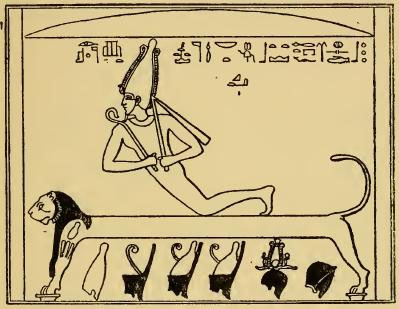
Depiction of Osiris-Khentiamentiu. Note the similarity to Paimon's sigil.31
The title is used numerous times in the Pyramid Texts in reference to Osiris and Anubis. In the Unis text 306, offerings of abundance to the deceased seem to be connected to the title. The Pharaoh Teti as Osiris is said in numerous places to act in the guise of the Foremost of the Westerners, and Pepi is shown in this way also. Anubis is likened to the Pharaoh's staff at the westerner's fore. Uniquely, one goddess, Neith, is also taken to assume that identity in the Pyramid Text 666.11
The final depiction of Khenti-Amentiu as a deity in his own right belongs to an Eleventh Dynasty depiction at Abydos, especially the mahat-chapel of Nebhepetre Mentuhotep II. It is a curiosity to Egyptologists why the god as an independent form seems to disappear, dispersing his cult title among Osiris and Anubis. Mentuhotep ended the first Intermediate Period, reuniting Egypt and becoming the first Pharaoh of the Middle Kingdom. The dispersal may be rooted in that union.12, 13
III. The Lord of the Westerners
| Epithet | Meaning | Domain |
|---|---|---|
| nb Ꜣbḏw | Lord of Abydos | Civic endowment |
| nb tm | Lord of All | Ancestral, sound title |
| nb tꜣ-ḏsr | Lord of the Sacred Land | The West as sacred land |
Sources: Daoud, Khaled Abdalla. Corpus of Inscriptions of the Herakleopolitan Period from the Memphite Necropolis14, Penn Museum. “Stela Fragment, Object Number 29-87-448.”15 Vègh, Zsuzsanna. “Solar Cult in Abydos during the Middle Kingdom.”16
Khenti-Amentiu is an epithet meaning the Lord of the Westerners. The title seems to indicate a rulership over the setting place where she sun disappears, a realm tied to the dead in Egyptian thought. He was also called the Sovereign of the Ennead.16, 17
IV. The Temples of Khenti-Amentiu
Abydos
As said, the first temple at Abydos was possibly consecrated to Khenti-Amentiu. Penn’s Abydos report states for that reason: “the earliest were dedicated to Khentamenty, the original god of Abydos...” It existed within the temple enclosure of Osiris, and it eventually became the Great Temple of Osiris-Khentiamentiu that dominated the area.18,19
Another site existed at the presinct of Pepi I to the south, which intersects with the evidence from the Pyramid Texts. Pepi built a rock-cut shrine to Khenti-Amentiu that explicitly shows him as an indpendent god with a distinctive liturgical bent. The Mahat-chapel of Nebhepetre Mentuhotep II is the final site referencing the god independently.6,12,20
V. The West in the Egyptian Mind
Egyptians often conveyed that burial places would be eternal resting homes, even sometimes named as the real and true homes, of the deceased. The necropolis was seen as being, in a sense, visible as the world of our direct perception before us all. The orientation of Egyptian society was singularly unique in that way, the way in which it put the abode of the invisible on an equal par. Khenti-Amentiu being the foremost one of the direction concerned with the dead was a major status.21,22
The west is where the sun disappears because the earth spins from west to east, doing so exactly on the spring and autumn equinoxes. It then makes its mysterious renewal from the east the next day. So, in its essence, the cardinal direction was almost viewed as a portal, allegorical of death. The sign of Libra and the 7th House represents this astrologically.23,24
A litany of ancient authors commenting on Egypt corroborate the importance of the western direction. Herodotus, Diodorus and others place the pyramids' direction towards Libya. Strabo paying witness to Thebes in his time says the Memnonium and the rock-cut "tombs of kings" are located on the far side of the river, to the west-bank necropolis.26,27,28
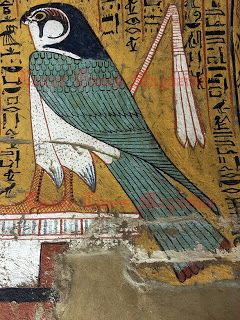
Khenti-Amentiu as a hawk
Additionally, the west itself was codified as a goddess, the mysterious Amentet.29 Amenti themselves as a group were believed to dwell where the sun set, and Khenti was their lord. Occasionally, Khenti-Amentiu was represented as a hawk.30,31
Bibliography:
- Encyclopaedia Britannica. “Khenty-Imentiu.” Encyclopaedia Britannica. Modern variant spellings Khenty-Imentiu / Khenti-Imentiu and the quoted meaning “Foremost of the Westerners.”
- British Museum. “Khentimentiu.” Collections Online. Used for the variant Khentimentiu, Abydos god-of-the-dead identification, and assimilation into Osiris’ epithets.
- Wilkinson, Toby A. H. Early Dynastic Egypt. London and New York: Routledge, 1999.
- Smith, Mark. Following Osiris: Perspectives on the Osirian Afterlife from Four Millennia. Oxford: Oxford University Press, 2017. Cited: Den and Qaʿa seal impressions, the “recumbent jackal determinative,” the ambiguity between name and epithet, and the “no unequivocal evidence” caution for independent deity-status before the later Fifth Dynasty.
- Sperveslage, Gunnar, and Thomas C. Heagy. “A Tail’s Tale: Narmer, the Catfish, and Bovine Symbolism.” The Journal of Egyptian Archaeology 109, nos. 1–2 (2023): 65–75. Cited: the two Abydos necropolis seals showing First Dynasty royal sequences from Narmer to Den and Narmer to Qaʿa.
- Kraemer, Bryan. “A Shrine of Pepi I in South Abydos.” The Journal of Egyptian Archaeology 103, no. 1 (2017): 13–34. Used/quoted for the Pepi I shrine “built by Pepi I for the local god Khentiamentiu.”
- Kelsey Museum of Archaeology, University of Michigan. “The Jackal Gods at Abydos.” In Death Dogs: The Jackal Gods of Ancient Egypt. 2018. Used/quoted for the 5th/6th Dynasty Abydos tomb wall “offering inscription invoking Khentiamentiu.”
- “ḫnt.j-jmn.tjw,” Lemma ID 119180. Thesaurus Linguae Aegyptiae. Corpus Edition 20, Web App version 2.5.1. Edited by Tonio Sebastian Richter and Daniel A. Werning et al.
- Wegner, Josef. “Abydos and the Cult of Osiris.” Expedition Magazine 48, no. 2 (July 2006). Penn Museum.
- Dreyer, Günter. “Ein Siegel der frühzeitlichen Königsnekropole von Abydos.” Mitteilungen des Deutschen Archäologischen Instituts, Abteilung Kairo 43 (1987): 33–43.
- Allen, James P. The Ancient Egyptian Pyramid Texts. 2nd ed. Writings from the Ancient World 23. Atlanta: SBL Press, 2015. See: Teti PT 224, 371, 419, Pepi I PT 438, 441, 460, 601, 674 (Osiris), Teti, PT 224, Pepi I 419, fragmentary PT *728 (Anubis), PT 666 (Neith).
- Damarany, Ayman M., Yasir Abdel-Razik, Ashraf Okasha, Josef Wegner, Kevin Cahail, and Jennifer Wegner. “A New Temple: The Mahat of Nebhepetre at Abydos.” Egyptian Archaeology 46 (Spring 2015): 3–7.
- Oppenheim, Adela, Dorothea Arnold, Dieter Arnold, and Kei Yamamoto, eds. Ancient Egypt Transformed: The Middle Kingdom. New York: Metropolitan Museum of Art, 2015.
- Daoud, Khaled Abdalla. Corpus of Inscriptions of the Herakleopolitan Period from the Memphite Necropolis: Translation, Commentary and Analyses. BAR International Series 1459. Oxford: Archaeopress, 2005.
- Penn Museum. “Stela Fragment, Object Number 29-87-448.” Penn Museum Online Collections. Used for the formula naming “Osiris, Khentiamentiu, The Great God, Lord of Abydos.”
- Vègh, Zsuzsanna. “Solar Cult in Abydos during the Middle Kingdom.” Zeitschrift für Ägyptische Sprache und Altertumskunde 143, no. 1 (2016): 83–102.
- Faulkner, Raymond O. The Ancient Egyptian Coffin Texts. Vol. 1, Spells 1–354. Warminster: Aris & Phillips, 1973. Cite for “Sovereign of the Ennead”: Coffin Text Spell 335, CT IV 314b, pp. 261, 265.
- O’Connor, David. “Abydos and the University Museum.” Expedition 12, no. 1 (1969): 2–22.
- Smith, William Stevenson. The Art and Architecture of Ancient Egypt. Baltimore: Penguin Books, 1958.
- Cahail, Kevin M. In the Shadow of Osiris: Non-Royal Mortuary Landscapes at South Abydos during the Late Middle and New Kingdoms. PhD diss., University of Pennsylvania, 2014.
- NASA Goddard Space Flight Center, StarChild Team. “Why Does the Sun Rise in the East and Set in the West?” StarChild. Accessed June 26, 2026.
- Gangui, Alejandro. “Whither Does the Sun Rove?” arXiv, April 12, 2011. arXiv:1104.2347.
- Watts, Edith Whitney, and Barry Girsh. The Art of Ancient Egypt: A Resource for Educators. New York: Metropolitan Museum of Art, 1998.
- Paulus Alexandrinus. Introductory Matters. Translated by Robert Schmidt. Edited by Robert Hand. Berkeley Springs, WV: Golden Hind Press, 1993. 3rd ed., rev. 1995.
- Firmicus Maternus, Julius. Matheseos Libri VIII. Edited by Wilhelm Kroll and Franz Skutsch. 2 vols. Leipzig: B. G. Teubner, 1897–1913.
- Herodotus. Histories. Book 2. Translated by A. D. Godley. Loeb Classical Library. Cambridge, MA: Harvard University Press, 1920.
- Diodorus Siculus. Library of History. Book 1. Translated by C. H. Oldfather. Loeb Classical Library. Cambridge, MA: Harvard University Press, 1933.
- Strabo. Geography. Book 17. Translated by Horace Leonard Jones. Loeb Classical Library. Cambridge, MA: Harvard University Press, 1932.
- Wilfong, T. G. Life, Death, and Afterlife in Ancient Egypt: The Djehutymose Coffin in the Kelsey Museum of Archaeology. Kelsey Museum Publication 9. Ann Arbor: Kelsey Museum of Archaeology, 2013.
- Jenkins, Nancy. The Boat Beneath the Pyramid: King Cheops’ Royal Ship. New York: Holt, Rinehart and Winston, 1980.
- Budge, E. A. Wallis. Osiris and the Egyptian Resurrection. Vol. 1. London: Philip Lee Warner; New York: G. P. Putnam’s Sons, 1911.