



| Language / Culture | Name of Mithras | Attestation |
|---|---|---|
| Classical Greek | Μιθρας | Xenophon, Cyropaedia (c. 370 BCE) |
| Latin | Mithras | Quintus Curtius Rufus (mid-1st century CE) |
29 min read
MITHRAS
author: High Priest Zevios Metathronos
co-author: Novice Priest Karnonnos
I. The Name of Mithras
The theonym Mithras is most likely the Roman inheritance of a divine name from Persia, though this is ambiguous. It descends from the Indo-Iranian *mitra, the deity of the sworn bond, known to the Iranian world as Mithra and to the Vedic hymns as Mitra. Greco-Roman authors never disguised the eastern origin of the figure they worshipped in their caves.1
Etymologically the name derives from Proto Iranian root *mitra meaning "that which binds," "contract" or "covenant." Both treaties from the second millennium BC and Rig Vedic invocations of Mitra preserve this meaning. In most modern Indian languages "mitr" still means "friend." Binding oaths carry a particular significance for Roman gods: this meaning governs the whole ethic of a cult that revolves around loyalty, secrecy, the sworn word of soldiers.2
In Greek, Xenophon's Cyropaedia, his ideal biography of Cyrus composed around 370 BCE, is where Greek form of Mithra, the Iranian god, first appears. Nobles swear by Mithras among Persians. Latin gets the name in Historiae Alexandri Magni by Quintus Curtius Rufus from the middle of the first century CE. In both Greek and Latin, foreign deity name Mithra is treated indeclinable but only the Hellenized and Latinized form Mithras takes a real case ending sign which marks the linguistic naturalization of the god in the West.3,4
Sources: Clauss, The Roman Cult of Mithras, trans. Gordon (2000); Chalupa, "The Origins of the Roman Cult of Mithras" (2016); Xenophon, Cyropaedia (1914); Quintus Curtius Rufus, History of Alexander (1946).1,2,3,4
II. The Secret God
Mithras is a deity of the Hellenistic world whose mystery cult became, rather dramatically, a dominating occult force during the latter stages of the Roman Empire. The cult of Mithras, which has held the attention of classicists for centuries, was encased in secrecy, and it holds the singular distinction of being one of the few mystery cults of the ancient gods that was never accompanied by exoteric worship. The worship of Mithras possessed no popular dimension beyond his late imperial identity as the Unconquerable Sun.1
The hidden character of the figure and the absence of any major surviving mythology mean that every attempt to convey his meaning to a modern audience must view the deity's functions through the lens of his cult, his extant symbolism, and whatever associated evidence has endured.5
Even as a notable deity, this god of law and the covenant has a fragmented mythology. Several authors record that Euboulus wrote a mythological history of Mithras "in many volumes," as Jerome reports in Against Jovinianus, yet this work is entirely lost. Porphyry, drawing on it, relates that Zoroaster, sage of the Persians, was the first to consecrate a natural cave, adorned with flowers and springs, in honour of Mithras "the maker and father of all things." That cave, the first mithraeum, was made to resemble the cosmos, holding within it the symbols of the elements and climes of the world.6,7
The other notice Porphyry preserves concerns the three ranks of the Persian magi and their strict dietary and sacred protocols, descended from that same mystery, so the lost history evidently treated Persian religion at some length. Porphyry adds, though not necessarily quoting Euboulus, that the initiates believed in the transmigration of souls, that the men of the cult were called lions and the women lionesses, and the servants crows. Nothing else of the work survives.7
"They call the mystagogue who initiates them 'father,' and the initiate himself 'son.' They say that Zoroaster first dedicated a natural cave in honour of Mithras, the maker and father of all."
Porphyry, De antro nympharum 6 (trans. adapted)
The origin myth of the Mithraic cult at Rome is preserved by Plutarch and Appian, who record that the soldiers of Mithridates Eupator taught the rites of Mithras to the pirates and warlords of Cilicia, who in the chaos of the age had seized control of, by the ancient count, "over four hundred cities." When Pompey defeated these corsairs and forcibly resettled the survivors in Greece and Italy after his conquest of Asia Minor, the secretive cult began its formal and large-scale operation on Roman soil.8,9
From that point the cult spread slowly across the empire. Evidence indicates that the majority of Mithraic worshippers were soldiers, officials, and men of affairs, with a dense focal point at Rome and Ostia, yet the cult admitted many strata of Roman society through its mysterious doors, from slaves to merchants to senators. Hundreds of mithraea survive in Rome alone, and many hundreds more in the provinces, often in the far-flung military frontiers of Germania, Pannonia, and Dacia. The god of the sworn bond found his most natural congregation in the army of the frontier.1,10
The interpretation of Mithraic symbolism is difficult precisely because the field remains, of necessity, speculative. The paucity of any explanatory mythology, the sheer volume of archaeological excavation that first drove the "Mithraic craze," and the fact that the cult struck many scholars as a rival to Christianity, defended in part by the dozen or more Church Fathers who wrote acerbic attacks upon it, together with the many churches raised over former mithraea, have not made a clear and coherent account any easier to formulate.5,11
III. The Epithets of Mithras
The Roman god is known above all by his solar titles In the art of the mithraeum, Sol, the Unconquered Sun, stands perpetually beside Mithras, and in a great number of dedications the god himself is named Deus Sol Invictus Mithras. The epithets below record the principal forms of that solar identity as they appear across the surviving inscriptions.10
| Epithet | Meaning | Domain |
|---|---|---|
| Sol Invictus Mithras (Soli Invicto Mithrae) | The Unconquered Sun Mithras | Core Roman Mithraic title |
| Deus Sol Invictus Mithras (Deo Soli Invicto Mithrae) | The god, Unconquered Sun Mithras | Full dedicatory formula |
| Deus Invictus Mithras (Deo Invicto Mithrae) | The Unconquered god Mithras | Compressed invictus formula; divine victory and power |
| Sol Mithras (Soli Mithrae / Ἑλιῳ Μίθῥᾳ) | Sun Mithras | Solar identity, Greek and Latin |
Sources: Clauss, The Roman Cult of Mithras, trans. Gordon (2000); Mišic, "Cognitive Theory and Religious Integration" (2015); Vágási, "Epigraphic Records of the Friendship of Mithras and Sol in Pannonia" (2018); Vermaseren, CIMRM (1956–1960).1,10,12,13
IV. Notable Mithraea
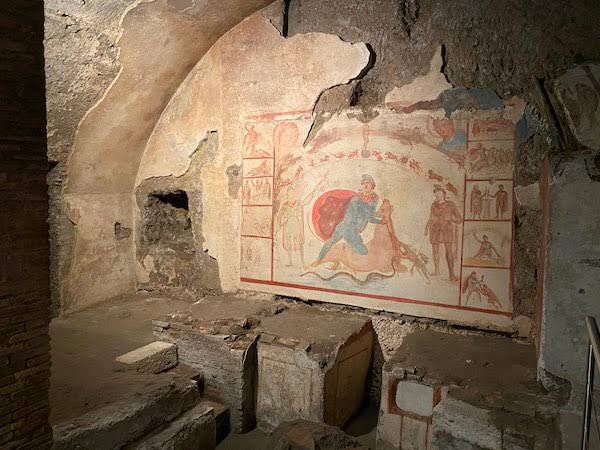
Barberini Mithraeum
The Mithraeum was never a temple in the sense of how most temples were built in Greece and Rome as it was a spelaeum, a cave dug from living rock or contrived into a vaulted sophisticated chamber to mimic a cave. It was small by design: a small intimate hall partly underground with benches facing each other for sharing a meal and at far end the tauroctony. Porphyry has it that the cave was fashioned "as an image of the cosmos" and surviving rooms show vaults painted with stars and fittings which encode the order of the planets. Since the Mithraic cult was cellular rather than congregational, a single city could house dozens of such caves serving a company of no more than a few dozen initiates.5,7
Ostia, the harbor of Rome, preserves the densest surviving cluster of Mithraea. At least eighteen have been identified among excavated parts of the town: they are tucked into basement levels of warehouses, baths and apartment blocks rather than set in sacred areas. The Felicissimus Mithraeum is famous less for its architecture and more for black and white floor mosaics lining its aisle. Each aisle length mosaic pairs seven grades of initiation with emblems of guardian planets; this is our clearest monument to the internal ladder of the cult.10,14
 Floor mosaic of the Mithraeum of Felicissimus at Ostia
The grade mosaic of the Mithraeum of Felicissimus at Ostia, pairing each of the seven degrees with its planetary tutelary.
In Rome, the Mithraeum of Santa Prisca, located in the Aventine district of Rome, has the most decorated testimony through painting. Its walls have the procession of degrees and a set of poem acclamations (nama) to invoke each degree as it relates to their respective planets.
Underneath the Basilica of San Clemente exists an intact cave from ancient times directly beneath a Christian Church; this illustrates the physical transition by which the newer religions often occupied land used previously for older religious practices.
At Dura-Europos, near where the Euphrates River formed part of the eastern border of the Roman Empire, a Roman military Mithraeum with many original paintings of a Tauroctony and several Roman officers' written dedications shows how widespread the cult had become.10,15
The provincial frontiers tell the same story in stone.Along the Rhine and Danube, at Poetovio in Pannonia, at Carnuntum, at Heddernheim in Germania and along Hadrian's Wall in Britain, temples for Mithras cluster wherever legions and their officers are stationed. Distribution is concentrated wherever the Roman army was and its administrative apparatus existed, as it seems Mithras accompanied men whose lives were regulated by sworn oaths.10,11
V. Symbolism
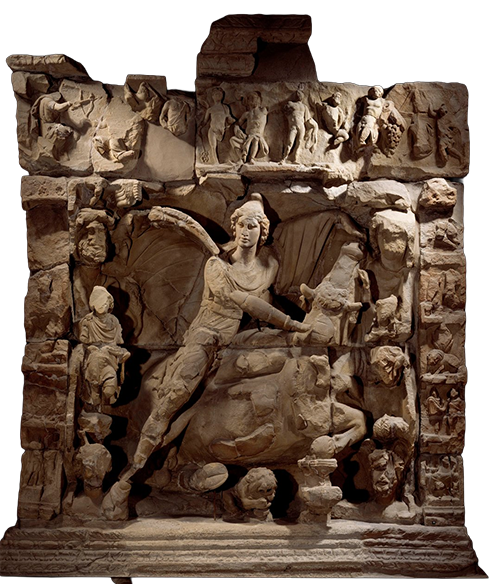
Gallo Roman Art: relief depicting Mithra the god of light with the bull. From a Mithraeum, 50 BC-100CE, Museum of Fine Arts
Mithraism left no scripture, so its theology must be read from images and the testimony of outsiders like Porphyry. These images are remarkably consistent throughout the whole empire. Images found wherever Mithraeums are located, from Britain to the Euphrates recur again and again and again: the slaying of the bull, birth from rock, banquet of Mithras and Sol, two bearers with torches and encircling band of zodiac. Uniformity itself is the first fact of symbolism of Mithraism. Such a uniformity implies fixed doctrine transmitted with discipline and meaning was taught to initiates gradually, possibly orally, rather than being written down.5,10
Figures such as bulls, dogs, serpents, ravens, scorpions, cups, lions and ears of grain correspond very precisely to a band of constellations, and the torch bearers align with the tilt of the celestial axis. Whatever else the Mysteries meant to their members, their symbolic language drew from the sky and the Mithraea roofed with painted stars were built as a working model of cosmos through which the soul might imagine ascent.5,16
Two additional symbols anchor the whole cult system. Sol Invictus, the Unconquered Sun, is Mithras' constant companion and frequently goes by name: repeatedly Mithras is styled Deus Sol Invictus. Birth from rock, petra genetrix, is the origin image and gives the cave meaning as well. Everything else inside the Mithraeum, grades, torches and feast are organized around the two main natural symbols: a prism of light that triumphs and the sturdier rock that brings it into being.10,11
VI. The Tauroctony
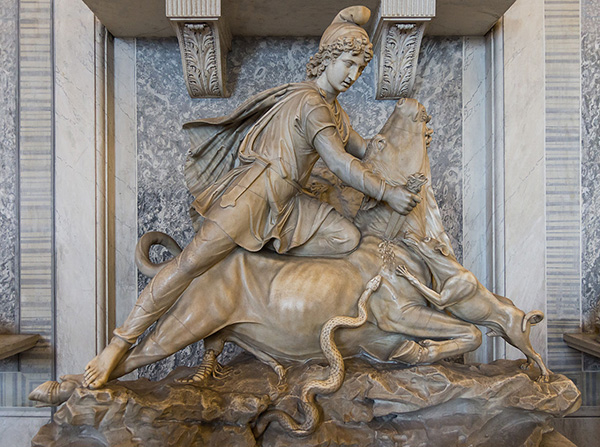
Tauroctony. Vatican Museum, second century CE, Rome.
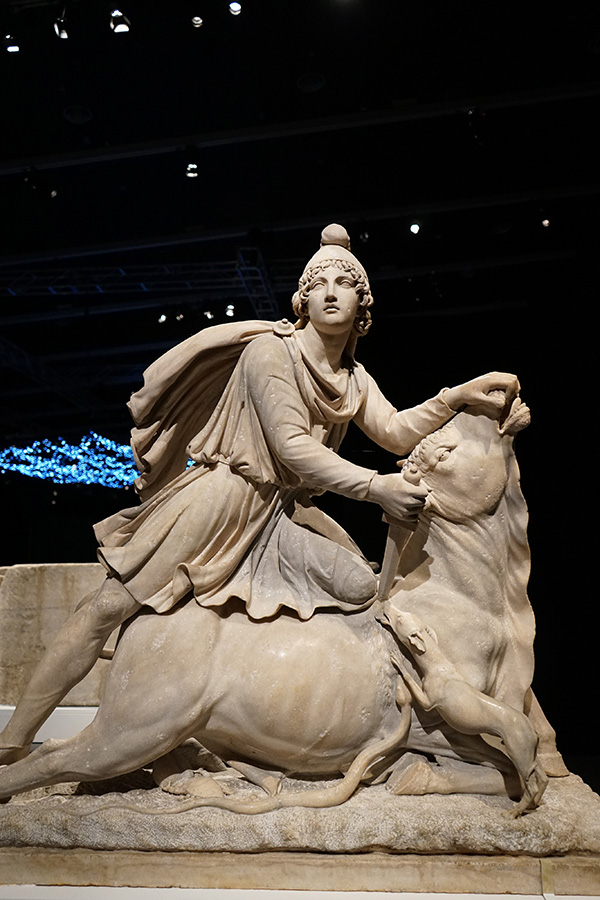
The scene of Mithras slaying the bull, the god typically in a Phrygian cap and flying tunic, one knee upon the beast, the head wrenched back as the knife goes into its neck, is the most familiar of all his images. It was the central focus of every mithraeum ever found: whether the room was a true cave or an artificial chamber, the tauroctony stood at the far endpoint of the arched hall, where every member reclining at the banquet could see it.1,10
The classical notices that survive insist that the scene is a deeply occult set of symbols rather than any exhortation to animal sacrifice. In the Neoplatonic reading transmitted by Porphyry, the bull is referred to the Moon, whose exaltation falls in Taurus, and the horns answer to the lunar crescent; the bull carries the changeable element of water and the unstable proxy of earth. The Moon governs the sub-lunar, material world, the realm of division and mortality where things grow, sicken, change, die, and renew. The Unconquered Sun setting his knife to the throat of that volatile animal is therefore a figure of attaining eternal life by ending the cycle, of establishing order over formless matter, of light illuminating what crumbles and shifts in the dark.5,7
Further meaning is encoded in the same interpretive tradition, which holds that Mithras is "carried in the bull," that is, that he is born into the world, rises within it, and comes forth from it. Porphyry adds that the Sun and Moon are the "gates of souls," through which souls descend and ascend. Origen, reporting Celsus, describes the Mithraic rite as a representation of "the two heavenly revolutions" and of the soul's journey through them, by way of a ladder with seven planetary gates and an eighth above, the sixth assigned to the Moon and the seventh to the Sun. The tauroctony, visible from every part of the cave, held this goal perpetually before the initiate, even where it was only half-consciously understood.7,17
Two torch-bearers, Cautes and Cautopates, are almost always present, flanking the bull-slaying as smaller, youthful figures in eastern dress.Cautes holds his torch upraised (pointing upward), while Cautopates holds his pointed downward. Their positions are not always fixed (Cautopates is often on the left, but variations exist), and they sometimes carry other attributes like a bull’s head (with Cautes) or scorpion (with Cautopates).
The torch-bearers, even in modern consideration, are considered to represent mythic dualities important to Mithras' attributes. Cautes’s upward torch symbolizes sunrise, dawn, and the ascent of light; Cautopates’s downward torch represents sunset, dusk, and the descent into darkness. Cautes embodies the vernal (spring) equinox, when the sun crosses the celestial equator upward, bringing renewal, growth, and the "force of life" increasing (often linked to the constellation Taurus). Cautopates stands for the autumnal equinox--the sun’s downward crossing, decline, harvest, and the onset of decay (linked to Scorpio). Some monuments even show seasonal trees or zodiac symbols reinforcing this.
The raised torch may evoke birth, new life, genesis, and spiritual ascent; the lowered torch signifies death, apogenesis (dissolution), and descent. In the mysteries, this likely symbolized the initiate’s path through life, death, and potential rebirth or cosmic ascent (most importantly, this ties directly to Shamash's role in Gilgamesh, Enkidu and the Netherworld. while textual evidence places Mithras himself at the equinox, since Porphyry assigns him a station "near the equinoctial circle." Cautopates, torch down, marks the soul's descent into matter at the height of summer; Cautes, torch up, marks the ascent toward the divine and the rebirth of the year at the winter solstice, the shortest day, on which, as Macrobius attests in the Saturnalia, antiquity set the births of so many child-gods of the returning light.4,17
Statius when writing his Thebaid in CE 90 already knows the image of "the god who twists unruly horns under rocks in a Persian cave." This line is our earliest dated notice in Latin poetry of bull-wrestling Mithras. The tauroctony is firmly fixed in Roman imagination right at the time when Mithraea start multiplying.19
VII. The Astrological Dimension
Celestial references were important to Mithraism. Porphyry preserves a remark from Pallas that the Mithraic grades were "commonly referred to the circle of the Zodiac," though, he adds, "truly and accurately speaking" they signify something about human souls and probably their rank. From that testimony, and from the astronomy legible in the tauroctony, it is inferred that the higher orders of the cult possessed a developed knowledge of astrology, and that the worship of Mithras as a god of cosmic order entailing a science of celestial order.5,7
The torch-bearers carry the clearest seasonal charge. Cautes' raised torch signifies sunrise, the ascent of light, and the vernal crossing of the celestial equator, linked to Taurus; Cautopates' lowered torch signifies sunset, decline, and the autumnal crossing, linked to Scorpio. Some monuments reinforce the reading with seasonal trees or zodiacal signs set beside the two figures. The raised and lowered flames thus map the double gate of the year, the ascent into life and the descent into matter, upon the initiate's own path through birth, death, and the hoped-for cosmic rebirth.5,16
Typically Mithraea were underground or designed to look that way, while torchlight was practical for rites. Practitioners saw the cave as a microcosm of the universe; painted vaults showed the night sky and stars. Flames moved and these were lit up so that stepping into the mithraea was like stepping into a working model of celestial things.5,20
It also seems as though the killing of the Bull draws upon the same mythological theme from earlier Iran, where the primeval cattle (Gav-dat) was killed, and this act created the world. Additionally, it seems there is another link among various cultures when we see the bovine connected to creation of the universe: Hera creates the Milky Way from the biting of Heracles, the Egyptian goddess Hathor's milk is what creates the Milky Way, and the Norse god Auðhumla provides for the primordial giant Ymir, who is later slain by those gods to create the earth. This repetition supports the idea that the Tauroctony fit well into an early universal "grammar" of creating through the sacrifice of a bovine.16,21
Scholars interpret this in different ways, for example, Rebecca Jelbert suggests that figure of Mithras in tauroctony corresponds directly to the Milky Way itself. Shape, scale and placement of the Milky Way match that of Mithras among surrounding figures. Seen this way, Mithras, the god of light and creation, is imaged as the brightest feature of the night sky. The gates of the soul between Taurus and Gemini and Scorpius and Sagittarius where Milky Way meets the ecliptic become points of entry into life and the exit at death. Reconstruction of doctrine descends from late Platonic works such as Porphyry's Cave of Nymphs.22,23
The Romans (particularly the soldiery) dipped the tall, dried stalks in tallow or pitch to make torches, called "candelaria" or funeral torches. The thick, woolly leaves also served as natural wicks for oil lamps. [1] Fittingly, depictions of these plant (Apulian vases, the Akroterion of the Parthenon, and friezes at the Castrum Minervae sanctuary) were primarily linked to Minerva and Apollo, specifically in the notion of them as occultic "bringers of light"--not only in the literal sense of the sun, but also in the sense of bringing wisdom, or even offering guidance in the afterlife when used in the funerary context. 24,25
Like almost any of the sacred plants, mullein had its variety of medicinal uses, ranging from treating respiratory ailments, to being used as a poultice for inflammations, with the roots useful for joint and tooth aches. Perhaps more interesting however, were its other associations with warmth and lightness. Mullein had an especially interesting use case, utilized in ancient hair dyes for bright, blonde hair, and Native Americans (after the plant's introduction) and colonists would line their shoes with the plant to keep out the cold.25
Lastly, the pine tree was sacred in Roman Mithraism, appearing in the background of certain reliefs, with a divine "tree birth" even being one of Mithras' smythic origins, his hand clutched around a torch even from birth. Even in other variations of the birthing scene which show a "rock", the rock is shaped to resemble a pinecone. [7] Pine trees were decorated with ornaments during the winter solstice rites in Rome (Dec 17–25), symbolizing eternal life, renewal, and the return of solar light, echoing neighbouring Germanic Yule traditions. This links to Zoroastrian (Persian) fire imagery, where torches and sacred evergreens (pine/cypress) represent the immortal spark of divine body and its nadis, lit from one flame to another. Appropriately, the pine tree itself was the traditional source of wood for ancient torches, given its bright, long burning qualities.24,25,26
VIII. The Grades
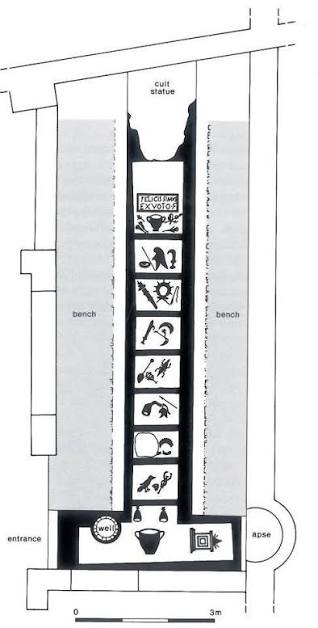
Seven grades of initiation structured the cult: in ascending order, the Raven (Corax), the Bridegroom (Nymphus), the Soldier (Miles), the Lion (Leo), the Persian (Perses), the Sun-Runner (Heliodromus), and the Father (Pater). Each was paired with a planet, as the visual evidence makes plain: the floor mosaic of the Mithraeum of Felicissimus at Ostia sets the emblems of each grade beside the sign of its tutelary planet, and Celsus, as quoted by Origen, describes the Mithraic mysteries in astral terms, with a ladder reaching to the heavens through the planetary spheres.14,17
Ravens are represented commonly in scenes, including tauroctonies, as the messenger of Sol Invictus to Mithras. The rave or Corax represents the beginning stage of the initiate, who can only forge information from gathering different things. At this point, the initiate is flighty and strongly mentally inhabited like that bird. The story is related to that of Apollo cursing the raven and rendering it black forever; so, in becoming an initiate, the hopeful message is that the raven has returned for redemption. The symbol of the cadeuceus was related to the raven because the wand was a healing element and a representation of stagnant death being transmuted towards new life. Naturally, the planet representing this is Mercury; evidence is also shown in inscriptions that state nama Coracibus tutela Mercurii (“Hail to the Ravens under the protection of Mercury”). When attending the service, the raven was obliged to wear a mask of that animal’s face. 14,15
Above this, the bridegroom (Nymphe or Nymphus) represents a distinct stage where seriousness and gravity come into play, often represented with a diadem, a lamp and depicted with him wearing a veil. The name for this level in Greek was the chrysalis of a bee, relating to the bee symbolism of Demeter and other goddesses and attesting to the fact that at this stage, the initiate had to shield themselves from malign influences and the bad aspects of desire. The chrysalis symbolism is also allegorical of transformation and productive work beginning that culminates in the true bee of the Lion rank, while the lamp represents neos phos, the light of the god inhabiting. Modern assumptions that the ‘bridegroom’ was actually a ‘bride of Mithra’ are nonsensical and not supported by any textual or archeological evidence. Venus was represented in this stage. The famous ceremony of the crown attached to a sword actually occurred at this point:5,15
"When he is initiated in the cave, in the very camp of darkness, and a crown is offered to him at the point of a sword and set upon his head, he is taught to put it aside with his hand and remove it, saying that Mithras is his crown. And thereafter he is never crowned again, and this he keeps as a token when he is tested at his military oath, and he is at once acknowledged a soldier of Mithras if he has cast the crown away, declaring that his crown is in his god."
Tertullian, De corona 15 (trans. adapted)
The Miles, or the Soldier, is by far the most external facing rank. In fact, he is sworn to Mithras as a direct act of obedience to Mars. The Miles also has a responsibility for keeping the oath made to Mithra (i.e., granting victory) as described in the ancient Persian texts. We have evidence from Tertullian that each soldier was signed on the forehead by Mithras.10,27
Next came Leo, the lion, the stage associated visually with the sistrum of Egypt and the thunderbolt of Zeus. At this point, initiates would wash themselves with honey rather than water. The symbolism of fire burning away all flawed mortal parts begins here, and so this grade was intended to show where real knowledge and self-possession occurs, the culmination of all previous works lending to proper expression of creativity. This was the degree of the adept initiate. Full participation in the ceremonies was permitted here as the initiate was considered to be sacred enough to have a conducting role. The leonine grade was naturally paired with Jupiter. 5,28
Perses was the following grade, under the Moon. One major symbol was the Harpe sword given to Perseus by Hermes used to defeat Medusa, a sacred object showing a transitional stage from humanity to the daimonic realm. Another was the akinakes, a dagger from the Persian military, which was symbolic because the Shah of the realm would only send the sword to his favorites. A plow was deployed to symbolize the progression to this state, as the fully plowed field is a symbol of further growth into the divine. The symbolism of representing the son of Perseus who started the civilization of Iran is imbued with a symbolism of rising above all earthly concerns and allegiances, positioning oneself toward God. Since the Moon is tied to this grade, that lunar symbolism is intended to show increasing mastery of all things sub luna, including lower drives and passions.5,16
The sun-runner or Heliodromus was a pinnacle of achievement; it conveyed a fully realized personality. The rank had the attributes of the Sun: the flame, the radiating crown and the whip, and the range refers to the path that Mithras takes on the solar chariot during its ascent. Plowing the field leads to the sunflower rising in its place, and the whip that Sol uses to pull his four-horsed chariot is represented in the symbolism too. Like the Pater, only one Heliodromus existed per Mithraeum, perhaps signifying a sub-clerical role.5,28
Father or Pater, the final grade, was the grade of the Mithraic priesthood, the one who ran each mithraeum, its formal Defender. This rank was associated with the sickle of Saturn; if the raven could gather seeds, the Pater is able to shear the field and scatter them, allowing them to grow anew. Ultimate control is needed at this point, for Pater status was a permanent divine entanglement of eternal status, and so the Phrygian cap of Mithras represented freedom but freedom in the context of the sacred where the will of the Pater is aligned with the divine in all circumstances. The priest was represented alongside Mithras at the tauroctony as his earthly representative. 5,14
| Grade | Latin Name | Tutelary Planet | Principal Emblems |
|---|---|---|---|
| Raven | Corax | Mercury | Caduceus, beaker, raven mask |
| Bridegroom | Nymphus | Venus | Lamp, diadem, veil |
| Soldier | Miles | Mars | Lance, helmet, soldier's pack |
| Lion | Leo | Jupiter | Fire-shovel, sistrum, thunderbolt |
| Persian | Perses | Moon | Harpe, akinakes, crescent, plough |
| Sun-Runner | Heliodromus | Sun | Radiate crown, torch, whip |
| Father | Pater | Saturn | Phrygian cap, staff, sickle, patera |
Sources: Becatti, Scavi di Ostia II: I Mitrei (1954); Vermaseren and van Essen, The Excavations in the Mithraeum of the Church of Santa Prisca (1965); Gordon, "Reality, Evocation and Boundary in the Mysteries of Mithras" (1980); Beck, The Religion of the Mithras Cult (2006).5,14,15,28
IX. Mithras and the Rock
The scene of the birth of Mithras from a rock occurs with greater frequency than any other depiction in all of the Mithraic artistic depictions after the bull slaying. Mithras appears from the living stone as an adolescent wearing the Phrygian cap, holding a flame-throwing torch with his right hand and a knife (or a sword) in his left. Flames are depicted breaking from the stone surrounding Mithras on numerous representations. This rock is known as the petra genetrix or "rock that gives birth" and its prominent display, surpassed only by the tauroctony, indicates that this was far more than a peripheral element of the Mithraic mythological system.10,11
The theme has primarily been documented for non-cult members (Christian authors) because of the similarity it shares with the Christian doctrine which made it abhorrent to them. In this light, Justin Martyr refers to the Mithriatic mysteries as follows: "those who hand down the mysteries of Mithras say that he was begotten of a rock, and call the place where they initiate his believers a cave." Additionally, Commodian records an invocation using the Latin phrase invictus de petra natus, or "The unconquerable, born from the stone", and Firmicus Maternus has the Greek invocation, theos ek petras, or "God from stone". The fact that all three accounts document this aspect of the Mithric rite so similarly demonstrates how important this aspect is.29,30,31
The rock carries several meanings at once. It is the earth and the cosmos, the fertile stone from which life issues, and it is bound to the cave, the spelaeum, in which the whole drama of the god unfolds; on some reliefs a serpent coils about the stone, tying it to the terrestrial realm. In the astronomical reading, the rock-birth is the moment of cosmogenesis, light striking forth from the fixed frame of the heavens, and the torch in the newborn god's hand declares from the first instant what he is: the bringer of light out of the unformed dark.5,16
X. Mithras and the Roman Emperors
The expansion of Mithras paralleled that of the Roman Empire. Many of Mithras' adherents (albeit not all, as the next section testifies to) came from the military, administrative branch of government, customs office, and the elite. Therefore, as most of these individuals were stationed at the borders (Rhine and Danube), as well as in the ports (Ostia) and capital city (Rome), so too did many of the strongest remaining concentrations of followers. Since each mithraeum was relatively small and comprised separate cells for various ranks and groups within the cult, there was not a visible, civic presence. Instead, Mithras expanded through the private loyalties of its members who are also the ones whose careers depend upon their sworn loyalty to their Oath (the gods).1,5
Emperors themselves were also involved in invoking Mithra. In 307 or 308 CE, Diocletian, Galerius and Licinius held a meeting at Carnuntum (which was located near the river Danube) where they each participated in restoring one of the mithraea to Mithras. They jointly dedicated this mithraeum to Mithras, describing him as fautor imperii sui ("patron of their empire"), which is a rare example of a public acknowledgement from emperors that Mithras had been enlisted into the formal guarantees of Roman order. The wide scale promotion of Sol Invictus by later emperors like Aurelian (during the late 3rd century), provided Mithraic Sol Invictus with a context for his own imperial role as solar god.10,11
The public solar festival stood close to this imperial cult. The Chronography of 354, the great illustrated calendar of the city of Rome, has at 25 December the entry N(atalis) Invicti, the "Birthday of the Unconquered," attended by thirty chariot races, a festival of the returning sun that even Christian writers themselves acknowledged had been the ground upon which the Nativity was later set.18,32
XI. The Universality of the Mithraic Cult
Mithraism's social range was impressive as it did have a wide class base. There were no prohibitions based on class; senators as well as slaves were members of the cult. Also, there are records of initiates into the cult at all levels of Roman society, and even evidence that slaves within Mithraism could be manumitted for their exceptional roles. Although we know of hundreds of mithraea in Rome itself, we also have evidence for many thousands more throughout the Roman Empire with an abundance located on the furthest boundaries of the empire, namely in Germany, Pannonia and Dacia.1,10
That combination, an intensely private rite of personal salvation, carried by the mobile servants of a world-empire and framed in the universal language of the stars, is what gives Mithraism its peculiar character. It was universal in terms of its coverage as well as the cosmological nature of its claims. The God of the Covenant and Conquering Light was worshiped in equal numbers of caves across three continents. Men who believed that each man's cave represented the totality of creation, recognized his climb up the ranks of the grade system as a representation of the same soul climbing out of the darkness.5,11,16
In the end, this universality also goes back to Mitra in the Vedic annals and his Buddhist successor in Maitreya, all gods being predicated on the concept of covenant, patronage and assistance.
XII. Herbal Symbolism
Mithraism's social range was impressive as it did have a wide class base. There were no prohibitions based on class; senators as well as slaves were members of the cult. Also, there are records of initiates into the cult at all levels of Roman society, and even evidence that slaves within Mithraism could be manumitted for their exceptional roles. Although we know of hundreds of mithraea in Rome itself, we also have evidence for many thousands more throughout the Roman Empire with an abundance located on the furthest boundaries of the empire, namely in Germany, Pannonia and Dacia.1,10
Mithraism's social range was impressive as it did have a wide class base. There were no prohibitions based on class; senators as well as slaves were members of the cult. Also, there are records of initiates into the cult at all levels of Roman society, and even evidence that slaves within Mithraism could be manumitted for their exceptional roles. Although we know of hundreds of mithraea in Rome itself, we also have evidence for many thousands more throughout the Roman Empire with an abundance located on the furthest boundaries of the empire, namely in Germany, Pannonia and Dacia.1,10
Sources and Bibliography
- Manfred Clauss. The Roman Cult of Mithras: The God and His Mysteries. Translated by Richard Gordon. New York: Routledge, 2000.
- Aleš Chalupa. “The Origins of the Roman Cult of Mithras in the Light of New Evidence and Interpretations: The Current State of Affairs.” Religio 24, no. 1 (2016): 65–96.
- Xenophon. Cyropaedia. Translated by Walter Miller. 2 vols. Loeb Classical Library 51–52. Cambridge, MA: Harvard University Press, 1914.
- Quintus Curtius Rufus. History of Alexander. Translated by John C. Rolfe. 2 vols. Loeb Classical Library 368–369. Cambridge, MA: Harvard University Press, 1946.
- Roger Beck. The Religion of the Mithras Cult in the Roman Empire: Mysteries of the Unconquered Sun. Oxford: Oxford University Press, 2006.
- Jerome. Adversus Jovinianum (Against Jovinianus). In Nicene and Post-Nicene Fathers, 2nd ser., vol. 6, edited by Philip Schaff and Henry Wace. Buffalo: Christian Literature Company, 1893. Preserves the notice that Euboulus wrote a history of Mithras “in many volumes.”
- Porphyry. On the Cave of the Nymphs (De antro nympharum). Translated by Robert Lamberton. Barrytown, NY: Station Hill Press, 1983. For the Zoroastrian cave, the “maker and father of all,” the lions and crows, and Mithras’ station at the equinox.
- Plutarch. “Life of Pompey.” In Lives, vol. 5, translated by Bernadotte Perrin. Loeb Classical Library 87. Cambridge, MA: Harvard University Press, 1917. On the Cilician pirates and the transmission of the rites (Pompey 24).
- Appian. Roman History, vol. 2, The Mithridatic Wars. Translated by Horace White. Loeb Classical Library 3. Cambridge, MA: Harvard University Press, 1912.
- Maarten J. Vermaseren. Corpus Inscriptionum et Monumentorum Religionis Mithriacae. 2 vols. The Hague: Martinus Nijhoff, 1956–1960.
- Robert Turcan. The Cults of the Roman Empire. Translated by Antonia Nevill. Oxford: Blackwell, 1996. Ch. 5, “Mithra and Mithraism.”
- Blanka Mišic. “Cognitive Theory and Religious Integration: The Case of the Poetovian Mithraea.” In TRAC 2014: Proceedings of the Twenty-Fourth Annual Theoretical Roman Archaeology Conference, edited by Tamara Brindle et al., 31–40. Oxford: Oxbow Books, 2015.
- Tünde Vágási. “Epigraphic Records of the Friendship of Mithras and Sol in Pannonia.” Acta Antiqua Academiae Scientiarum Hungaricae 58, nos. 1–4 (2018): 357–376.
- Giovanni Becatti. Scavi di Ostia II: I Mitrei. Rome: Istituto Poligrafico dello Stato, 1954. For the grade-and-planet floor mosaic of the Mithraeum of Felicissimus.
- Maarten J. Vermaseren and C. C. van Essen. The Excavations in the Mithraeum of the Church of Santa Prisca in Rome. Leiden: E. J. Brill, 1965. For the grade inscriptions and the nama acclamations.
- David Ulansey. The Origins of the Mithraic Mysteries: Cosmology and Salvation in the Ancient World. New York: Oxford University Press, 1989.
- Origen. Contra Celsum. Translated by Henry Chadwick. Cambridge: Cambridge University Press, 1953. Book 6.22, on the seven-gated ladder of the planets and the celestial journey of the soul.
- Macrobius. Saturnalia. Edited and translated by Robert A. Kaster. 3 vols. Loeb Classical Library 510–512. Cambridge, MA: Harvard University Press, 2011. Book 1.18, on the solar theology and the solstitial births.
- Statius. Thebaid 1.719–720. In Thebaid, Books 1–7, edited and translated by D. R. Shackleton Bailey. Loeb Classical Library 207. Cambridge, MA: Harvard University Press, 2004. The earliest Latin literary reference to Mithras twisting the bull’s horns.
- Lewis M. Hopfe. “Archaeological Indications on the Origins of Roman Mithraism.” In Uncovering Ancient Stones: Essays in Memory of H. Neil Richardson, edited by Lewis M. Hopfe, 147–158. Winona Lake, IN: Eisenbrauns, 1994.
- Franz Cumont. The Mysteries of Mithra. Translated by Thomas J. McCormack. Chicago: Open Court, 1903.
- Rebecca Jelbert. “Illuminating Mithraic Iconography: Mithras, God of Light, as the Milky Way.” Journal of Big History 5, no. 1 (2022): 1–34.
- David Ulansey. “The Cosmic Mysteries of Mithras.” In Biblical Archaeology Review 20, no. 5 (1994): 40–53. On the tauroctony as a star map and the precession of the equinoxes.
- Nicolò Soldovieri, Alessandro Lazzara, Giulia Albani Rocchetti, Flavia Bartoli, and Giulia Caneva. “FIAT LUX: The Mullein’s (Verbascum sp.) Image and Its Symbology through History within the Euro-Mediterranean Culture.” Plants 14 (2025).
- Pliny the Elder. Natural History, Book 25. Translated by W. H. S. Jones. Loeb Classical Library 393. Cambridge, MA: Harvard University Press, 1956. On the medicinal uses of mullein.
- Manfred Clauss. Mithras: Kult und Mysterien. Munich: C. H. Beck, 1990. For the pinecone-shaped rock and the arboreal birth variant.
- Tertullian. De praescriptione haereticorum (Prescription against Heretics). In Ante-Nicene Fathers, vol. 3, edited by Alexander Roberts and James Donaldson. Buffalo: Christian Literature Company, 1885. Ch. 40, on the sign set upon the soldier’s brow and the “image of a resurrection.”
- Richard L. Gordon. “Reality, Evocation and Boundary in the Mysteries of Mithras.” Journal of Mithraic Studies 3 (1980): 19–99.
- Justin Martyr. Dialogue with Trypho 70. In Ante-Nicene Fathers, vol. 1, edited by Alexander Roberts and James Donaldson. Buffalo: Christian Literature Company, 1885. On Mithras “begotten of a rock” and the initiatory cave.
- Commodian. Instructiones 1.13. In Ante-Nicene Fathers, vol. 4, edited by Alexander Roberts and James Donaldson. Buffalo: Christian Literature Company, 1886. The formula invictus de petra natus, “the Unconquered born from the rock.”
- Firmicus Maternus. The Error of the Pagan Religions (De errore profanarum religionum). Translated by Clarence A. Forbes. Ancient Christian Writers 37. New York: Newman Press, 1970. For the formula theos ek petras, “god from rock.”
- Michele Renee Salzman. On Roman Time: The Codex-Calendar of 354 and the Rhythms of Urban Life in Late Antiquity. Berkeley: University of California Press, 1990. For the entry N(atalis) Invicti with thirty circus races on 25 December in the Chronography of 354.