




| Language / Script | Name of Montu | Attestation |
|---|---|---|
| Old Egyptian | mnṯw | Pyramid Texts (c. 2350–2200 BCE) |
| Greek | place-name Hermonthis (Ἑρμωνθις) | Ptolemaic and Roman periods |
| Coptic | Ermont (ⲉⲣⲙⲟⲛⲧ), Erment (ⲉⲣⲙⲉⲛⲧ) | Late antique; preserved in modern Armant |
21 min read
MONTU
author: High Priest Zevios Metathronos
co-author: Novice Priest Karnonnos
I. The Name
When Montu is high, I will be high with him;
when Montu runs, I will run with him.
Pyramid Texts, Utterance 503 (trans. Faulkner, adapted)1
The name of Montu was written as mnṯw in the Egyptian writing system. The name of the god has been spelled as Montu, Mont, Month, Menthu and other variations. As the vowels were added in recent times, they do not reflect a historical recording of an older time period. The old handbook gloss "Nomad" can be found in many references today. This comes from an assumed relationship with an Egyptian verb for "to wander". The philology behind it is questionable.
Edward Werner's dissertation on the god as the most thorough study done on Montu considers the etymology as being ambiguous and unresolved versus established. No ancient texts provide information about what the name means. Modern translations provided above are interpretations made by scholars, based on their interpretation of the words themselves. The gods' own explanation is missing.1,2
The Pyramid Texts are where any primary attestations to Montu seem to occur which date back to the end of the Old Kingdom Period. However, in these texts, Montu does not have the shape of the war god he becomes later, though this deviation from later roles in a funerary context is common in the text. Utterance 503 describes the Pharaoh who will ascend to heaven as traveling with Montu; while Utterance 555 states that the deceased king declares that he has ascended to the heavens like Montu.
Additionally, Utterance 412 refers to "the stars of Montu," placing Montu among the stars, though some like Faulkner believe this is a reference to hair. Finally, as far back as the sixth dynasty, Montu may have appeared in royal inscriptions. However, since the astronomically-based god of the Pyramid Texts is the earliest figure that we can identify in the texts, the warrior form developed much later and perhaps relates to a living, non-chthonic function.1,3
We also know that Montu continued to exist in Egypt beyond the spoken Egyptian language because a location was named after him. The primary cult site for Montu located to the south of Memphis was Iunnu-Montu (jwnw-mnṯw), or "the Heliopolis of Montu". His name passed through Greek as Hermonthis (from Egyptian jwnw-mnṯw), into Coptic as Ermont (ⲉⲣⲙⲟⲛⲧ), and finally into Modern Arabic as Armant. Therefore, the name of Montu survived in his original city.4,5
Sources: Pyramid Texts; Werner, The God Montu; Faulkner, The Ancient Egyptian Pyramid Texts; Gauthier, Dictionnaire des noms géographiques; Wilkinson, The Complete Gods and Goddesses.1,2,3,4,5
II. The History of Montu
The Old Kingdom
As an initial sky god from the Theban area, Montu does not appear initially as a god of war. In association with the stars and the rising of the dead Pharaoh, he appears in the Pyramid Texts. According to Fernand Bisson de la Roque (who assembled all available information up until his 1941 bulletin of the Institut Français), even when Montu's role as a warrior became firmly established later on, the celestial nature of Montu remained. He has been referred to as "the son of Nut", which is the name of the Egyptian goddess of the sky. The early form of the god is associated with the burning sky and while he had the power for destruction (due to his ability to produce fire through the sun) he could use it at a later time against the enemies of Egypt, probably because the Pyramid Texts are not related to earthly concerns per se.6
The Middle Kingdom
The rise of Montu belongs to the Eleventh Dynasty. Rulers from Thebes, who were patrons of their family and the unification wars of Egypt (2055BCE), used his name when naming themselves. There were four rulers named Mentuhotep ("Montu is satisfied") because they credited the god for the military successes Thebes had through their unification of Upper and Lower Egypt. Montu was placed close to the top of the Egyptian pantheon and was an important divinity for nearly all of the militant Theban monarchy during this time period as their patron. During this time the Twelfth Dynasty expanded or build many temples dedicated to Montu across the Theban nome.5
The god's warlike character is a Middle Kingdom development, though Montu as a deity began to recede in prominence when Amun's cult became ubiquitous. Still he kept his martial place and his religious centers, and no later god displaced him from the role of being Egypt's primary god of war.
The New Kingdom
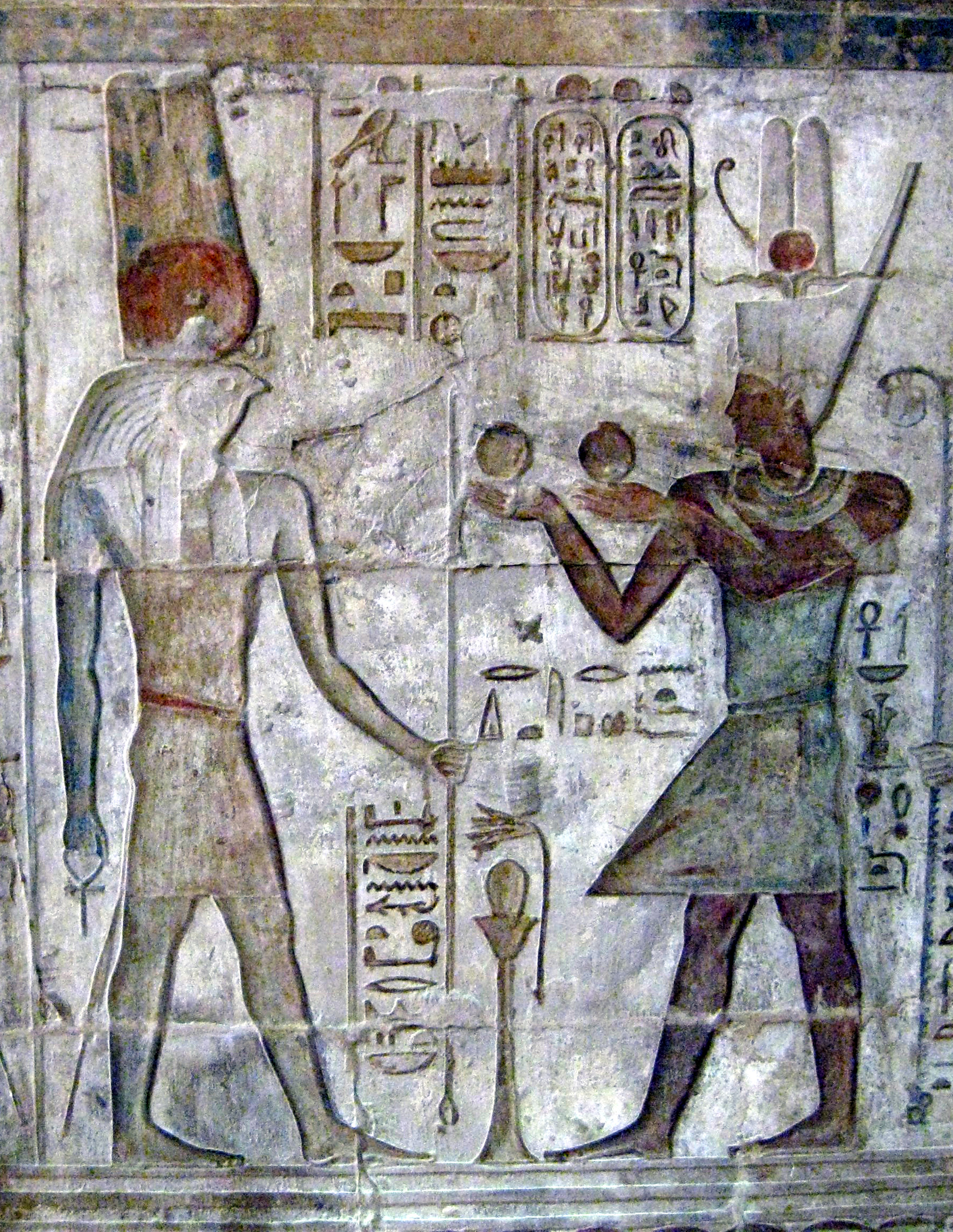
Under the New Kingdom, Montu was used to represent the warrior Pharaoh. In his battles against Syria and Nubia during the Eighteenth Dynasty and Nineteenth Dynasty, the Pharaohs describe themselves as embodiments of Montu. On the chariots of the Pharaohs on which they go to battle (as with Thutmose IV), Montu was shown riding alongside the Pharaoh too. Pharaohs of the Eighteenth and Nineteenth Dynasties have also paid homage to his temple at Armant and Karnak since Thutmose III. This is the time that he established himself as a symbol for "the Falcon of Victory." During this time, the curved sword, and the defeated enemy became standard symbols of the war god..6,7
The Late, Ptolemaic, and Roman Periods
During the late period Montu's cult had developed the system of elaborate bull worship. The Buchis bull was considered to be his divine presnce on earth during the Thirtieth dynasty. After this, the Ptolemies and Romans continued building in his temples. The historian David Klotz explained how much the Roman theology of Thebes organized his images and gathered the four disparate Montus of the four sanctuaries together to create one systematized god and gave him a universal reach, far surpassing what he was in his military role. Cleopatra VII also built a mammissi for her son Caesareon in Montu's precinct. The Buchis cult functioned until the end of the 4th centuryCE. It was one of the final active cults in Egypt, testifying to his broad popularity.8,9
III. The Epithets of Montu
Montu's titles record the two poles of his nature, the celestial and the martial. The table below ranks the principal ones by their weight in cult rather than their frequency in literary texts. The oldest is the plain "Lord of Thebes," Neb Waset, under which the Eleventh Dynasty enthroned him. The tetrad titles that bind him to his four sanctuaries belong to the developed theology of the later periods.
| Epithet | Meaning | Domain |
|---|---|---|
| Nb Wꜣst (Neb Waset) | Lord of Thebes | The dynastic and civic office, from the 11th Dynasty |
| Mnṯw-Rꜥ (Montu-Ra) | Montu-Ra | The solar identity; the destructive heat of the sun |
| Nb Iwnw (Neb Iunu) | Lord of Hermonthis (Armant) | His primary southern cult seat and the Buchis bull |
| Nb Mꜣdw | Lord of Medamud | Northern anchor of Thebes |
| Nb Ḏrty | Lord of Tod (Djerty) | Southern anchor of Thebes |
| Ḥr ḫpš (Hor-khepesh) | Horus of the Strong Arm | The martial identity fused with Horus |
| Kꜣ nḫt (Ka-nakht) | Mighty Bull | Royal-military epithet, shared with the pharaoh |
Sources: Wilkinson, The Complete Gods and Goddesses;5 Klotz, Caesar in the City of Amun;9 Hart, The Routledge Dictionary of Egyptian Gods and Goddesses.10
IV. The Temples of Montu
Montu was worshipped across a quadrilateral area of cult centers surrounding Thebes. The importance of these four sanctuaries gave rise to the concept of a fourfold Montu, "four Bas united as one." The principal temples were Medamud to the north, Armant and Tod to the south, and the precinct at Karnak itself, while an outlying temple carried his cult south to the Nubian zones.9
Medamud
The site is located near to modern-day Medamud (ancient Madu) which is about 5km northeast of Karnak. The area of the site had an earlier Old Kingdom period or First Intermediate Period sanctuary dedicated to Montu. A walled compound housed a double cave sanctuary within two mound-shaped earthworks. Possibly, these were "natural" hillocks which predated the construction of the complex. The structure was expanded under the Twelfth Dynasty during the reign of Senusret III who included himself as one of the builders. Subsequently, the temple continued to be enlarged through the Roman and Ptolemaic periods. The site was excavated repeatedly since 1925 by the French Institute of Oriental Archaeology by Fernand Bisson de la Roque and since 1927 by the Louvre Museum whose accounts are the core of study.11
Armant
Armant, the ancient Iuni and the Greek Hermonthis, was Montu's chief southern seat and the home of the Buchis bull. A temple of Montu existed here since the time of the Eleventh Dynasty and Mentuhotep II's reign. It was expanded during the Twelfth and Thirteenth dynasties. During the New Kingdom, it was significantly expanded once again, particularly through Thutmose III's endeavor.
Thutmose III's pylon remained the most significant surviving element of this temple for many years. Nectanebo II then began construction on another temple which was later used by the Ptolemies and the final ruler of Egypt, Cleopatra VII, commissioned an extension that included a mammisi (a birth house) and a sacred lake honoring her son Caesarion. This temple existed until 1861 when it was abominably destroyed so that the stones could be reused in a sugar factory. Today, we primarily know of this site due to earlier drawings and archaeological excavations conducted by Robert Mond and Oliver Myers for the Egypt Exploration Society.8,12,13
Karnak and Uronarti
Within the great temple complex at Karnak, north of the precinct of Amun, lies the Precinct of Montu. This enclosure of some twenty thousand square meters holds the god's temple together with a temple of Harpre, a temple of Ma'at, a sacred lake, and the prominent gateway of Ptolemy III. Amenhotep III is credited with building a sacred enclosure for Montu here. Far to the south stood another temple, at the Middle Kingdom fortress of Uronarti near the Second Cataract. It was dedicated to Montu during the reigns of the fortress-building kings, the same god carried to the Nubian frontier by the garrison that held Egypt's southern border.5,14
El-Tod
At Tod, ancient Djerty and Greek Tuphium, a temple of Montu is attested from the Middle Kingdom. The site lies some twenty kilometers southwest of Luxor, with major building under Mentuhotep II, Mentuhotep III, and Senusret I.15 Beneath the temple of Senusret I, in the stone foundations, Bisson de la Roque made a famous discovery in 1936. This was the Tod Treasure, a hoard of silver and lapis lazuli objects of Near Eastern origin sealed in bronze chests, one of the most important finds of the Middle Kingdom.15 Ptolemaic halls completed the visible temple, which stood over the older sanctuary.
Others
Beyond the four principal sites, Montu received worship at scattered other areas through his identification with the pharaoh and the sun. Chapels and reliefs name him across the Theban west bank and at Karnak itself. His cult followed the Theban theology into the oases and southern temples under Roman rule. There the falcon of war was present at the elaborate priestly systems of Hermonthis and its dependencies.9
V. Montu and the Middle Kingdom Pharaohs
The making of Montu into a war god cannot be separated from the political history of the Eleventh Dynasty. Thebes was a provincial town of the fourth Upper Egyptian nome. It rose during the First Intermediate Period as the seat of a line of rulers who fought their way to control of the whole country. Montu was the god in whose name they fought. The reunification achieved by Nebhepetre Mentuhotep II around 2055 BCE ended a long division. The king who accomplished it bore in his very name the claim that Montu was satisfied with his house.5
Mentuhotep II, Mentuhotep II, and Mentuhotep IV were all willing to include the god Montu in their titularies. They also placed their own monuments at Tod, Armant, and Medamud to associate their reunifying monarchic power with his sanctuaries. A lintel fragment found in the temple at Tod listed Montu along with Menuhotep II and the goddess Satis to associate the god with the excursion at the southern border.The ferocity exhibited by the god Montu reflected the ferocity of a dynasty that had taken the throne by battle.12,15
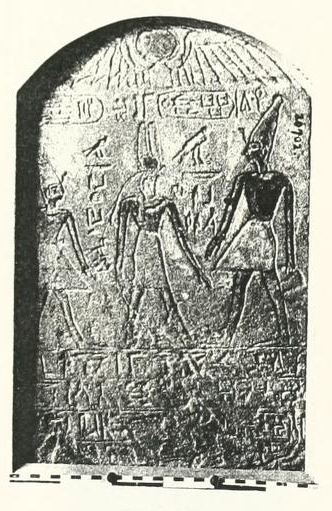
The Twelfth Dynasty continued the theme as Senusret III, whose campaigns pushed the Egyptian frontier deep into Nubia, was among the builders at Medamud, and a stela even shows the warrior in Montu's presence. By the end of the Middle Kingdom, the political ground had shifted. Historians believe from their evidence that Amun, whose name means "the hidden one" had risen at Karnak to become the supreme god of Thebes
VI. The Weapons of Montu and His Symbolism
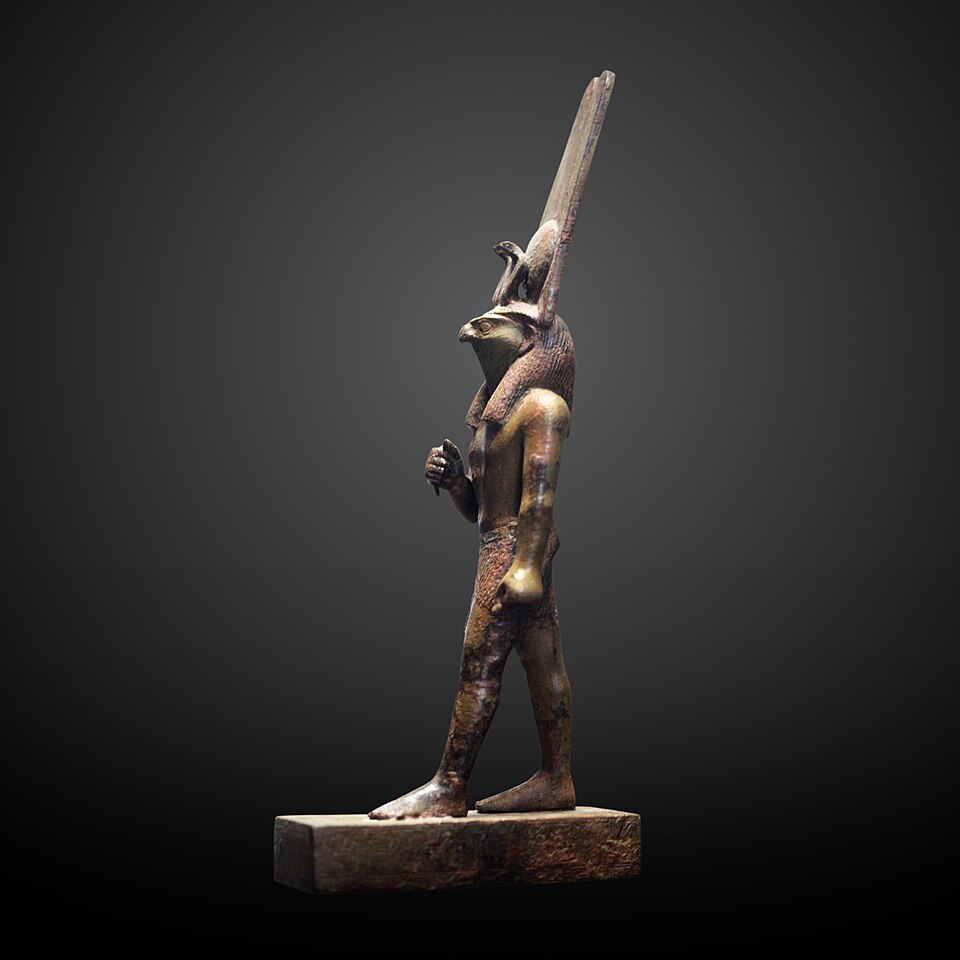
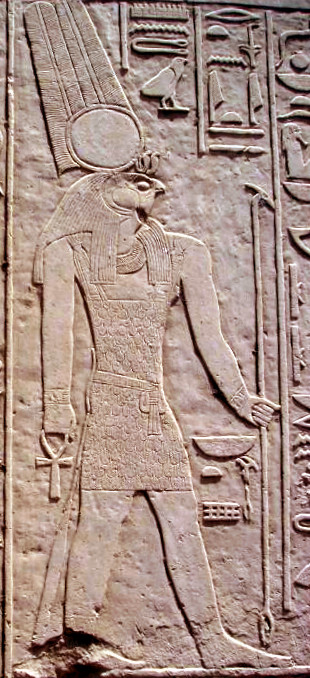
Montu is depicted as a male with a falcon's head, crowned by the solar disk and double uraeus, along with two large feathers. The solar Disk and uraei signify his solar identity and the falcon signifies his authority to control the skies. With the rise of warfare during the New Kingdom, he is shown carrying all weapons of war. These include the curved sword or Khepesh, the spear, bow, arrows and knife. Iconography for these depictions formed during this time show him crushing and impaling the enemies of Egypt. A ceremonial battle-axe, showing four Montu figures, each standing on top of defeated foes in a victorious position were carried before the armies, so the fourfold Montu is martial in its context too.5,16
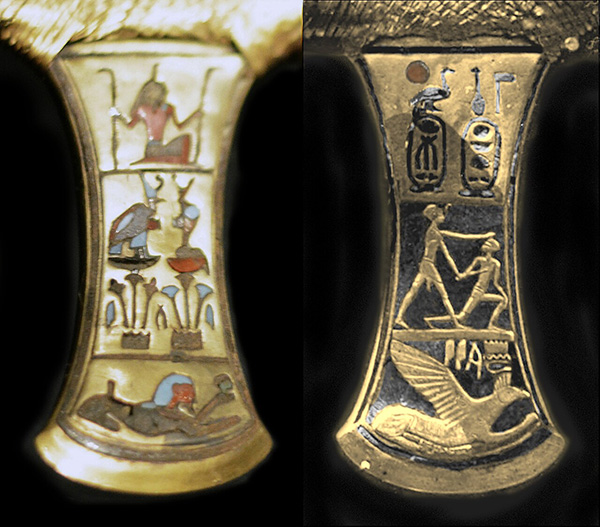
An older and stranger image survives on a ceremonial battle-axe from the burial equipment of Queen Ahhotep, of the late Seventeenth and early Eighteenth Dynasty. On it Montu appears as a winged griffin in Phoenician style. The griffin-Montu of the axe shows how the god's martial image could absorb foreign forms while remaining the sponsor of Egyptian arms. In the Late Period, as the bull cult grew, Montu could also be shown with the head of a bull, the animal whose strength and rage matched his own.5,17
Together, the falcon and bull represent the totality of Montu's symbolism. The falcon represents the sky and the swift nature of his punishment. The bull represents earthly and fertile power. The solar disk placed atop his head relates back to Ra, whose intense heat Montu was thought to embody, and Horus, whose control of the horizons was held to be given aspect in Montu. His weapons are used to destroy those against divine order.18
VII. The Buchis Bull
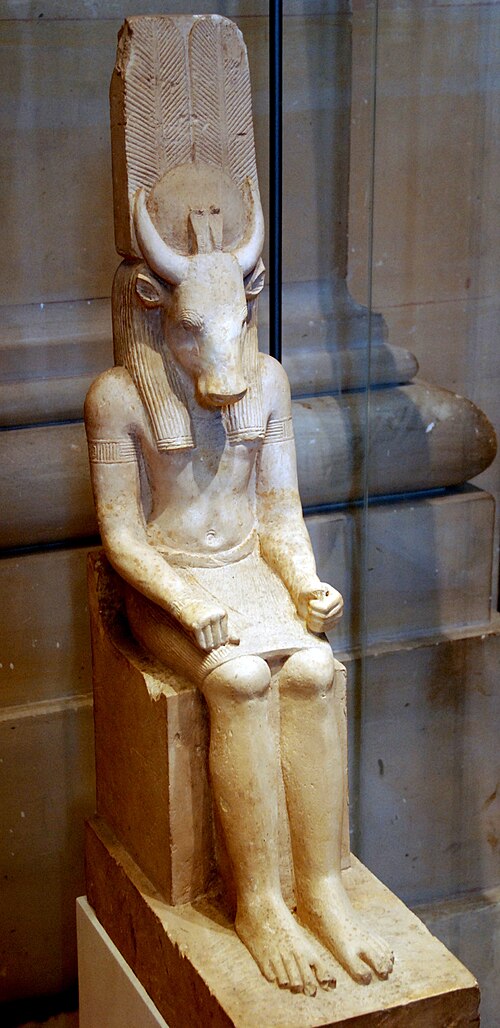
A symbol of an incarnation of Montu, the Buchis was a white bull with a black head which lived at Armant. Its Egyptian name is Bakha; it was named "Bouchis" in Greek. A legend says the bull's fur color changed depending upon the hour of the day. Additionally, according to Macrobius, the hair on its hide grew in the opposite direction of most cattle. The Buchis was maintained at the Temple where it had its own attendants, being decorated with regalia and jewels. It was considered to be the Ba of Montu, but also curiously as Ra visible in the flesh. The formal worship of the Buchis began during the Thirtieth Dynasty. The first documented burial of the Buchis occurred under Pharaoh Nectanebo II who was the last native ruler (around 340 BCE). However, there is evidence indicating that a sacred bull may have been present at Armant dating back to the Eighteenth Dynasty.8,18
The formal cult of the Buchis, with elaborate burial of the dead bulls, dates from the Thirtieth Dynasty. The first securely recorded burial belongs to the reign of Nectanebo II, the last native pharaoh, about 340 BCE. There are indications, though, that a sacred bull was kept at Armant as early as the Eighteenth Dynasty. Each bull, on its death, was mummified with the ceremony due to a god. It was interred in a great sandstone sarcophagus in the underground catacomb near Armant called the Bucheum, its mother buried in a separate gallery known as the Baqaria.
The site of the Bucheum was excavated between 1927-1932 by Robert Mond and Oliver Myers working on behalf of the Egypt Exploration Society. Their excavation resulted in a three volume publication detailing all aspects of this cult. Thousands of stelae were discovered at the site and were dated to match the reign of each individual bull. These stelae allowed researchers to document the history of the cult over nearly six hundred years starting from the time of the Thirtieth Dynasty through to the Roman Empire. The date for the final Buchis burial falls around the mid-fourth century CE, lasting rather long.8
VIII. The Ties of Montu to Ra and Horus
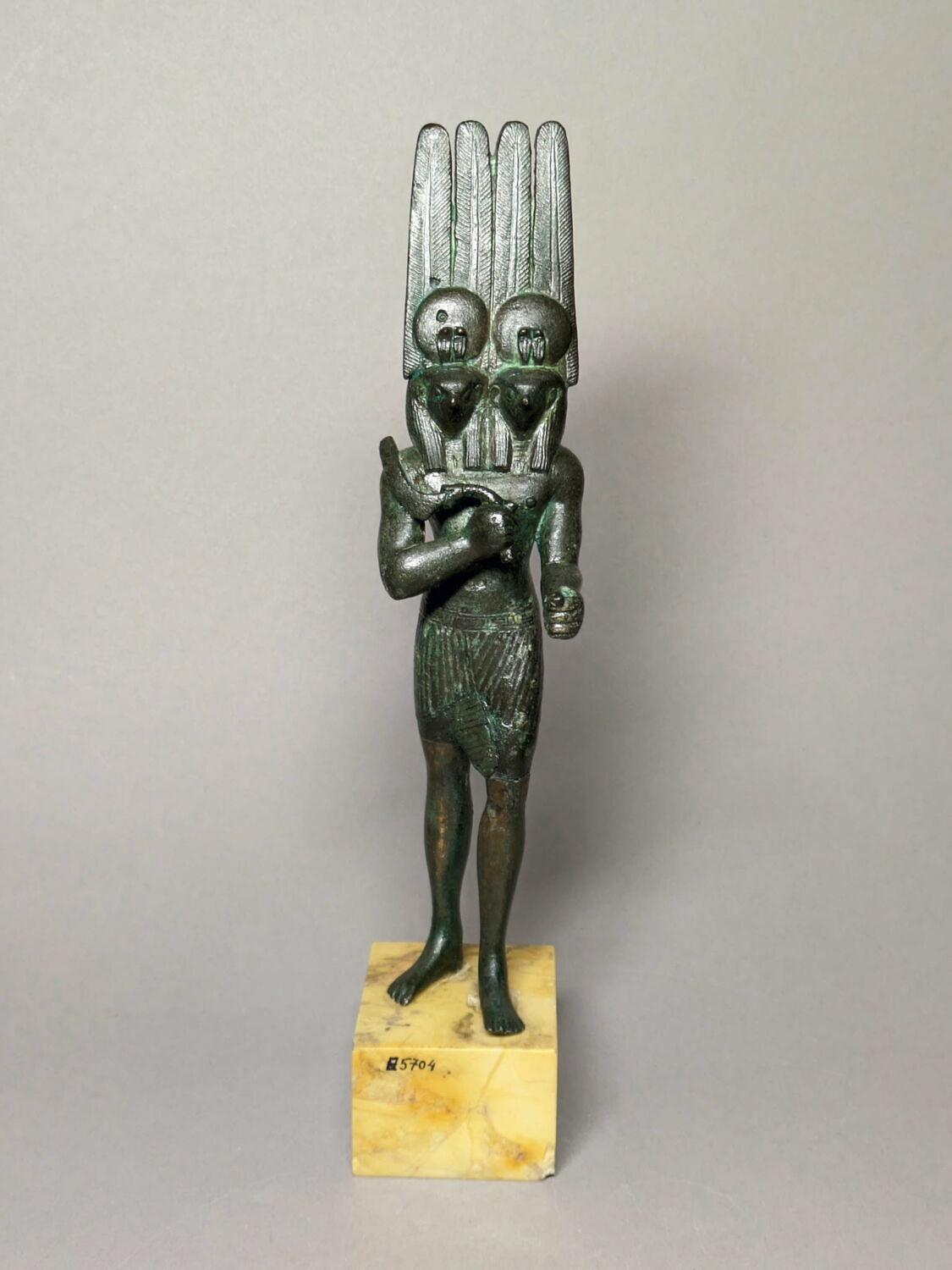
Montu was bound to Ra from the earliest theology, understood as the burning, destructive aspect of the sun. The epithet Montu-Ra expresses the identity directly. The falcon-head and the solar disk he shares with the sun god are the visible signs of this bond. It was speculated in antiquity that Montu-Ra and Atum-Ra stood for the two kingships of Upper and Lower Egypt, the fierce southern sun against the settled sun of the north. His destructive solar heat is the theological root from which the war god grew.5,18
The connection between Montu and Horus stems from the shared depiction of the falcon deity, as well as the role of royal champion. While tied to Horus, Montu was referred to as "Horus of the Strong Arm" (Hor-Netjer), where both falcon deities overlapped when referring to the defense of the king in battle. At Armant and Medamud, the god received a consort and a child in the same manner as other Theban deities. The consort of Montu included the local goddesses Tjenenet and Iunit, however most notably was Raet-Tawy ("Raet of the Two Lands"), Ra's feminine counterpart. With Raet-Tawy, Montu sired a child god named Harpre, "Har-pa-Ra", Horus of the Sun; a solar manifestation of Horus that bears extreme visual similarity to Harpocrates, Horus-the-Child.5,19,20
This triad of Montu, Raet-Tawy, and Harpre provided Montu with a position within the framework of divine family relationships used to organize Egyptian temple religions. Dániel Varga examined the children of Montu including Harpre and its relation to Horus-Shu in Ptolemaic and Roman Theban theology. He demonstrates how the martial falcon deity was assimilated into both the solar and Horian traditions of late period temples and through Raet, Montu connected to the solar cycle. Through Harpre and the falcon form he connected to the earlier identity of Horus, and through both forms he became part of the greater solar mythology of Thebes while retaining his weaponry.21
IX. The God of War
Montu was considered the divine source of victory upon whom the Pharaoh modeled himself. To rage in battle meant to rage like the falcon and so many of Egypt's warrior kings cited an affiliation with Montu as one of the greatest descriptions of their martial prowess. Thutmose III, who conquered Syria, was referred to as "A Valiant Montu on the Battlefield." His son Amenhotep II was noted to have the strength and accuracy of Montu when shooting arrows through copper targets from a moving chariot, while Amenhotep III, who was generally a peaceful ruler, titled himself "Montu of the Rulers."5
Montu could appear personally in battles. A broken papyrus dealing with Thutmose III's Syrian campaign included a first person account describing his assistance during the battle. Three hidden Montus appear in the form of a wind with Montu riding ahead in it to help destroy his enemies. The four major shrines at Hermonthis, Tod, Thebes and so on become an army unit; each shrine providing a god representing itself at the side of its monarch. The martial version of Montu was often invoked for average citizens as well. A magic spell for deflecting a physical assault invokes Montu, "the Star of Gods", stating that he will take away his attackers' strength and put it in his victim's hand. The starry symbolism plays into the Herculean role.22,23
The fullest deployment of Montu in war is in the account of the Battle of Kadesh, fought by Ramesses II against the Hittites about 1274 BCE. During the commemoration poem and relief images depicting this battle, Ramesses II identifies himself as "Montu of Both Lands". He describes seeing his enemies and raging at them "as Montu, Lord of Thebes". After equipping himself for battle he claims to be putting on the falcon's ornamentation as Pharaoh and god united in the instance of conflict. The Greeks later associated Montu with their own war god Ares, but because he radiated the solar essence of Ra they compared him to Apollo as well. The falcon deity from Thebes had evolved from being a representative of burning skies to being an exemplar model for every Egyptian king who took up arms.16,24,26
Tellingly, in Macrobius' solar theology of the Saturnalia, he immediately speaks of Hercules before moving on later to the Buchis bull. In that respect, the Hercules whom he calls the Sun in all living things and the Buchis that he takes as velut imago solis in adversam mundi partem nitentis (as a [living] image of the Sun moving in the opposite direction to the world) are in approximation.27
Sources and Bibliography
- Faulkner, Raymond O. The Ancient Egyptian Pyramid Texts. Oxford: Clarendon Press, 1969. For Utterances 412, 503, and 555, the earliest attestations of Montu as an astral god associated with the sky and the ascent of the king.
- Werner, Edward K. The God Montu: From the Earliest Attestations to the End of the New Kingdom. PhD diss., Yale University, 1985. The fullest study of the god; for the uncertainty of the name's derivation and the development of the war god from the celestial figure.
- Faulkner, Raymond O. "The King and the Star-Religion in the Pyramid Texts." Journal of Near Eastern Studies 25, no. 3 (1966): 153–161. For the reading of the "Montu-stars" and the alternative interpretation of the passage in Utterance 412.
- Gauthier, Henri. Dictionnaire des noms géographiques contenus dans les textes hiéroglyphiques. 7 vols. Cairo: Société royale de géographie d'Égypte, 1925–1931. For Iunu-Montu (Hermonthis) and the derivation of Coptic Ermont and modern Armant from the god's name.
- Wilkinson, Richard H. The Complete Gods and Goddesses of Ancient Egypt. London: Thames & Hudson, 2003. Pages 203–204 for Montu's history, iconography, consorts, and solar and Horian identities; pages 168 and 150 for Tjenenet and Iunit.
- Bisson de la Roque, Fernand. "Notes sur le dieu Montou." Bulletin de l'Institut français d'archéologie orientale 40 (1941): 1–49. The foundational study of the god's character, including the celestial aspect, the title "son of Nut," and the pairing with Seth as protection to right and left of the king.
- Werner, Edward K. "Montu and the 'Falcon Ships' of the Eighteenth Dynasty." Journal of the American Research Center in Egypt 23 (1986): 107–123. For the representations of Montu accompanying the king in war, including the chariot of Thutmose IV and the falcon-ships.
- Mond, Robert, and Oliver H. Myers. The Bucheum. 3 vols. Memoir of the Egypt Exploration Society 41. London: Egypt Exploration Society, 1934. The record of the excavation of the Buchis catacomb at Armant, the burials from the Thirtieth Dynasty to the Roman period, and the earliest and latest datable interments.
- Klotz, David. Caesar in the City of Amun: Egyptian Temple Construction and Theology in Roman Thebes. Monographies Reine Élisabeth 15. Turnhout: Brepols, 2012. For the tetrad of the four Montus, the ritual theology of Roman Hermonthis, and the systematization of the god's forms. See page 148 for the four bas.
- Hart, George. The Routledge Dictionary of Egyptian Gods and Goddesses. 2nd ed. London and New York: Routledge, 2005. For the epithets, the griffin iconography of the Ahhotep axe, and the Late Period bull-headed form.
- Bisson de la Roque, Fernand. Rapports sur les fouilles de Médamoud. Fouilles de l'Institut français d'archéologie orientale. Cairo: IFAO, 1926–1933. For the excavation of the temple of Montu at Medamud, the Old Kingdom sanctuary beneath the Middle Kingdom temple, and the Twelfth Dynasty rebuilding under Senusret III.
- Bard, Kathryn A., ed. Encyclopedia of the Archaeology of Ancient Egypt. London and New York: Routledge, 1999. For the temple of Montu at Armant from the Eleventh Dynasty, its builders from Mentuhotep II onward, and the Tod lintel naming Montu, Mentuhotep II, and Satis.
- Fletcher, Joann. Cleopatra the Great: The Woman Behind the Legend. London: Hodder & Stoughton, 2008. For the mammisi and sacred lake built by Cleopatra VII at Armant in honor of Caesarion.
- Wilkinson, Richard H. The Complete Temples of Ancient Egypt. London: Thames & Hudson, 2000. For the Precinct of Montu at Karnak, with its temples of Montu, Harpre, and Ma'at, the sacred lake, and the gateway of Ptolemy III.
- Bisson de la Roque, Fernand, Georges Contenau, and Fernand Chapouthier. Le trésor de Tôd. Documents de fouilles de l'IFAO 11. Cairo: IFAO, 1953. For the temple of Montu at Tod, its Middle Kingdom builders, and the discovery in 1936 of the Tod Treasure beneath the temple of Senusret I.
- Rachet, Guy. Dizionario della civiltà egizia. Rome: Gremese Editore, 1994. For the "four Montu" insignia carried before the armies, the military iconography, and the Greek identification of Montu with Ares and Apollo.
- Saleh, Mohamed, and Hourig Sourouzian. The Egyptian Museum Cairo: Official Catalogue. Mainz: Philipp von Zabern, 1987. For the ceremonial axe from the burial of Queen Ahhotep depicting Montu as a winged griffin.
- Pinch, Geraldine. Egyptian Mythology: A Guide to the Gods, Goddesses, and Traditions of Ancient Egypt. Oxford: Oxford University Press, 2004. Pages 165–166 for Montu as the enemy of the foes of Maat, the Buchis bull, and the solar theology linking Montu-Ra and Atum-Ra to the two kingships.
- Klotz, David. Kneph: The Religion of Roman Thebes. PhD diss., Yale University, 2008. For the consorts of Montu, the goddess Iunit of Hermonthis, and the theology of the Theban region in the Roman period.
- el-Sayed, Ramadan. "Thoth n'a-t-il vraiment pas de mère?" Revue d'Égyptologie 21 (1969): 71–76. For Raet-Tawy as the consort of Montu and the mother of Harpre, the solar child comparable to Harpocrates.
- Varga, Dániel. "The Children of Montu: Harpara and Horus-Shu in Ptolemaic and Roman Thebes." Journal of Ancient Egyptian Interconnections 39 (2023): 273–289. For Harpre (Harpara) and Horus-Shu as the child gods of Montu in the late Theban temples.
- Botti, Giuseppe. "A Fragment of the Story of a Military Expedition of Tuthmosis III to Syria (P. Turin 1940–1941)." Journal of Egyptian Archaeology 41 (1955): 64–71. For the account of three Montus intervening in the form of a wind on behalf of Thutmose III, stationed at the king's right, left, and front.
- Borghouts, J. F. Ancient Egyptian Magical Texts. Nisaba 9. Leiden: E. J. Brill, 1978. For the spell invoking Montu, "the star of the gods," to take the strength of an attacker on behalf of an ordinary person.
- Lichtheim, Miriam. Ancient Egyptian Literature. Vol. 2, The New Kingdom. Berkeley: University of California Press, 1976. Pages 57–72 for the poem of the Battle of Kadesh, in which Ramesses II rages "like Montu, Lord of Thebes."
- Kitchen, Kenneth A. Ramesside Inscriptions, Translated and Annotated: Translations. Vol. 2, Ramesses II, Royal Inscriptions. Oxford: Blackwell, 1996. For the Kadesh narrative in which the king "assumed the adornments of his father, Montu," and styled himself "Montu of the Two Lands."
- Macrobius. Saturnalia 1.20.6-1.21–21. Edited and translated by Robert A. Kaster. Saturnalia, Volume I: Books 1–2. Loeb Classical Library 510. Cambridge, MA: Harvard University Press, 2011.