NEMESIS
author: High Priest Zevios Metathronos
co-author: Novice Priest Karnonnos
Hieratic Information about Nemesis
| Divine Names |
|---|
| Nemesis (Νέμεσις) | goddess of retribution and due measure. |
|---|
| Rhamnousia | “She of Rhamnous,” her great Attic sanctuary. |
|---|
| Adrasteia | “the One whom None Escape.” |
|---|
| Divine Symbols |
|---|
- The Wheel
- The Measuring Rod
- The Bridle and Yoke
- The Gryphon
- Wings
- The Apple Branch
- The Scales
|
| Divine Forces |
|---|
- Retribution and Indignation
- Restorative Justice
- The Checking of Hubris
- Fortune and Chance (with Tyche)
- Cosmic Order and Due Measure
|
| Important Titles |
|---|
- Rhamnousia, She of Rhamnous
- Adrasteia, the One whom None Escape
- Nemesis Ourania, the Heavenly
- Nemesis Campestris, of the Drill-Ground
|
| Names Across Civilizations |
|---|
| Classical Greek | Νέμεσις (Nemesis) |
|---|
| Latin | Nemesis |
|---|
I. Names
The name Nemesis is first referenced in both of Hesiod's works, the Theogony and the Works and Days. The word relates to distribution,
indignation and retribution even before this context, but this is the first instance of divine personification; her name comes from the verb
νέμειν or to distribute.1, 2, 3
In Latin, she clearly appears as her alternate name Rhamnusia virgo in Catullus' works of the first century BCE. Her first physical
attestation as Nemesis is on a coin of Nero's reign from Smyrna, dating 68–69 AD. She may have appeared earlier in Hyginus' Fabulae, but
the dating of that work is not securely known and can only be inferred from linguistic context.4, 5, 6
Sources: Hesiod, Theogony; Hesiod, Works and Days; Liddell and Scott, A Greek-English Lexicon (1940); Catullus, The Poems of Catullus; Burnett, Amandry, and Ripollès, Roman Provincial Coinage (1992); Smith and Trzaskoma, Apollodorus’ Library and Hyginus’ Fabulae (2007).1, 2, 3, 4, 5, 6
II. Nemesis
Nemesis is the punishing and chthonic aspect of violating Maat. The reference to the dual goddess in many Greek and Roman contexts is a
direct relation to Egyptian themes; it is constantly impressed that Nemesis is part of a duo, and sometimes she is referred to in the plural
as Nemeseis. Historians have long struggled to understand which other Goddess is being referenced, leading them to ask: "which Nemesis
is the other?" To answer this question, historians have equated her twin with particular Goddesses in areas of symbolic overlap and proximity.7
The truth is that this is a dualistic role of occult meaning, yet the visual allusion of the dyad also draws on the relationship of
Nemesis (Maat) to Aphrodite and Hera, whose punishing powers of the Nemesis overlap with hers. To some
extent, historians are correct to equate the dyad with the other symbolic deity Themis, since they shared a temple, and her
association with Tyche and Dike is notable. One of the two forms of Maat within the Chamber of the Heart does represent, to some
extent, a darker aspect of destruction in pursuit of the law. What Nemesis dealt with in a Greek context was also retribution,
indignation and restorative justice. Her punishments could be terrifying; the attempt of Ixion to violate Hera was repaid by him being
placed upon the perpetually burning, turning wheel. She could bring the most evil of individuals to
Tartarus with haste. The Rhamnousian deme of Athens was known to be of her lineage, while particular oral
traditions among them named her as the mother of Helen, contributing symbolically to the events of the Iliad. Nemesis is often simply
called Rhamnousia.8, 9
Nemesis is not purely a punishing deity. Many of the references to her in Greek plays and literature revolve around the idea of
preventing hubris, suppressing excessive pride and the desire to do criminal acts, but in these references comes an awareness of her
contribution to fulfilling and maintaining the cosmic order. She is invoked in conversation generally not to throw vengeance on random
individuals or to wish to consign them to Hell as Christianity and Islam impart so lovingly with their angels, but to convey a spirit
of deliberation and thought intertwined with the power of pure reason, lest the potential offender fall victim to their own particular
karma (for more on this, view
this
sermon), and above all to encourage self-awareness, because her punishment is actually often blatantly in the present and
simply beyond the awareness of a limited human mind experiencing it, not always in the future. Nemesisean symbolism did not
just relate to direct acts of hubris warranting prompt punishment, but the punishment reflected in states of decay and unawareness
lasting decades or lifetimes, which is part of why she was represented with a wheel symbolic of the ultimate need to escape karma
through advancement. Nonetheless, the contrast of her functions towards holy people and the masses outside the temple were marked,
just like Ares:8, 10
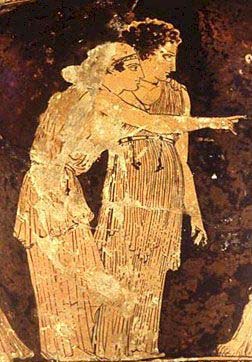
Nemesis with Tyche
Orphic Hymn 6111
Nemesis, I call on you, goddess, greatest queen, all-seeing, who look upon the life of mortals’many races. Eternal, all-holy, alone rejoicing
in the righteous, you change your much-varying ever-shifting word, you whom all mortals fear, placing your yoke upon their necks. For you care
about all men’s thoughts, nor does the soul which is over-proud in words (ψυχὴ ὑπερϕρονέουσα λόγων), without discretion, escape you. You see
all and hear all, and all do you arbitrate. In you reside the judgements (δίκαι) of mortals, highest deity. Come, blessed one, pure one,
always helpful to initiates. Grant them to have good understanding, putting an end to hateful, unhallowed, altogether arrogant and fickle
thoughts (πανεχθεῖς γνώμας οὐχ ὁσιας, πανυπέρϕρονας, ἀλλοπροσάλλας).
AP 12.193, Epigram, Strato of Sardis12
You don’t take any notice of what the Nemeseis of Smyrna tell you, Artemidoros: “Nothing beyond measure.” But, always playing a part,
you talk so arrogantly and savagely and as is not even becoming in a comic actor. You will remember this, haughty boy; you too will love and
play the part of the “Locked-Out Lady”.
Her mythological role is limited. Ovid shows her as the destroyer of Narcissus whose vain cruelty either prompts him to spurn the nymph Echo
or leads his beloved to commit suicide. The Cypria, a prelude work to the Iliad by Stasinus of Cyprus, gives Nemesis as the mother of Helen.
One explanation for her rage is that Zeus pursued her relentlessly, where she transformed into a goose to escape him, but he managed to
overcome her in the form of a swan. The egg was then given to Leda, the conventional mother of Helen, Klytemnestra and the Dioskouroi, and
from it came Helen alone, the passive agent of the Iliad's chaos.13, 14
III. Epithets
Sources: Hornum, Nemesis, the Roman State, and the Games (1993); Pausanias, Description of Greece; Binder, The Monuments and Sites of Athens (2001); Tataki, “Nemesis, Nemeseis, and the Gladiatorial Games at Smyrna” (2009); Strabo, Geography.7, 15, 16, 17, 18
IV. Temples
Her temple complexes were called Nemeseaions, and they were seemingly erected and restored for particular reasons.
The temple of Nemesis at Smyrna was unusual as the city worshipped the two Nemeseis openly, not only one Nemesis. The historian Pausanias had
this to say of the foundation legend: Alexander, hunting on Mount Pagos, came to a sanctuary of the Nemeseis with a spring and a plane-tree
before it. Sleeping there, he saw the Nemeseis in a dream, and they commanded him to found a new city and move the Smyrnaeans from the old
city into it. The Smyrnaeans then consulted Apollo at Claros, received an approving oracle, and migrated willingly. Pausanias adds that they
believed in two Nemeseis, whose mother was Night, unlike the Athenians, who made the mother of the Rhamnousian Nemesis Okeanos although this
primordial form is linked to Hesiod too. The temple thereafter was essentially central to Smyrna’s civic identity: the goddesses were divine
founders of the renewed city.15, 19
The temple’s exact location is debated as no excavated temple can be securely identified with it. Modern study notes that the Smyrnaean
temples of the Nemeseis and Tyche are known from written and numismatic evidence, not standing architecture; Roman imperial coins show the
temple of the Nemeseis as a tetrastyle building with the two goddesses inside, but whether that coin image reproduces the real temple is
uncertain. Scholars have placed it either on Mount Pagos, following the foundation story, or near the agora, because Pausanias mentions the
spring and plane-tree and because some inscriptions and topographic arguments point toward the southern side of the agora or its surrounding
area. The safest formulation is therefore that Smyrna had a famous sanctuary/temple of the Nemeseis, probably tied in memory to Pagos and in
civic life to the city-centre, but its precise architectural remains have not been recovered.20
In Smyrnaean society, the Nemeseis functioned as civic protectors, symbols of the refounded city, also as guardians of justice, fortune, and
imperial public order. Their cult was close to Tyche, and modern scholarship stresses that both Tyche and the Nemeseis represented Smyrna in
antiquity, though the Nemeseis were more deeply tied to the city’s Hellenistic foundation legend. By the Roman imperial period the cult also
seems to have interacted with imperial religion. A third-century inscription dated to 211/212 CE records an enlargement connected with the
temple of the Nemeseis, Caracalla’s grant of land, and the philosopher Papinius’ dedication of an adjoining house to the goddesses; the same
study argues that this strongly associates the temple with the imperial cult. The Martyrdom of Pionius likewise places Christian refusal in
front of the altar of the temple of Nemesis, showing that sacrifices there were still part of Smyrna’s public religious life under Decius in
250 CE. The Nemeseis are interpreted to have a kindly and brutal aspect each, much like the dual Weighing of the Heart forms of Maat.20, 21, 22
Rhamnous was a sanctuary, deme and fort northeast of Athens that became so synonymous with the goddess that she is most often referred to as
Rhamnousia in texts. Pausanias says that Nemesis of Rhamnous was the most relentless goddess against men of violence, and he connected her
anger with the Persians who landed at Marathon during the invasion of Greece explicitly. The famous story iterated is that the Persians had
brought a block of Parian marble to make a trophy after their expected victory; after their defeat, Phidias, according to Pausanias’ version,
used that very marble to make the statue of Nemesis. The Rhamnous sanctuary was a place where Nemesis rather than being “revenge” in the
abstract was a goddess who punished the highest imperial hubris of Darius and Xerxes and turned the Persian intended victory-monument into her
own cult-image.15, 23
The sanctuary itself contained two closely placed temples. The smaller earlier temple, usually associated with Themis and Nemesis, was a
modest poros structure, while the larger Classical temple of Nemesis was a marble Doric temple probably built or completed in the later fifth
century BCE, around 430–420 BCE. The temple was a peripteral hexastyle, 71 feet (22 m) long and 33 feet (10 m) broad, with 12 columns on the
side, and with a pronaos, cella, and posticum in the usual manner. The larger temple housed the celebrated cult-statue of colossal stature,
now usually attributed not to Pheidias himself but to Agorakritos of Paros, Pheidias’ pupil; fragments of the statue and its sculptured base
have been recovered, and the base seems to have shown a family grouping connected with Helen, Leda and the Dioskouroi, a frame that tied
Nemesis into the story of divine justice and the consequences of beauty, desire and violence. Nemesis' beautiful statue within the temple was
very famous, adorned with stags and miniature versions of Nike:15, 24, 25
"Of this marble Pheidias made a statue of Nemesis, and on the head of the goddess is a crown with deer and small images of Victory. In her
left hand she holds an apple branch, in her right hand a cup on which are wrought Aethiopians. [...] Neither this nor any other ancient statue
of Nemesis has wings, for not even the holiest xoana of the Smyrnaeans have them"
Pausanias, Description of Greece15
It is known Alexander erected several Nemeseaions during his conquests, and her temple at Alexandria was dated prior to the Roman conquest, as
a papyrus from Memphis attests. One example of how her worship could be restructured in response to shifting circumstances was in Alexandria
after the chaos of a Hebrew revolt in the city with endless bloodshed during the Kitos War, after which the emperor Trajan rebuilt the complex
rather pointedly to proclaim victory over the rebels. Another convention originating in Hellenistic Egypt, but becoming a more prevalent
imagery during the Trajanic age, is the image of Nemesis trampling a prone figure, likely relating to crushing of that kind of anti-theist
iniquity.7
V. Roman Uses
In Rome, a state inclined to war, Nemesis came to be associated with the Roman machinery of state on a bellicose footing. Thanks to Julius
Caesar at least nominally making her his patron deity to allegorically insist that Pompey had started the civil war rupturing the Republic,
the Roman emperors had a temenos of Nemesis referenced on coins. Pliny the Elder mentions that a statue of Nemesis existed on the foundational
Capitoline Hill. A massive amount of cameos and coins featuring her proliferated during the Late Republic and early imperial period. Nemesis
was considered a patroness of theaters and other grounds of entertainment in a Roman context. She increasingly became associated with the
funerary games and the gladiatorial games with the expansion of the Roman state, likely in regard to contests held between those who betrayed
Rome, but this was an aspect that was treated with some ambivalence and horror from Greeks, not being found in their own traditions of the
agon (although the only inscription from a Priest of Nemesis in a theatrical and arena context does exist in Roman-period Athens, a place
where gladiatorial and bloody combat was seemingly totally banned, which is rather telling).7, 27
In this context, Nemesis was associated with training of the body and soul, but this contention in the arena often took on vulgar and impious
associations among the gladiator milieu that the High Priest of Apollo Plutarch unilaterally
condemned.28
Among the Greeks, the main militaristic context of Nemesis is her role in punishing Persian hubris during the invasion of Greece. Rhamnous
itself was a frontier fort and had large garrisons of soldiers, bestowing to us a large amount of military inscriptions, possibly showing a
connection in a more vague sense.26, 29, 30
Nemesis had a presence in the Roman military as soldiers lived close to the same forces she governed: danger, discipline, revenge, punishment,
victory and chance, sometimes dancing perilously on karmic knife edges. Her cult appears especially in military amphitheatre contexts, where
soldiers, gladiators, guards, veterans, and military communities dedicated altars or reliefs to her. At Deva (modern Chester in England), a
red sandstone altar to Nemesis was found in the legionary amphitheatre, in a small room behind the arena wall which was probably a shrine of
Nemesis; the find-spot itself shows how naturally her cult belonged beside the spectacle and military entertainment. At Carnuntum, beside the
legionary amphitheatre, there was also a shrine of Nemesis, and the dedications there are heavily connected with the military community,
especially men of Legio XIV Gemina. In the eastern and Danubian provinces, the pattern is similar. At Cabyle, a Roman military camp in Thrace,
fragments of an inscribed relief show Nemesis’ cult inside or beside a military setting, while at Chersonesos a beneficiarius of the Eleventh
Claudian legion dedicated to “Nemesis the Protector” for safety.31, 32, 33, 34
VI. Rod and Wheel
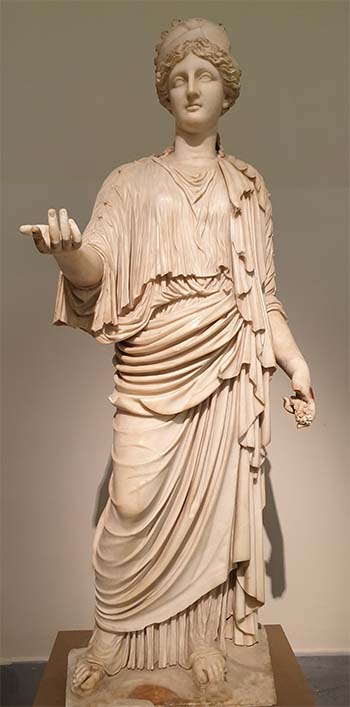
Nemesis is depicted in statuary as an austere diadem-wearing woman of equilibrium with a measuring rod, bridle or outstretched palm, which are
subtle symbols of her intent to measure humanity's commitment to divine laws. The bridle was said to be a yoke put on humanity until they
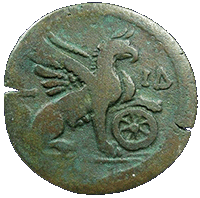
advanced. She is also frequently depicted near a wheel emblazoned with a gryphon, a continual theme in her recovered symbolic language,
relating in Michael Hornum's analysis of mythology to correctives in erotic discipline. She is not represented as a warrior like Athena or
Dike; her posture and set of symbols are subtle ones like those of Maat. In vases, she is represented with Tyche (Fate) as a duo. On coinage
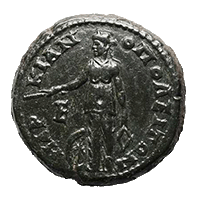
from the Classical period onwards but intensifying with the Roman imperial period, she is shown with wings (in total contradiction to
Pausanias' statement that a statue of Nemesis will never have them), a measuring rod and a branch. The gryphon with the wheel often serves as
her shorthand, and sometimes she is shown in a dualistic manner with the Goddess of Peace, Pax. The coin of Geta shows her link to Maat as she
wields a pair of scales.7, 35, 36, 37
Gryphon coin, Marcus Aurelius era
Coin of Philip II of Rome
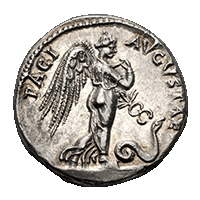
Nemesis with wand and serpent
Sources and Bibliography
- Hesiod. Theogony. In The Homeric Hymns and Homerica, translated by Hugh G. Evelyn-White. Loeb Classical Library 57. London: William Heinemann; New York: G. P. Putnam’s Sons, 1914. Section cited: 223.
- Hesiod. Works and Days. In The Homeric Hymns and Homerica, translated by Hugh G. Evelyn-White. Loeb Classical Library 57. London: William Heinemann; New York: G. P. Putnam’s Sons, 1914. Sections cited: 200–201.
- Liddell, Henry George, Robert Scott, Henry Stuart Jones, and Roderick McKenzie. A Greek-English Lexicon. 9th ed. Oxford: Clarendon Press, 1940. S.v. “νέμεσις.”
- Catullus. The Poems of Catullus. Edited and translated by F. W. Cornish. Loeb Classical Library 6. Cambridge, MA: Harvard University Press, 1913. Sections cited: Carmen 64.395; 68.71–72.
- Burnett, Andrew, Michel Amandry, and Pere Pau Ripollès, eds. Roman Provincial Coinage. Vol. 1, From the Death of Caesar to the Death of Vitellius (44 BC–AD 69). London: British Museum Press; Paris: Bibliothèque Nationale, 1992. Section cited: RPC I 2490.
- Smith, Scott R., and Stephen M. Trzaskoma, trans. Apollodorus’ Library and Hyginus’ Fabulae: Two Handbooks of Greek Mythology. Indianapolis: Hackett Publishing, 2007.
- Hornum, Michael B. Nemesis, the Roman State, and the Games. Religions in the Graeco-Roman World 117. Leiden: Brill, 1993.
- Stafford, Emma J. “Nemesis, Hybris and Violence.” In La violence dans les mondes grec et romain, edited by Jean-Marie Bertrand. Paris: Éditions de la Sorbonne, 2005.
- Mesomedes. “Hymn to Nemesis.” In Greek Lyric, Volume V: The New School of Poetry and Anonymous Songs and Hymns, edited and translated by David A. Campbell. Loeb Classical Library 144. Cambridge, MA: Harvard University Press, 1993.
- Metathronos, Zevios. “Anti-Suffering Powers of the Zevist: About Life’s Unavoidable Suffering.” Ancient Forums.
- The Orphic Hymns. Translated by Apostolos N. Athanassakis and Benjamin M. Wolkow. Baltimore: Johns Hopkins University Press, 2013. Section cited: Hymn 61, “To Nemesis.”
- Strato of Sardis. “Epigram 12.193.” In The Greek Anthology. Vol. 4, translated by W. R. Paton. Loeb Classical Library 85. Cambridge, MA: Harvard University Press, 1918.
- Ovid. Metamorphoses. Vol. 1, Books 1–8. Translated by Frank Justus Miller. Revised by G. P. Goold. Loeb Classical Library 42. Cambridge, MA: Harvard University Press, 1977. Sections cited: Narcissus and Nemesis episode.
- West, M. L., ed. and trans. Greek Epic Fragments: From the Seventh to the Fifth Centuries BC. Loeb Classical Library 497. Cambridge, MA: Harvard University Press, 2003. Sections cited: Cypria fragments on Nemesis and Helen.
- Pausanias. Description of Greece. Translated by W. H. S. Jones and H. A. Ormerod. Loeb Classical Library 93, 188, 272, 297. Cambridge, MA: Harvard University Press, 1918–1935. Sections cited: 1.33.2–3; 7.5.1–3.
- Binder, Judith. The Monuments and Sites of Athens: A Sourcebook for the Greek, Roman, and Byzantine Periods. Athens: Dipylon / Sourcebook, 2001. S.v. “Nemesis Ourania.”
- Tataki, Athanasia B. “Nemesis, Nemeseis, and the Gladiatorial Games at Smyrna.” Tekmeria 10 (2009): 49–88.
- Strabo. Geography. Translated by Horace Leonard Jones. Loeb Classical Library 49–50, 174, 196, 223, 241, 267, 319, 358. Cambridge, MA: Harvard University Press, 1917–1932. Section cited: 13.1.13.
- Hadjittofi, Foteini. “Smyrna and Its Local Traditions in the Poetic Investiture of Quintus’ Posthomerica.” The Classical Quarterly 75, no. 1 (2026).
- Kılıç, M. “The Cults of Nemeseis and Tyche at Smyrna.” Belleten 76, no. 276 (2012): 603–28.
- “The Martyrdom of Pionius.” In The Acts of the Christian Martyrs, edited and translated by Herbert Musurillo. Oxford: Clarendon Press, 1972. Sections cited: 5, 13–15.
- Kuhn, Christina T. “Alexander the Great and the Double Nemesis: The Construction of a Foundation Myth.” Scripta Classica Israelica 31 (2012): 21–36.
- Rous, Sophia A. “Social Memory and the Reuse of Marble in Athens.” PhD diss., Harvard University, 2016.
- Miles, Margaret M. “A Reconstruction of the Temple of Nemesis at Rhamnous.” Hesperia 58, no. 2 (1989): 133–249.
- Lapatin, Kenneth D. S. “A Family Gathering at Rhamnous? Who’s Who on the Nemesis Base.” Hesperia 61, no. 1 (1992): 107–19.
- McLeod, Wallace E. “An Ephebic Dedication from Rhamnous.” Hesperia 28, no. 2 (1959): 122–28.
- Pliny the Elder. Natural History. Vol. 8, Books 28–32. Translated by W. H. S. Jones. Loeb Classical Library 418. Cambridge, MA: Harvard University Press, 1963. Section cited: 28.22.
- Plutarch. “On the Intelligence of Animals.” In Moralia. Vol. 12, translated by Harold Cherniss and William C. Helmbold. Loeb Classical Library 406. Cambridge, MA: Harvard University Press, 1957.
- Friend, John L. “The Nemesia in Lycurgan Athens.” In Ancient Documents and Their Contexts: First North American Congress of Greek and Latin Epigraphy (2011), edited by John Bodel and Nora Dimitrova, 98–110. Brill Studies in Greek and Roman Epigraphy 5. Leiden: Brill, 2015.
- Vanderpool, Eugene. “A Garrison Inscription from Rhamnous.” Hesperia 15, no. 4 (1946): 329–36.
- Roman Inscriptions of Britain. “RIB 3149: Altar to Nemesis.” Roman Inscriptions of Britain. Section cited: altar to Nemesis found in the legionary amphitheatre at Chester/Deva.
- Golvin, Jean-Claude, and Christian Landes. Amphithéâtres & gladiateurs. Paris: Presses du CNRS, 1990.
- Stoyanov, Totko, and Daniela Stoyanova. “Nemesis’ Cult and the Arena Spectacles: Evidence from the Black Sea Region.” In The Black Sea in the Light of New Archaeological Data and Theoretical Approaches, edited by Manolis Manoledakis, 179–90. Oxford: Archaeopress, 2016.
- Chersonesos Museum. “Dedications to the Goddess Nemesis.” Section cited: dedication to Nemesis the Protector by Titus Flavius Celsinus, beneficiarius consularis of the Eleventh Claudian legion, made by vow for safety.
- Faraone, Christopher A. Ancient Greek Love Magic. Cambridge, MA: Harvard University Press, 1999.
- Classical Art Research Centre, University of Oxford. “215552, ATHENIAN, Berlin, Antikensammlung, Berlin, Schloss Charlottenburg.” Beazley Archive Pottery Database.
- Geta, AE17 of Anchialus, Thrace. A CEΠT ΓETAC, draped and cuirassed bust right / AΓCIAΛEΩN, Aequitas/Nemesis standing left, holding scales and cornucopiae. Moushmov 2872.